Microtome vs Tissue Processor: What Is the Difference?
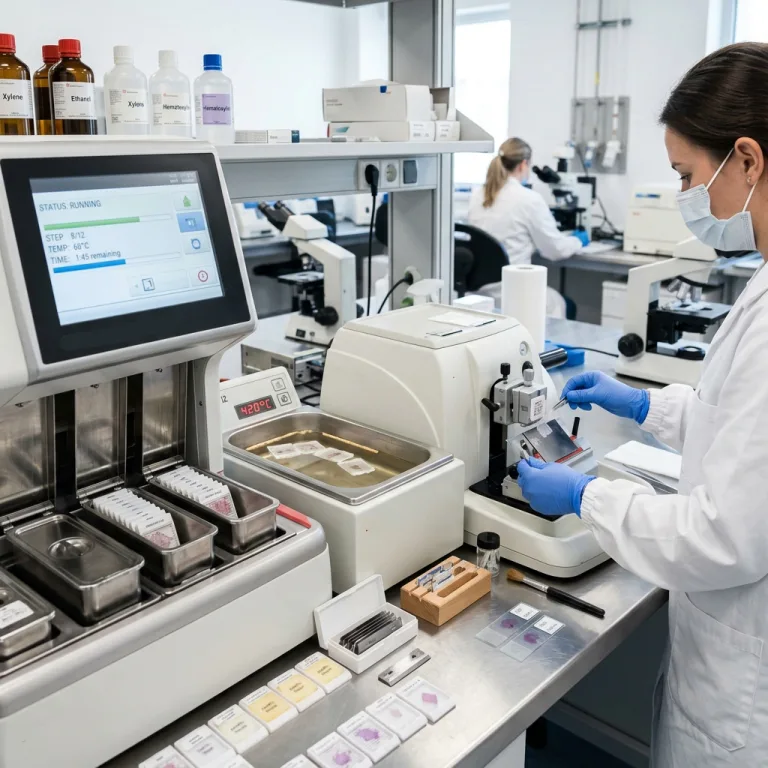
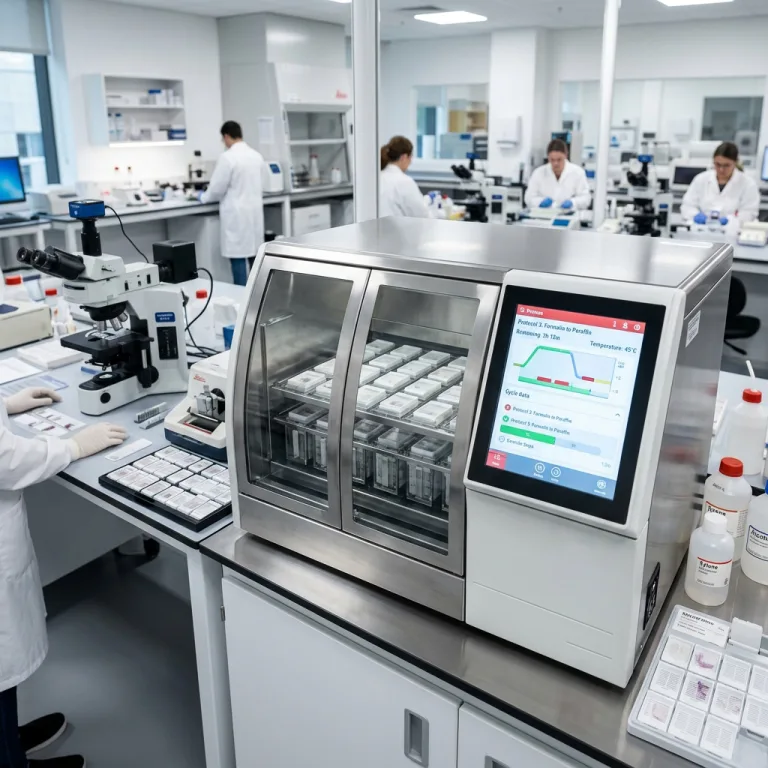
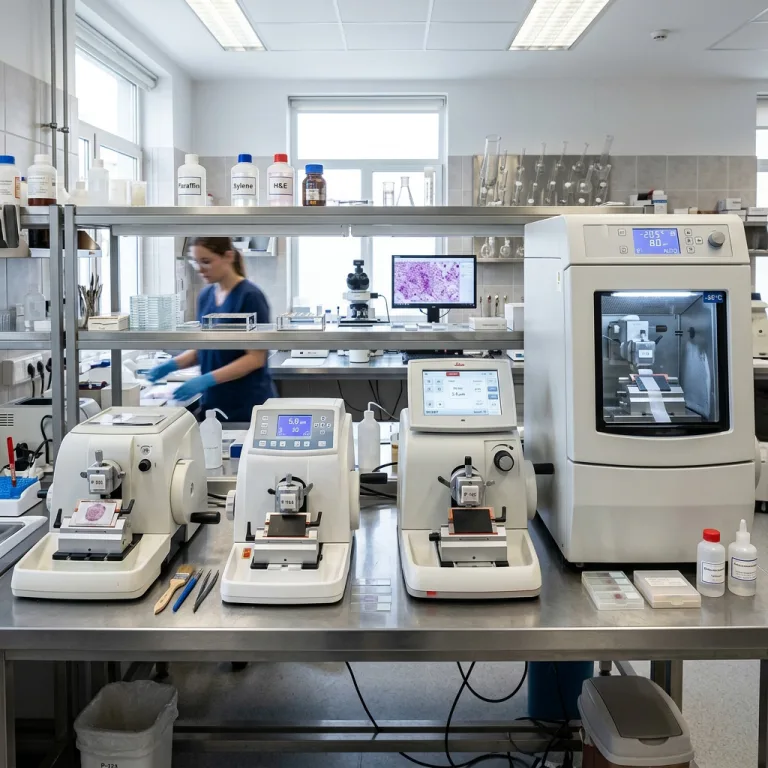
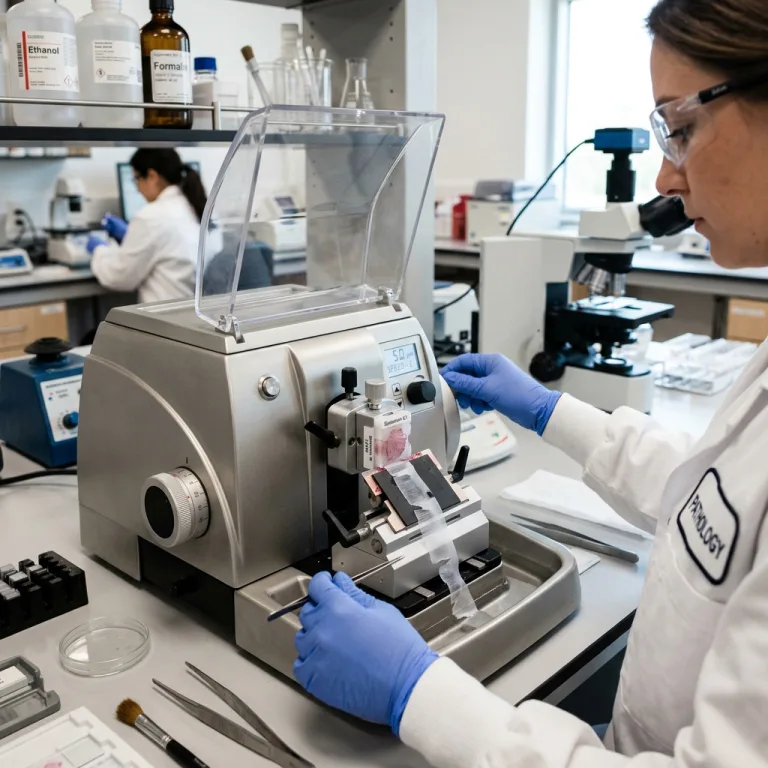
The easiest way to understand the two instruments is to look at their position in the workflow.
| Feature | Tissue Processor | Microtome |
|---|---|---|
| Main function | Processes tissue | Cuts tissue sections |
| Starting material | Fixed tissue | Embedded tissue block |
| Main process | Dehydration, clearing, infiltration | Microtomy / sectioning |
| Typical embedding medium | Not applicable until infiltration | Paraffin, frozen medium or other suitable medium |
| Main output | Tissue ready for embedding | Thin tissue section |
| Main consumables | Reagents, alcohol, clearing agents, paraffin | Blades or knives |
| Key specifications | Capacity, retort, protocols, reagents, temperature, vacuum | Feed system, section thickness, blade holder, specimen orientation |
| Common applications | Histology, histopathology, research | Histology, histopathology, research |
| Position in workflow | Before embedding | After embedding |
The simplest explanation is:
The tissue processor prepares the specimen. The microtome prepares the section.
Neither machine replaces the other in a conventional FFPE workflow.
The Complete Histology Equipment Workflow
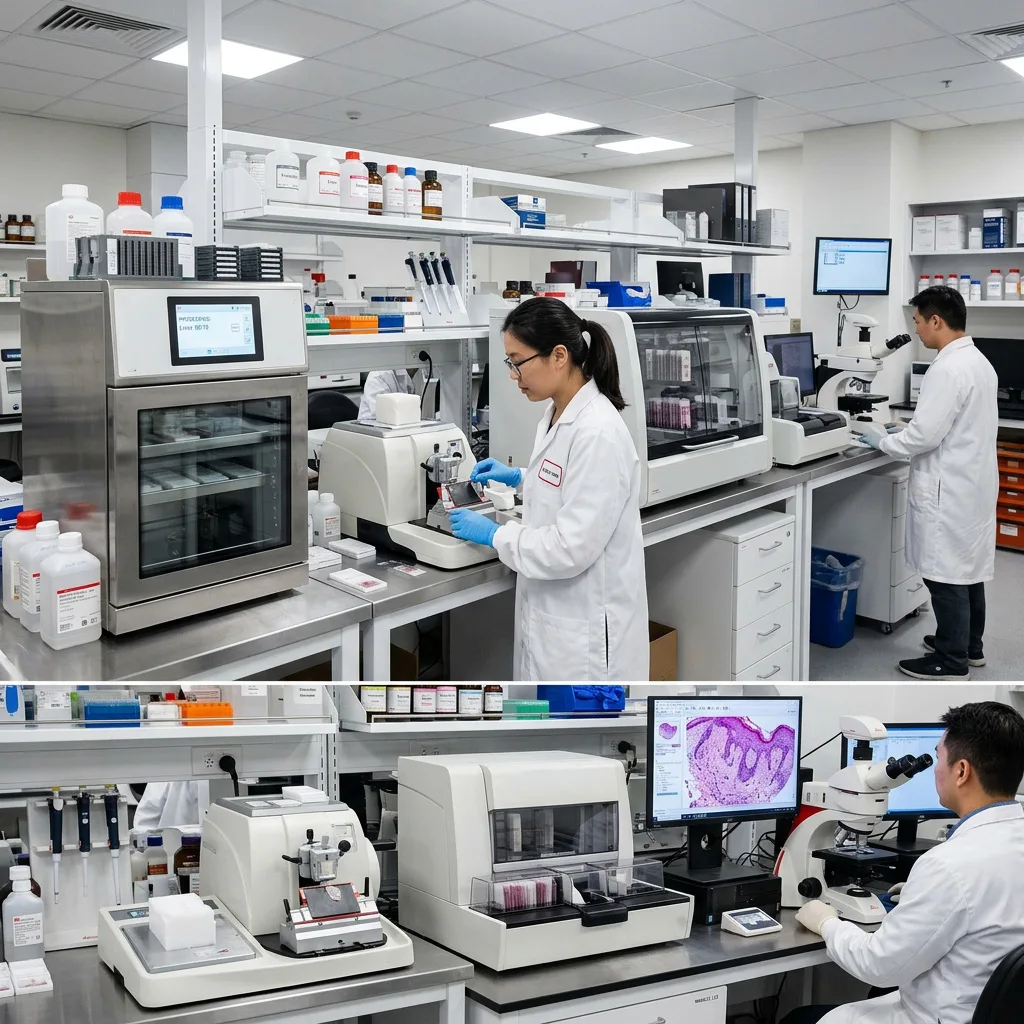
A laboratory planning its equipment should look at the complete chain rather than buying machines separately.
1. Tissue Collection
The specimen is obtained and identified according to the laboratory’s clinical or research workflow.
Correct identification and handling are critical before the sample reaches any automated instrument.
2. Fixation
The tissue is fixed to preserve morphology and reduce degradation.
In routine histopathology, formalin-based fixation is widely used.
3. Grossing
The specimen is examined, described and trimmed into appropriately sized pieces.
The size and thickness of the tissue can influence the later processing protocol.
4. Tissue Processing
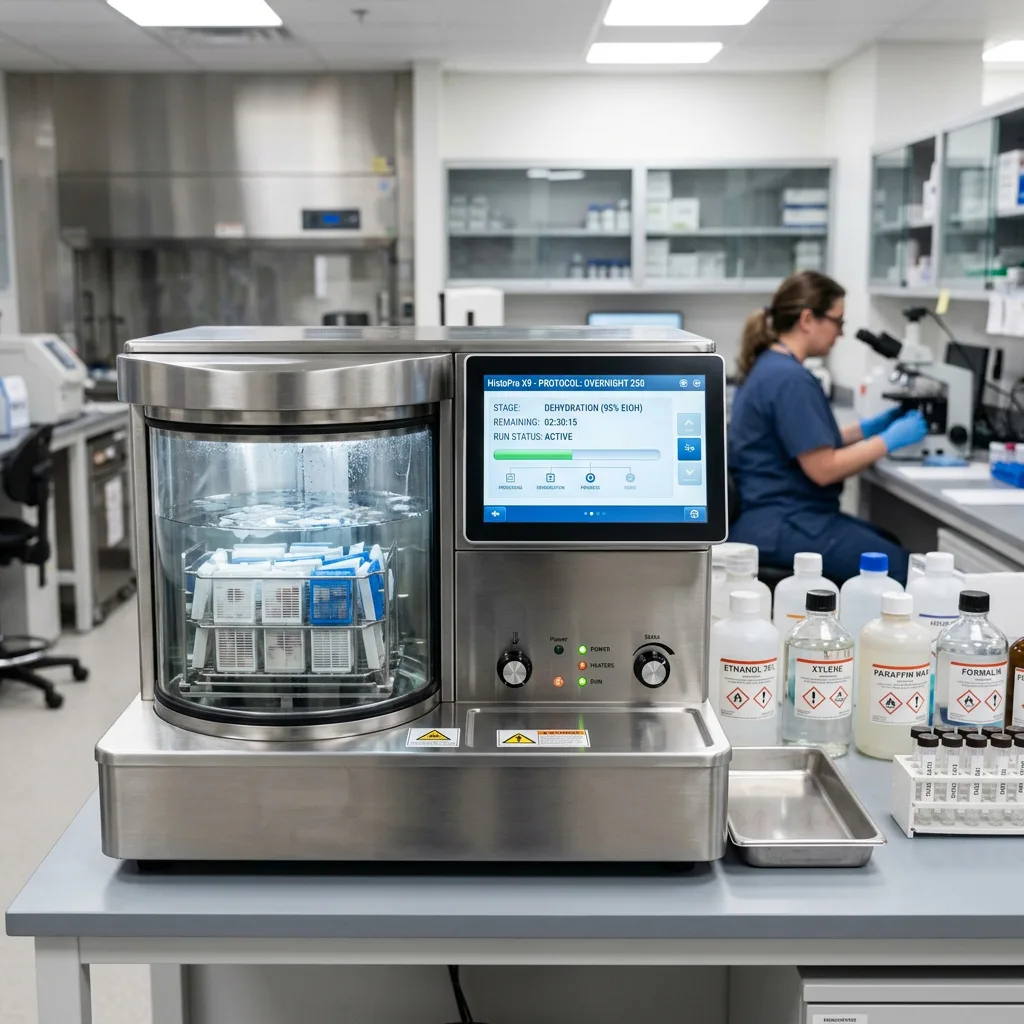
The tissue processor carries out the preparation stages required before embedding.
The conventional sequence includes:
Dehydration → Clearing → Paraffin Infiltration
Different specimen types may require different protocols.
5. Paraffin Embedding
The processed tissue is positioned in molten paraffin and allowed to form a solid block.
The orientation of the tissue matters because the cutting plane determines which structures appear in the final section.
6. Microtomy
The tissue block is mounted in a microtome.
The instrument produces thin sections that can be transferred to glass slides.
7. Slide Preparation
Sections may be floated on a water bath, collected and dried according to laboratory practice.
8. Staining
Routine stains such as H&E make tissue structures easier to visualize.
Special stains and immunohistochemistry may be used for additional evaluation.
9. Microscopy
The prepared slide is examined under a microscope.
10. Digital Pathology
Where applicable, the slide may be scanned for whole-slide imaging and digital analysis.
This workflow is important for equipment buyers because a problem at one stage may appear later in another.
For example:
Poor tissue processing → difficult embedding → poor block quality → difficult sectioning
A laboratory should therefore consider the processor and microtome as connected parts of one workflow rather than unrelated machines.
Why Tissue Processing Quality Affects Microtome Performance
A common assumption is:
“If the tissue section is poor, the microtome must have a problem.”
That is not always true.
A microtome can be correctly adjusted while the tissue block itself remains unsuitable for sectioning.
Possible upstream problems include:
- incomplete fixation
- insufficient dehydration
- incomplete clearing
- poor paraffin infiltration
- unsuitable embedding
- incorrect tissue orientation
- inappropriate processing protocol
Research on histological processing has shown that dehydration, clearing and infiltration conditions can influence tissue morphology and downstream section quality.
This creates an important troubleshooting path:
Check the section → Check the block → Check embedding → Check infiltration → Check tissue processing → Check fixation
The visible problem may originate several steps earlier.
Why Tissue Processor and Microtome Should Be Selected Together
A laboratory may be tempted to select each machine independently.
A better approach is to examine how they interact.
Consider a simple example.
A laboratory purchases a high-capacity tissue processor capable of handling a large daily workload.
However, its microtome remains entirely manual and the laboratory only has one operator.
The processor may finish tissue preparation faster than the sectioning team can handle the resulting blocks.
The opposite can also happen.
A laboratory may purchase an advanced automatic microtome while using an outdated tissue-processing workflow that produces inconsistent blocks.
The result is that the microtome cannot compensate for poor tissue preparation.
This is why a balanced workflow matters:
Processing capacity should support sectioning capacity.
What Equipment Does a Histology Laboratory Usually Need?
A basic conventional histology workflow may require several equipment categories.
Specimen Handling
- Tissue cassettes
- Grossing equipment
- Fixation containers
- Specimen labeling system
Tissue Processing
- Tissue processor
- Processing reagents
- Reagent containers
- Paraffin
Embedding
- Paraffin embedding station
- Cold plate
- Molds
- Forceps
Sectioning
- Microtome
- Microtome blades
- Blade holder
- Specimen clamps
Slide Preparation
- Water bath
- Slide dryer or warming equipment
- Microscope slides
Staining
- Manual or automated staining system
- Coverslipper
- Staining reagents
Examination
- Light microscope
- Digital slide scanner, where required
The actual equipment list depends on the size and purpose of the laboratory.
A teaching laboratory may use a smaller and simpler configuration.
A hospital pathology laboratory may need substantially more automation and throughput.
Small Histology Laboratory Setup
A small laboratory may have a relatively straightforward workflow.
Typical equipment priorities may include:
basic tissue processor
manual rotary microtome
embedding station
water bath
microscope
staining equipment
The main purchasing concerns can be:
- ease of operation
- reasonable capacity
- simple maintenance
- consumable availability
- staff training
- technical support
- total acquisition cost
There is little value in purchasing an extremely complex system if the laboratory does not have the workload or staff to use its additional capabilities.
Medium Histology Laboratory Setup
A medium-sized pathology or research laboratory may need greater workflow consistency.
Possible requirements include:
automatic tissue processor
semi-automatic or automatic microtome
multiple processing protocols
reagent management
more specimen capacity
digital record keeping
better operator ergonomics
more structured maintenance
At this scale, equipment integration and workflow timing become more important.
For example:
How many cassettes can be processed overnight?
How many tissue blocks can be sectioned during the next shift?
How are urgent specimens handled?
How quickly can the laboratory recover from an equipment failure?
These questions are often more useful than looking at the equipment price alone.
High-Volume Pathology Laboratory Setup
High-volume laboratories may have more complex requirements.
They may consider:
dual-retort tissue processors
large cassette capacity
multiple processing protocols
rapid processing options
automatic microtomes
barcode tracking
LIS integration
digital pathology
preventive maintenance programs
spare-parts inventory
service contracts
Current commercial tissue-processing systems demonstrate how high-throughput models can use dual retorts, multiple reagent and paraffin stations, programmable protocols and tracking features to support larger workflows. (leicabiosystems.com)
This does not mean every high-volume laboratory needs every feature.
The configuration should match the actual workload.
Microtome Selection for a Histology Laboratory
The selection of the microtome should begin with specimen type.
For conventional paraffin work, the rotary microtome remains a common equipment category.
For frozen tissue workflows, a cryostat microtome provides the refrigerated environment required for frozen sectioning.
For specialized research applications, laboratories may consider sliding microtomes, heavy-duty systems or ultramicrotomes depending on specimen and microscopy requirements.
A useful decision path is:
Paraffin tissue? → Rotary microtome
Frozen tissue? → Cryostat
Specialized resin or ultrastructural work? → Specialized microtome
The sectioning method should therefore be decided before the buyer starts comparing brands.
Tissue Processor Selection for a Histology Laboratory
For tissue processors, the main decision begins with workload and protocol.
Important questions include:
How many cassettes are processed?
What types of tissue are handled?
Are multiple protocols needed?
Are rapid biopsies part of the workflow?
Does the laboratory need dual retorts?
Is vacuum required?
Is pressure or agitation required?
Does the laboratory use xylene or an alternative clearing reagent?
How important is reagent tracking?
Does the laboratory need barcode or LIS connectivity?
This creates a very different purchasing process from buying a simple laboratory appliance.
Microtome and Tissue Processor Capacity Should Be Balanced
One of the less obvious purchasing issues is workflow capacity balance.
Suppose:
Tissue processor capacity = 300 cassettes per run
but
microtomy capacity = significantly fewer blocks per shift
The laboratory may create a bottleneck after tissue processing.
Now consider the opposite situation:
The laboratory has a highly automated microtome workflow but a low-capacity processor.
Operators may spend time waiting for the tissue blocks needed for the next stage.
The practical objective is:
Keep the major workflow stages reasonably balanced.
The exact capacity calculation depends on laboratory staffing, specimen type and processing schedules.
It is usually more useful to examine the entire daily workflow than to compare the largest number printed in a product brochure.
Processing Time vs Sectioning Time
The processor and microtome also operate on different time scales.
A tissue processor may operate through a long programmed cycle, potentially overnight.
A microtome works more directly with individual blocks and operator workflow.
This difference can affect laboratory scheduling.
For example:
Evening: Tissue processor starts a programmed run.
Morning: Processed tissue goes through embedding.
Day shift: Technicians perform sectioning.
Later: Slides are stained and reviewed.
A processor with flexible scheduling can therefore influence the whole laboratory’s next-day workload.
Likewise, a microtome with efficient controls may influence how quickly processed blocks move toward staining.
Manual vs Automatic Equipment in the Complete Workflow
Automation does not have to mean automating every stage.
A laboratory might use:
automatic tissue processor + manual microtome
or:
automatic tissue processor + semi-automatic microtome
or:
automatic tissue processor + automatic microtome
The appropriate combination depends on the laboratory.
Automation becomes more valuable when:
- specimen volume is high
- workflows are repetitive
- multiple operators use the equipment
- consistent operation is important
- manual workload is a bottleneck
- traceability is required
Manual systems can remain practical where:
- workload is smaller
- skilled operators are available
- budget is limited
- workflow is relatively simple
The correct goal is not maximum automation.
It is appropriate automation.
How Do Microtomes and Tissue Processors Affect H&E Results?
The final H&E slide is the result of multiple preparation stages.
Tissue must first be:
properly fixed
then:
processed
then:
embedded
then:
sectioned
then:
stained
A sectioning artifact or processing artifact can affect the final slide.
Poor processing can contribute to:
- soft tissue
- hard tissue
- incomplete infiltration
- shrinkage
- tissue distortion
- difficult sectioning
Poor microtomy can contribute to:
- folds
- chatter
- compression
- knife lines
- uneven sections
- incomplete ribbons
H&E staining itself is a core method in anatomical pathology, and the quality of the final result depends partly on appropriate specimen preparation upstream. (pubmed.ncbi.nlm.nih.gov)
So when evaluating histology equipment, think about slide quality, not just machine performance.
Microtome and Tissue Processor in Immunohistochemistry
IHC adds another reason to consider the workflow as one system.
Immunohistochemistry depends on suitable tissue preservation and preparation.
Fixation and tissue-processing conditions can influence antigen preservation and subsequent staining behavior. Studies have identified tissue fixation and processing as important factors affecting IHC reproducibility.
This means laboratories performing IHC should not evaluate only:
antibodies
staining instruments
and detection systems.
The quality of the tissue entering those procedures also matters.
Microtomy and Digital Pathology
Digital pathology has introduced another downstream consideration.
A whole-slide scanner converts a prepared microscope slide into a digital image.
Artifacts already present in the physical section can therefore become part of the digital image.
Examples include:
- folds
- chatter
- tears
- compression
- uneven thickness
- tissue loss
Recent histopathology literature highlights the relationship between microtomy quality and downstream digital image quality and analysis. (pmc.ncbi.nlm.nih.gov)
For laboratories moving toward digital pathology, tissue processing and microtomy are therefore part of the digital workflow, not separate from it.
How to Build an Equipment Specification
Before requesting quotations, create one combined specification.
Microtome Requirements
Define:
- Microtome type
- Manual / semi-automatic / automatic
- Section thickness range
- Specimen orientation
- Feed mechanism
- Blade holder
- Blade compatibility
- Safety system
- Ergonomic requirements
- Accessories
- Maintenance requirements
Tissue Processor Requirements
Define:
- Processor type
- Cassette capacity
- Single or dual retort
- Reagent stations
- Paraffin stations
- Protocol quantity
- Rapid processing
- Vacuum
- Pressure
- Agitation
- Temperature control
- Reagent management
- Xylene or xylene-free workflow
- Barcode tracking
- Data connectivity
- Safety functions
- Power-failure recovery
This combined specification lets suppliers quote equipment that actually fits the laboratory.
Should You Buy Both Machines From One Supplier?
There can be practical advantages to purchasing related histology equipment from one medical equipment supplier.
Potential advantages include:
one quotation process
one export arrangement
coordinated shipping
simpler communication
combined documentation
one after-sales contact
project-based equipment planning
However, buyers should still evaluate every individual machine.
One supplier having a broad product portfolio does not automatically mean that every product is manufactured in the same factory or uses the same technology.
The key questions remain:
Who manufactures the equipment?
What is the exact model?
What documentation is supplied?
What service is available?
What spare parts are supported?
China Microtome and Tissue Processor Supplier
China is an important sourcing market for laboratory and medical equipment.
International buyers searching for:
China microtome manufacturer
China tissue processor supplier
histology equipment manufacturer China
pathology equipment supplier China
microtome and tissue processor supplier
may find both direct manufacturers and multi-category medical equipment companies.
For B2B procurement, the buyer should distinguish between:
manufacturer
OEM supplier
trading company
medical equipment distributor
Some laboratories may prefer direct factory sourcing.
Others may want one supplier capable of providing a wider range of hospital and laboratory equipment.
There is no single supply model suitable for every project.
What Should a Medical Equipment Buyer Check?
Before ordering, verify:
Manufacturer Information
Check the legal company name, factory information and product model.
Product Documentation
Request technical specifications, manuals and applicable conformity or certification documents.
Manufacturing Capability
Ask whether the product is manufactured in-house, produced through an OEM arrangement, or sourced from another factory.
Quality System
Ask which quality-management system applies to the manufacturer and product.
Sample or Demonstration
Where practical, review the actual equipment or request a demonstration.
After-Sales Support
Confirm online technical support, spare parts and service arrangements.
Export Experience
Ask whether the supplier regularly handles international shipments and documentation.
Warranty
Confirm the warranty period and what it covers.
UMY Medical Equipment as a Multi-Category Supplier Example
UMY Medical Equipment Co., Ltd. is one example of a China-based medical equipment supplier with a broad product portfolio.
According to UMY’s current company information, the company reports serving more than 1,100 healthcare entities in over 168 countries and regions, with more than 30 medical subsidiaries and 18 production bases. Its portfolio covers more than 1,500 medical devices and consumables across areas such as imaging, ultrasound, laboratory equipment and hospital products. (umymedical.com)
For a buyer interested in histology equipment, the relevant point is not simply the size of the wider portfolio.
It is the possibility of working with a supplier that already handles multiple medical equipment categories and international B2B projects.
UMY currently lists an Advanced Cryostat Microtome under SKU UMY-MI-002. The product page specifies Class II classification, ISO 13485 quality-system information, one-year warranty, online technical support, spare-parts support and a minimum order quantity of one for that model. (umymedical.com)
The same product page describes features including a refrigerated chamber, Peltier fast-freezing station, precision specimen feeding, touch-screen operation and dual-compressor refrigeration. (umymedical.com)
For any buyer evaluating UMY or another supplier, the appropriate next step is still to request the exact documentation and specifications for the model being quoted.
A company-wide portfolio should not substitute for product-level due diligence.
Microtome and Tissue Processor Price
Searching for:
microtome price
tissue processor price
histology equipment price
can produce a very wide range of results.
The reason is that laboratory equipment is specified differently according to the application.
For a microtome, price can be affected by:
manual or automatic operation
microtome type
sectioning mechanism
cryostat refrigeration
specimen orientation
safety features
accessories
automation
For a tissue processor, price can be affected by:
cassette capacity
single or dual retort
number of reagent stations
paraffin stations
vacuum
pressure
protocol management
tracking
software
safety
accessories
The purchase price is therefore only one part of the financial comparison.
Consumables Should Be Part of the Purchase Decision
For a tissue processor, review:
alcohol
clearing agents
paraffin
filters
containers
cleaning materials
For a microtome, review:
disposable blades
specimen clamps
blade holders
embedding accessories
water bath consumables
A supplier should be able to explain which consumables are proprietary and which can be sourced more widely.
This can influence the long-term cost of ownership.
Spare Parts and Technical Support
A pathology laboratory cannot always afford long equipment downtime.
Before purchasing, ask:
Are spare parts stocked?
How quickly can parts be shipped internationally?
Is remote technical support available?
Are video installation instructions available?
Is technician training provided?
Can the supplier provide preventive-maintenance guidance?
What happens after the warranty expires?
This becomes particularly important for overseas buyers.
A supplier may be thousands of kilometers away from the hospital, so remote support and reliable spare-parts logistics can become a major part of the procurement decision.