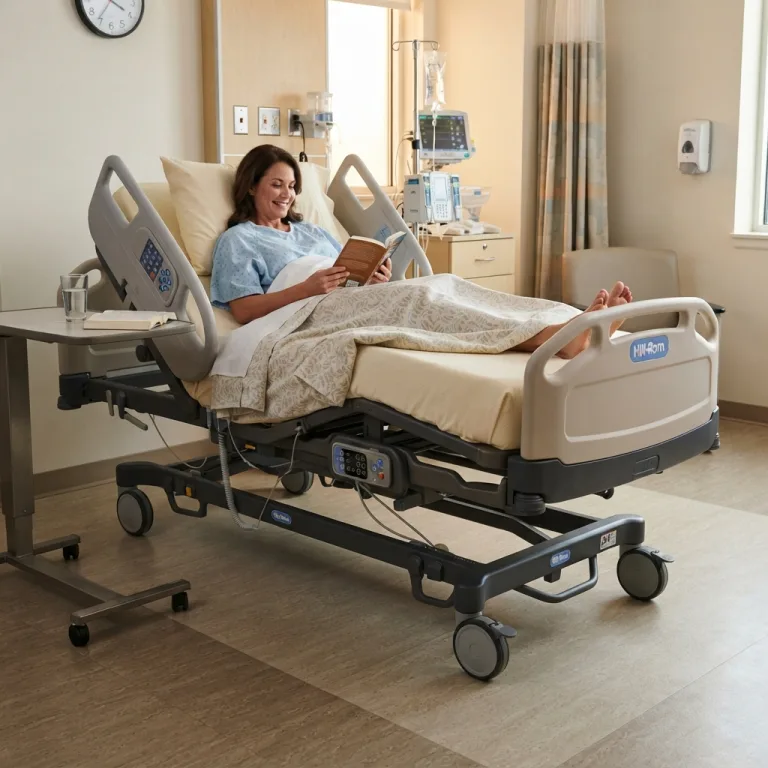
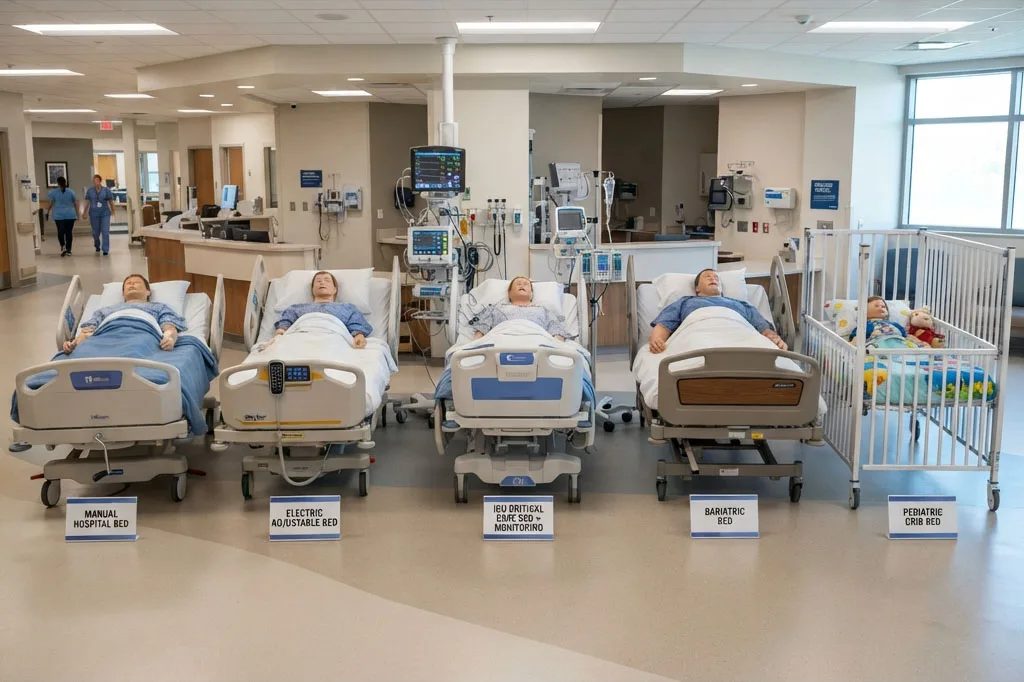
A General Ward and an Intensive Care Unit Do Not Need the Same Bed
A hospital is preparing to purchase 100 new patient beds. The general ward needs practical adjustable beds for routine patient care, while the ICU requires more advanced positioning and emergency functions. The rehabilitation department needs beds that support patient mobility, and the long-term care unit has different requirements for accessibility and comfort.
Should the hospital purchase one bed model for every department?
Not necessarily.
Different hospital departments have different patient-care requirements, operating environments and equipment needs. This is why the medical bed market includes manual hospital beds, electric hospital beds, ICU beds, bariatric beds, pediatric beds, low beds and other specialized configurations.
Understanding these categories helps hospital procurement teams avoid paying for unnecessary functions or selecting beds that are unsuitable for their intended applications.
This guide compares the major types of hospital beds, explains their differences and provides practical selection advice for hospitals, clinics, nursing facilities, rehabilitation centers and international medical equipment buyers.
1. Manual vs Semi-Electric vs Full Electric Hospital Beds
The first major decision when purchasing a hospital bed is the adjustment system.
Hospital beds are commonly divided into three categories according to how their functions are operated.
Manual Hospital Bed
A manual hospital bed uses mechanical cranks to adjust the mattress platform.
Depending on the model, manual adjustment may include:
- Backrest adjustment
- Knee section adjustment
- Overall bed height adjustment
- Other mechanical positioning functions
Advantages
Simple operating structure
Manual beds use mechanical components rather than relying on electric motors for adjustment.
No electrical power required for mechanical adjustment
This can be useful in facilities where electrical infrastructure is limited or where a basic mechanical configuration is preferred.
Lower initial equipment cost in some configurations
Manual beds may offer a lower purchase price than beds with comparable electric functions.
Straightforward mechanical design
The equipment can be suitable for general hospital wards where frequent electric adjustment is not essential.
Limitations
Manual adjustment requires physical effort from staff.
If the bed needs frequent repositioning, operating the crank system may increase workload.
The available functions may also be more limited than those of an advanced electric medical bed.
Suitable Applications
Manual hospital beds may be considered for:
- General hospital wards
- Basic patient rooms
- Selected nursing facilities
- Healthcare centers with simple bed requirements
- Facilities with limited electrical infrastructure
When purchasing, check the number of adjustment functions, crank accessibility, mechanical stability, braking system and availability of replacement components.
Semi-Electric Hospital Bed
A semi-electric hospital bed combines powered adjustment with manual mechanical operation.
For example, some models use electrical motors for backrest and knee adjustment while using a manual crank for bed-height adjustment.
The exact arrangement varies by manufacturer.
Advantages
- Electric adjustment for selected functions
- Reduced manual effort during routine positioning
- Convenient patient positioning
- Potentially lower initial cost than a comparable full-electric configuration
Limitations
Not every adjustment function is motorized.
Healthcare staff may still need to operate a hand crank for certain functions.
Before purchasing, confirm which functions are electrical and which are mechanical.
Suitable Applications
Semi-electric beds may be considered for general wards, smaller hospitals and healthcare facilities that need selected electric adjustment functions without the complete configuration of a full-electric bed.
Full Electric Hospital Bed
A full electric hospital bed uses electric motors to operate multiple adjustment functions.
Depending on the model, these functions may include:
- Backrest adjustment
- Knee adjustment
- Height adjustment
- Trendelenburg positioning
- Reverse Trendelenburg positioning
- Other specialized positions
The adjustment controls may be operated through a handset, staff control panel or both.
Advantages
Convenient positioning
Staff can adjust the bed through electrical controls rather than manually turning cranks.
Flexible adjustment
Different sections of the mattress platform can be positioned according to the available configuration.
Reduced manual workload
Electric adjustment can reduce the physical effort associated with repeatedly changing bed positions.
Additional control functions
Some models provide nurse controls, positioning memory, lockout functions and emergency release options.
Limitations
Full-electric hospital beds generally have a higher initial purchase cost than basic manual beds.
They also require consideration of electrical components, motor maintenance and suitable power arrangements.
Suitable Applications
Full-electric hospital beds may be considered for:
- General hospital wards
- Private hospitals
- Critical care environments, where the configuration is suitable
- Rehabilitation facilities
- Long-term care facilities
- Patient rooms requiring frequent bed adjustment
Manual vs Semi-Electric vs Full Electric: Quick Comparison
| Feature | Manual Bed | Semi-Electric Bed | Full Electric Bed |
|---|---|---|---|
| Adjustment | Hand crank | Electric and manual | Electric |
| Backrest | Model-dependent | Commonly electric | Commonly electric |
| Knee section | Model-dependent | Commonly electric | Commonly electric |
| Height adjustment | Often manual | Often manual | Often electric |
| Electrical power | Not needed for mechanical functions | Needed for powered functions | Needed for powered functions |
| Operating effort | Higher for manual adjustment | Moderate | Lower for motorized functions |
| Initial cost | Often lower | Intermediate | Often higher |
| Typical use | Basic general care | General wards | Facilities requiring more adjustment functions |
The exact configuration must always be confirmed in the product datasheet.
A more expensive electric hospital bed is not automatically the best choice for every department. The decision should reflect the clinical workflow and the facility’s budget.
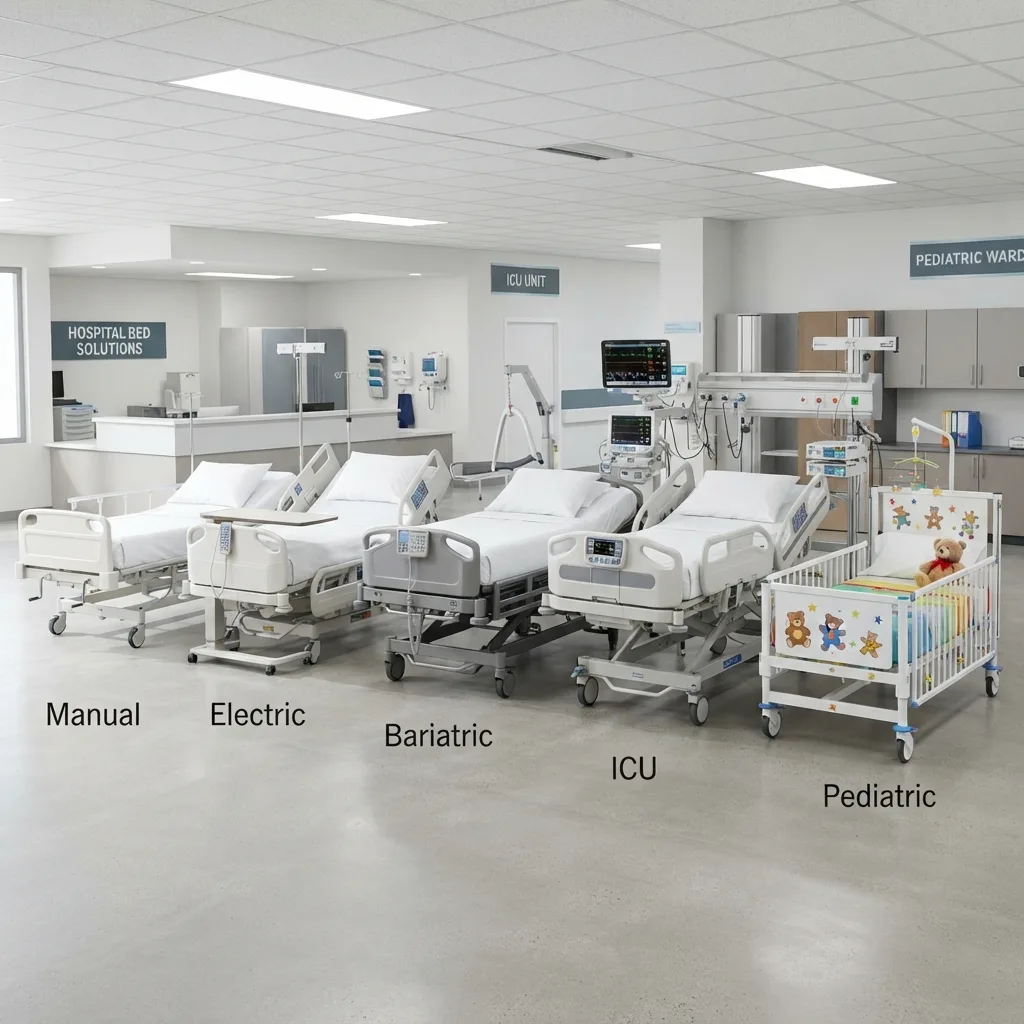
2. ICU Hospital Beds: What Makes Them Different?
An ICU hospital bed, also known as an intensive care bed or critical care bed, is designed for intensive care environments where patient positioning, access and operational convenience can be especially important.
Unlike a basic general ward bed, an ICU bed may offer additional adjustment functions, control arrangements and accessories.
The exact features depend on the manufacturer and model.
Common ICU Hospital Bed Features
Multi-Function Electric Adjustment
An ICU bed may provide multiple motorized adjustment functions.
These can include backrest adjustment, knee adjustment, height adjustment and specialized positioning.
Trendelenburg and Reverse Trendelenburg
Some ICU beds include these positioning functions.
They allow the platform to tilt according to the available range and control design.
CPR Function
Selected ICU beds include a CPR release function that allows rapid placement of the bed into a specified emergency position.
The mechanism may be manual or electrically controlled, depending on the model.
Nurse Control Panel
Some models include a staff control panel that allows nurses to operate selected bed functions.
This may be separate from the patient handset and can include function-lock controls.
Bed Exit Alarm
Some advanced beds offer patient movement or bed-exit monitoring features.
These functions can support a facility’s monitoring workflow, but they do not replace clinical assessment or observation.
Integrated Weighing System
Selected ICU beds include an integrated weighing function.
This may allow staff to obtain patient weight measurements without moving the patient to a separate weighing device.
Buyers should check the weighing range, accuracy, calibration requirements and whether the feature is included in the quoted configuration.
Battery Backup
Some electric medical beds include battery backup or another emergency power arrangement.
The available functions during a power interruption vary between models.
Accessory Mounting
ICU beds may offer mounting points or compatible accessories for selected patient-care equipment.
Buyers should verify the accessory types, load ratings and compatibility requirements.
How to Choose an ICU Bed
An ICU bed should be selected according to the intensive care department’s workflow.
Consider:
- Required adjustment functions
- Safe working load
- Bed dimensions
- Mattress compatibility
- Side rail design
- Emergency positioning
- Nurse control functions
- Patient monitoring accessories
- Electrical requirements
- Cleaning and maintenance
- Spare parts and technical support
An ICU bed with many functions may not necessarily be suitable if the department does not need them.
The goal is to match the bed configuration to the actual critical-care environment.
3. Bariatric Hospital Beds: Width, Capacity and Patient Accessibility
A bariatric hospital bed is designed for patients who require a wider sleeping surface or a higher load capacity than a standard medical bed provides.
Bariatric hospital beds are used in hospitals, long-term care facilities and specialized patient care environments.
Their design may include a reinforced frame, a wider mattress platform and higher-capacity support components.
What Makes a Bariatric Bed Different?
Wider Mattress Platform
A bariatric bed may provide additional width to accommodate patients who require more usable space.
Higher Safe Working Load
The bed must be designed for its specified load capacity.
Buyers should distinguish between maximum patient weight and safe working load.
Safe working load may include the patient, mattress, accessories and other supported components, depending on the manufacturer’s definition.
Reinforced Frame
The bed frame and supporting structure may be designed for higher loads.
The actual construction and material specifications should be reviewed.
Heavy-Duty Casters
A wider and heavier bed may require a caster system suitable for its total weight and intended movement.
Compatible Mattress
Bariatric beds may require specialized mattresses with appropriate dimensions and load ratings.
Transfer Compatibility
The bed should be considered together with the facility’s patient transfer equipment, lifting systems and available room space.
What Should Buyers Check?
- Maximum safe working load
- Recommended patient weight
- Mattress platform width
- Overall bed dimensions
- Mattress compatibility
- Caster capacity
- Frame construction
- Transfer equipment compatibility
- Room access
- Maintenance requirements
A bariatric bed should not be selected based on patient weight alone. The patient’s physical dimensions, mobility and required support surface should also be considered.
Bariatric Bed vs Standard Hospital Bed
| Feature | Standard Hospital Bed | Bariatric Hospital Bed |
|---|---|---|
| Width | Standard mattress platform | Often wider |
| Load capacity | Standard model rating | Higher model-specific rating |
| Frame | Standard construction | Designed for higher loads |
| Mattress | Standard compatible mattress | Wider and appropriately rated mattress |
| Casters | Standard bed casters | May use higher-capacity components |
| Main selection factor | General patient-care requirements | Patient dimensions and load requirements |
For larger hospitals, bariatric beds should be planned alongside suitable wheelchairs, transfer aids, patient lifts and other supporting equipment.
4. Low Hospital Beds: Accessibility and Fall-Risk Considerations
A low hospital bed is designed to lower the mattress platform closer to the floor than a conventional medical bed.
It may be considered for certain patients who have an increased risk of injury associated with leaving or falling from a bed.
Low beds are found in selected hospital wards, rehabilitation facilities and long-term care environments.
Common Low Bed Features
- Low mattress platform position
- Adjustable bed height on some models
- Side rail or assist-rail options
- Lockable casters
- Compatible mattress designs
- Optional movement or bed-exit monitoring functions
What Are the Advantages of Low Hospital Beds?
A lower bed position can reduce the distance between the mattress and floor.
Some low beds also allow the platform to be raised for nursing activities and transfers.
This can help healthcare staff adapt the working height to different situations.
However, a low bed does not automatically prevent falls.
The decision should consider the patient’s mobility, behavior, transfer ability and overall clinical needs.
The FDA and Hospital Bed Safety Workgroup emphasize individual assessment, suitable bed systems and monitoring rather than treating bed rails or low beds as universal fall-prevention solutions.
What Should Buyers Consider?
- Minimum platform height
- Maximum platform height
- Mattress compatibility
- Rail configuration
- Ease of patient transfer
- Brake operation
- Under-bed clearance
- Caregiver ergonomics
- Available monitoring functions
For healthcare procurement, it is useful to distinguish between a genuinely low-profile adjustable medical bed and a conventional bed that simply has a lower minimum height than another model.
5. Pediatric Hospital Beds: Designed for Younger Patients
A pediatric hospital bed is designed for use by children.
It is not simply a smaller version of an adult hospital bed.
Pediatric beds require particular attention to dimensions, side rail design, openings, mattress compatibility and age-appropriate safety considerations.
The correct design depends on the intended age group and use environment.
Common Pediatric Bed Features
Depending on the model, pediatric medical beds may include:
- Child-appropriate bed dimensions
- Protective side rail or enclosure arrangements
- Adjustable positioning
- Locking wheels
- Mattress compatibility
- Easy-clean surfaces
- Staff access functions
Specialized pediatric beds may also have different mechanisms for adjustment and access.
Pediatric Bed Safety
Children have different body dimensions and physical abilities from adults.
As a result, adult hospital bed safety measurements and specifications should not automatically be applied to pediatric beds.
The FDA’s hospital bed entrapment guidance is primarily based on adult bed systems and explicitly notes that its adult dimensional assessment tools are not appropriate for children in most cases.
For buyers, important questions include:
- Which age group is the bed designed for?
- What are the dimensions of the mattress platform?
- What type of side rail or enclosure is provided?
- What are the applicable pediatric safety requirements?
- Are the mattress and accessories compatible?
- What instructions are provided for safe operation?
A pediatric bed should always be selected according to the intended patient population and applicable requirements.
6. Other Specialized Hospital Beds
Apart from general, electric, ICU, bariatric, low and pediatric beds, hospitals may need other specialized bed configurations.
These products should be selected according to the intended clinical application.
Orthopedic Hospital Bed
An orthopedic hospital bed may be used in patient-care environments where specialized positioning, traction-related accessories or other orthopedic support arrangements are needed.
Depending on the model, it may include accessory mounting points for compatible traction equipment.
Buyers should confirm the actual intended function rather than assuming that every adjustable hospital bed is an orthopedic bed.
Related search terms:
- orthopedic hospital bed
- orthopedic medical bed
- traction hospital bed
- orthopedic patient bed
- hospital bed with traction accessories
Obstetric and Delivery Bed
Obstetric beds are designed for maternity and childbirth-related healthcare environments.
They may have specialized positioning functions, adjustable sections, removable components and accessory arrangements.
They should not be confused with general ward beds simply because both have adjustable sections.
Related search terms:
- obstetric hospital bed
- delivery bed
- labor and delivery bed
- birthing bed
- maternity hospital bed
Recovery Room Bed
Recovery room beds are used in selected post-procedure or post-anesthesia care environments.
Depending on the design, they may include adjustable positioning and features intended to support recovery workflows.
Buyers should distinguish these beds from transport stretchers, which are mainly designed for patient movement.
Related search terms:
- recovery room bed
- post anesthesia care bed
- medical recovery bed
- hospital recovery bed
- PACU patient bed
Long-Term Care Bed
Long-term care beds are used in nursing facilities, residential care environments and other settings involving extended patient accommodation.
Important considerations include:
- Ease of adjustment
- Accessibility
- Cleaning
- Durability
- Mattress compatibility
- Mobility assistance
- Maintenance
- Patient-specific safety
A low adjustable bed or a suitable electric medical bed may be considered depending on the resident’s needs.
Related search terms:
- long term care bed
- nursing home bed
- elderly care hospital bed
- long term patient bed
- adjustable nursing bed
7. How to Match Different Hospital Beds With Different Departments
The same hospital bed configuration is not necessarily appropriate for every department.
The following table provides a general purchasing reference.
| Healthcare Department | Bed Type to Evaluate | Key Considerations |
|---|---|---|
| General ward | Manual, semi-electric or electric bed | Routine adjustment and staff workflow |
| ICU | Specialized electric ICU bed | Positioning, controls and emergency functions |
| Emergency department | General medical bed or suitable transfer bed | Accessibility and workflow |
| Rehabilitation | Adjustable medical bed | Patient mobility and transfers |
| Long-term care | Electric or low hospital bed | Accessibility and daily operation |
| Pediatric ward | Pediatric bed | Child-appropriate safety and dimensions |
| Bariatric care | Bariatric hospital bed | Width, safe working load and transfer compatibility |
| Maternity department | Obstetric or delivery bed | Clinical positioning and accessories |
| Recovery room | Recovery bed | Positioning and post-procedure workflow |
| Orthopedic ward | General or orthopedic-specific bed | Traction compatibility and positioning requirements |
These are general selection directions. Actual equipment requirements should be determined by the department’s clinical activities, patient population and facility policies.
8. Hospital Bed Functions: Which Features Are Worth Paying For?
When comparing hospital bed quotations, buyers may encounter many additional functions.
Some are important for a particular clinical environment, while others may not be necessary for a general ward.
Electric Height Adjustment
Useful where frequent adjustment between patient access and staff working positions is needed.
Adjustable Backrest
Can support different upper-body positions.
Adjustable Knee Section
Allows selected changes to the lower part of the mattress platform.
Trendelenburg and Reverse Trendelenburg
Available on certain beds for specific positioning requirements.
CPR Release
A function found on selected beds intended to enable rapid emergency repositioning.
Integrated Weighing System
Available on certain advanced beds and useful in workflows requiring weight measurement without moving the patient to a separate scale.
Bed Exit Monitoring
Some beds include monitoring functions that can alert staff when a defined movement or bed-exit condition is detected.
Central Locking System
A convenient wheel-control arrangement available on selected medical beds.
Nurse Control System
May provide additional control over patient handset functions, bed positions or operating locks.
Battery Backup
Some models include a backup power arrangement for selected electric functions.
Accessory Compatibility
Selected beds support IV poles, lifting poles, drainage bag holders, patient monitoring accessories and other equipment.
However, accessories should only be used where the bed is designed to support them.
When choosing optional features, ask one question:
Will this function be used regularly in the intended department, and does it provide a meaningful operational benefit?
This helps prevent over-purchasing unnecessary functions.
9. Mattress and Bed Compatibility: An Important Purchasing Issue
Hospital bed performance cannot be evaluated by the bed frame alone.
The mattress, side rails and accessories form a combined bed system.
This is particularly important for beds with adjustable mattress platforms, specialized pressure redistribution mattresses and bariatric configurations.
Before ordering, confirm:
Dimensions
Does the mattress match the length, width and thickness specified by the manufacturer?
Articulation
Can the mattress accommodate the bed’s adjustment movements?
Pressure redistribution
Is a specific pressure redistribution mattress required for the patient-care application?
Compatibility with rails
Does the mattress and bed rail combination maintain appropriate clearances?
Cover material
Is the mattress cover compatible with the facility’s cleaning and infection-control procedures?
Replacement availability
Can the mattress be replaced without changing the entire bed system?
A mattress that fits the platform physically is not automatically a suitable or safe combination.
Hospitals should review manufacturer compatibility information and the complete bed-system risk assessment.
10. Hospital Bed Safety: Why Side Rails Require Careful Selection
Side rails are a common hospital bed feature, but they should not be treated as universally necessary or automatically protective.
Their use depends on the patient and the intended care activity.
Potential risks include:
- Entrapment
- Injury when attempting to climb over a rail
- Gaps between the mattress and rail
- Incompatibility between bed components
- Problems caused by mattress compression
The FDA recommends that healthcare providers assess individual patient needs before using bed rails and regularly inspect the compatibility of beds, mattresses and rails.
For hospital procurement teams, this means a complete bed system should be evaluated.
Do not purchase side rails separately without checking that they are approved for the selected bed and compatible with its mattress.
Also confirm whether the bed’s patient and nurse controls are integrated into the rail system.
If so, replacing or removing rails may affect equipment functions or warranty conditions.
Final Buying Advice: The Right Bed Depends on the Intended Use
A manual hospital bed may be suitable for a basic ward, while an electric patient bed can provide more convenient adjustment for departments that need frequent repositioning.
An ICU bed may require additional emergency and positioning functions. Bariatric beds need appropriate width and load capacity, while pediatric beds must be designed for younger patients.
There is no single hospital bed that is ideal for every healthcare environment.
The purchasing process should follow:
Department requirements → Patient population → Bed category → Functions → Mattress compatibility → Safety → Standards → Maintenance → Supplier evaluation.
For hospitals purchasing large quantities, it is also worth evaluating whether different wards need different configurations instead of ordering one standard model for the entire facility.
A well-planned hospital bed procurement project should deliver equipment that suits the actual patient-care environment, supports everyday nursing activities and can be maintained over its working life.
Frequently Asked Questions
1. What are the main types of hospital beds?
The main categories include manual hospital beds, semi-electric hospital beds, full electric hospital beds, ICU beds, bariatric beds, pediatric beds, low beds, orthopedic beds and obstetric beds.
2. What is the difference between manual and electric hospital beds?
Manual beds use mechanical cranks to adjust selected functions. Electric beds use motors and electrical controls to operate specified adjustment functions.
3. What is a semi-electric hospital bed?
A semi-electric hospital bed combines motorized adjustment with manual mechanical functions. The exact configuration varies by model.
4. What is a full electric hospital bed?
A full electric hospital bed uses electrical motors for multiple adjustment functions, which may include the backrest, knee section and bed height.
5. What is better, a manual or electric hospital bed?
It depends on the healthcare environment, staff workflow, adjustment requirements, electrical infrastructure and budget. An electric bed is not automatically necessary for every patient room.
6. What is the difference between an ICU bed and a general hospital bed?
An ICU bed may offer additional positioning, emergency, control and accessory functions designed for intensive care environments. A general hospital bed is typically intended for routine patient accommodation and care.
7. What is a five-function hospital bed?
A five-function hospital bed provides five specified adjustment functions, but the exact combination varies by manufacturer. Buyers should check the individual product datasheet.
8. What is a bariatric hospital bed?
A bariatric hospital bed is designed to support patients who require a wider mattress platform or a higher load capacity than a standard bed offers.
9. What is a pediatric hospital bed?
A pediatric hospital bed is designed specifically for children, with dimensions, enclosure features and safety considerations appropriate to its intended patient population.
10. What is a low hospital bed used for?
A low hospital bed provides a lower mattress platform and may be considered for selected patients with particular mobility or fall-risk requirements. It does not independently prevent falls.
11. What is a Trendelenburg hospital bed?
It is a bed designed to tilt the patient platform so that the head end is lower than the foot end.
12. What is a reverse Trendelenburg hospital bed?
It is a bed designed to tilt so that the head end is higher than the foot end.
13. What is a CPR hospital bed?
A CPR hospital bed is a medical bed with a function designed to rapidly place the mattress platform into a specified emergency position. Availability and operation vary by model.
14. What is an ICU electric hospital bed?
An ICU electric bed is a motorized medical bed designed for intensive care workflows. It may include multiple adjustment functions and selected emergency or monitoring features.
15. What is the difference between a bariatric bed and a standard hospital bed?
A bariatric bed generally offers a wider support surface and a higher specified safe working load. The correct selection also depends on the patient’s physical dimensions and suitable mattress configuration.
16. Do all electric hospital beds have battery backup?
No. Battery backup is model-dependent and should be checked in the technical specifications.
17. Are hospital bed side rails necessary?
Not for every patient. Their use should be based on individual clinical assessment, potential risks, equipment compatibility and healthcare facility policies.
18. What is the difference between a hospital bed and an ICU bed?
An ICU bed is a specialized category of hospital bed designed for intensive care requirements. It may provide more advanced positioning, control and accessory options.
19. What is the difference between a hospital bed and an obstetric bed?
An obstetric bed is designed for maternity and childbirth-related care, while a general hospital bed supports routine patient accommodation.
20. Can an orthopedic hospital bed include traction accessories?
Some orthopedic-specific beds support compatible traction accessories. Buyers should confirm the design and intended configuration with the manufacturer.
21. Which hospital bed is suitable for a rehabilitation center?
Depending on patient needs and rehabilitation activities, a center may consider adjustable electric beds, low beds or other suitable medical beds. Mobility, transfer access and safety should be evaluated.
22. What should I compare when purchasing different hospital bed types?
Compare bed dimensions, adjustment functions, safe working load, mattress compatibility, side rails, caster systems, electrical components, accessories, documentation and maintenance requirements.
23. Which standard applies to adult medical beds?
IEC 80601-2-52:2026 is an international standard covering the basic safety and essential performance of adult medical beds within its defined scope. Pediatric beds and several specialty categories have separate considerations.
24. How do I choose an ICU bed manufacturer?
Evaluate its ICU bed configurations, adjustment functions, technical specifications, applicable documentation, accessory compatibility, spare parts and after-sales support.
25. Can hospital beds be customized for different departments?
Some manufacturers support customization of dimensions, colors, adjustment functions, accessories and other configurations. Confirm whether the requested modifications affect product testing or compliance documentation.