Start With Laboratory Workload
The first specification buyers often notice is:
Tissue processor capacity
Capacity matters, but the largest number is not automatically the correct choice.
A laboratory processing a small number of routine specimens does not necessarily need a high-capacity system designed for a large pathology department.
At the other end, a high-volume laboratory may quickly find a low-capacity system restrictive.
The first step is to understand actual workload.
Consider:
- Average cassettes per day
- Peak daily workload
- Number of processing runs
- Routine versus urgent specimens
- Weekend or overnight processing
- Number of operators
- Expected future growth
A laboratory that currently processes 100 cassettes a day may need to consider what happens if that number increases over the next few years.
A purchase should therefore support both current workflow and reasonable future demand.
What Does Cassette Capacity Mean?
Cassette capacity refers to the number of tissue cassettes a tissue processor can handle within a processing run or retort configuration.
However, capacity specifications need to be read carefully.
A manufacturer may describe:
maximum capacity
standard protocol capacity
xylene-free protocol capacity
capacity per retort
capacity per basket
or simultaneous processing capacity.
These are not necessarily the same thing.
For example, Leica’s current HistoCore PELORIS 3 is specified for up to 600 cassettes under its standard high-capacity configuration, while its xylene-free configuration is listed at 432 cassettes.
The important purchasing lesson is:
Compare capacity under the same processing conditions.
Do not compare one supplier’s maximum number against another supplier’s standard protocol number without checking the details.
Single Retort vs Dual Retort Tissue Processor
One of the most important equipment design questions is:
Single retort or dual retort?
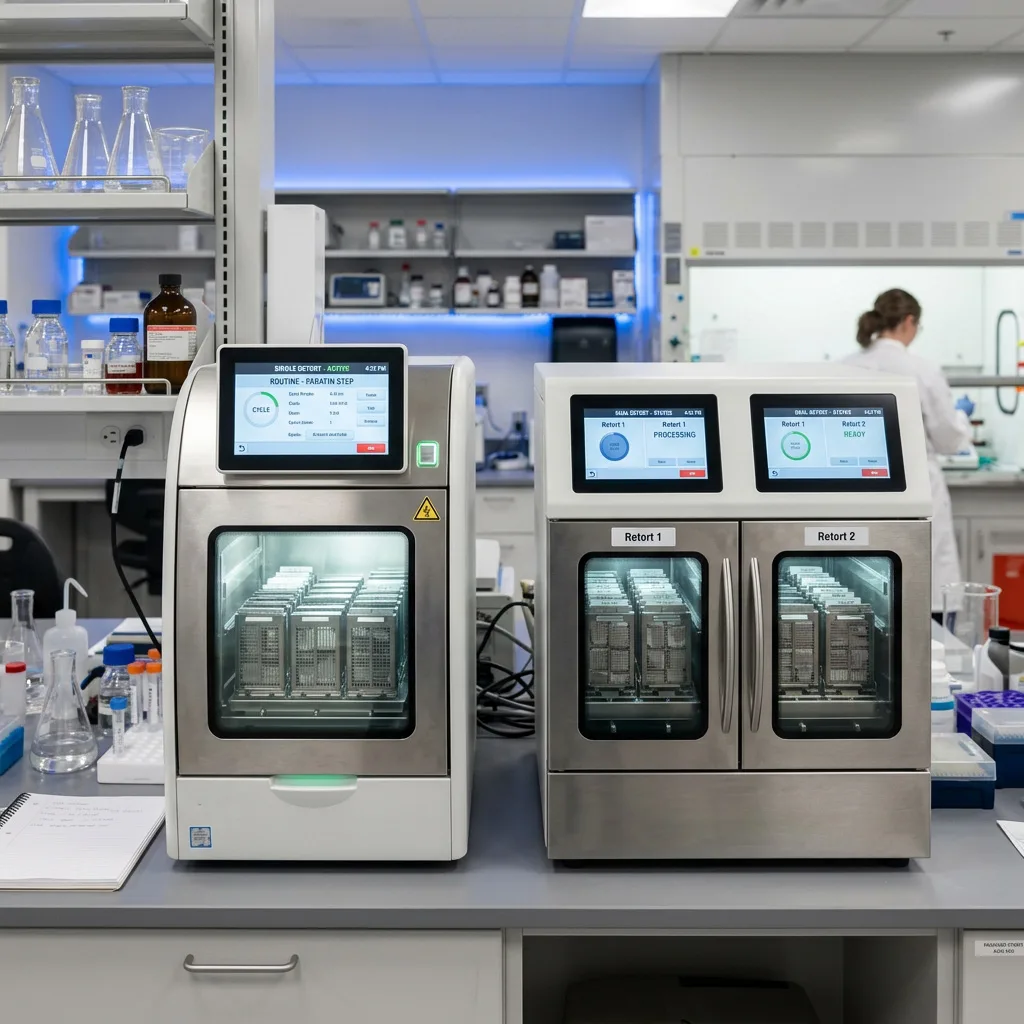
A retort is the processing chamber where tissue cassettes remain while processing fluids are introduced and removed.
A single-retort system has one main processing chamber.
A dual-retort system has two processing chambers, which can allow different specimen groups or protocols to be processed separately.
This can be useful when a laboratory needs greater flexibility.
For example:
Retort A: standard overnight protocol
Retort B: urgent or special protocol
The exact capabilities depend on the model.
Leica’s current dual-retort portfolio uses two retorts and lists models designed for different laboratory throughput levels, including systems with two sets of 200 or 300 cassette capacity.
Why Is Dual-Retort Processing Useful?
Dual-retort systems can provide workflow flexibility.
Imagine a pathology laboratory that has:
routine tissue
fatty specimens
urgent biopsies
special protocols
A single processor may force all work into one schedule.
A dual-retort system can potentially separate processing workloads.
This can reduce the need to wait for one large cycle to finish before another type of specimen can be processed.
Current high-capacity systems market dual-retort designs specifically around flexible scheduling and parallel processing.
However, dual retorts also mean more equipment complexity and potentially higher acquisition and maintenance costs.
Therefore:
Choose dual retort for a workflow reason, not simply because two chambers sound better.
Tissue Processor Protocols: One of the Most Important Features
A tissue processing protocol defines the sequence and conditions used to process specimens.
Depending on the system, a protocol can control:
- Reagent sequence
- Processing time
- Temperature
- Vacuum
- Pressure
- Agitation
- Paraffin infiltration
- Reagent selection
- Number of processing steps
Different specimens can require different protocols.
A small biopsy may need a different schedule from a large or fatty specimen.
Recent research using automated tissue processing shows that different sample sizes and thicknesses can require different processing lengths, with thicker samples generally requiring longer dehydration or processing conditions.
This makes protocol flexibility an important buying criterion.
Can a Tissue Processor Run Different Protocols?
Many modern automated tissue processors allow laboratories to create and store multiple programs.
Possible protocol categories include:
Routine overnight
Biopsy
Rapid processing
Large specimen
Fatty tissue
Special research protocol
Xylene-free protocol
The names and available functions differ by manufacturer.
When comparing systems, ask:
How many protocols can be stored?
Can operators modify processing times?
Can temperatures be changed?
Can vacuum or pressure conditions be adjusted?
Can different protocols be used independently?
Are protocol changes password protected?
Is there a record of who changed a protocol?
These questions become more important in laboratories where multiple technicians use the same machine.
Tissue Processor Cycle Time
Another common search is:
tissue processor processing time
or
how long does a tissue processor take?
There is no single answer.
Cycle time depends on:
sample thickness
tissue composition
fixation
number of reagent steps
reagent temperature
vacuum
processing protocol
required tissue quality
paraffin infiltration
A rapid program may be useful for urgent cases, but shortening the cycle should not automatically be the main objective.
The actual goal is:
appropriate tissue processing within the required laboratory turnaround time.
For example, current commercial systems may advertise rapid protocols alongside standard and fatty-tissue programs, showing how modern processors are designed around different workflow requirements.
What Is a Rapid Tissue Processing Protocol?
A rapid tissue processing protocol is a shorter processing cycle intended for situations where tissue needs to move through the histology workflow more quickly.
Potential uses include:
- Small biopsies
- Urgent pathology cases
- Selected routine specimens
- Same-day workflows
However, not every specimen is suitable for rapid processing.
A thick specimen cannot necessarily be processed in the same time as a small biopsy simply because a machine has a “rapid” setting.
Recent automated-processing research reinforces the importance of matching processing duration to specimen size and thickness.
Reagent Stations and Reagent Capacity
Another important specification is:
number of reagent stations
A tissue processor can require multiple reagent containers for:
- Fixation
- Alcohol dehydration
- Clearing
- Paraffin infiltration
- Cleaning
The exact number depends on the design and processing protocol.
One published example of an automated processor used 17 reagent vessels as part of a multi-step FFPE processing workflow, while current commercial systems may use different configurations.
The number of bottles alone should not decide the purchase.
Instead, ask:
How many are required for the protocols we use?
How much reagent does each station hold?
How often must reagents be replaced?
How are reagent positions managed?
Can the system monitor reagent use?
Why Reagent Management Matters
A tissue processor can only deliver consistent results when the reagents are suitable for the protocol.
Reagent management can involve:
concentration
contamination
age
replacement schedule
reagent rotation
identification
waste handling
If an alcohol solution becomes excessively contaminated or a clearing reagent loses effectiveness, the tissue-processing result can be affected.
Some modern systems offer automated reagent tracking or management functions.
Leica’s current tissue processor range, for example, includes systems with reagent information and tracking features, including basket, user and reagent data capture on selected models.
For procurement, ask what the machine actually monitors rather than assuming “reagent management” means automatic replacement.
Tissue Processor Vacuum: Why Does It Matter?
Vacuum tissue processing is a common feature in modern automated processors.
Vacuum can be used during certain processing stages to help move processing fluids through tissue and improve workflow efficiency.
Some systems also use pressure cycles.
Current commercial processors can specify both retort vacuum and pressure values as part of their operating specifications. Leica’s HistoCore PELORIS 3, for example, lists maximum retort vacuum and pressure values alongside its capacity and reagent configuration.
For buyers, the important questions are:
Is vacuum available during processing?
Is vacuum programmable?
Can different protocols use different vacuum conditions?
What happens if the vacuum system fails?
Is the vacuum system easy to maintain?
Avoid choosing a processor simply because it advertises a larger vacuum number.
The practical question is whether the vacuum function supports the laboratory’s validated processing workflow.
Tissue Processor Pressure and Agitation
Some advanced systems also provide pressure or agitation functions.
Agitation moves processing fluid around or through the specimen to improve contact between tissue and reagent.
Leica’s HistoCore PELORIS 3, for example, uses a magnetically coupled stirrer in each retort and lists user-selectable agitation operation.
These features may help optimize processing efficiency, but their importance depends on the machine’s overall design.
When comparing manufacturers, evaluate:
vacuum + pressure + agitation + fluid circulation
as a combined system rather than comparing one number at a time.
Temperature Control in a Tissue Processor
Temperature control becomes particularly important during paraffin infiltration.
The processor must maintain appropriate temperatures for processing reagents and paraffin according to the selected protocol.
Modern systems may provide separate temperature settings for:
processing reagents
paraffin
cleaning reagents
The available ranges vary by model.
For example, Leica’s current PEGASUS specifications provide selectable temperature ranges for processing reagents, paraffin and cleaning reagents.
A buyer should therefore ask:
What is the temperature range?
How accurately is temperature controlled?
How quickly does the system heat?
Is temperature monitored continuously?
What alarms are available?
Temperature control should be considered together with the laboratory’s processing protocols.
Paraffin Stations
The paraffin station is an important part of a tissue processor because paraffin infiltration occurs after dehydration and clearing.
A system may have one or multiple paraffin stations or baths.
The key questions are:
How many paraffin stations are available?
What is the capacity of each station?
How is the paraffin heated?
How long does it take to reach the operating temperature?
How easy is cleaning?
Can paraffin be drained or replaced easily?
Current high-capacity processors list multiple paraffin stations as part of their configuration. For example, HistoCore PELORIS 3 specifies four paraffin wax stations.
Again, more is not automatically better.
The configuration should match the intended workload and protocol structure.
Xylene and Xylene-Free Tissue Processing
Another increasingly important procurement question is:
Does the tissue processor require xylene?
Traditional tissue processing commonly uses xylene or another clearing medium.
Some modern processors support xylene-free or alternative reagent workflows.
Current commercial systems describe xylene-free processing options using alternative solvents such as isopropanol-based workflows or other clearing substitutes.
For laboratories considering a xylene-free workflow, ask:
Which reagents are required?
Are existing laboratory protocols compatible?
What changes are needed in processing time?
Are special consumables required?
Does the manufacturer validate the alternative protocol?
A xylene-free capability can be useful, but it should be evaluated as part of the entire laboratory workflow.
Open Tissue Processor vs Enclosed Tissue Processor
Another purchasing decision involves processor design.
An open or tissue-transfer processor generally moves tissue containers between reagent stations.
An enclosed or fluid-transfer processor keeps the tissue in a processing chamber while fluids are moved into and out of the chamber.
Enclosed systems can provide a different approach to:
reagent containment
automation
fluid handling
protocol management
specimen movement
The choice depends on workflow, safety procedures, capacity and laboratory preferences.
Published pathology descriptions distinguish traditional “dip and dunk” processing from enclosed fluid-transfer designs and describe the latter as systems in which reagents are pumped through a processing chamber.
Tissue Processor Safety Features
Safety should be evaluated before price.
Depending on the machine, look for:
enclosed processing chamber
reagent containment
leak detection
temperature alarms
pressure or vacuum monitoring
power-failure handling
door or retort locking
ventilation compatibility
emergency procedures
fault alarms
The exact safety functions differ between models.
A good procurement process should ask:
What happens when power is interrupted?
What happens if a reagent bottle is empty?
What happens if the vacuum pump stops?
What happens when the chamber temperature is outside the programmed range?
Can the machine safely recover an interrupted processing cycle?
These questions matter because a tissue processor can hold many patient specimens during a single automated run.
Recent pathology literature highlights the importance of automation, tracking and process control for reducing opportunities for human error and supporting patient safety.
Power Failure and Tissue Processor Backup
A tissue processor may operate for many hours, including overnight.
Power interruption is therefore a practical risk that buyers should consider.
Ask the supplier:
Does the machine remember the current program?
Can the cycle resume automatically?
Can the operator choose a recovery step?
What happens to the tissue if power is interrupted for several hours?
Is UPS support recommended?
The correct solution varies by machine.
For critical pathology laboratories, backup power and recovery procedures should be considered alongside the equipment purchase.
The supplier should explain the machine’s actual recovery logic rather than giving only a general statement such as “power-failure protection.”
User Interface and Software
A modern tissue processor can involve multiple protocols, reagent positions and alarms.
This makes the user interface important.
Look for:
clear program selection
easy-to-read status display
remaining-time display
alarm notifications
user access control
protocol editing
maintenance reminders
reagent information
run history
data export
user identification
Not every laboratory needs advanced software.
But an interface that is difficult to operate can increase training time and create avoidable errors.
For larger laboratories, data records can also contribute to workflow traceability.
Current pathology automation literature discusses the growing role of digital tracking across processing, embedding, microtomy, staining and archiving.
Tissue Tracking and Traceability
For laboratories handling many patient specimens, traceability becomes an important issue.
Questions include:
Can the machine identify a basket?
Can it record the operator?
Can it store processing information?
Can reagent information be tracked?
Can a run be reviewed later?
Can the system connect with laboratory information systems?
Not every tissue processor offers the same level of tracking.
A high-volume pathology department may value these capabilities more than a small laboratory.
Recent literature on pathology automation emphasizes traceability as an important part of modern laboratory workflow, especially when multiple automated instruments are linked together.
Tissue Processor Cleaning and Maintenance
A tissue processor is exposed to chemicals, paraffin, heat and repeated processing cycles.
Maintenance therefore matters.
Routine tasks may include:
cleaning reagent lines
cleaning the retort
checking seals
cleaning paraffin stations
checking filters
checking pumps
checking vacuum systems
checking temperature systems
removing paraffin residue
replacing worn components
The actual schedule depends on the model.
Ask the supplier for:
daily maintenance
weekly maintenance
monthly maintenance
annual service
and:
recommended spare parts
A machine that is simple to clean can reduce maintenance time.
Reagent Consumption and Operating Cost
A buyer may focus on the purchase price but overlook operating expenses.
A tissue processor can consume:
alcohol
clearing agents
paraffin
cleaning reagents
filters
other consumables
The real operating cost depends on specimen volume and processing protocol.
A supplier quotation should therefore answer:
How much reagent is required per run?
How often do reagents need replacement?
What is the maximum bottle capacity?
How much paraffin is used?
What consumables are proprietary?
Are compatible alternatives available?
Current commercial models specify reagent bottle volumes and paraffin capacities because these affect workflow and replenishment requirements.
Tissue Processor Price: What Affects the Cost?
Searches for:
tissue processor price
automatic tissue processor price
histology tissue processor price
pathology tissue processor cost
can produce very different quotations.
The price can depend on:
capacity
single or dual retort
automation level
protocol flexibility
vacuum and pressure
reagent stations
paraffin stations
tracking
barcode functions
software
certification
accessories
warranty
installation
training
shipping
A small single-retort processor and a high-capacity dual-retort system are not equivalent products.
Therefore, compare specifications before comparing price.
Total Cost of Ownership
The purchase price is only one part of the cost.
A better B2B comparison includes:
Equipment price
Shipping
Installation
Training
Reagents
Consumables
Maintenance
Spare parts
Service
Downtime
Energy consumption
For example, a machine with a lower purchase price may require more frequent manual work or have higher reagent consumption.
Another machine may have a higher purchase price but provide automation or larger capacity that fits a high-volume workflow better.
This is why a laboratory should calculate cost per processed cassette or cost per case when enough operational data is available.
That provides a more meaningful comparison than unit price alone.
Tissue Processor for a Small Laboratory
A small laboratory may prioritize:
reasonable capacity
simple operation
easy maintenance
lower acquisition cost
straightforward protocols
local support
A high-capacity dual-retort processor may provide more capability than the laboratory actually needs.
The best specification is the one that matches the daily workflow.
Tissue Processor for a Medium-Sized Laboratory
A medium laboratory may need greater flexibility.
Typical priorities can include:
multiple processing programs
moderate to high cassette capacity
reagent management
automated processing
operator-friendly controls
reliable service
future capacity
A semi-advanced system with flexible programming may be more useful than a basic machine with limited protocol options.
Tissue Processor for a High-Volume Pathology Laboratory
High-volume laboratories may place greater emphasis on:
capacity
dual-retort processing
parallel workflows
rapid protocols
traceability
barcode management
reagent monitoring
system reliability
service response
integration with laboratory information systems
Current commercial dual-retort systems explicitly target flexible and scalable high-throughput laboratory workflows.
Research on pathology automation also points toward greater integration between processing, embedding, microtomy, staining, scanning and archiving.
What About Tissue Processor Capacity for Future Growth?
Do not size the machine only according to today’s workload.
Consider:
current cases
expected growth
new hospital contracts
new pathology services
weekend processing
urgent cases
additional operators
future automation
However, buying a machine far larger than needed can increase the initial investment and operating complexity.
The goal should be:
enough capacity + reasonable flexibility + room for growth
Common Tissue Processor Buying Mistakes
Choosing the highest capacity
Large capacity is useful only when the laboratory can actually use it.
Comparing price without comparing configuration
A low quotation may exclude accessories, installation, training or certain software features.
Ignoring reagent costs
Operating expenses can become significant over years of daily use.
Ignoring maintenance
Pumps, seals, filters, heating systems and other components require service.
Assuming all tissue processors support the same protocols
Protocol flexibility varies by model.
Ignoring power failure procedures
An overnight processing cycle can be affected by an unexpected outage.
Ignoring future workflow integration
A laboratory may later need barcode tracking or LIS integration.
Choosing a machine without a service plan
A technically capable machine can still become difficult to operate if spare parts and technical support are not readily available.
Frequently Asked Questions About Choosing a Tissue Processor
How do I choose a tissue processor?
Start with specimen type, laboratory workload and processing protocols. Then compare cassette capacity, retort design, reagent configuration, temperature control, vacuum, automation, safety, maintenance and service.
What capacity tissue processor do I need?
The required capacity depends on the number of cassettes processed per run, daily workload, peak demand and future growth. Compare standard operating capacity rather than only the manufacturer’s maximum number.
What is a retort in a tissue processor?
A retort is the processing chamber where tissue cassettes remain while processing reagents are introduced and removed in many enclosed tissue-processing systems.
What is the difference between single retort and dual retort?
A single-retort processor has one processing chamber, while a dual-retort processor has two. Dual-retort systems can provide greater workflow flexibility by allowing different processing runs to be handled separately, depending on the model.
Is a dual-retort tissue processor better?
Not automatically. It may be useful when the laboratory needs parallel workflows or greater flexibility, but a single-retort system can be appropriate for laboratories with simpler workloads.
What is the difference between a tissue processor and an automatic tissue processor?
“Tissue processor” describes the equipment category. An automatic tissue processor uses programmed automation to control some or most of the processing sequence.
What is a good tissue processor capacity?
There is no universal capacity that suits every laboratory. The appropriate capacity depends on workload, specimen type, protocol and future demand.
Does a tissue processor use vacuum?
Many modern tissue processors use vacuum and, in some designs, pressure as part of tissue processing. The actual functions and operating values depend on the model.
Does every tissue processor use xylene?
No. Some systems support alternative clearing agents or xylene-free workflows. Buyers should confirm reagent compatibility with their intended protocol.
Can tissue processors process fatty tissue?
Yes, but fatty tissue can require a different processing protocol from small routine biopsies. Specimen size and composition should be considered when selecting processing conditions.
Can a tissue processor run overnight?
Many automated tissue processors are designed for programmed processing cycles, including overnight workflows. The available duration and scheduling options depend on the model.
What is a tissue processor protocol?
A processing protocol is a programmed sequence of reagents, times and operating conditions used to prepare tissue for embedding.
How often should tissue processor reagents be replaced?
There is no universal replacement interval. Replacement depends on reagent type, specimen volume, contamination, concentration and the laboratory’s validated procedures.
Does tissue processor capacity mean cassette capacity?
Usually it refers to how many cassettes can be processed within the specified configuration, but the exact definition should be checked because manufacturers may specify different capacities for different protocols or configurations.
Is tissue processor automation important?
Automation can reduce repetitive manual steps and improve process standardization, but the appropriate automation level depends on laboratory workload and workflow. Recent pathology literature describes automation as increasingly important across multiple stages of the laboratory workflow.
Should a tissue processor have barcode tracking?
Barcode or tracking functions can be valuable for laboratories with large specimen volumes and complex workflows. The need depends on laboratory size and existing information systems.
Does a tissue processor need LIS integration?
Not every laboratory needs it. However, LIS integration can become valuable for larger or highly automated pathology workflows.
What should I ask before buying a tissue processor?
Ask about capacity, retort design, protocols, reagent stations, paraffin stations, vacuum, pressure, temperature control, safety, power-failure recovery, maintenance, spare parts, warranty and technical support.