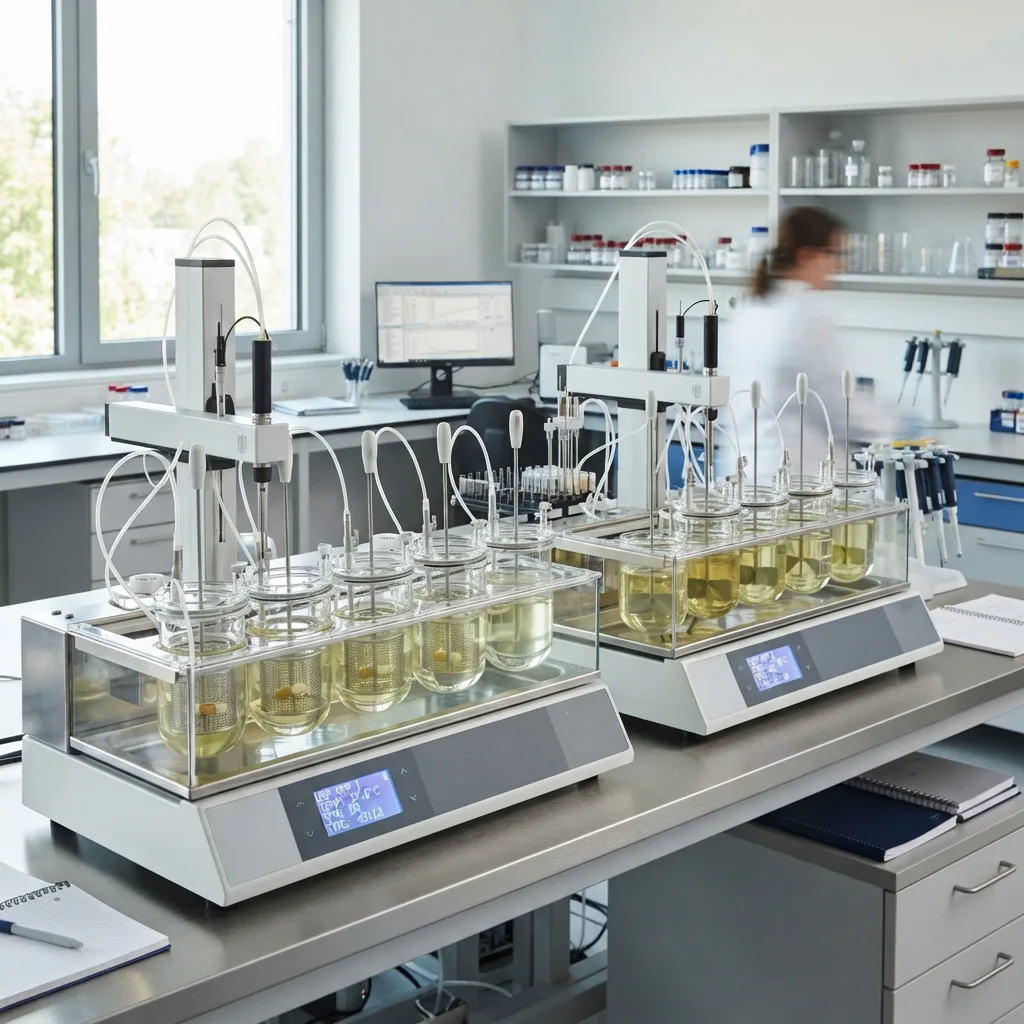
Inside a hemispherical glass dissolution vessel containing 900 milliliters of buffer rotating at a gentle 50 rpm, fluid dynamics are incredibly sensitive. If the stainless steel paddle shaft exhibits a tiny, almost invisible off-axis wobble of just 1.5 millimeters, it acts like an uncontrolled vortex generator.
This microscopic mechanical flaw creates severe hydrodynamic shear forces at the bottom of the vessel where the tablet rests. The fluid physically rips the boundary layer of dissolved drug away from the tablet surface much faster than natural diffusion would allow. The clinical result? A batch of medication that should have failed its 45-minute Q-value test artificially passes, simply because the machine agitated it too aggressively. When a regulatory inspector discovers this mechanical failure during a routine audit, the laboratory receives an immediate deficiency letter, and the pharmaceutical company faces a catastrophic batch recall.
A dissolution tester is not just a heated water bath with stirring motors. It is a highly calibrated hydrodynamic testbed.
For laboratory directors, Contract Research Organizations (CROs), and analytical instrument distributors, procuring a dissolution tester requires an intense focus on mechanical precision. This buyer’s guide deconstructs the critical hardware specifications that define a regulatory-grade dissolution tester, the evolution of vessel configurations, and the necessity of automated sampling robotics.
1. Mechanical Qualification (MQ) and ASTM E2503 Compliance
Historically, laboratories proved their dissolution testers were functioning properly by running chemical Performance Verification Tests (PVT) using USP Prednisone Reference Standard tablets. However, chemical tablets have their own manufacturing variances.
Today, global regulatory bodies (including the FDA) heavily emphasize Mechanical Qualification (MQ)—frequently guided by the ASTM E2503 standard. MQ relies on laser micrometers, digital tachometers, and digital levels to prove the physical perfection of the machine’s geometry before any drug is ever tested.
When evaluating an equipment tender, procurement officers must demand that the instrument is engineered to hold the following mechanical tolerances:
                  ASTM E2503 / USP MECHANICAL TOLERANCES
+-------------------------------------------------------------------------+
| 1. SHAFT WOBBLE (RUNOUT)                                                |
|    - Measured with a dial indicator at the top and bottom of the shaft. |
|    - Tolerance: Total indicated runout must not exceed 1.0 mm.          |
|    - High-end systems utilize monolithic cast frames to prevent flex.   |
|                                                                         |
| 2. VESSEL CENTERING                                                     |
|    - The paddle/basket shaft must be perfectly centered in the vessel.  |
|    - Tolerance: Within +/- 1.0 mm from the exact center axis.           |
|    - Achieved via self-centering vessel rings or precision-milled decks.|
|                                                                         |
| 3. SHAFT & VESSEL VERTICALITY (PLUMB)                                   |
|    - Neither the glass vessel nor the steel shaft can lean.             |
|    - Tolerance: Must be exactly 90 degrees (+/- 0.5 degrees) relative   |
|      to the horizontal vessel deck.                                     |
|                                                                         |
| 4. ROTATIONAL SPEED (RPM) & TEMPERATURE                                 |
|    - RPM Tolerance: +/- 4% of the target speed (e.g., 50 +/- 2 rpm).    |
|    - Water Bath Uniformity: 37.0 degrees Celsius (+/- 0.5 degrees)      |
|      across all vessels simultaneously without cold spots.              |
+-------------------------------------------------------------------------+
The Engineering of Vibration Isolation
Even if the shafts are perfectly straight, external vibrations can transfer through the laboratory bench, down the paddle shaft, and into the fluid. This “micro-vibration” artificially accelerates dissolution rates.
-
Premium dissolution testers decouple the heavy water bath circulation pump and the heater element from the main vessel deck.
-
By mounting the circulation pump on independent shock-absorbing bushings (or placing it externally), the tester ensures that the glass vessels remain completely isolated from mechanical motor hum.
2. Vessel Configurations: Sizing for Laboratory Throughput
The layout and quantity of the glass vessels dictate the daily throughput of the QC laboratory. Purchasing the wrong configuration leads to wasted bench space or constant testing bottlenecks.
| Configuration | Layout & Capacity | Primary Application & Advantages | Disadvantages |
| 6-Vessel System | 2 rows of 3, or 1 row of 6 | Basic academic training or small compounding pharmacies. Tests 6 tablets to satisfy USP Stage 1 (S1). | Obsolete for modern QC. Lacks dedicated vessels for the standard control or a blank media reference. |
| 8-Vessel System | 2 rows of 4 | The Modern QC Standard. Allows testing of 6 patient samples + 1 Reference Standard + 1 Blank/Media volume. | Larger physical footprint than 6-vessel units. |
| 12-Vessel / 14-Vessel System | 2 rows of 6, or 2 rows of 7 | High-Throughput / CRO Workhorse. Allows laboratories to run USP Stage 2 (S2) testing (12 tablets) in a single run. | Requires dual heavy-duty heater/circulator units to maintain 37.0 degrees across such a massive water bath volume. |
| Bathless Systems | Individual vessel heating jackets | Rapid heating (no 30-liter water bath to warm up). Extremely compact. | Direct contact heating jackets can sometimes create localized hot spots if not perfectly calibrated. |
The Value of the 8-Vessel Standard
In a modern analytical laboratory, inserting a sample into an HPLC or UV-Vis spectrophotometer requires comparing the unknown tablet against a known baseline. An 8-vessel dissolution tester provides the perfect geometry:
-
Vessels 1 through 6: Hold the pharmaceutical batch being tested.
-
Vessel 7: Holds the active pharmaceutical ingredient (API) Reference Standard.
-
Vessel 8: Holds pure dissolution media (the “Blank”) to zero the optical instruments. This configuration ensures that the standard and the blank are subjected to the exact same 37.0-degree temperature fluctuations and evaporation rates as the test tablets over the 45-minute run, maximizing analytical accuracy.
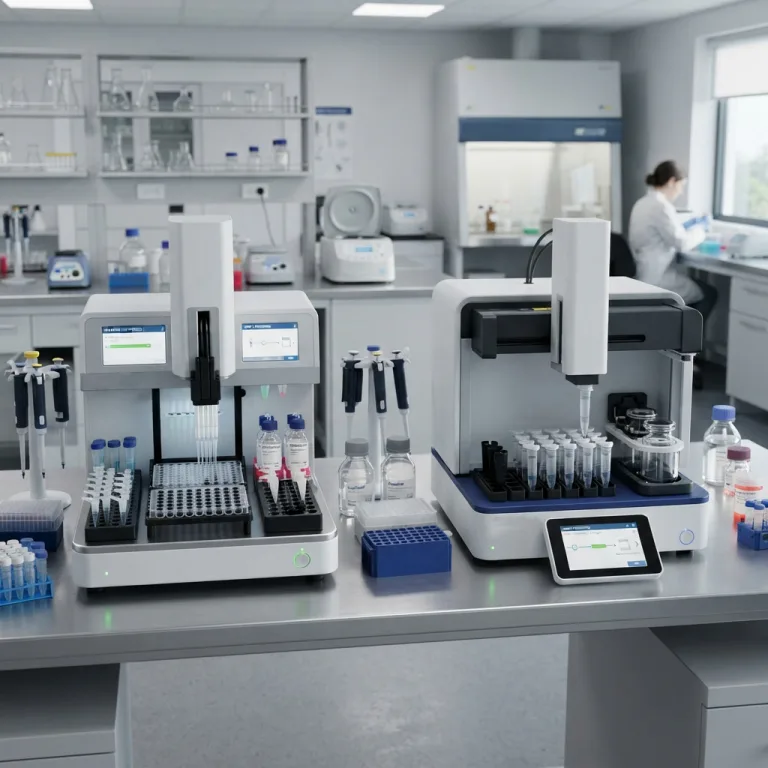
3. The Automation Imperative: Robotic Sampling Fluidics
If mechanical qualification ensures the fluid dynamics are perfect, Automated Sampling ensures the analytical chemistry is perfect.
In a manual dissolution test, an operator holds a glass syringe attached to a long metal cannula. At exactly the 15-minute mark, they must insert the cannula into all six vessels, draw exactly 10 milliliters of fluid, push that fluid through a 0.45-micrometer filter into a glass vial, and then pipette exactly 10 milliliters of fresh, heated media back into the vessels to maintain the volume. Doing this perfectly for 6 vessels simultaneously is biologically impossible for a single human. The time delay between sampling Vessel 1 and Vessel 6 means Vessel 6 actually had 15 minutes and 45 seconds to dissolve.
Automated syringe sampling stations completely eliminate human timing variance and spatial sampling errors.
                  THE USP SAMPLING ZONE REQUIREMENT
+-------------------------------------------------------------------------+
| [ Media Surface Level ]                                                 |
|          |                                                              |
|          v (Midway point)  <--- Motorized cannulas must drop to this    |
| [ EXACT USP SAMPLING ZONE ]     exact depth, while staying at least     |
|          ^                      1.0 cm away from the glass vessel wall. |
|          |                                                              |
| [ Top of the Paddle/Basket ]                                            |
|                                                                         |
| *Automated manifolds drop all 6 or 8 cannulas into this exact coordinate|
| simultaneously, hold for 5 seconds to draw, and immediately retract to  |
| avoid disturbing the fluid dynamics during the rest of the test.*       |
+-------------------------------------------------------------------------+
Core Features of an Automated Sampling Workstation
When evaluating an automated sampling add-on, buyers must inspect the fluidic architecture:
-
Programmable Syringe Pumps: High-precision Teflon or ceramic syringe pumps that can draw aliquots ranging from 1.0 mL to 25.0 mL with volumetric accuracy exceeding 99%.
-
Motorized Drop Manifolds: The sampling cannulas must not remain inside the vessel during the entire test (as they act as baffles, altering the vortex). The automated manifold drops the cannulas into the fluid only at the programmed time points, draws the sample, and immediately retracts.
-
Inline Micro-Filtration: As fluid is drawn out of the vessel, it contains undissolved tablet granules. If these granules are not immediately filtered, they will continue to dissolve inside the sample vial, artificially raising the final result. Automated systems force the fluid through inline 0.45-micrometer or 0.22-micrometer membrane filters before dispensing.
-
Automated Media Replacement: To maintain “sink conditions” and comply with USP volume requirements, the robotic pump automatically draws fresh, pre-heated media from a reserve tank and injects it back into the vessels to replace the exact volume that was removed for testing.
4. Analytical Hyphenation: Online vs. Offline Integration
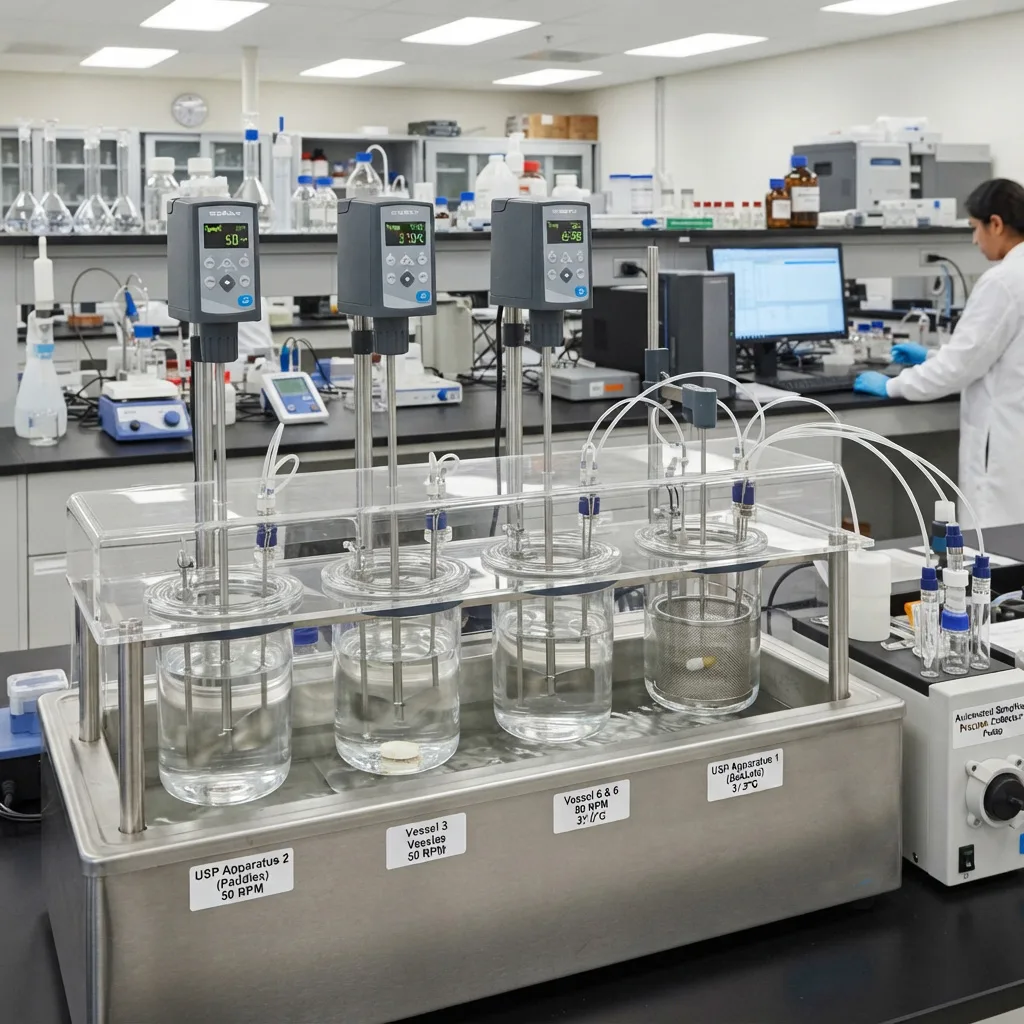
Once the automated sampler draws the fluid, where does it go? Laboratories must choose between Offline, Online, or On/Offline hyphenated architectures.
A. Offline Systems (The Versatile Standard)
The syringe pump dispenses the filtered samples directly into standard HPLC glass vials or test tubes housed in a motorized fraction collector rack.
-
Advantage: Highly flexible. The technician can take the tray of vials to any Liquid Chromatography (HPLC / UPLC) system in the laboratory. Ideal for complex formulations or low-dose drugs that require chromatographic separation.
B. Online UV-Vis Systems (The High-Speed Approach)
The syringe pump drives the filtered fluid through a closed-loop Teflon tube directly into the flow cells of a multi-cell UV-Vis Spectrophotometer. The spectrometer reads the absorbance instantly, and the fluid is either pumped into a waste line or pushed back into the dissolution vessel.
-
Advantage: Instantaneous data. The QC manager can watch the dissolution release curve plot in real-time on the computer monitor. Ideal for immediate-release formulations with a single active ingredient that absorbs UV light cleanly without excipient interference.
C. On/Offline (The Hybrid Solution)
The ultimate R&D configuration. The fluid is routed through the UV-Vis flow cells for real-time monitoring, but the system also deposits a physical backup aliquot into a fraction collector vial. If the UV-Vis data looks erratic due to excipient cloudiness, the backup vials are ready for HPLC injection.
Frequently Asked Questions (FAQ)
Q1: Why do dissolution testers use amber glass vessels instead of clear glass?
While standard clear borosilicate glass is used for 90% of routine testing, amber glass vessels (which block ultraviolet and short-wavelength visible light) are mandatory when testing light-sensitive APIs (such as nifedipine or certain vitamins). Without amber vessels, the bright fluorescent lighting of the laboratory would cause the dissolved drug molecules to undergo photo-degradation during a 12-hour or 24-hour extended-release test, yielding a false-low chemical analysis.
Q2: How often must a laboratory perform Mechanical Qualification (MQ) on a dissolution tester?
In a strictly regulated GMP pharmaceutical environment, full Mechanical Qualification—checking wobble, centering, verticality, and temperature across all positions—is typically performed every 6 months. Additionally, MQ must be repeated immediately if the machine is physically moved to a different laboratory bench, or if the drive head undergoes mechanical maintenance.
Q3: What is “coning” in a dissolution vessel, and why is it a problem?
Coning is an adverse hydrodynamic phenomenon that occurs during Apparatus 2 (Paddle) testing, particularly with formulations that contain large amounts of heavy, insoluble excipients (like dicalcium phosphate). As the paddle rotates, centrifugal forces sweep the insoluble powder into a dense, cone-shaped mound directly under the center of the paddle. The active drug molecules get trapped inside this dead-zone cone, unable to dissolve into the bulk fluid. If coning occurs, the laboratory must often petition regulatory agencies to increase paddle speed to 75 rpm or switch to Apparatus 1.
Q4: Can a single dissolution tester run two different methods at the same time?
Standard single-drive dissolution testers rotate all 6 or 8 shafts using a single drive belt and motor; therefore, every vessel must run at the exact same RPM and temperature. However, premium Dual-Drive 12-vessel systems feature two independent motors (one controlling vessels 1-6, the other controlling vessels 7-12). This allows R&D scientists to test a new drug formulation at 50 rpm on the left side while simultaneously testing it at 75 rpm on the right side, cutting method development time in half.
Q5: Is cleaning the dissolution tester a fully automated process?
While fluid lines and syringe pumps feature automated “Wash Cycles” that aggressively flush the internal Teflon tubing with hot water and methanol to prevent cross-contamination, the large glass vessels and paddle shafts must still be manually removed, washed, and dried by laboratory personnel between test batches.
Summary
A pharmaceutical dissolution tester is the ultimate convergence of strict mechanical engineering and analytical chemistry. By prioritizing ASTM E2503 Mechanical Qualification (shaft wobble, centering, and verticality), optimizing throughput with 8-vessel or 12-vessel configurations, and eliminating human error through Automated Syringe Sampling Workstations, pharmaceutical QC laboratories protect themselves from catastrophic regulatory audit failures. Ensuring that the hardware performs flawlessly guarantees that the final dissolution data represents the true clinical behavior of the drug, not a mechanical artifact of the machine.