The Complete Closed Loop: From Pill Compression to Patient Recovery
The lifecycle of an innovative antibiotic or a generic diabetic medication requires passing through two distinct, yet deeply interconnected, scientific domains before it can be deemed successful.
Before a drug ever enters the human body, it must survive the mechanical violence of the pharmaceutical manufacturing press and the simulated gastrointestinal environment of the laboratory. It must be physically hard enough to withstand global shipping, yet chemically formulated to dissolve at a precise, predictable rate.
However, perfect physical chemistry is meaningless if the drug fails to trigger a physiological response in the patient. Once swallowed, the focus shifts entirely from the drug’s physical properties to the patient’s biological response. The clinician must monitor whether the patient’s acute inflammation is subsiding, whether their long-term blood glucose is stabilizing, or whether their kidneys are experiencing adverse toxicity.
For decades, the equipment used for drug physical testing (Pharmacopeia QC) and patient biological testing (Clinical IVD) were treated as isolated silos. Today, modern healthcare infrastructure—driven by Contract Research Organizations (CROs), integrated university hospitals, and international B2B medical distributors—is tearing down these walls.
By integrating Tablet Hardness Testers, Dissolution Testers, and Specific Protein Analyzers into unified procurement strategies, the medical industry establishes a seamless bridge between pharmacokinetics (what the body does to the drug) and pharmacodynamics (what the drug does to the body).
1. The CRO and Bioequivalence (BE) Ecosystem
Contract Research Organizations (CROs) are the scientific engines behind global pharmaceutical development. When a pharmaceutical company develops a new generic drug, they must prove to regulatory bodies (like the FDA or EMA) that their generic version is therapeutically equivalent to the expensive brand-name original. This is known as a Bioequivalence (BE) study.
A bioequivalence trial is the ultimate intersection of analytical chemistry and clinical diagnostics. It requires the CRO to operate two highly synchronized laboratory divisions.
               THE BIOEQUIVALENCE (BE) TESTING ECOSYSTEM
+-------------------------------------------------------------------------+
| STEP 1: THE IN-VITRO PHARMACEUTICAL QC LAB                              |
| - Hardness Tester: Verifies generic tablet breaking force matches brand.|
| - Dissolution Tester: Runs USP 711 multi-point release curves (f2       |
|   similarity factor) to prove the generic dissolves at the exact same   |
|   speed as the original innovator drug in pH 1.2, 4.5, and 6.8 media.   |
|                                                                         |
| STEP 2: THE IN-VIVO CLINICAL DIAGNOSTICS LAB                            |
| - Healthy volunteers ingest the validated generic formulation.          |
| - Specific Protein Analyzer: Continuously monitors patient safety       |
|   biomarkers (e.g., Cystatin C for renal clearance, high-sensitivity    |
|   CRP for unexpected immune reactions, and Immunoglobulins).            |
|                                                                         |
| OUTCOME: In-Vitro In-Vivo Correlation (IVIVC)                           |
| - Proves that laboratory dissolution perfectly predicts human blood     |
|   absorption and therapeutic safety.                                    |
+-------------------------------------------------------------------------+
The Role of Specific Protein Analyzers in Clinical Trials
During Phase I through Phase III clinical trials, establishing the safety profile of a novel API is paramount.
-
Monitoring Drug-Induced Toxicity: Nephrotoxicity is a common reason experimental drugs fail clinical trials. By utilizing a specific protein analyzer to measure Serum Cystatin C and Urinary Microalbumin (mALB), clinical investigators can detect microscopic glomerular filtration drops days before traditional serum creatinine levels become abnormal.
-
Efficacy Benchmarking: If a CRO is running a trial for a new Rheumatoid Arthritis biologic or a novel diabetic therapeutic, the specific protein analyzer provides the primary endpoints for success by measuring the exact quantitative drop in Rheumatoid Factor (RF), Anti-CCP, or Glycated Hemoglobin (HbA1c) over the 12-week trial period.
2. Integrated University Hospitals and Regional Medical Centers
In large-scale public healthcare tenders, the end-user is frequently a massive regional medical center or a university teaching hospital. These mega-facilities do not just diagnose patients; they conduct academic research, mix custom intravenous drugs, and compound specialized oral dosages.
The Department of Pharmacy & Hospital Formulation
Many advanced hospitals operate their own internal compounding pharmacies and formulation laboratories. They produce specialized dosages that are not commercially available—such as ultra-low-dose pediatric cardiovascular tablets, customized sustained-release psychiatric medications, or localized clinical trial batches.
-
Because these compounded drugs are administered directly to critical-care patients, the hospital pharmacy must adhere to Good Manufacturing Practice (GMP) standards.
-
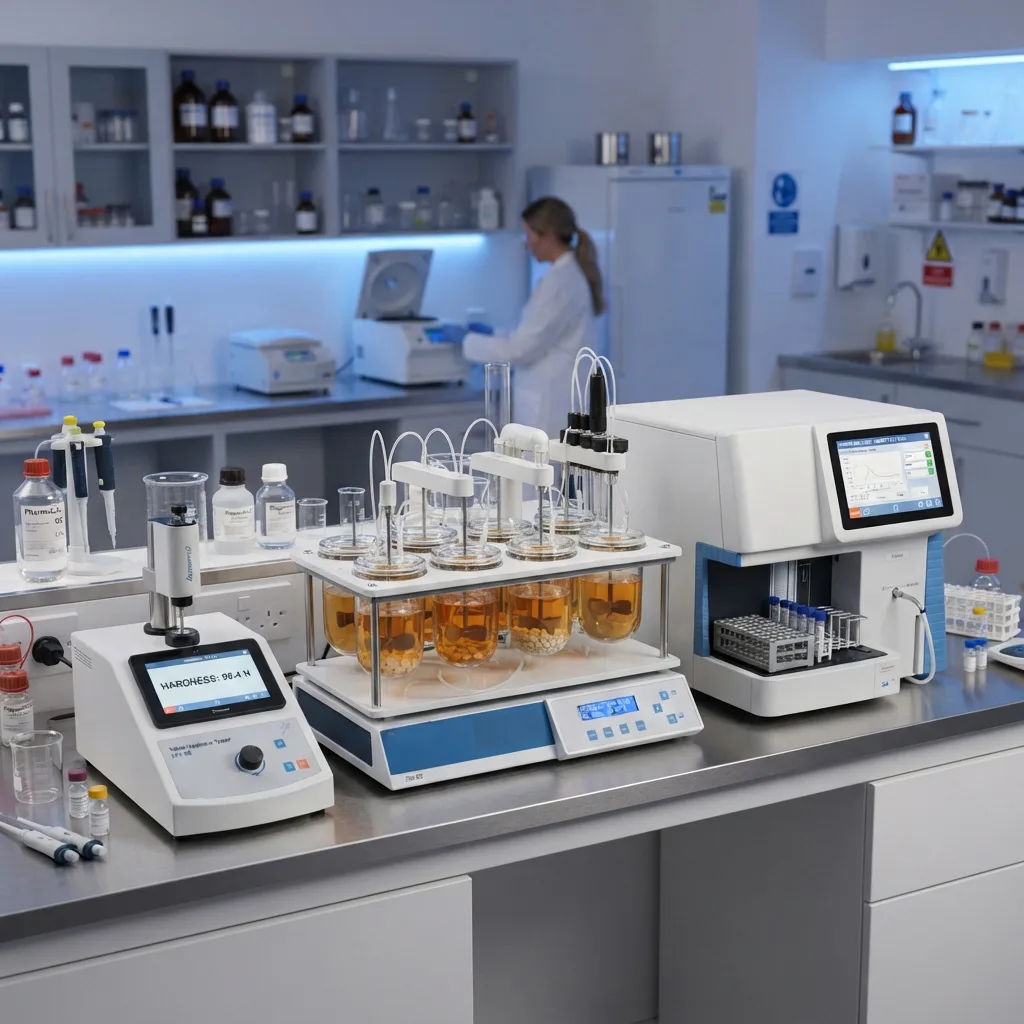
The pharmacy relies on Tablet Hardness Testers to ensure their custom pills will not shatter during unit-dose repackaging, and Dissolution Testers to verify that their custom sustained-release matrices will not dump the entire drug dose into a pediatric patient’s stomach at once.
The Central Clinical Laboratory
A few floors below the pharmacy, the hospital’s core clinical laboratory processes thousands of patient samples an hour.
-
The laboratory relies on high-throughput Specific Protein Analyzers (equipped with cap-piercing whole blood robotics and latex-enhanced nephelometry) to triage emergency room patients.
-
They quantify C-Reactive Protein (CRP) and Serum Amyloid A (SAA) to direct emergency antibiotic stewardship, and measure Procalcitonin (PCT) to manage septic shock in the Intensive Care Unit.
When a hospital purchasing committee issues a public tender for “Laboratory and Diagnostic Equipment,” they are actively seeking vendors capable of outfitting both the pharmacy’s physical QC requirements and the central laboratory’s IVD diagnostic needs simultaneously.
3. Unifying Quality Management: Data Integrity Across Disciplines
Whether an instrument is crushing a tablet in a pharmaceutical plant or measuring antibodies in a patient’s blood serum, the global regulatory requirements for laboratory software have converged.
The FDA, EMA, and international accreditation bodies (such as ISO 15189 for medical laboratories and ISO 17025 for testing laboratories) mandate absolute data traceability. By procuring pharmaceutical QC devices and clinical diagnostic analyzers that share modern software architectures, institutions simplify their IT validation processes.
The ALCOA+ Standard and FDA 21 CFR Part 11
Both a dissolution tester capturing 45-minute Q-values and a specific protein analyzer generating HbA1c patient reports must comply with the ALCOA+ principles (Attributable, Legible, Contemporaneous, Original, and Accurate) governed by FDA 21 CFR Part 11.
-
No Manual Transcription: The multi-parameter hardness tester must transmit weight, thickness, and breaking force directly to the Laboratory Information Management System (LIMS). The specific protein analyzer must use bidirectional HL7/ASTM protocols to pull patient orders via barcode and push results directly to the Electronic Health Record (EHR).
-
Multi-Level Security & Audit Trails: Both systems require hierarchical passwords. If a pharmaceutical QA manager alters a dissolution method RPM, or if a clinical biochemist recalibrates a CRP master curve, the unalterable electronic audit trail must record the exact timestamp, the operator ID, and the justification for the change.
-
Electronic Signatures: Both systems must generate secure, encrypted PDF batch reports that operators and supervisors can digitally sign, permanently linking the human reviewer to the verified data output.
By ensuring that all laboratory instruments—from physical QC to liquid IVD—meet the exact same cybersecurity and data integrity benchmarks, hospital IT departments eliminate integration vulnerabilities.
4. The Single-Source B2B Consolidation Strategy
For international medical equipment distributors, system integrators, and import firms, building a fragmented catalog from dozens of different single-product manufacturers is a logistical nightmare.
When bidding on a massive Ministry of Health (MOH) tender to equip a newly built national hospital network, the tender will list hundreds of required items—ranging from operating room lights to dissolution baths to automated immunoassay analyzers.
Distributors who consolidate their procurement through a single, vertically integrated manufacturer gain a massive competitive and financial advantage:
| Logistical Hurdle | Fragmented Multi-Brand Sourcing | Single-Source Consolidation |
| Shipping & Freight | Paying multiple LCL (Less than Container Load) fees across different factories, increasing customs clearance delays. | Combining IVD and Pharma QC equipment into a single FCL (Full Container Load), slashing international freight costs. |
| Biomedical Training | Engineers must travel to different brands to learn different hardware components and software languages. | Engineers learn a unified operating logic, sharing optical, fluidic, and mechanical troubleshooting principles. |
| Regulatory Registration | Enduring the sluggish Ministry of Health registration process for five different factory CE/ISO certificates. | Submitting a single factory’s ISO 13485 and CE dossier for the entire equipment fleet. |
| Spare Parts Inventory | Tying up working capital in disparate proprietary load cells, stepper motors, and syringe pumps. | Streamlining spare parts. A shared manufacturer often standardizes internal robotics and fluidic valves across product lines. |
5. Bridging the Gap with UMY Medical
To successfully implement a consolidated laboratory strategy, healthcare institutions and B2B distributors require an original equipment manufacturer (OEM) that possesses both the deep engineering expertise to build rigorous physical pharmacopeia instruments and the biological precision to develop sensitive clinical immunochemistry platforms.
广州优迈医疗器械有限公司 (UMY Medical Equipment Co., Ltd.) is a globally recognized manufacturer bridging the gap between pharmaceutical quality control and in-vitro diagnostics.
Plaintext
                  THE UMY MEDICAL CONSOLIDATED ECOSYSTEM
                                     |
     +-------------------------------+-------------------------------+
     |                               |                               |
     v                               v                               v
[ CLINICAL IVD DIAGNOSTICS ]    [ PHARMACEUTICAL QC LAB ]       [ MEDICAL INFRASTRUCTURE ]
- Specific Protein Analyzers    - Automated Hardness Testers    - Surgical Operating Lights
- Urine & Fecal Workstations    - USP 711 Dissolution Testers   - Medical Headlights
- CASA Sperm Analyzers          - Disintegration & Friability   - Medical Imaging Solutions
The Direct Factory Advantage:
-
Uncompromising Engineering: From the precision ASTM E2503 mechanical tolerances (sub-millimeter shaft wobble) in their dissolution testers, to the high-sensitivity latex-enhanced nephelometric optics in their protein analyzers, every UMY Medical instrument is built for ultimate precision and maximum uptime.
-
Global Quality Certification: UMY Medical operates under strict ISO 13485 medical quality management systems. All equipment is fully CE certified, guaranteeing smooth regulatory registration for distributors in Asia, Africa, the Middle East, Europe, and the Americas.
-
Turnkey B2B Support & OEM/ODM: Beyond standard distribution, UMY Medical provides deep technical training, white-label private branding options, and long-term spare parts security to help international distributors win complex hospital and MOH tenders.
-
Wholesale Capital Efficiency: By manufacturing both advanced pharmaceutical analytical instruments and clinical diagnostic analyzers in-house, UMY Medical completely eliminates third-party trading markups. Distributors access direct factory wholesale pricing, maximizing profit margins and drastically lowering the 5-year Total Cost of Ownership (TCO) for end-user hospitals.
To explore technical data sheets, request comprehensive laboratory layout solutions, or secure wholesale pricing for your upcoming hospital tender, visit the official website at https://www.umymedical.com/.
Frequently Asked Questions (FAQ)
Q1: Can a specific protein analyzer be used in a pharmaceutical laboratory?
Yes. During the preclinical and clinical phases of drug development (such as testing a new anti-inflammatory drug), pharmaceutical laboratories and CROs use specific protein analyzers to measure inflammatory cytokines, CRP, and immunoglobulins in animal models and human trial participants to establish pharmacokinetic and pharmacodynamic profiles.
Q2: Why is the transition to automated 4-in-1 tablet hardness testing so important for CROs?
In Bioequivalence studies, documentation is constantly scrutinized by regulatory auditors. If an auditor finds manual corrections or missing weigh-slips for the generic tablets used in the dissolution test, the entire million-dollar clinical trial can be invalidated. Automated 4-in-1 hardness testers generate a secure, 21 CFR Part 11 compliant digital report that physically guarantees the weight, thickness, diameter, and breaking force of every tested pill without human transcription error.
Q3: How do dissolution testers simulate the human digestive tract?
The human stomach is highly acidic (around pH 1.2), while the small intestine is neutral to alkaline (pH 6.8). Dissolution testers use highly accurate water baths to maintain a constant 37.0 degrees Celsius. To test enteric-coated tablets, the laboratory fills the glass vessel with 0.1 N Hydrochloric Acid for the first two hours (simulating the stomach), and then automatically raises the pH using a buffer to simulate the drug’s entry into the intestines, observing exactly when and how fast the active ingredient is released.
Q4: Are the spare parts for pharmaceutical QC machines and clinical IVD machines cross-compatible?
While a load cell from a hardness tester cannot be used in a protein analyzer, partnering with a unified manufacturer like UMY Medical means that the underlying technological architecture (such as the touchscreen operating systems, internal stepper motor brands, fluidic syringe pumps, and LIS data output protocols) is highly standardized. This allows a single hospital biomedical engineer to easily learn, maintain, and troubleshoot the entire fleet of equipment.
Q5: What is the most critical factor when an international distributor is selecting a manufacturing partner for a major tender?
The most critical factor is the manufacturer’s ability to provide a complete, compliant dossier. Government tenders require meticulous documentation: ISO 13485 certificates, CE Declarations of Conformity, detailed technical compliance matrices, and letters of authorization. Partnering directly with an established, certified factory ensures that the distributor receives these documents instantly and accurately, eliminating the fatal delays often caused by third-party trading intermediaries.