The Thousand-Hour Bulb Disaster: Why Time Is Not Energy
In many budget-conscious research laboratories, technicians often attempt to fix DNA to nylon membranes using a rudimentary UV lightbox controlled by a simple kitchen timer. They calculate that 30 seconds of exposure works perfectly on day one. A year later, they follow the exact same 30-second protocol, but their Southern blot experiments suddenly begin failing. The DNA simply washes off the membrane during hybridization.
What happened? The laboratory fell victim to UV bulb decay.
Every low-pressure mercury vapor UV tube undergoes solarization and phosphor degradation. After roughly 1,000 to 1,500 hours of operation, a 254 nm bulb will lose up to 50% of its original optical output intensity. If a laboratory operates a crosslinker using only a “Time Mode” (exposing the sample for exactly 30 seconds regardless of bulb health), the actual photonic energy delivered to the DNA drops every single month.
To prevent catastrophic sample loss and ensure perfect experimental repeatability across years of operation, a professional UV crosslinker must divorce itself from relying on time. It must measure actual photonic energy.
For core facility managers, procurement officers, and B2B scientific equipment distributors, understanding the internal sensor architecture and chamber geometry of a UV crosslinker is the only way to evaluate competitive tenders.
1. The Core Procurement Mandate: Microprocessor Energy Sensors
The single most important component inside a scientific UV crosslinker is not the light bulb; it is the UV Photo-Detector Sensor.
Premium crosslinkers feature a closed-loop microprocessor system operating in Energy Mode (measured in Joules or microJoules per square centimeter).
How Energy Mode Guarantees Repeatability
The physical formula for delivered light energy is:
Energy = Intensity x Time
When a technician programs the crosslinker for the standard DNA fixation dose of 120,000 microJoules/cm2, the internal microprocessor does not blindly turn on a timer.
-
The bulbs ignite.
-
The internal UV sensor continuously monitors the exact intensity of the light bouncing around the chamber (e.g., measuring 4.0 milliWatts/cm2).
-
The microprocessor actively calculates the accumulating Joules in real-time.
-
As soon as the total energy hits exactly 120,000 microJoules/cm2, the microprocessor cuts the power.
If the bulbs are brand new, the machine might run for 25 seconds. If the bulbs are two years old, the machine will automatically keep the lights on for 55 seconds. The technician does not need to know the age of the bulbs; the sensor ensures the biological sample receives the exact same dose of covalent bonding energy every single time.
2. Chamber Geometry and Spatial Uniformity
In a high-throughput genomic laboratory, technicians frequently process large 20 cm x 20 cm nylon membranes, or place multiple small Petri dishes into the chamber simultaneously.
If the UV light is brighter in the center of the chamber and dimmer in the corners, the samples will suffer from the edge effect. DNA in the center might become over-crosslinked (destroying the target sequences), while DNA in the corners remains under-crosslinked (washing away during processing).
The Importance of Polished Stainless Steel
When evaluating a UV crosslinker, buyers must inspect the material lining the internal chamber.
-
Aluminum or Plastic Interiors: Inexpensive units use brushed aluminum or coated plastics. These materials absorb a high percentage of UV-C light or scatter it poorly, creating dark spots in the corners of the chamber.
-
Polished Stainless Steel (The Standard): High-end systems utilize mirror-polished stainless steel for the floor, ceiling, and all four walls. Stainless steel acts as a highly efficient UV reflector. By bouncing the 254 nm waves endlessly around the enclosed cavity, the system bathes the sample in a uniform, omnidirectional UV field.
Bulb Layout and Wattage
The spatial arrangement of the bulbs also dictates uniformity. A standard clinical crosslinker typically utilizes five or six 8-watt UV tubes arranged parallel to each other across the ceiling of the chamber. This distributed 40-watt or 48-watt array provides overlapping fields of illumination, ensuring that the footprint of the standard testing area varies by less than +/- 5% in total energy delivery, regardless of where the sample is placed on the floor.
3. Operational Versatility: Wavelength Interchangeability
While 254 nm (UV-C) is the absolute gold standard for crosslinking DNA to nylon membranes and decontaminating PCR workstations, molecular biology laboratories frequently require other UV wavelengths for different protocols.
Procurement officers can maximize their laboratory budget by purchasing a single crosslinker mainframe that supports interchangeable bulb wavelengths.
| UV Wavelength | Spectrum Category | Primary Laboratory Applications |
| 254 nm | UV-C (Shortwave) | Southern/Northern blot DNA/RNA fixation. PCR decontamination. Bacterial mutagenesis. |
| 312 nm / 302 nm | UV-B (Midwave) | Visualizing ethidium bromide-stained DNA on agarose gels without causing severe photon-induced DNA strand breakage (ideal if the DNA needs to be extracted and cloned). |
| 365 nm | UV-A (Longwave) | UV curing of adhesives, photopolymerization of hydrogels, and non-destructive fluorescence excitation. |
Premium crosslinkers are designed with modular bulb sockets and smart ballasts. If a laboratory shifts its research focus from genomics to photopolymer chemistry, the technician can simply pull out the 254 nm bulbs, snap in 365 nm bulbs, and recalibrate the microprocessor, effectively getting two machines for the price of one.
4. Hardware Safety Specifications (Occupational Health)
Ultraviolet light at 254 nm is profoundly hazardous. It does not just crosslink DNA on a nylon membrane; it will actively crosslink the DNA inside the cells of a technician’s retina and skin, causing severe photokeratitis (corneal burns) and erythema.
Because UV-C is invisible to the human eye, technicians cannot rely on visual cues to know if they are being irradiated. A compliant laboratory crosslinker must feature two non-negotiable safety hardware mechanisms:
-
UV-Blocking Viewing Window: The front door of the machine must include a viewport that is physically impregnated with UV-blocking compounds. This allows the technician to look inside and verify that the bulbs are ignited (which appear as a faint blue/purple visible glow from the argon gas inside the tube) without allowing any harmful 254 nm radiation to escape into the room.
-
Instant Magnetic Safety Interlock: If an operator accidentally pulls the door open before the exposure cycle finishes, a magnetic reed switch or mechanical interlock must cut power to the electronic ballasts in a fraction of a millisecond. The UV light must be entirely extinguished before the door opens wide enough to expose the operator’s hands or eyes.
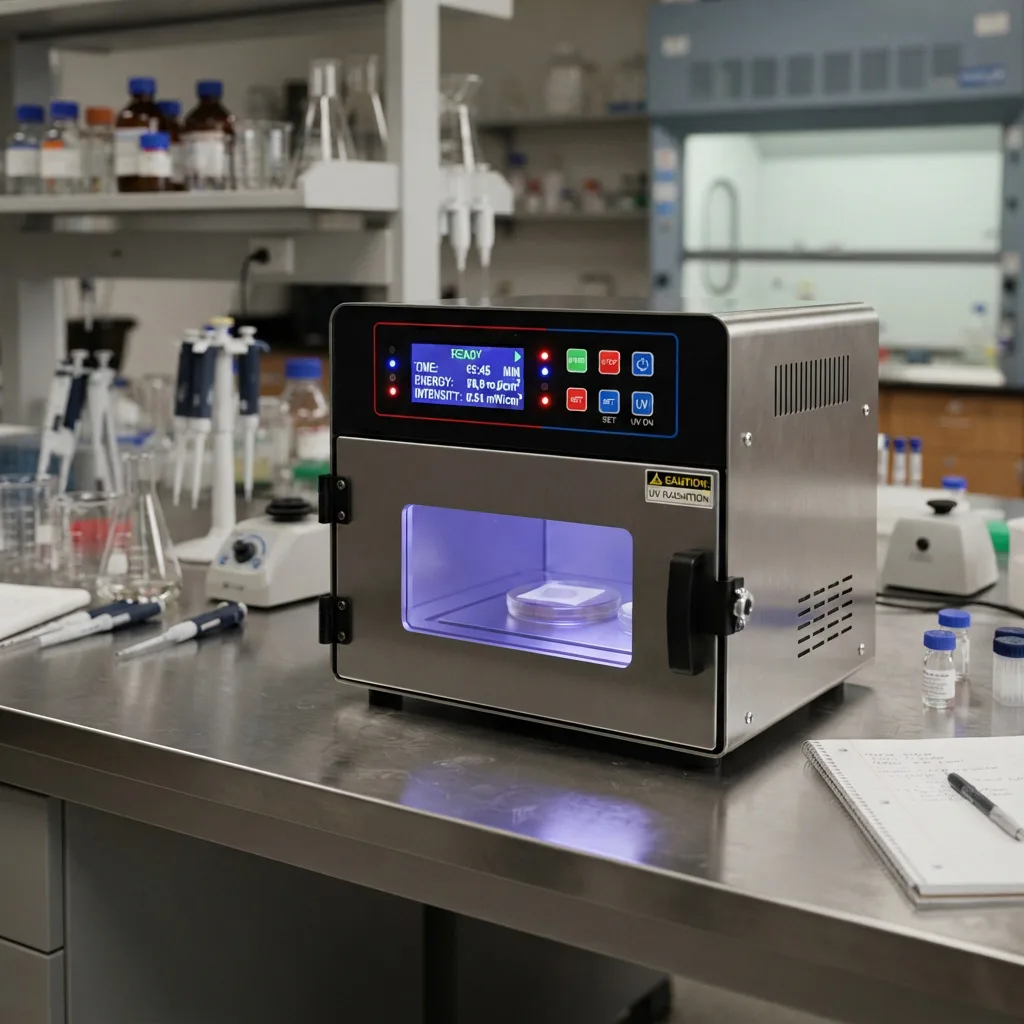
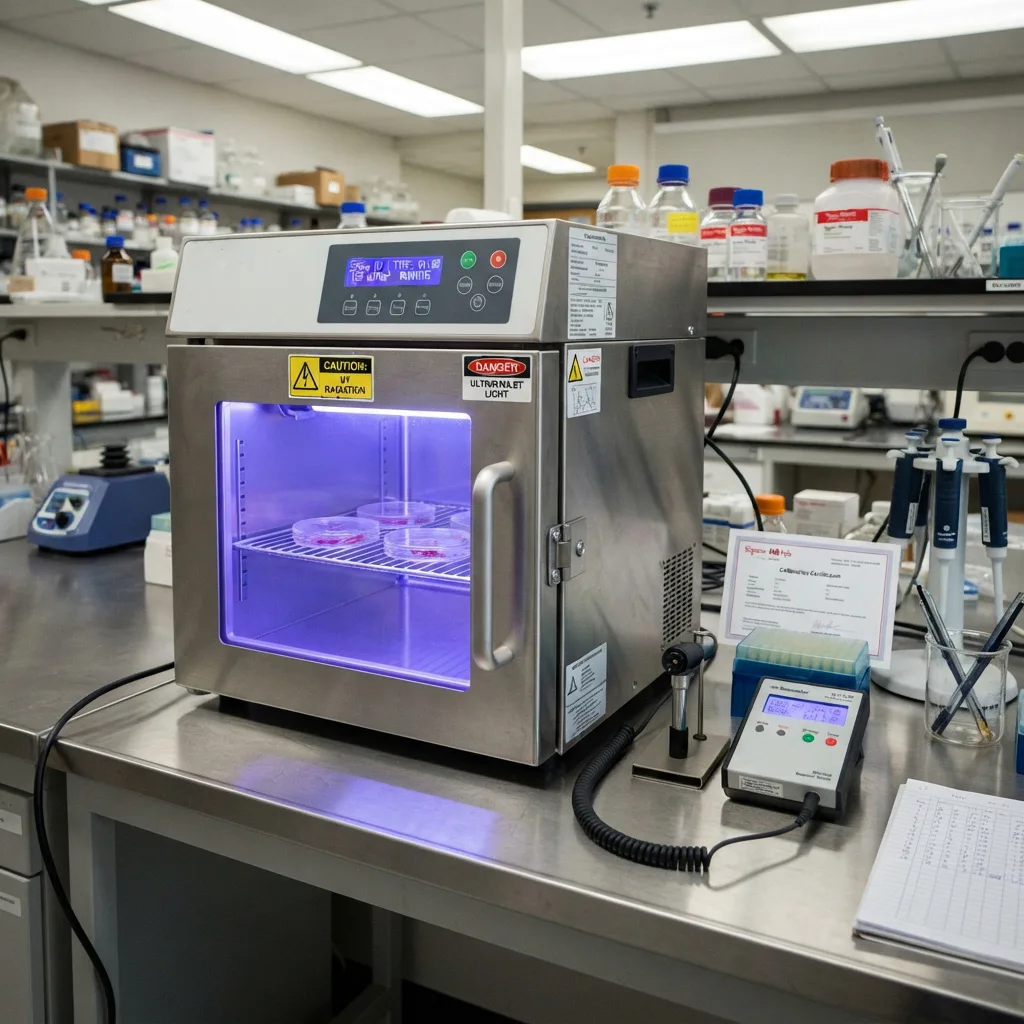
A stainless steel UV crosslinking device actively irradiating biological samples in petri dishes, featuring a clear digital control panel for precise energy and time settings.
5. Calibration and Maintenance
Even the highest quality microprocessor sensor will drift over years of use. To satisfy Good Laboratory Practice (GLP) and ISO audits, the crosslinker must be able to be recalibrated.
When drafting a procurement tender, verify the calibration protocol:
-
Does the manufacturer offer a secondary, NIST-traceable external UV radiometer?
-
Can the laboratory’s metrology technician place this calibrated radiometer inside the chamber, run a test cycle, and use a hidden menu on the crosslinker’s keypad to adjust the internal sensor’s baseline to perfectly match the certified external reading?
Without the ability to recalibrate the internal photo-detector, the entire machine becomes obsolete the moment the sensor drifts out of specification.
6. The B2B Sourcing Strategy
For regional laboratory equipment distributors, university procurement departments, and Contract Research Organizations (CROs), sourcing high-quality molecular biology equipment requires finding reliable manufacturers who understand precise optical engineering.
广州优迈医疗器械有限公司 (UMY Medical Equipment Co., Ltd.) is a highly certified manufacturer of clinical and laboratory analytical equipment. By engineering UV crosslinkers with precision microprocessor energy sensors, highly reflective stainless steel chambers, and strict safety interlocks, UMY Medical ensures that genomic laboratories can achieve perfect nucleic acid fixation shift after shift. Furthermore, by supplying equipment directly from the factory, UMY Medical allows international B2B distributors to access wholesale pricing, complete ISO compliance documentation, and long-term spare bulb supply chains without third-party trading markups. (To review hardware specifications and request tender quotations, visit the official website at https://www.umymedical.com/).
Frequently Asked Questions (FAQ)
Q1: Can I use a UV crosslinker to sterilize N95 masks or laboratory tools?
Yes, but with limitations. The 254 nm UV-C light produced by a crosslinker is highly germicidal and will destroy the DNA/RNA of bacteria and viruses (including SARS-CoV-2) on smooth, directly exposed surfaces. However, UV light has zero penetration depth. It will not sterilize the internal layers of a porous N95 mask or the shadowed underside of a pair of forceps. It is excellent for surface decontamination of glass slides or PCR plates, but it does not replace a steam autoclave.
Q2: How often do the 254 nm UV bulbs need to be replaced?
Most standard low-pressure mercury UV bulbs have a rated operational lifespan of 1,000 to 2,000 hours before their intensity drops significantly. If the crosslinker is equipped with an “Energy Mode” microprocessor, it will automatically compensate for this decay by extending the exposure time. However, once the exposure time becomes frustratingly long for the laboratory workflow (e.g., a standard 25-second protocol now takes 2 minutes), it is time to replace the bulbs.
Q3: Do UV bulbs require a warm-up period before testing?
Unlike older fluorescent technology, modern high-frequency electronic ballasts ignite UV bulbs almost instantly. However, for maximum absolute precision in quantitative applications, some metrology protocols recommend allowing the bulbs to run for 1 to 2 minutes to reach thermal equilibrium and stable mercury vapor pressure before conducting critical calibration tests.
Q4: Why is my crosslinker generating a distinct “burning” or “metallic” smell?
The 254 nm UV-C wavelength is energetic enough to interact with oxygen in the air inside the chamber, splitting it to form trace amounts of Ozone. Ozone has a very distinct, sharp, metallic, or bleach-like odor. While low levels of ozone are normal during operation, crosslinkers should always be operated in a well-ventilated laboratory environment to prevent buildup.
Q5: Can a UV crosslinker dry out my agarose gel?
Yes. If you are using a crosslinker equipped with 312 nm bulbs to visualize DNA inside a thick agarose gel for an extended period, the heat generated by the bulbs and the enclosed nature of the chamber can begin to dehydrate and shrink the gel. If prolonged visualization or gel cutting is required, an open-face UV transilluminator is generally preferred over an enclosed crosslinker box.
Purchasing a UV crosslinker for a molecular biology laboratory should never be an afterthought. By ignoring cheap timer-based light boxes and mandating microprocessor-controlled energy sensors, stainless steel uniformity, and instant safety interlocks, procurement teams guarantee the integrity of their facility’s genomic research.