
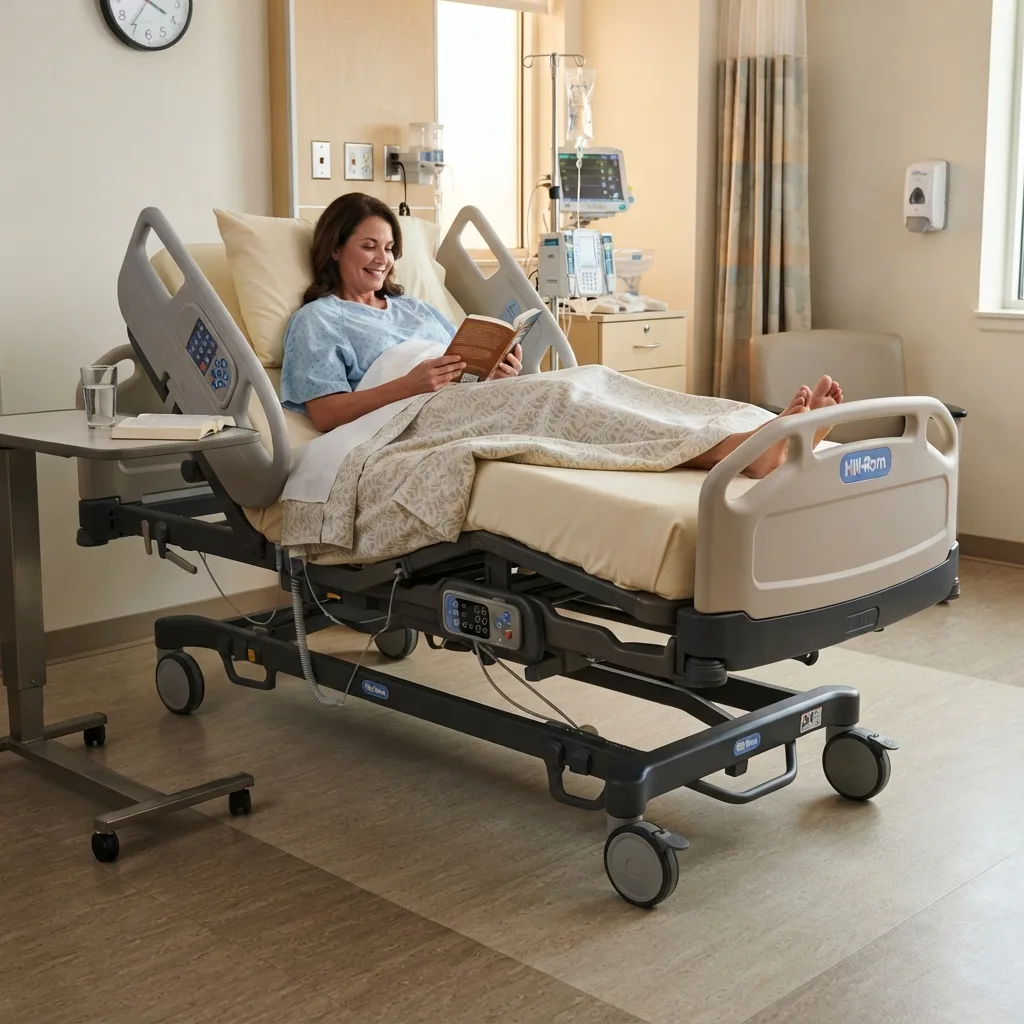
A Hospital Bed Is More Than a Place for Patients to Sleep
When a hospital purchases new beds, the decision involves more than the appearance or price of the equipment.
A hospital bed is an important part of the patient care environment. It affects patient positioning, staff workflow, mobility assistance, cleaning procedures and the overall use of available ward space.
A general hospital ward may require adjustable medical beds for routine inpatient care. An intensive care unit may need beds with additional positioning and monitoring-related functions. A rehabilitation center may prioritize patient mobility and accessibility, while a long-term care facility may focus on comfort, ease of operation and maintenance.
These different requirements explain why hospital beds are available in many designs and configurations.
Common options include:
- Manual hospital beds
- Semi-electric hospital beds
- Full electric hospital beds
- Adjustable medical beds
- ICU hospital beds
- Low hospital beds
- Bariatric hospital beds
- Pediatric hospital beds
- Specialized medical beds
For hospital procurement managers, medical equipment distributors and healthcare project contractors, understanding these differences is the first step toward selecting an appropriate product.
This guide explains the main hospital bed types, essential components, adjustment functions, mattress compatibility, safety considerations and purchasing requirements.
1. What Is a Hospital Bed?
A hospital bed, also called a medical bed, patient bed or nursing bed, is a specially designed bed used in healthcare facilities to support patient care and positioning.
Unlike a standard residential bed, a hospital bed may have adjustable sections, movable components, side rails, locking casters and other features intended for healthcare environments.
Depending on the model, a hospital bed can provide:
- Adjustable backrest positioning
- Adjustable leg or knee sections
- Variable bed height
- Head and foot positioning
- Mobility and transfer assistance
- Side rail support
- Emergency positioning functions
- Accessory mounting points
Not every hospital bed includes all these functions.
A basic manual medical bed may have only a few mechanical adjustments, while an advanced electric hospital bed can offer multiple motorized functions and additional controls.
The correct configuration depends on the intended patients, healthcare department and daily operating requirements.
Hospital Bed vs Medical Bed vs Nursing Bed
These terms are often used interchangeably in medical equipment catalogs.
Hospital bed generally refers to a bed designed for use in hospitals and other healthcare facilities.
Medical bed is a broader term covering beds intended for medical care and related healthcare environments.
Nursing bed often describes an adjustable patient bed designed to support nursing care and daily patient handling.
Electric hospital bed refers to a medical bed with electrically powered adjustment functions.
Adjustable hospital bed describes a bed with movable sections or height-adjustment capabilities, whether manually or electrically operated.
When searching for a hospital bed supplier, buyers may encounter all these terms. It is therefore important to check the actual product configuration instead of relying only on the name.
2. Main Types of Hospital Beds
Hospital beds are available in different designs to accommodate different healthcare environments.
The most common purchasing categories are manual, semi-electric and full electric hospital beds. Other configurations are designed for particular patient groups or clinical departments.
Manual Hospital Bed
A manual hospital bed uses mechanical hand cranks to adjust selected parts of the bed.
Depending on the model, the crank system may control:
- Backrest adjustment
- Knee or leg section adjustment
- Bed height
The actual number of adjustment functions varies between products.
Main Advantages
No dependence on electric motors
Manual beds can provide adjustment functions without relying on an electrical motor system.
Straightforward mechanical operation
The bed uses mechanical components that can be operated through hand cranks.
Suitable for selected general wards
Manual hospital beds may be considered for facilities with basic patient-care requirements.
Lower initial purchase cost in some configurations
A manual bed may have a lower initial equipment cost than a comparable electric model, although long-term maintenance and staffing requirements should also be considered.
What Should Buyers Check?
- Number of crank functions
- Ease of crank operation
- Mechanical stability
- Bed frame construction
- Wheel locking system
- Mattress platform design
- Load capacity
- Availability of replacement mechanical components
A manual hospital bed may be suitable for certain general care environments, but its adjustment process may require more physical effort from healthcare staff.
Semi-Electric Hospital Bed
A semi-electric hospital bed combines electric adjustment with manual mechanical functions.
For example, a model may use electric motors for backrest and knee adjustment while relying on a manual crank for height adjustment.
However, configurations differ between manufacturers.
Main Advantages
- Motorized adjustment for selected positions
- Reduced manual effort for certain daily operations
- More convenient patient positioning
- Potentially lower cost than a comparable fully electric configuration
When comparing semi-electric hospital beds, buyers should identify exactly which functions are electric and which remain manual.
Do not assume that every semi-electric model has the same arrangement.
Full Electric Hospital Bed
A full electric hospital bed uses electric motors to control several adjustable functions.
Depending on the model, these may include:
- Backrest adjustment
- Knee or leg adjustment
- Overall bed height
- Trendelenburg positioning
- Reverse Trendelenburg positioning
Electric controls may be available through a patient handset, staff control panel or both.
Main Advantages
Convenient adjustment
Staff can adjust bed positions using electrical controls rather than manually turning cranks.
Flexible positioning
Multiple adjustable sections can support different patient positioning requirements.
Reduced manual operation
Electric adjustment may reduce the physical effort involved in routine bed positioning.
More control options
Some configurations include additional controls, position-lock functions and emergency features.
What Should Buyers Check?
- Number of electric adjustment functions
- Motor configuration
- Control handset
- Nurse control panel
- Emergency lowering or release arrangements
- Power supply
- Battery backup, if available
- Maximum safe working load
- Maintenance and replacement motor availability
A full electric hospital bed may be appropriate for healthcare facilities that require more frequent patient positioning and convenient adjustment.
However, its suitability still depends on the clinical application, budget and maintenance arrangements.
Other Hospital Bed Categories
In addition to the three main operating types, healthcare facilities may need specialized hospital beds.
These include ICU beds, low beds, bariatric beds, pediatric beds and other application-specific medical beds.
Their configurations and safety requirements will be discussed in greater detail in Post 2.
3. Understanding Hospital Bed Functions
Hospital bed functions influence how patients can be positioned and how healthcare personnel work around the bed.
When reviewing a hospital bed specification, buyers should understand the following terms.
Backrest Adjustment
Backrest adjustment raises or lowers the upper section of the mattress platform.
This allows the patient to rest in different upper-body positions.
It may be useful for selected daily activities, comfort positioning and nursing procedures.
Common search terms include:
- adjustable hospital bed backrest
- electric backrest hospital bed
- adjustable head section medical bed
- Fowler position hospital bed
- hospital bed backrest adjustment
Knee and Leg Adjustment
The knee or leg section can be adjusted to support different patient positions.
Some beds allow the backrest and knee section to move together or independently.
This functionality may be useful for routine positioning and selected patient-care procedures.
When purchasing, ask whether the knee section is independently adjustable and how it is controlled.
Height Adjustment
Height adjustment changes the overall height of the mattress platform.
This function can help healthcare staff adjust the working position of the bed and may support patient transfers.
Important specifications include:
- Minimum bed height
- Maximum bed height
- Height adjustment range
- Electric or manual height adjustment
- Under-bed clearance
The bed’s lowest position can also be relevant when considering patient mobility and fall-risk management.
Trendelenburg Position
Trendelenburg positioning places the patient with the head end lower than the foot end.
Some specialized hospital beds provide this function through an adjustable platform.
However, the function should only be used when appropriate for the clinical procedure and according to healthcare protocols.
Buyers should not assume that every general hospital bed supports Trendelenburg positioning.
Reverse Trendelenburg Position
Reverse Trendelenburg places the head end higher than the foot end.
This function may be available on selected electric hospital beds.
When purchasing a bed with Trendelenburg or reverse Trendelenburg functions, confirm the available angle range, control method and manufacturer specifications.
Emergency CPR Function
Some electric hospital beds include CPR release or rapid positioning functions.
These features are intended to help healthcare professionals place the bed into a specified emergency position more quickly.
The design differs across models. Buyers should confirm whether the CPR function is manual, electric or another manufacturer-specific arrangement.
Locking and Brake System
A hospital bed generally needs a suitable wheel-locking arrangement to prevent unwanted movement when stationary.
Possible designs include:
- Individual wheel brakes
- Central locking systems
- Directional locking functions
- Combined caster control systems
The exact arrangement depends on the bed configuration.
For procurement, check how easily staff can engage and release the brakes and whether the system suits the intended clinical environment.
4. Important Components of a Hospital Bed
A hospital bed consists of several connected components.
Understanding the structure helps buyers evaluate product quality, maintenance requirements and accessory compatibility.
Bed Frame
The bed frame is the main supporting structure.
It holds the mattress platform and other mechanical or electrical components.
Common construction materials include coated steel and other specified metal structures.
When comparing hospital bed frames, evaluate:
- Structural stability
- Surface finish
- Corrosion resistance
- Weld quality
- Mechanical connections
- Load capacity
- Cleaning accessibility
The material name alone does not establish product quality. Buyers should request the actual material and construction specifications.

Mattress Platform
The mattress platform supports the mattress and is commonly divided into adjustable sections.
Depending on the design, it may consist of multiple articulated sections that correspond to the backrest, seat, thigh and lower-leg areas.
Important considerations include:
- Platform dimensions
- Section arrangement
- Adjustment range
- Mattress compatibility
- Weight capacity
- Ease of cleaning
The platform and mattress should be designed to work together.
Side Rails
Hospital bed side rails are positioned along the sides of the bed.
They may support selected patient mobility and positioning activities and can help define the bed’s boundaries.
Different models may use:
- Full-length side rails
- Split side rails
- Folding side rails
- Retractable side rails
- Integrated side rail controls
However, side rails are not automatically appropriate for every patient.
They can introduce risks, including entrapment or injury, depending on the patient’s condition and the bed system.
Healthcare facilities should assess individual patient needs and follow their approved bed-safety policies.
The FDA’s hospital bed guidance identifies potential entrapment areas involving the bed rails, mattress, headboard, footboard and bed frame. It also recommends considering mattress dimensions and compatible components when assessing bed-system safety.
Headboard and Footboard
The headboard and footboard form the upper and lower ends of the bed.
Depending on the model, they may be fixed or removable.
Buyers should consider:
- Material
- Attachment method
- Durability
- Cleaning
- Ease of removal where necessary
- Compatibility with other bed components
Some medical beds use detachable panels to support cleaning, access or maintenance.
Casters and Wheels
Casters allow the bed to be moved within the healthcare facility.
A suitable wheel system should support the bed’s intended use and operating environment.
Consider:
- Wheel diameter
- Rotation
- Braking arrangement
- Directional locking
- Floor compatibility
- Load rating
- Maintenance requirements
For large hospitals, caster performance can influence daily bed movement and transportation within the ward.
Electric Motors and Control System
Electric hospital beds may contain motors for backrest, knee and height adjustment.
The control system can include patient handsets, staff control panels and electrical control units.
For buyers, important questions include:
- How many motors are installed?
- Which functions does each motor control?
- Are controls easy to operate?
- Are there lockout functions?
- Is an emergency release available?
- Are replacement motors available?
- What electrical requirements apply?
The exact motor and control arrangement should be confirmed for the specific bed model.
5. Hospital Bed Mattress: Why Compatibility Matters
A hospital bed mattress is an important part of the complete bed system.
The mattress needs to match the bed platform’s dimensions, adjustable sections and intended use.
A mattress that is too large, too small or incompatible with the bed may create problems with fit, movement and safety.
Types of Hospital Bed Mattresses
Common mattress categories include:
Standard hospital mattress
Designed for general patient accommodation and routine ward use.
Pressure redistribution mattress
Designed to help redistribute pressure through specific construction or material arrangements.
Foam hospital mattress
Uses foam construction, with performance depending on the material, design and clinical purpose.
Alternating pressure mattress
Uses an air-cell system that alternates inflation and deflation to support pressure redistribution for selected patients.
Specialized support surfaces
May include other designs intended for specific patient-care requirements.
These products should not be treated as interchangeable. Mattress selection should follow clinical assessment, manufacturer instructions and the bed’s compatibility requirements.
What Should Buyers Check?
- Mattress length and width
- Mattress thickness
- Mattress platform compatibility
- Maximum supported load
- Cover material
- Cleaning and disinfection requirements
- Fire-safety documentation where applicable
- Pressure redistribution properties
- Replacement availability
A useful procurement question is:
Is the quoted mattress included with the hospital bed, or does it need to be purchased separately?
This can make a significant difference when comparing complete hospital bed quotations.
6. Hospital Bed Safety: What Should Procurement Teams Know?
Patient safety should be a major part of the purchasing decision.
A hospital bed is a system that includes the frame, mattress, rails and compatible accessories.
The safety of the complete combination matters.
Patient Entrapment
Patient entrapment refers to a situation where a person becomes caught or trapped in an opening within or around a bed system.
Potential areas include:
- Within the side rail
- Between the rail and mattress
- Under the side rail
- Between split rails
- Between the mattress and headboard or footboard
- Around other openings in the bed frame
The FDA identifies seven potential entrapment zones in its hospital bed safety guidance.
Not every bed or patient has the same risk. Facilities should assess the complete bed system and the individual patient’s circumstances.
Are Higher Side Rails Always Safer?
No.
Side rails may offer some benefits in particular situations, but they can also create entrapment risks and other safety concerns.
Their use should be based on the patient’s condition, mobility, risk assessment and healthcare facility policy.
Buyers should evaluate:
- Rail design
- Gap dimensions
- Mattress compatibility
- Rail operation
- Locking mechanism
- Instructions for use
- Compatible accessories
The final safety assessment should involve the relevant clinical and biomedical personnel.
Weight Capacity and Safe Working Load
Hospital bed specifications commonly include a maximum safe working load.
This should not be confused with the maximum patient weight.
The safe working load may account for the patient, mattress, accessories and other supported loads, according to the manufacturer’s definition.
Before purchasing, ask the manufacturer to clarify:
- Safe working load
- Maximum recommended patient weight
- Load distribution assumptions
- Applicable operating conditions
- Accessories included in the stated capacity
This is especially important for bariatric hospital bed procurement.
7. What Standards Should Buyers Check?
Medical beds are subject to safety and performance requirements that vary by product type and market.
For adult medical beds, an important current international reference is:
IEC 80601-2-52:2026 — Medical electrical equipment — Part 2-52: Particular requirements for the basic safety and essential performance of medical beds for adults.
This standard was published in May 2026 and applies to both electrical and non-electrical adult medical beds, including beds with or without adjustable functions.
It does not cover every type of medical bed. The published scope excludes pediatric beds, certain adults with atypical anatomies, specialty mattresses and equipment intended mainly for examination or transportation, such as stretchers and examination tables.
For a buyer, this means the equipment’s intended use and market-specific requirements must be identified before requesting compliance documents.
Other considerations may include:
- General medical electrical equipment safety requirements, where applicable
- Medical device registration in the destination country
- Applicable electrical safety and EMC requirements
- Quality management documentation
- Product labeling and instructions
- Mattress and accessory compatibility
- Risk-management documentation
Do not assume that a manufacturer’s general CE or ISO statement proves that every model complies with every requirement in the destination country.
Ask for the actual documentation applicable to the quoted product.
8. How to Choose the Right Hospital Bed for Different Healthcare Facilities
Different healthcare environments require different bed configurations.
General Hospital Wards
General wards commonly need beds that support routine positioning, patient mobility assistance and nursing work.
Buyers may evaluate manual, semi-electric and full electric hospital beds.
Important considerations include:
- Backrest adjustment
- Height adjustment
- Side rail design
- Braking system
- Mattress compatibility
- Cleaning
- Maintenance
Intensive Care Units
ICUs may require specialized beds with additional positioning, controls and emergency functions.
The specific features depend on the clinical environment and hospital requirements.
A more detailed comparison of ICU hospital beds will be covered in Post 2.
Rehabilitation Centers
Rehabilitation facilities may prioritize patient mobility, transfer accessibility and adjustable bed positioning.
The appropriate configuration depends on the rehabilitation program and patient population.
Long-Term Care Facilities
Long-term care settings may consider comfort, adjustment convenience, cleaning, durability and long-term maintenance.
Patient accessibility and individual risk assessment are also important.
Pediatric Healthcare Facilities
Pediatric beds are designed for children and should not simply be treated as smaller adult hospital beds.
The design needs to consider the intended age and patient population, dimensions, side rails and age-specific safety requirements.
Bariatric Care
Bariatric hospital beds are designed for larger patients and may offer wider platforms and different load capacities.
Buyers should compare the manufacturer’s stated safe working load, patient weight limit, mattress dimensions and available adjustment functions.
9. What Dimensions Should You Check Before Buying?
Hospital bed dimensions are important for both patient comfort and hospital room planning.
Do not rely only on the external length and width listed in a catalog.
Review these measurements separately:
Overall bed length
The total length of the assembled bed.
Overall bed width
The external width, including the structure and side rails where applicable.
Mattress platform dimensions
The actual usable dimensions of the mattress support area.
Bed height
The minimum and maximum height of the mattress platform.
Head and foot section clearance
The space required for movement and access.
Under-bed clearance
The available space below the bed for cleaning or compatible equipment.
Side rail dimensions
The dimensions and gaps that influence patient access and safety.
When planning a new hospital ward, dimensions should be coordinated with room layouts, doors, corridors, elevators and other equipment.
A bed that fits comfortably in a catalog drawing may be difficult to move or operate in a crowded room.
10. How to Compare Hospital Bed Manufacturers and Suppliers
Choosing a supplier is as important as selecting the bed configuration.
For international procurement, buyers should evaluate several areas.
Product Range
Does the supplier offer manual, electric and specialized hospital bed options?
Can the supplier recommend a configuration according to the healthcare department and required functions?
Manufacturing Capability
If the supplier is also the manufacturer, ask about production facilities, assembly processes, quality inspection and product traceability.
For trading or integrated procurement suppliers, clarify which company actually manufactures the bed.
Product Specifications
Request detailed information about:
- Bed dimensions
- Frame materials
- Mattress platform
- Adjustment functions
- Motor system
- Safe working load
- Casters
- Side rails
- Electrical requirements
- Compatible accessories
Quality and Regulatory Documentation
Ask for product-specific documentation, applicable certifications, test reports and instructions for use.
Spare Parts and Maintenance
Check the availability of motors, controls, casters, mechanical components and other replacement parts.
Customization
Some projects require specific dimensions, colors, mattress configurations, electrical arrangements or accessories.
Ask whether OEM or ODM services are available and clarify which changes can be supported.
Export and Logistics
For overseas hospital projects, confirm:
- Export packaging
- Container loading arrangements
- Shipping dimensions
- Product documentation
- Delivery terms
- Installation instructions
- After-sales communication
A reliable quotation should clearly distinguish between the bed frame, mattress, side rails, accessories, delivery and other optional items.
11. How Much Does a Hospital Bed Cost?
Hospital bed prices vary considerably.
The cost depends on the design, materials, adjustment functions, electrical components and complete configuration.
Important pricing factors include:
- Manual or electric operation
- Number of adjustment functions
- Bed frame construction
- Motor configuration
- Side rail design
- Mattress type
- Caster system
- Patient weight capacity
- Additional accessories
- Safety documentation
- Warranty
- Shipping and installation
A basic manual medical bed and a fully electric ICU bed should not be compared simply because both are listed as hospital beds.
For accurate purchasing, request quotations based on equivalent configurations.
What Should Be Included in the Quotation?
A professional RFQ should specify:
- Bed type and intended department
- Quantity required
- Overall bed dimensions
- Mattress platform dimensions
- Required adjustment functions
- Safe working load
- Mattress requirements
- Side rail configuration
- Casters and braking system
- Electrical specifications, if applicable
- Required accessories
- Applicable certificates and documentation
- Warranty and spare parts
- Delivery destination and packaging requirements
This information makes it easier to compare suppliers and avoid unexpected costs.
12. Hospital Bed Procurement Checklist
Before placing an order, use this checklist to review the complete bed system.
Product Configuration
- Is it a manual, semi-electric or fully electric bed?
- Which department will use it?
- Are the available functions suitable for the intended work?
Structure
- What materials are used in the frame?
- Is the mattress platform suitable for the required mattress?
- Are headboards and footboards detachable?
Safety
- Are side rails compatible with the mattress?
- Are entrapment risks considered?
- Is the safe working load clearly specified?
- Are brakes and locking functions appropriate?
Electrical Functions
- What motors are included?
- Which functions are electrically adjustable?
- Is an emergency release or backup function available?
- Does the electrical configuration match the destination market?
Mattress and Accessories
- Is the mattress included?
- Are the mattress dimensions correct?
- Are additional accessories required?
- Are the accessories compatible with the bed?
Maintenance
- Are spare parts available?
- What is the warranty?
- Are maintenance manuals supplied?
- Is technical support available?
Logistics
- What are the packing dimensions?
- How many beds can fit in a shipment?
- Are export documents available?
- What is the expected delivery arrangement?
A complete evaluation helps hospitals and distributors make a more informed purchasing decision.
Final Buying Advice: Choose the Bed According to the Patient and the Department
There is no single hospital bed configuration suitable for every healthcare facility.
A general hospital ward may need a practical adjustable medical bed. An ICU may require specialized positioning and control functions. A rehabilitation center may prioritize accessibility and patient mobility, while a long-term care facility may emphasize comfort, maintenance and ease of operation.
Before choosing a medical bed, evaluate:
Department requirements + patient needs + adjustment functions + mattress compatibility + safety + dimensions + maintenance + total cost.
A complete hospital bed purchase should always consider the bed frame, mattress, side rails, casters and accessories as a connected system.
For international buyers, it is equally important to verify the manufacturer’s technical documentation, applicable medical bed standards, spare-parts availability and after-sales support.
The goal is not simply to purchase a hospital bed at an attractive price. It is to select a medical bed that meets the actual requirements of the healthcare facility and can be maintained throughout its operating life.
Frequently Asked Questions
1. What is a hospital bed?
A hospital bed is a medical bed designed for patient accommodation and care in hospitals and other healthcare facilities. Depending on the model, it may include adjustable backrest and leg sections, height adjustment, side rails and locking casters.
2. What are the different types of hospital beds?
Common types include manual hospital beds, semi-electric hospital beds, full electric hospital beds, ICU beds, low beds, bariatric beds and pediatric beds.
3. What is the difference between a manual and an electric hospital bed?
A manual hospital bed uses mechanical cranks for adjustment, while an electric hospital bed uses motors and electrical controls to adjust selected bed sections and, depending on the model, the overall height.
4. What is a semi-electric hospital bed?
A semi-electric hospital bed combines motorized adjustment functions with manual adjustment functions. The exact combination depends on the manufacturer’s design.
5. What is a full electric hospital bed?
A full electric hospital bed uses electric motors to control multiple functions, which may include backrest adjustment, knee adjustment and overall bed height.
6. What is a three-function hospital bed?
A three-function hospital bed typically provides three adjustment functions, often involving backrest, knee section and overall bed height. Buyers should verify the exact function arrangement for the model.
7. What is a five-function hospital bed?
A five-function hospital bed generally includes additional positioning functions beyond a basic three-function configuration. The exact functions depend on the model, so buyers should check the manufacturer’s specification.
8. What is a Fowler position hospital bed?
A Fowler position refers to a patient position in which the upper body is elevated. Hospital beds with adjustable backrests can support different Fowler-related positions, depending on the available adjustment range.
9. What is a Trendelenburg hospital bed?
A Trendelenburg hospital bed is designed to tilt the mattress platform so that the head end is lower than the foot end. This function is available only on selected models and should be used according to clinical procedures.
10. What is a bariatric hospital bed?
A bariatric hospital bed is designed for larger patients and may feature a wider mattress platform and higher safe working load. Buyers should confirm the manufacturer’s specific patient weight limit and total load capacity.
11. What is an ICU hospital bed?
An ICU hospital bed is designed for intensive care environments and may offer additional adjustment, emergency positioning, control and accessory functions.
12. What is a pediatric hospital bed?
A pediatric hospital bed is specifically designed for children. Its dimensions, enclosure and safety requirements differ from those of standard adult beds.
13. What is a low hospital bed?
A low hospital bed is designed to lower the mattress platform closer to the floor than a conventional bed. It may be considered as part of a patient mobility and fall-risk management strategy.
14. What is the safe working load of a hospital bed?
Safe working load is the maximum load specified by the manufacturer for the bed under defined conditions. It should not automatically be interpreted as the maximum patient weight because the total load may also include the mattress and accessories.
15. What mattress should be used with a hospital bed?
The mattress should match the bed’s platform dimensions, design, intended use and compatibility requirements. Some facilities may require standard foam mattresses, pressure redistribution mattresses or other specialized support surfaces.
16. Are hospital bed mattresses interchangeable?
Not automatically. Mattress dimensions, thickness, platform design, bed rails and intended use should all be checked to ensure compatibility.
17. Why do hospital beds have side rails?
Side rails may assist with selected patient positioning and mobility activities. Their use should be based on individual patient assessment because rails can also introduce entrapment and other safety risks.
18. What materials are used for hospital bed frames?
Hospital bed frames commonly use metal structures such as steel with specified surface finishes. Actual durability and suitability depend on the material specification, construction and quality control.
19. What is the difference between a hospital bed and a patient stretcher?
A hospital bed is intended primarily for patient accommodation and care, whereas a stretcher is mainly intended for patient transportation or transfer under medical supervision.
20. What standard applies to adult medical beds?
IEC 80601-2-52:2026 is an important international standard covering the basic safety and essential performance of adult medical beds, including manual and electrical designs within its scope.
21. How much does an electric hospital bed cost?
The price depends on the number of adjustment functions, motor configuration, frame materials, mattress, side rails, accessories, shipping and other project requirements.
22. How do I choose a hospital bed supplier?
Evaluate product configurations, manufacturing capability, technical documentation, applicable regulatory information, customization, spare parts, warranty, export experience and after-sales technical support.
23. Can hospital beds be customized?
Some manufacturers and suppliers offer customization of dimensions, colors, functions, accessories and other specifications. Confirm which modifications are available and whether they affect testing or certification.