Without feeding every manufactured batch of a medication to human volunteers and drawing their blood, how do global regulatory agencies—such as the FDA or EMA—know with absolute certainty that a generic blood pressure tablet will absorb into a patient’s bloodstream at the exact same speed as the expensive brand-name original?
The answer lies in In-Vitro Dissolution Testing.
When a patient swallows a solid oral dosage form, the tablet must first disintegrate into smaller granules, and those granules must dissolve completely into the gastrointestinal fluids before the active molecules can cross the intestinal wall into the systemic circulation. If a generic tablet is formulated with binders that are too hard, it will dissolve too slowly, depriving the patient of the therapeutic dose. If it dissolves too fast, it could trigger a dangerous spike in drug blood concentration (dose dumping).
Dissolution testing bridges the gap between the manufacturing press room and human physiology. By simulating the temperature, pH, and fluid dynamics of the human stomach and intestines inside a series of precisely engineered glass vessels, analytical chemists can accurately predict human bioavailability.
This guide breaks down the core mechanics of dissolution testing, the critical differences between USP Apparatus 1 and Apparatus 2, the science of media degassing, and the strict acceptance criteria used in modern pharmaceutical laboratories.
1. Bridging the Gap: IVIVC and the Biopharmaceutics Classification System (BCS)
The ultimate goal of dissolution testing is to achieve an In-Vitro In-Vivo Correlation (IVIVC). An IVIVC is a predictive mathematical model that maps the relationship between an in-vitro property of a dosage form (the rate of drug dissolution in the lab beaker) and an in-vivo response (the plasma drug concentration profile in a human patient).
Once a pharmaceutical company establishes a robust IVIVC for a specific drug, they can use laboratory dissolution data as a surrogate for expensive human clinical trials during post-approval manufacturing changes.
However, establishing an IVIVC depends entirely on the physical and chemical properties of the drug molecule, which is categorized by the Biopharmaceutics Classification System (BCS).
                  BIOPHARMACEUTICS CLASSIFICATION SYSTEM (BCS)
+-------------------------------------------------------------------------+
| CLASS I: High Solubility, High Permeability                             |
| - Examples: Propranolol, Metoprolol, Paracetamol.                       |
| - Behavior: Dissolves rapidly and absorbs easily across gut walls.      |
| - Dissolution Role: Routine QC. Biowaivers are easily granted.          |
|                                                                         |
| CLASS II: Low Solubility, High Permeability                             |
| - Examples: Ibuprofen, Diclofenac, Ketoconazole.                        |
| - Behavior: Absorbs easily, but struggles to dissolve in fluid.         |
| - Dissolution Role: CRITICAL. The dissolution rate is the rate-limiting |
|   step for human absorption. Excellent IVIVC candidates.                |
|                                                                         |
| CLASS III: High Solubility, Low Permeability                            |
| - Examples: Cimetidine, Acyclovir, Captopril.                           |
| - Behavior: Dissolves instantly, but struggles to cross the gut wall.   |
| - Dissolution Role: Absorption is limited by human biology, not the pill|
|                                                                         |
| CLASS IV: Low Solubility, Low Permeability                              |
| - Examples: Taxol, Furosemide, Ritonavir.                               |
| - Behavior: Very difficult to formulate; poor candidates for oral pills.|
+-------------------------------------------------------------------------+
For BCS Class II drugs, the dissolution tester is the most important piece of equipment in the laboratory. Because these drugs are highly permeable but poorly soluble, any slight deviation in tablet hardness, granule size, or lubricant coating will immediately alter how fast the drug dissolves, directly changing the patient’s blood concentration.
2. Dissecting USP 711: Apparatus 1 vs. Apparatus 2
The United States Pharmacopeia (USP) chapter 711 and European Pharmacopoeia (Ph. Eur.) chapter 2.9.3 outline several standardized mechanical apparatuses designed to test different dosage forms. The vast majority of global pharmaceutical testing relies on Apparatus 1 and Apparatus 2.
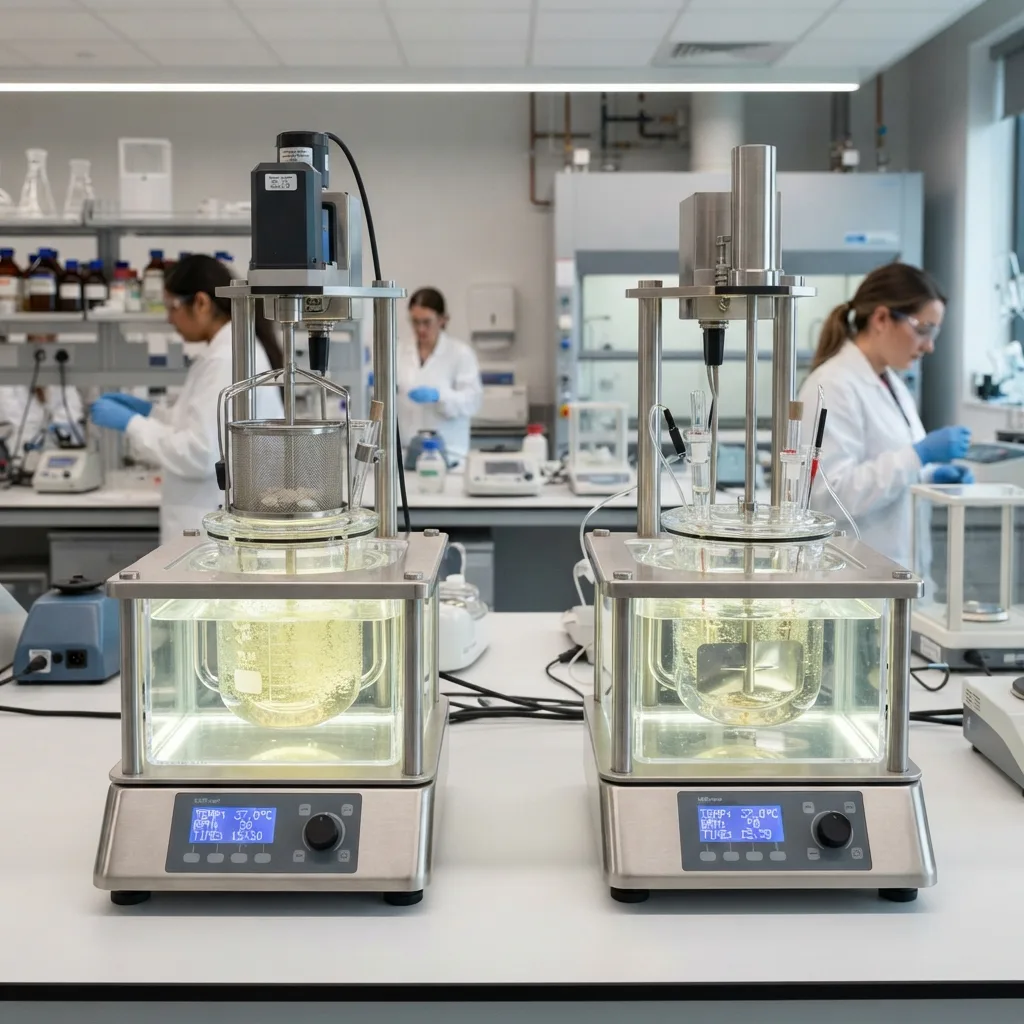
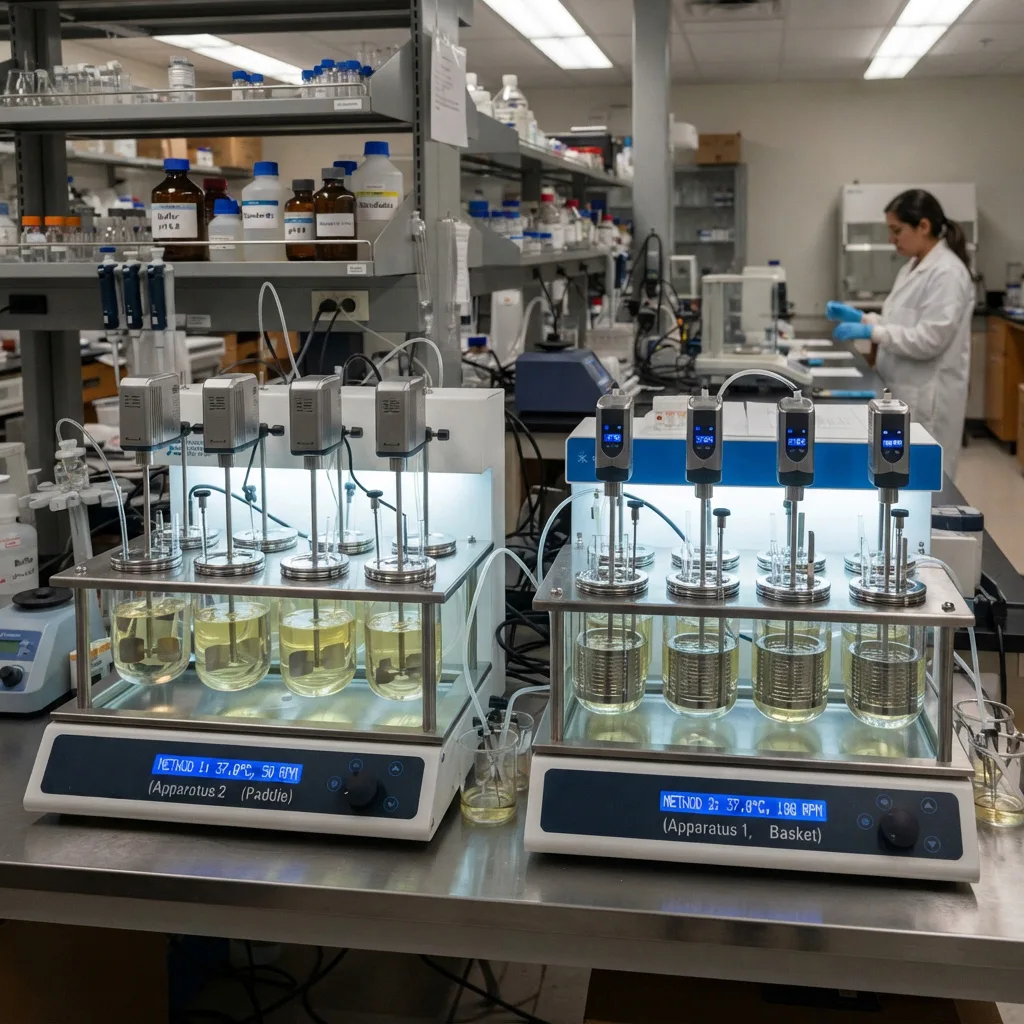
Both systems utilize a standardized hemispherical-bottom borosilicate glass vessel holding 500 mL, 900 mL, or 1000 mL of media, submerged in a precisely controlled 37.0 +/- 0.5 degrees Celsius water bath to simulate human body temperature. The difference lies in how the drug is agitated.
USP Apparatus 1: The Basket Method
-
The Mechanism: The dosage form is placed inside a small cylindrical basket made of 40-mesh (0.38 mm aperture) stainless steel wire. This basket is attached to the end of a motorized drive shaft and rotated smoothly at a standardized speed (typically 50, 75, or 100 rpm).
-
Primary Applications: Hard gelatin capsules, softgel capsules, suppositories, and tablets that tend to float.
-
Why Use the Basket? Gelatin capsules trap air. If dropped into a standard vessel, a capsule will float to the surface, completely evading the fluid shear forces at the bottom of the beaker. The steel basket forces the floating capsule to remain fully submerged in the designated hydrodynamic zone.
-
Drawbacks: Gummy or sticky formulations can clog the fine 40-mesh wire, blocking fluid from entering the basket and artificially lowering the dissolution rate.
USP Apparatus 2: The Paddle Method
-
The Mechanism: The dosage form is dropped directly into the bottom of the glass vessel. A standardized paddle (often coated in Teflon/PTFE or made of electro-polished stainless steel) is positioned exactly 25 +/- 2 mm above the lowest inner curve of the vessel. As the paddle rotates (usually at 50 or 75 rpm), it generates a highly controlled vortex and fluid shear force that dissolves the tablet sitting at the bottom.
-
Primary Applications: Standard immediate-release tablets, chewable tablets, and enteric-coated tablets.
-
Managing Floaters with Sinkers: If a tablet happens to float (or if a capsule is being tested in Apparatus 2), it will drift into the chaotic turbulent zone near the liquid surface. To prevent this, QC technicians wrap the dosage form in a Sinker—a few loops of non-reactive stainless steel wire—which acts as an anchor to hold the drug at the very bottom of the vessel directly under the paddle.
Specialty Apparatuses for Complex Formulations
While 1 and 2 cover 90% of routine testing, pharmacopeias define additional setups for advanced drug delivery systems:
-
Apparatus 3 (Reciprocating Cylinder): Designed for extended-release (ER) or controlled-release formulations. The drug is moved up and down through a series of different glass tubes containing different pH media, simulating the journey from the stomach to the jejunum to the colon.
-
Apparatus 4 (Flow-Through Cell): The tablet is placed in a small chamber, and fresh media is continuously pumped through the cell from bottom to top. Ideal for poorly soluble BCS Class II/IV drugs requiring massive volumes of fluid to achieve sink conditions, or for implantable medical devices.
-
Small Volume Apparatus (Mini-Vessels): Uses 100 mL to 250 mL vessels for testing ultra-low dose formulations, pediatric drugs, or expensive novel APIs where traditional 900 mL dilution would render the drug undetectable by the UV-Vis spectrometer.
3. The Hidden Saboteur: Dissolution Media Preparation and Degassing
A mechanical dissolution tester can only provide accurate data if the liquid inside the vessel (the dissolution medium) is perfectly prepared.
The human gastrointestinal tract experiences wild pH variations. To simulate this, laboratories use highly specific chemical buffers. 0.1 N Hydrochloric Acid (pH 1.2) is standard for simulating the fasting human stomach. Phosphate buffers (pH 6.8 to 7.2) are used to simulate the alkaline environment of the small intestine. For poorly soluble drugs, synthetic surfactants like Sodium Lauryl Sulfate (SLS) or Tween 80 are added to mimic human bile salts.
However, achieving the correct pH is not the hardest part of media preparation. The greatest hidden saboteur in dissolution testing is dissolved atmospheric gas.
               THE PHYSICS OF DEGASSING IN DISSOLUTION TESTING
+-------------------------------------------------------------------------+
| THE BUBBLE BARRIER EFFECT                                               |
| - Standard distilled water naturally absorbs oxygen and nitrogen.       |
| - When heated from room temperature to 37.0 degrees Celsius in the test |
|   vessel, these dissolved gases come out of solution as micro-bubbles.  |
| - These microscopic bubbles cling to the surface of the tablet, the     |
|   basket mesh, and the paddle blades.                                   |
|                                                                         |
| THE CLINICAL CONSEQUENCE                                                |
| - Air is a barrier. Where a bubble touches the tablet, liquid cannot.   |
| - This drastically reduces the effective surface area of the pill.      |
| - A highly aerated medium can artificially reduce the dissolution rate  |
|   by up to 20% to 30%, causing a perfectly good drug batch to fail      |
|   its USP QC parameters.                                                |
+-------------------------------------------------------------------------+
The USP Degassing Protocol
To ensure that micro-bubbles do not alter fluid hydrodynamics or shield the tablet, USP <711> strictly mandates that the dissolution medium must be degassed prior to testing (unless the specific drug monograph proves the drug is insensitive to dissolved gas).
The standard USP degassing methodology involves three simultaneous physical actions:
-
Heating: The bulk media is heated to 41 to 45 degrees Celsius (since gases are less soluble in hot liquids).
-
Vacuum Filtration: The heated media is pulled through a 0.45-micrometer membrane filter under a strong vacuum (less than 100 mbar). The pressure drop forces dissolved gases out of the liquid.
-
Stirring/Sonication: The liquid is stirred vigorously or subjected to ultrasonic waves while under vacuum for 5 minutes.
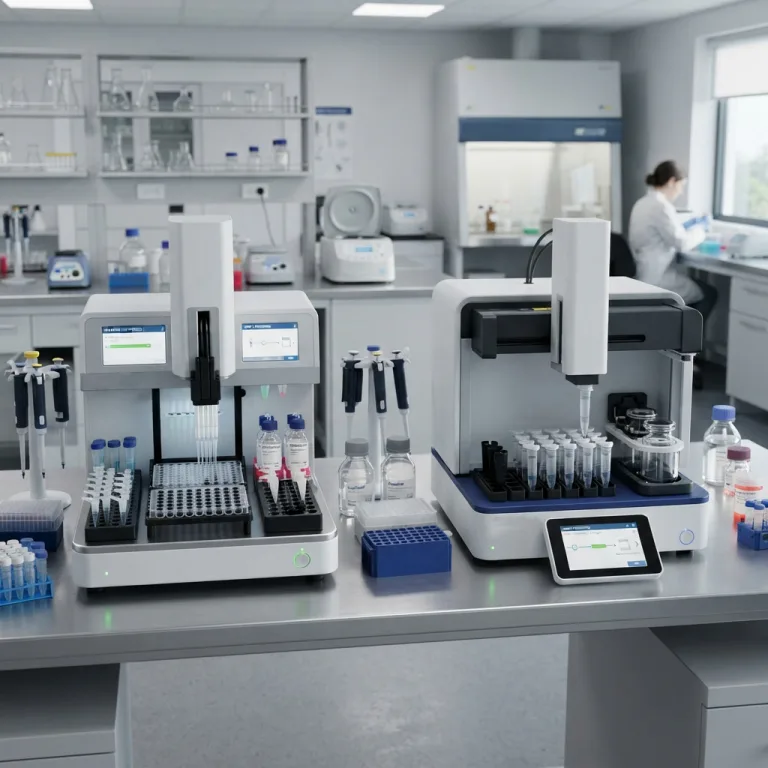
Laboratories traditionally performed this manually using heavy glass vacuum flasks, which was tedious and dangerous due to implosion risks. Modern high-throughput laboratories utilize Automated Media Preparation Stations that draw in tap or DI water, heat it, degas it under high vacuum, buffer the pH, and dispense exactly 900.0 grams of bubble-free media directly into the dissolution vessels in a single push-button cycle.
4. Reading the Results: The “Q” Value and the 3-Stage Acceptance Criteria
Once the test is running, aliquots (samples) of the fluid are extracted at specific time intervals (e.g., 10 minutes, 20 minutes, 30 minutes, and 45 minutes) and pumped into a UV-Vis Spectrophotometer or HPLC to calculate how much drug has dissolved.
The ultimate benchmark for passing a batch is the Q Value.
The Q Value is the percentage of the labeled active ingredient that must be dissolved within a specified time limit. For a typical immediate-release (IR) tablet, a drug monograph might state: “The tolerance is not less than Q = 80% dissolved in 30 minutes.”
However, in pharmaceutical manufacturing, a single bad tablet should not instantly doom a batch of 1 million pills. Therefore, pharmacopeias employ a 3-Stage Statistical Testing Hierarchy (S1, S2, S3).
S1 Stage (First 6 Tablets)
-
The laboratory tests 6 tablets.
-
Pass Criteria: Every single one of the 6 tablets must release at least Q + 5%.
-
Example (If Q = 80%): Every tablet must hit 85% or higher. If all 6 pass, testing stops immediately, and the batch is approved. If even one tablet falls to 83%, the laboratory must proceed to Stage S2.
S2 Stage (Add 6 More Tablets)
-
The laboratory tests an additional 6 tablets (for a total of 12).
-
Pass Criteria: The average of all 12 tablets must be equal to or greater than Q. Additionally, no single tablet out of the 12 can be less than Q – 15%.
-
Example: The average of all 12 must be 80%+. No single tablet can be below 65%. If this is met, the batch is approved. If it fails, the laboratory moves to the final S3 stage.
S3 Stage (Add 12 More Tablets)
-
The laboratory tests a final 12 tablets (for a total of 24 data points).
-
Pass Criteria: The average of all 24 tablets must be equal to or greater than Q. No more than 2 tablets out of the 24 can be less than Q – 15%, and strictly zero tablets can be less than Q – 25%.
-
Example: Average must be 80%+. Max two pills can drop below 65%. Zero pills can drop below 55%.
-
If the drug fails S3, the entire manufacturing batch is officially rejected and must be destroyed.
5. Beyond Immediate Release: Enteric and Extended-Release Profiles
While testing a standard painkiller takes 45 minutes, testing complex modified-release formulations requires highly sophisticated multi-stage methodologies.
Delayed-Release (Enteric-Coated) Testing
Enteric-coated tablets (such as low-dose daily aspirin or omeprazole) are designed to survive the harsh acid of the stomach and only release the drug once they reach the neutral pH of the small intestine. This protects the stomach lining from ulcers or protects acid-sensitive APIs from destruction.
-
The Acid Stage (2 Hours): The tablet is submerged in 0.1 N HCl (pH 1.2) for exactly two hours. To pass this stage, the tablet must release less than 10% of its drug. If it releases 15%, the enteric coating is deemed defective.
-
The Buffer Stage (45 Minutes): The tablet is immediately transferred to a pH 6.8 phosphate buffer. Now, the coating must dissolve rapidly, and the tablet must hit standard immediate-release Q-value targets (e.g., 80% in 45 minutes).
Extended-Release (ER) Testing
Extended-release medications (such as 24-hour hypertension drugs or sustained-release metformin) utilize advanced polymer matrices to leak the API slowly over 12 to 24 hours, preventing blood concentration spikes and allowing the patient to take only one pill a day.
-
Multi-Point Acceptance: Instead of a single Q value at 45 minutes, ER monographs specify multiple windows.
-
Example Monograph:
-
Hour 2: Between 20% and 40% dissolved.
-
Hour 4: Between 40% and 65% dissolved.
-
Hour 8: Between 60% and 85% dissolved.
-
Hour 12: Greater than 85% dissolved. If the drug releases 50% at Hour 2, it fails due to “dose dumping” (which could cause a lethal overdose in a patient). If it releases only 10% at Hour 2, it fails due to being too tightly bound.
-
Frequently Asked Questions (FAQ)
Q1: What are “Sink Conditions” and why do they matter?
In chemistry, as a liquid becomes saturated with a dissolved solute, the rate of dissolution naturally slows down. If a small volume of fluid becomes highly saturated with drug API, the test will stall, failing to represent the true release mechanics of the tablet. Sink conditions refer to a laboratory setup where the volume of the dissolution medium is at least three to five times greater than the volume required to form a saturated solution of the drug. This ensures the fluid never reaches saturation, allowing the dissolution rate to be determined entirely by the tablet’s formulation, not the fluid’s capacity.
Q2: Why is testing at 50 rpm different from testing at 75 rpm?
The rotational speed of the paddle or basket dictates the fluid shear force scraping against the tablet’s boundary layer. A test run at 75 rpm strips away the saturated boundary layer much faster than at 50 rpm, leading to significantly faster dissolution times. Regulatory agencies are highly suspicious if a pharmaceutical company requests to test an immediate-release tablet at 100 rpm, as excessive agitation is often used to artificially mask a poorly dissolving, over-compressed generic tablet.
Q3: What is the USP Prednisone RS tablet test?
A dissolution tester is a complex hydrodynamic machine. Even if the temperature is 37.0 degrees and the speed is exactly 50 rpm, microscopic vibrations in the motor or slight imperfections in the glass vessel shape can alter fluid flow. To verify that the entire machine is functioning identically to other machines worldwide, laboratories run a Performance Verification Test (PVT) every six months using USP Prednisone Reference Standard (RS) tablets. Because the dissolution profile of these specific prednisone tablets is deeply sensitive to hydrodynamic shear, if the machine’s fluid dynamics are off, the prednisone results will fail, alerting the lab to calibrate the instrument geometry.
Q4: Can dissolution testing be fully automated?
Yes. The highest risk of error in dissolution testing occurs during sampling—when a technician must draw fluid from all 6 vessels at the exact same second, filter it, and inject it into vials. Modern laboratories use Automated Syringe Sampling Stations. These robotic pumps drop sampling cannulas into the vessels at exactly the 10, 20, and 30-minute marks, pull fluid through inline micro-filters, dispense it into HPLC vials, and immediately pump fresh, heated media back into the vessels to maintain the exact 900 mL sink volume.
Q5: What is the difference between Dissolution and Disintegration?
Disintegration (tested under USP 701) merely measures how long it takes for a tablet to break apart into smaller fragments and fall through a wire mesh screen in a water bath. It does not measure whether the active drug molecules have actually dissolved into the fluid. Dissolution (USP 711) is a quantitative chemical analysis that measures the exact molecular concentration of the drug in the liquid over time. Disintegration is a basic physical QC check; Dissolution is the definitive test for clinical bioavailability.
Summary
Pharmaceutical dissolution testing under USP 711 is the ultimate safeguard between a manufacturing press room and a patient’s bloodstream. By rigidly controlling temperature, fluid dynamics through Apparatus 1 (Basket) and Apparatus 2 (Paddle), and rigorously degassing the media to eliminate the bubble barrier effect, analytical scientists can accurately predict how a generic tablet will behave in the human body. Mastering the S1, S2, and S3 Q-value criteria ensures that life-saving formulations release their active ingredients at exactly the right time and location within the gastrointestinal tract.