The Complete Buyer’s Guide to Laboratory Automation Systems in 2026
What is a laboratory automation system?
A laboratory automation system is an integrated network of robotic instruments, conveyor tracks, and smart software designed to handle, route, and analyze clinical samples with minimal human intervention. These systems eliminate manual processing bottlenecks, reduce diagnostic errors, and drastically accelerate turnaround times (TAT) for high-throughput hospital laboratories and clinics.
Why are hospital procurement teams prioritizing lab automation?
Procurement managers prioritize laboratory automation systems primarily to solve severe clinical staffing shortages and reduce long-term operational costs. By automating repetitive pre-analytical, analytical, and post-analytical tasks, clinical labs can achieve a faster ROI, cut human error rates by up to 70%, and increase daily sample throughput without constantly hiring additional bench technicians.
The current landscape of healthcare diagnostics demands speed, precision, and scalability. As test volumes increase globally, traditional manual workflows are proving to be inefficient and error-prone. Modern automated diagnostic workflows replace manual pipetting, tube sorting, and data entry with robotic liquid handling and smart LIS (Laboratory Information System) integration. For procurement officers and lab directors, investing in modular automation is no longer a luxury—it is a critical requirement for maintaining a competitive edge, ensuring regulatory compliance, and delivering rapid patient care.
Total Laboratory Automation (TLA) vs. Task Targeted Automation (TTA): Which strategy fits your clinical lab?
Total Laboratory Automation (TLA) connects all phases of sample testing via comprehensive track-based robotics, making it ideal for high-volume hospitals processing over 1,500 tubes daily. Conversely, Task Targeted Automation (TTA) automates only specific bottlenecks—such as hematology lab automation or pre-analytical sample sorting—offering a highly cost-effective, modular solution for mid-sized clinics.
Choosing between TLA and TTA is the most critical decision a procurement manager will make. A complete TLA system requires significant capital investment, floor space renovations, and extensive IT infrastructure. However, it offers a “hands-free” environment where a sample tube is loaded once and never touched by a human again until disposal. TTA, on the other hand, allows facilities to target their most error-prone departments first. For example, a clinic might invest in a standalone automated centrifuge and aliquoting module, integrating it with their existing analyzers.
Comparison Table: TLA vs. TTA
| Feature / Metric | Total Laboratory Automation (TLA) | Task Targeted Automation (TTA) |
| Best Suited For | Large hospitals, reference labs (>1,500 tubes/day) | Mid-sized clinics, specialized labs (<1,000 tubes/day) |
| Upfront Capital Cost | Very High ($1M – $5M+) | Moderate to Low ($50k – $500k) |
| Space Requirements | Large, continuous floor plan required | Small footprint, easily retrofitted into existing benches |
| Implementation Time | 6 to 12 months | 1 to 3 months |
| Flexibility | Rigid workflow, harder to modify once installed | Highly modular, easy to upgrade or relocate |
| ROI Timeline | 48 to 60 months | 24 to 36 months |
How do you calculate clinical lab ROI for automation systems?
Calculating clinical lab ROI requires measuring direct labor savings, reagent waste reduction, and increased billable test volume against the capital expense of the new automation system. Most high-throughput clinical laboratories achieve a full return on investment within 36 to 48 months by drastically lowering their overall cost per test.
To build a compelling business case for hospital administration, procurement teams must look beyond the initial sticker price. The true ROI of laboratory automation systems stems from several intersecting factors:
-
Labor Optimization: Automation does not necessarily mean firing staff; it means reallocating highly skilled technologists away from mundane pre-analytical sample sorting and toward complex data review and quality control.
-
Reagent and Consumable Efficiency: Automated robotic liquid handling uses precise micro-volumes, significantly reducing the waste of expensive chemical reagents compared to manual pipetting.
-
Error Reduction (The Hidden Cost): The cost of a mislabeled tube or a cross-contaminated sample can be catastrophic, leading to re-draws, delayed diagnoses, and potential legal liabilities. Automation nearly eliminates pre-analytical errors.
-
Expanded Testing Capacity: A smart lab architecture allows a facility to accept samples from external regional clinics, turning the laboratory from a hospital cost center into a major revenue generator.
What are the core components of modern automated diagnostic workflows?
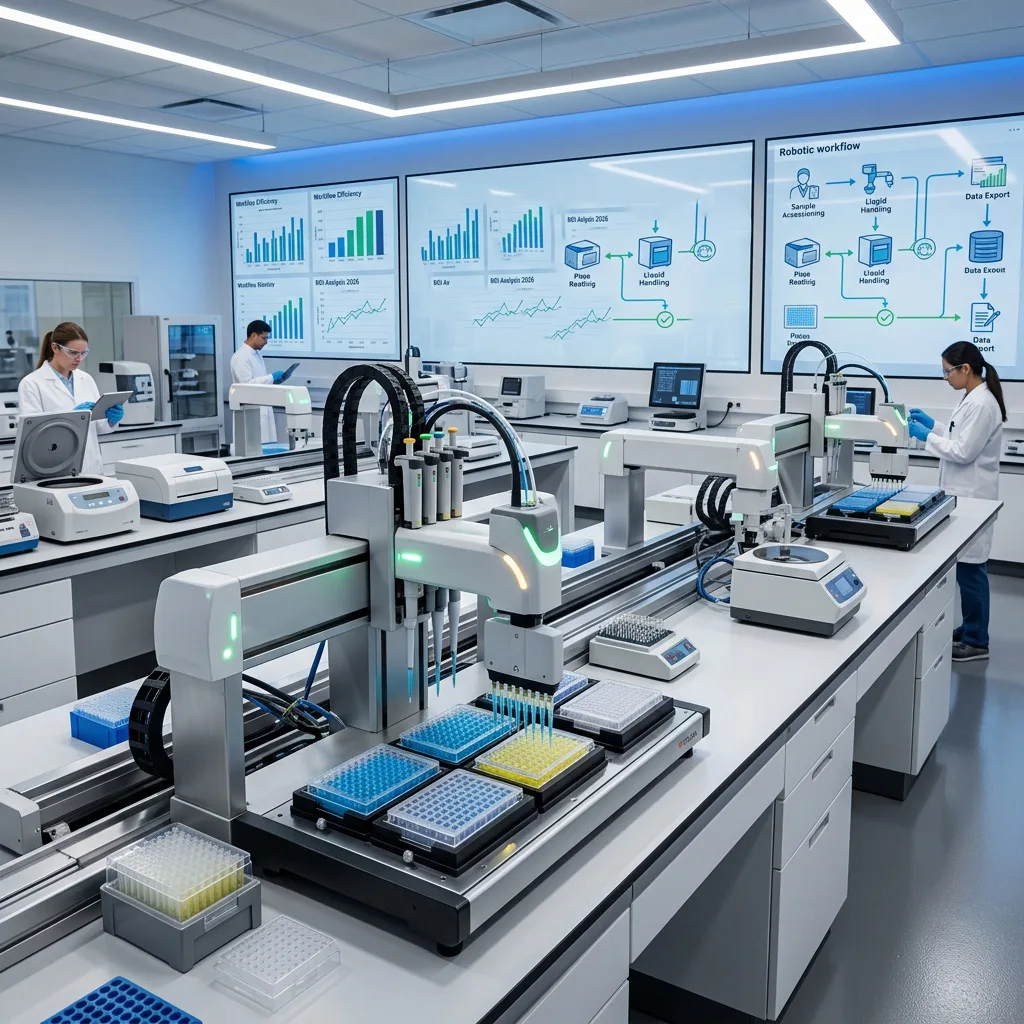
Modern automated diagnostic workflows are divided into three core phases: pre-analytical, analytical, and post-analytical. Each phase relies on specific robotic components that work in harmony with the lab’s software to ensure continuous sample flow.
-
Pre-Analytical Modules: This is where the most significant labor savings occur. Systems automatically identify barcodes, weigh tubes, centrifuge samples, decap caps, and perform aliquoting (splitting primary samples into secondary tubes for different testing departments).
-
Analytical Units: These are the actual testing engines. Modern chemistry analyzers, immunoassay systems, and hematology lab automation units are physically connected to the conveyor tracks. The smart track routes the sample to the exact analyzer required based on the LIS orders.
-
Post-Analytical Storage: Once testing is complete, robotic systems automatically recap the tubes and transport them to refrigerated storage archives. If a doctor orders an add-on test hours later, the software commands the robotic arm to retrieve the exact tube and route it back to the analyzer instantly.
-
Laboratory Information Systems (LIS) Middleware: The “brain” of the operation. This software bridges the physical instruments and the hospital’s electronic health records (EHR), directing traffic, flagging abnormal results for human review, and auto-validating normal results.



Why is LIS integration critical for laboratory automation systems?
LIS integration is critical because, without a seamless bi-directional data flow between the hospital’s central database and the robotic instruments, the physical automation is useless. LIS middleware directs the physical routing of every sample tube, auto-verifies normal test results, and flags critical clinical anomalies for immediate human review.
When a doctor enters a blood test order into the hospital system, the LIS generates a unique barcode. From the moment that barcode is scanned at the lab’s receiving station, the middleware takes over. It tells the pre-analytical sorting robot whether the tube needs centrifuging. It tells the conveyor track which analyzer to send the tube to. Finally, it receives the raw data from the analyzer, formats it, and sends the finalized diagnostic report back to the doctor’s screen. If procurement managers purchase automation hardware without auditing their current LIS compatibility, they risk creating massive IT bottlenecks.
Choosing the Right Manufacturer: Why UMY Medical Equipment Co Ltd Stands Out
When sourcing high-value diagnostic infrastructure, partnering with a reputable, globally recognized manufacturer is just as important as the technology itself. UMY Medical Equipment Co Ltd has established itself as an authoritative leader in the medical equipment sector, renowned for engineering robust, cost-effective, and highly reliable clinical solutions.
For hospital procurement teams seeking to modernize their facilities without breaking their capital budgets, UMY Medical Equipment Co Ltd offers unparalleled advantages. Their systems are designed with a deep understanding of the daily pressures faced by clinical technicians. By focusing on durable hardware, intuitive software interfaces, and exceptional post-sale technical support, UMY ensures that your transition from manual workflows to a smart lab architecture is seamless, profitable, and future-proof. Their strong reputation in the industry makes them a trusted partner for hospitals and clinics scaling their diagnostic capacities worldwide.
What are the hidden costs to avoid during lab automation procurement?
Procuring laboratory automation systems involves hidden costs such as facility infrastructure modifications, expensive proprietary LIS middleware integration fees, and mandatory long-term service contracts. Failing to account for these in the initial budget can delay deployment and destroy the projected ROI.
Procurement managers should rigorously evaluate the following hidden expenses before signing a contract:
-
Infrastructure and Facility Modifications: TLA systems are heavy and require extensive power, specialized plumbing for medical-grade water and waste disposal, and sometimes reinforced flooring.
-
Service and Maintenance Contracts: The upfront cost of the machine is just the beginning. Annual service contracts, preventative maintenance visits, and emergency repair SLAs (Service Level Agreements) can cost 10% to 20% of the equipment’s value every year.
-
Consumable Lock-In: Some manufacturers operate on a “razor and blades” model, selling the automation hardware at a discount but requiring the lab to purchase proprietary, expensive reagent tips, cuvettes, and barcode labels exclusively from them.
-
Staff Training and Downtime: Transitioning to a fully automated workflow requires extensive staff retraining. Labs must budget for the overtime costs required to maintain current testing volumes while technologists step away to learn the new system.
Frequently Asked Questions (FAQ) about Laboratory Automation Procurement
How long does it take to install a modular automation system?
Installing Task Targeted Automation (TTA) usually takes 4 to 12 weeks, including site preparation, physical installation, LIS integration, and staff training. In contrast, comprehensive Total Laboratory Automation (TLA) projects can take 6 to 12 months to become fully operational due to extensive facility renovations.
Will lab automation systems replace clinical technicians?
No, laboratory automation systems will not replace clinical technicians. Instead, they eliminate mundane tasks like sorting and pipetting, allowing skilled medical technologists to focus on complex diagnostic data review, quality control management, and handling specialized, non-automated clinical tests.
Can we upgrade Task Targeted Automation (TTA) to TLA later?
Yes, many modern automation platforms are built on an open, scalable architecture. Procurement managers can start by automating a specific high-volume area (like chemistry or hematology) with TTA, and later purchase additional conveyor track modules and pre-analytical units to bridge the systems into a unified TLA network as the hospital’s testing volume grows.
What is “Auto-Validation” in an automated lab?
Auto-validation is a software rule set within the LIS middleware that automatically reviews and releases normal test results directly to the patient’s electronic health record without human intervention. Technicians only manually review results that fall outside the normal clinical parameters, vastly improving diagnostic turnaround time (TAT).