Why Choosing the Right MRI Supplier Is Important
Purchasing an MRI machine is one of the biggest investments a hospital or diagnostic center will make.
Unlike ordinary medical equipment, an MRI scanner is a complex imaging system that requires:
- Advanced manufacturing technology
- Professional installation
- Technical training
- Long-term maintenance support
- Reliable spare parts supply
Therefore, choosing an MRI machine supplier is not only about finding the lowest price.
A reliable MRI manufacturer should become a long-term technology partner that supports your hospital throughout the entire equipment lifecycle.
Many buyers search online for:
- “MRI machine manufacturer”
- “MRI supplier China”
- “MRI scanner supplier”
- “best MRI equipment company”
However, with many suppliers available, how can hospitals identify a trustworthy manufacturer?
This guide explains the key factors buyers should evaluate before purchasing an MRI system.
1. Understand Your MRI Purchasing Requirements First
Before contacting suppliers, hospitals should define their requirements.
A clear purchasing plan helps suppliers provide accurate solutions.
Important questions include:
What Type of MRI Machine Do You Need?
Options may include:
- Low field MRI
- 0.35T MRI
- 0.5T MRI
- 1.5T MRI
- 3T MRI
The choice depends on:
- Clinical applications
- Budget
- Patient volume
- Hospital level
What Examinations Will You Perform?
Common applications include:
- Brain MRI
- Spine MRI
- Orthopedic MRI
- Joint MRI
- Abdominal MRI
- Cardiac MRI
- Oncology imaging
Different applications may require different configurations.
What Is Your Expected Patient Volume?
A small clinic and a large hospital have different requirements.
High-volume hospitals should focus on:
- Scanning speed
- System stability
- Workflow efficiency
- Long-term reliability
2. Evaluate MRI Manufacturer Experience
One of the most important factors is manufacturer experience.
A professional MRI supplier should have:
Long-Term Industry Experience
Look for:
- Years in medical imaging business
- Manufacturing history
- Global customer experience
Companies with long experience usually have stronger:
- Engineering teams
- Quality control systems
- Service capabilities
Real Factory Capability
A real MRI manufacturer should have:
- Production facilities
- Assembly lines
- Testing equipment
- Quality inspection process
Buyers should verify:
- Factory photos
- Production capacity
- Engineering team
- Manufacturing process
International Export Experience
Experienced exporters usually understand:
- Different country regulations
- Shipping requirements
- Installation conditions
- Local market needs
A supplier with global experience can provide smoother cooperation.
3. Check MRI Manufacturer Certifications and Quality Standards
Medical equipment requires strict quality control.
Before purchasing, buyers should ask suppliers about certifications.
Common certifications include:
ISO 13485
ISO 13485 is an important medical device quality management standard.
It shows that the manufacturer follows structured quality processes.
CE Certification
For many international markets, CE certification is an important requirement.
It demonstrates compliance with applicable European medical device regulations.
Local Registration Support
Different countries have different requirements.
A professional supplier should support:
- Registration documents
- Technical files
- Product information
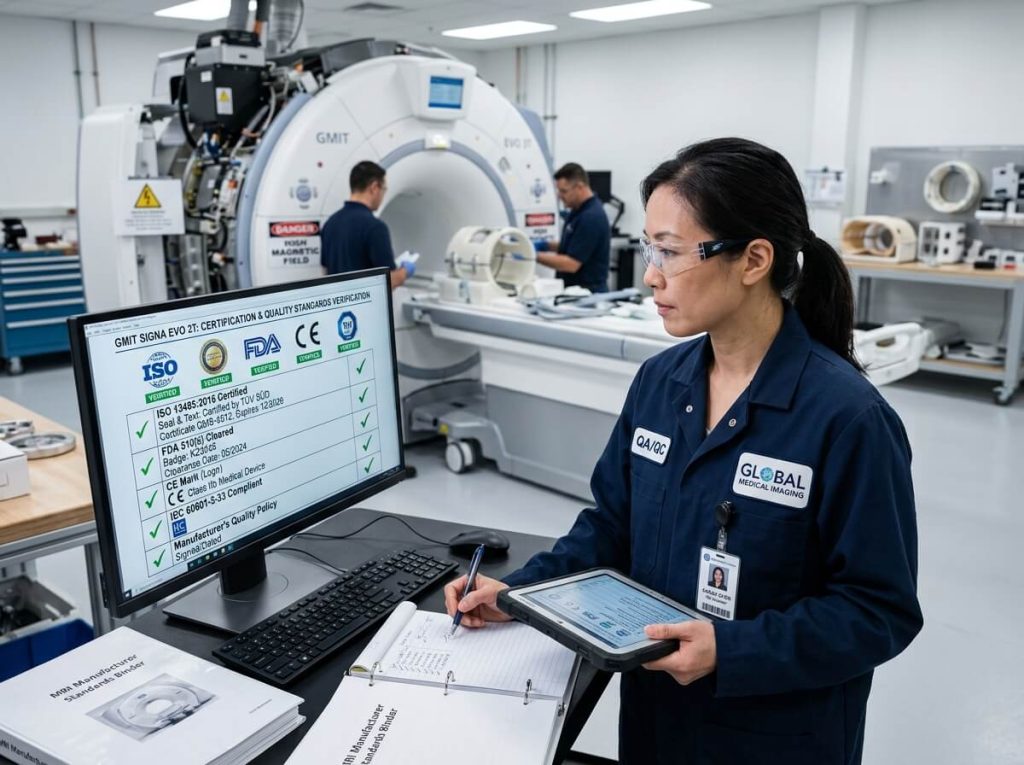
QA/QC specialist verifying ISO 13485, CE mark, and FDA clearance compliance checklist for medical imaging systems in a manufacturing facility.
4. Compare MRI Technical Specifications
When comparing MRI suppliers, do not only compare prices.
Technical specifications are equally important.
Important factors include:
4.1 Magnetic Field Strength
Compare:
- 0.35T MRI
- 0.5T MRI
- 1.5T MRI
- 3T MRI
Choose according to clinical requirements.
4.2 Image Quality
Important indicators include:
- Signal-to-noise ratio
- Resolution
- Imaging speed
- Advanced reconstruction technology
4.3 Software Functions
Modern MRI systems may include:
- AI-assisted imaging
- Automatic optimization
- Fast scanning protocols
- Advanced clinical applications
4.4 Patient Comfort
Consider:
- Bore size
- Noise reduction
- Patient table design
- User experience
Patient comfort affects:
- Examination success rate
- Hospital reputation
- Patient satisfaction
5. Evaluate MRI Installation and Technical Support
MRI installation is not a simple delivery process.
A professional supplier should provide complete support.
Site Planning Support
Before installation, suppliers should help evaluate:
- Room size
- Electrical requirements
- Shielding requirements
- Cooling system
Installation Service
A complete installation service may include:
- Equipment assembly
- System testing
- Calibration
- Performance verification
Training Service
Hospital staff need proper training.
Training should include:
- Equipment operation
- Patient positioning
- Basic troubleshooting
- Daily maintenance
6. Importance of MRI After-Sales Service
Many buyers focus on purchase price but underestimate after-sales support.
MRI equipment is expected to operate for many years.
A reliable supplier should provide:
Technical Support
Including:
- Remote assistance
- Software support
- Troubleshooting
Spare Parts Supply
Important questions:
- Are spare parts available?
- How quickly can parts be delivered?
- Is local support available?
Maintenance Service
Regular maintenance helps:
- Reduce downtime
- Extend equipment lifespan
- Maintain image quality
7. Why Hospitals Consider MRI Manufacturers From China
In recent years, Chinese medical imaging manufacturers have become important global suppliers.
Many hospitals and distributors choose Chinese suppliers because of:
7.1 Competitive Pricing
Compared with some international brands, Chinese MRI suppliers often provide:
- More affordable solutions
- Flexible configurations
- Better cost-performance ratio
7.2 Strong Manufacturing Capability
Professional Chinese manufacturers provide:
- Large production facilities
- Complete supply chains
- Engineering teams
- Quality management systems
7.3 OEM and ODM Solutions
Many Chinese medical equipment companies support:
- OEM manufacturing
- Private labeling
- Customized configurations
This is especially useful for:
- Medical distributors
- Regional agents
- Healthcare projects
8. MRI Supplier Evaluation Checklist
Before choosing an MRI supplier, buyers can use this checklist:
| Evaluation Item | Important Questions |
|---|---|
| Manufacturer Experience | How many years in MRI production? |
| Factory Capability | Does the company have its own factory? |
| Certifications | Are international certifications available? |
| Product Range | Does the supplier offer different MRI models? |
| Installation | Is professional installation included? |
| Training | Is operator training provided? |
| Warranty | What warranty period is offered? |
| Service | How fast is technical support? |
| Export Experience | Which countries have received products? |
9. Common Mistakes When Buying an MRI Machine
Mistake 1: Choosing Only Based on Price
The cheapest supplier may not provide:
- Reliable quality
- Technical support
- Long-term service
A lower initial price may create higher future costs.
Mistake 2: Ignoring Installation Requirements
MRI installation requires professional planning.
Poor installation may affect:
- System performance
- Image quality
- Equipment lifespan
Mistake 3: Not Checking After-Sales Capability
MRI machines require long-term support.
Always evaluate:
- Engineer availability
- Spare parts
- Maintenance service
Mistake 4: Buying Without Considering Future Growth
Hospitals should consider:
- Increasing patient demand
- New medical departments
- Future expansion
10. Questions to Ask an MRI Manufacturer Before Ordering
Before signing a contract, ask:
Product Questions:
- What MRI models do you provide?
- What applications does the system support?
- What accessories are included?
Commercial Questions:
- What is the delivery time?
- What payment terms are available?
- Is installation included?
Service Questions:
- How long is the warranty?
- Is remote support available?
- How are spare parts supplied?
Company Questions:
- How many countries have you exported to?
- Can you provide customer references?
- Do you have international project experience?
11. Why Choose a One-Stop Medical Equipment Supplier?
Many hospitals prefer suppliers that can provide complete solutions.
A professional medical equipment partner may provide:
- MRI systems
- CT scanners
- X-ray machines
- Ultrasound machines
- Laboratory equipment
- Operating room equipment
Advantages:
✔ Simplified procurement
✔ Consistent service
✔ Better project management
✔ Long-term cooperation
FAQ: MRI Supplier Questions
Q1: How do I find a reliable MRI machine manufacturer?
Check:
- Factory experience
- Certifications
- Export history
- Technical support capability
- Customer references
Q2: Are Chinese MRI manufacturers reliable?
Many Chinese MRI manufacturers now provide international-quality medical imaging systems and serve hospitals worldwide.
Q3: What should I compare when choosing MRI suppliers?
Compare:
- Technology
- Price
- Service
- Warranty
- Installation support
Q4: Can MRI manufacturers provide OEM service?
Yes. Many manufacturers provide OEM and customized solutions for international distributors.
Q5: How long does an MRI machine last?
With proper maintenance, an MRI system can typically provide reliable service for 10 years or longer.
Conclusion
Choosing an MRI machine manufacturer is a strategic decision that affects hospital operation for many years.
The right supplier should provide more than equipment.
A professional MRI partner should offer:
- Reliable technology
- Manufacturing capability
- Installation support
- Training
- After-sales service
- Long-term cooperation
When selecting an MRI supplier, hospitals should focus on overall value instead of only the purchase price.
A trusted medical imaging manufacturer can help healthcare providers build advanced diagnostic centers, improve clinical capability, and provide better patient care.