Executive Summary & Procurement Overview
Acquiring a computed tomography (CT) scanner is one of the most significant capital investments a hospital, diagnostic imaging center, or outpatient clinic will make. Whether you are expanding diagnostic capabilities, replacing an end-of-life imaging system, or establishing a new radiology department, selecting the right CT scan machine requires a thorough evaluation of clinical demand, slice architecture, initial purchasing price, ongoing operational overhead, and long-term return on investment (ROI).
This ultimate purchasing guide breaks down everything hospital procurement officers, biomedical engineers, and clinic owners need to know before buying a new or refurbished CT scanner. From evaluating slice configurations (16-slice vs 64-slice vs 128-slice) to navigating site planning, X-ray tube replacement costs, power requirements, and service level agreements (SLAs), this guide provides clear, practical advice designed for technical buyers and commercial decision-makers alike.
1. Understanding CT Scanner Price Tiers & Slice Configurations
The total cost of a CT scanner is heavily influenced by its detector slice configuration and clinical capability. Below is a detailed breakdown of market price ranges for new and pre-owned systems across the four primary equipment tiers.
| Tier Category | Slice Count Range | Estimated Price (New) | Estimated Price (Refurbished) | Primary Clinical Applications |
| Entry-Level / Basic | 16 – 32 Slices | $120,000 – $190,000 | $65,000 – $110,000 | Routine head & body scans, orthopedic imaging, urgent care clinics, basic ENT procedures. |
| Mid-Range / Workhorse | 64 Slices | $220,000 – $350,000 | $120,000 – $180,000 | General hospital emergency departments, routine chest/abdomen scans, basic trauma, vascular screening. |
| High-End / Advanced | 128 – 256 Slices | $380,000 – $650,000 | $200,000 – $320,000 | Advanced cardiac CT angiography (CCTA), neurology, high-speed pediatric imaging, oncology centers. |
| Premium / Ultra-Fast | 320+ Slices / Dual Source | $700,000 – $1,300,000+ | $380,000 – $550,000 | Whole-organ perfusion, single-heartbeat cardiac scans, academic research, high-volume trauma centers. |
16-Slice CT Scanners: Cost-Effective Outpatient Workhorses
For small diagnostic centers, community health facilities, and specialized orthopedic clinics, 16-slice CT scanners offer the lowest total cost of entry. These systems deliver fast scan times for anatomical cross-sections without requiring heavy electrical upgrades or massive cooling infrastructure. They are ideal for routine clinical workloads where advanced cardiac gating is not required.
64-Slice CT Scanners: The Industry Workhorse
A 64-slice CT machine represents the ideal balance between clinical versatility and financial ROI. It serves as the standard baseline for acute care hospitals and busy imaging centers. Capable of scanning 40mm of anatomical coverage per rotation, 64-slice systems significantly reduce patient breath-hold duration and motion artifacts, making them suitable for trauma, pulmonary embolism protocols, and routine cardiac screening.
128-Slice & 320-Slice CT Scanners: High-Speed Cardiac & Neuro Imaging
High-tier CT scanners (128 slices and above) are designed for demanding clinical environments. With ultra-fast gantry rotation speeds (down to 0.25 seconds per rotation), these systems capture full-organ perfusion imaging and clear coronary arteries in a single cardiac cycle. They are highly valued in high-volume hospitals where rapid patient turnaround and diagnostic accuracy for critically ill patients are paramount.
2. New vs. Refurbished CT Scanners: Making the Right Investment Choice
One of the most crucial financial decisions procurement teams face is deciding between purchasing a brand-new CT scanner directly from an Original Equipment Manufacturer (OEM) or acquiring a certified refurbished pre-owned system.
Benefits of Buying a New CT Scanner
-
Latest AI Low-Dose Software: Access to cutting-edge deep learning reconstruction algorithms that lower radiation dosage while maintaining image sharpness.
-
Full Manufacturer Warranty: Typically includes 12 to 24 months of full coverage for parts and labor, including X-ray tube coverage.
-
Longer Lifecycle Expectations: Expected operational lifespan of 10 to 12+ years before reaching end-of-life (EOL) status.
-
Maximum Up-Time Guarantees: OEM-backed service level agreements often promise 98%–99% operational uptime.
Benefits of Buying a Refurbished CT Scanner
-
30% to 50% Capital Cost Savings: Allows healthcare facilities to preserve capital for other medical equipment upgrades or facility expansion.
-
Proven Field Reliability: Refurbished models from major brands (such as GE LightSpeed/Optima, Siemens SOMATOM, Philips Brilliance, Toshiba/Canon Aquilion) have established track records and widely available spare parts.
-
Faster Return on Investment: Lower monthly debt service allows clinics with moderate patient throughput to achieve profitability within 12–18 months.
-
Eco-Friendly & Sustainable: Reconditioning pre-owned equipment supports medical sustainability initiatives.
3. Total Cost of Ownership (TCO) & Hidden Operational Costs
When calculating the return on investment for a CT scanner, looking solely at the purchase invoice will lead to severe budget overruns. Healthcare administrators must project the 5-year and 10-year Total Cost of Ownership (TCO) by evaluating several key operational variables.
1. X-Ray Tube Replacement Expenses
The X-ray tube is the most critical and highest-cost consumable component in a CT system. CT tubes are rated by Mega-Heat Units (MHU) and scan exposure seconds. A standard X-ray tube lasts between 500,000 to 1,500,000 slice rotations or 3 to 5 years under typical clinical usage. Replacement costs range from $40,000 to $130,000 per tube depending on system specifications. Ensure your purchase agreement clearly states whether tube replacement is covered under warranty or service contract.
2. Annual Service Contracts & Maintenance Agreements
Post-warranty maintenance contracts generally cost between 8% and 12% of the initial system purchase price annually. Facilities can choose between:
-
Full OEM Service Contracts ($35,000 – $90,000/year): Highest cost, but includes 24/7 technical support, factory parts, software updates, and full tube replacement coverage.
-
Independent Service Organization (ISO) Contracts ($20,000 – $50,000/year): Typically 20% to 40% cheaper, providing localized engineer support and certified aftermarket parts.
-
Preventive Maintenance (PM) Only Contracts ($10,000 – $25,000/year): Covers scheduled quarterly tune-ups and calibrations, with emergency repairs billed on a time-and-materials basis.
3. Facility Site Preparation & Installation Costs
Installing a medical CT scanner requires specialized architectural, electrical, and structural modifications. Site prep costs usually range from $25,000 to $85,000 and encompass:
-
Radiation Shielding: Installing lead sheet lining (2.0mm to 3.0mm lead equivalent) in scan room walls, leaded doors, and lead-glass operator viewing windows.
-
HVAC & Environmental Cooling: CT gantries and power cabinets generate substantial heat. Precision water chillers or high-capacity HVAC systems are required to maintain room temperatures between 18°C and 22°C (64°F–72°F).
-
Electrical Infrastructure Upgrades: A dedicated 3-phase 380V/480V power line with a step-down transformer and emergency Uninterruptible Power Supply (UPS) rated for 75 kVA to 120 kVA peak draw.
-
Structural Floor Reinforcement: CT gantries weigh between 1,800 kg to 3,500 kg (4,000 to 7,700 lbs). Floor loading capacity must be certified by a structural engineer.
4. Technical Specifications Every Procurement Officer Should Check
Before issuing a Request for Proposal (RFP) or signing a purchase contract, verify that the vendor provides explicit specifications for the following technical parameters:
-
Gantry Aperture / Bore Size: Standard bore size is 70 cm. Bariatric and trauma-focused systems feature wide 78 cm to 82 cm bore openings to accommodate larger patients and emergency monitoring equipment.
-
Generator Power Output (kW): Generators range from 40 kW (entry-level) to 100+ kW (premium). Higher kW ratings allow for faster exposure times and superior penetration through thick body tissue.
-
Spatial & Temporal Resolution: High spatial resolution (measured in line pairs per centimeter, lp/cm) ensures detailed visualization of small bone structures, while high temporal resolution prevents cardiac motion blur.
-
DICOM 3.0 & PACS Integration: Ensure seamless network compatibility with your hospital’s Picture Archiving and Communication System (PACS), Radiology Information System (RIS), and electronic health record (EHR) software.
-
Dose Reduction Technology: Verify the presence of Automated Exposure Control (AEC), pediatric dose protocols, and iterative reconstruction (e.g., ASiR, AIDR 3D, SAFIRE, or IMR) to minimize patient radiation exposure in accordance with ALARA guidelines.
5. Step-by-Step CT Scanner Purchasing Checklist
Follow this standardized step-by-step procurement process to ensure smooth acquisition and installation:
-
[x] Conduct Patient Volume Analysis: Estimate daily scan volume (e.g., 5–10 scans/day vs 40+ scans/day) to select the appropriate slice tier and generator strength.
-
[x] Perform Architectural & Structural Site Audit: Measure room dimensions, floor loading limits, access pathways (doorway and elevator clearances), and HVAC capacity.
-
[x] Request Itemized Quotations: Ensure quotes separately state system cost, rigging/shipping charges, installation fees, applications training, and warranty terms.
-
[x] Evaluate X-Ray Tube Warranty Coverage: Confirm whether the tube warranty is based on full calendar months, scan count, or pro-rated slice exposure limits.
-
[x] Review Local Regulatory & Radiation Safety Approvals: Secure permits from local atomic energy or health regulatory agencies prior to delivery.
-
[x] Schedule Clinical Applications Training: Ensure the vendor provides 3 to 5 days of on-site training for your radiologic technologists.
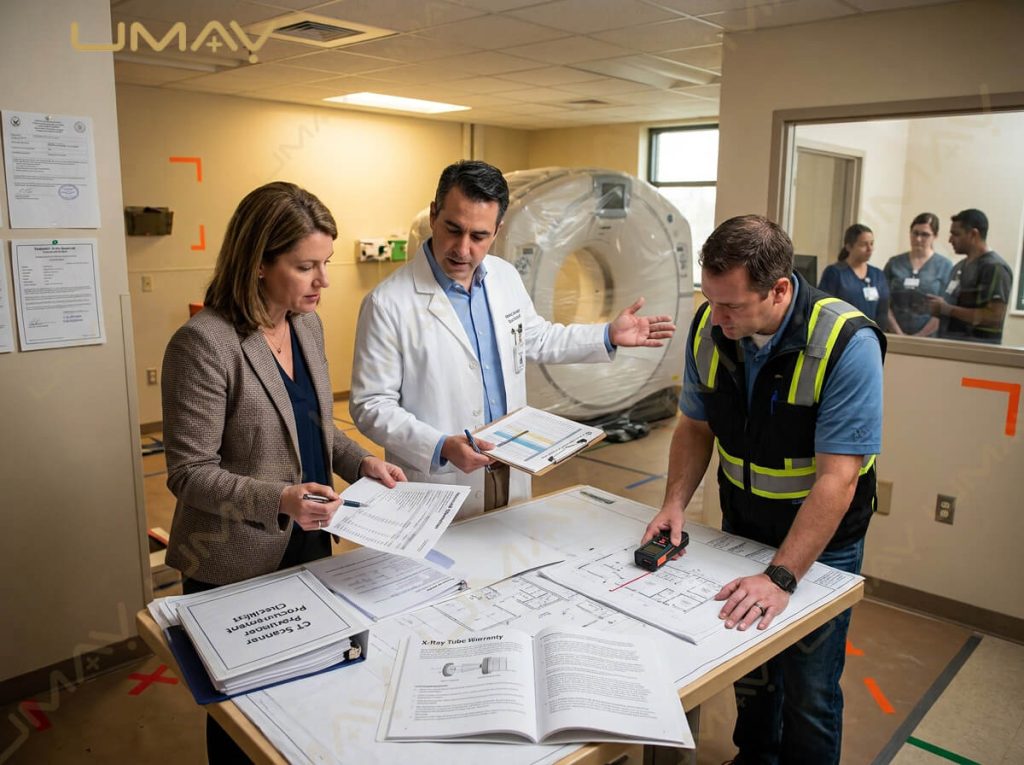
Radiology department team reviewing site planning floor plans, X-ray tube warranty documents, and CT scanner procurement checklist during facility installation.
6. Frequently Asked Questions (FAQ) for CT Scanner Buyers
Q1: How long does a medical CT scanner typically last?
With proper quarterly preventive maintenance and timely X-ray tube replacements, a quality CT scanner has an operational lifespan of 8 to 12 years. Many pre-owned systems refurbished at 5 years of age provide another 5 to 7 years of reliable service in outpatient centers.
Q2: How much power does a CT scanner consume?
CT scanners require a stable 3-phase high-voltage power source (typically 380V to 480V) with line capacity ranging between 75 kVA and 120 kVA during active peak exposures. Standby power consumption is significantly lower.
Q3: Can a 16-slice CT scanner perform cardiac imaging?
While a 16-slice scanner can perform calcium scoring and basic anatomical cardiac views, it generally lacks the speed required for detailed coronary CT angiography (CCTA). A 64-slice system or higher with ECG gating is strongly recommended for comprehensive cardiac diagnostics.
Q4: What is the average ROI payback period for a new CT scan machine?
In high-volume facilities performing 15 to 25 scans per day, a CT scanner typically pays for itself within 14 to 24 months. In lower-volume outpatient clinics (5 to 8 scans/day), certified refurbished systems offer a much safer financial pathway to achieve profitability within 18 months.