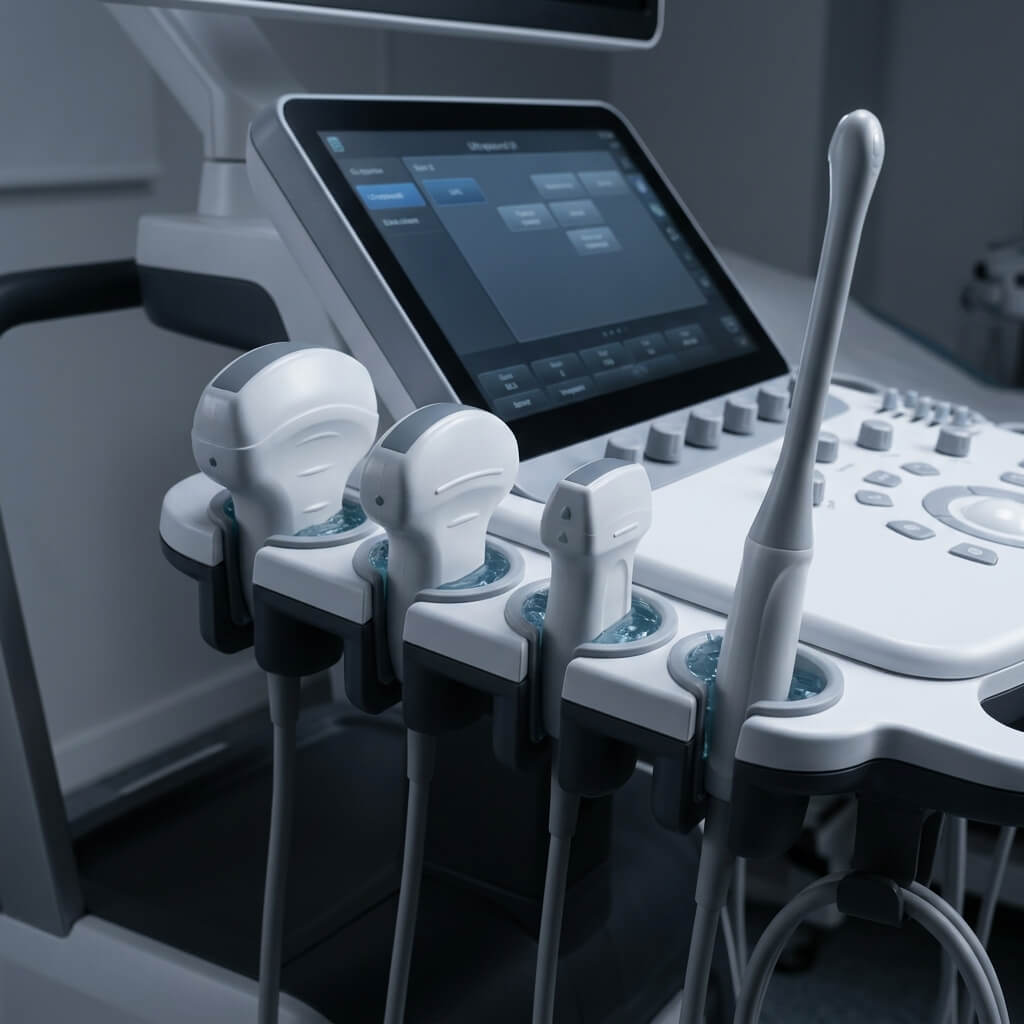
What Are the Different Types of Ultrasound Probes?
Ultrasound probes, also called ultrasound transducers, are available in different designs because different medical examinations require different imaging characteristics.
The main types of ultrasound probes include:
- Linear ultrasound probe
- Convex ultrasound probe
- Phased array ultrasound probe
- Endocavity ultrasound probe
- 3D/4D ultrasound probe
- Wireless ultrasound probe
- Pencil Doppler probe
- Hockey stick ultrasound probe
- Transesophageal echocardiography (TEE) probe
Each probe type has different features:
- Shape
- Frequency range
- Imaging depth
- Field of view
- Clinical application
For hospitals, clinics and medical equipment distributors, choosing the correct ultrasound transducer is important because the probe directly affects image quality and examination efficiency.
1. Why Are There Different Types of Ultrasound Probes?
A common question from healthcare buyers is:
“Why can’t one ultrasound probe be used for every examination?”
The reason is that different parts of the human body require different imaging conditions.
For example:
- Blood vessels are usually close to the skin and need high-resolution imaging.
- Abdominal organs are deeper and require stronger penetration.
- The heart is located between ribs and requires a small scanning footprint.
- Internal examinations require specially designed probes.
Therefore, ultrasound manufacturers develop different transducers for specific applications.
Common search keywords include:
- ultrasound probe types
- different types of ultrasound probes
- ultrasound transducer types
- medical ultrasound probe classification
- diagnostic ultrasound transducer types
- ultrasound probe selection
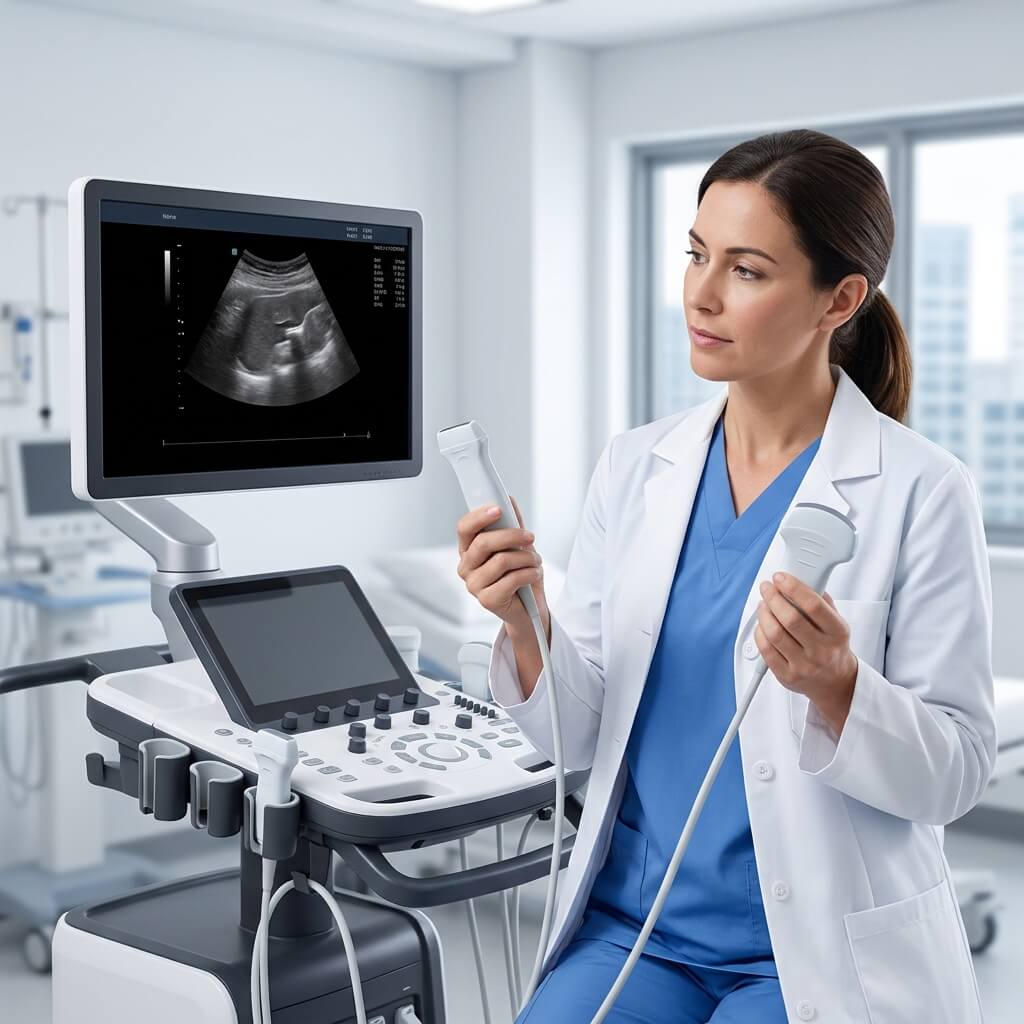
2. Complete Classification of Ultrasound Transducers
Ultrasound probes can be classified by:
1. Probe Shape
Including:
- Linear probe
- Convex probe
- Sector probe
- Endocavity probe
2. Array Technology
Including:
- Linear array transducer
- Curved array transducer
- Phased array transducer
- Matrix array transducer
3. Clinical Application
Including:
- Cardiac ultrasound probe
- Obstetric ultrasound probe
- Vascular ultrasound probe
- MSK ultrasound probe
- Abdominal ultrasound probe
4. Imaging Technology
Including:
- 2D ultrasound probe
- 3D ultrasound probe
- 4D ultrasound probe
- Doppler ultrasound probe
3. Linear Ultrasound Probe
What Is a Linear Ultrasound Probe?
A linear ultrasound probe is one of the most commonly used ultrasound transducers.
It has a flat scanning surface and produces a rectangular image.
Common keywords:
- Linear ultrasound probe
- Linear array transducer
- Linear array ultrasound probe
- High frequency ultrasound probe
- High resolution ultrasound transducer
Features of Linear Probes
Linear probes usually have:
- High frequency operation
- Excellent image resolution
- Wide near-field imaging
- Flat contact surface
They are designed for imaging structures close to the skin surface.
Linear Probe Applications
1. Vascular Ultrasound
Linear probes are widely used for:
- Arteries
- Veins
- Blood vessels
- Vascular access
Related keywords:
- vascular ultrasound probe
- vascular transducer
- Doppler vascular probe
- vein ultrasound probe
2. Musculoskeletal Ultrasound
Applications include:
- Tendons
- Ligaments
- Muscles
- Joints
Keywords:
- MSK ultrasound probe
- musculoskeletal ultrasound transducer
- orthopedic ultrasound probe
3. Breast Ultrasound
Used for:
- Breast tissue examination
- Lesion evaluation
Keywords:
- breast ultrasound probe
- breast imaging transducer
4. Thyroid Ultrasound
Used for:
- Thyroid imaging
- Neck examination
Keywords:
- thyroid ultrasound probe
- thyroid imaging transducer
Advantages of Linear Ultrasound Probes
Advantages include:
- High-resolution images
- Excellent superficial imaging
- Easy handling
- Suitable for small structures
Limitations of Linear Probes
Because they usually use higher frequencies:
- Imaging depth is limited
- Not ideal for deep abdominal organs
4. Convex Ultrasound Probe
What Is a Convex Probe?
A convex ultrasound probe, also called a curved array transducer, has a curved scanning surface.
Common keywords:
- Convex ultrasound probe
- Curved array ultrasound probe
- Curvilinear ultrasound transducer
- Abdominal ultrasound probe
Features of Convex Probes
Convex probes are designed for:
- Wider imaging area
- Deeper penetration
- Abdominal scanning
They usually operate at lower frequencies compared with linear probes.
Convex Probe Applications
1. Abdominal Ultrasound
Commonly used for:
- Liver
- Kidney
- Gallbladder
- Pancreas
- Abdominal organs
Keywords:
- abdominal ultrasound probe
- abdomen ultrasound transducer
- curved ultrasound probe
2. Pregnancy Ultrasound
One of the most common applications.
Used for:
- Fetal examination
- Obstetric imaging
- Pregnancy monitoring
Keywords:
- pregnancy ultrasound probe
- obstetric ultrasound transducer
- OB ultrasound probe
3. Emergency Ultrasound
Used in:
- Emergency departments
- Point-of-care ultrasound
Keywords:
- emergency ultrasound probe
- POCUS ultrasound transducer
Advantages of Convex Probes
- Good penetration depth
- Large scanning area
- Suitable for deep organs
5. Phased Array Ultrasound Probe
What Is a Phased Array Probe?
A phased array ultrasound probe uses electronically controlled elements to create a sector-shaped image.
It is also called:
- Sector probe
- Cardiac probe
- Echo probe
Common keywords:
- Phased array ultrasound probe
- Cardiac ultrasound probe
- Sector ultrasound transducer
- Echocardiography probe
Why Is a Phased Array Probe Used for Heart Imaging?
The heart is surrounded by ribs.
A phased array probe has:
- Small footprint
- Narrow scanning surface
- Wide imaging field
This allows imaging through spaces between ribs.
Applications of Phased Array Probes
Cardiology
Used for:
- Echocardiography
- Heart function evaluation
- Cardiac imaging
Keywords:
- cardiac ultrasound probe
- echo ultrasound probe
- echocardiography transducer
Emergency Medicine
Used for:
- Rapid assessment
- Point-of-care ultrasound
Keywords:
- POCUS cardiac probe
- emergency cardiac ultrasound probe
Advantages of Phased Array Probes
- Small footprint
- Excellent for cardiac imaging
- Suitable for deep structures
6. Endocavity Ultrasound Probe
What Is an Endocavity Probe?
An endocavity ultrasound probe is designed for internal examinations.
Common keywords:
- Endocavity ultrasound probe
- Internal ultrasound probe
- Transvaginal ultrasound probe
- Transrectal ultrasound probe
Types of Endocavity Probes
Transvaginal Ultrasound Probe
Used in:
- Gynecology
- Early pregnancy examination
- Pelvic imaging
Keywords:
- transvaginal ultrasound transducer
- vaginal ultrasound probe
Transrectal Ultrasound Probe
Used in:
- Urology
- Prostate examination
Keywords:
- transrectal ultrasound probe
- prostate ultrasound transducer
Advantages of Endocavity Probes
- Close proximity to target anatomy
- High-resolution internal imaging
- Specialized clinical applications
7. 3D and 4D Ultrasound Probes
What Are 3D/4D Ultrasound Probes?
Traditional ultrasound creates two-dimensional images.
3D/4D probes collect volume data and create three-dimensional images.
Common keywords:
- 3D ultrasound probe
- 4D ultrasound transducer
- Volume ultrasound probe
- 3D/4D ultrasound transducer
Applications of 3D/4D Probes
Obstetrics
Commonly used for:
- Fetal imaging
- Pregnancy visualization
Keywords:
- 4D pregnancy ultrasound probe
- fetal ultrasound transducer
Advanced Imaging
Applications include:
- Volume measurement
- Anatomical visualization
- Specialized examinations
Advantages of 3D/4D Ultrasound Probes
- Volume imaging
- More detailed anatomical visualization
- Advanced ultrasound applications
8. Wireless Ultrasound Probe
What Is a Wireless Ultrasound Probe?
A wireless ultrasound probe combines:
- Ultrasound transducer
- Signal processing
- Wireless communication
Common keywords:
- Wireless ultrasound probe
- Portable ultrasound probe
- Handheld ultrasound transducer
- Mobile ultrasound probe
Applications
Wireless probes are used in:
- Emergency medicine
- Ambulances
- Remote healthcare
- Point-of-care ultrasound
Advantages
- Portable
- Easy transportation
- Flexible clinical workflow
9. Pencil Doppler Ultrasound Probe
What Is a Pencil Doppler Probe?
A pencil Doppler probe is designed mainly for Doppler blood flow measurement.
Common keywords:
- Pencil Doppler probe
- Doppler ultrasound probe
- Continuous wave Doppler transducer
Applications
Used for:
- Vascular examination
- Blood flow assessment
- Peripheral circulation testing
10. Hockey Stick Ultrasound Probe
What Is a Hockey Stick Probe?
A hockey stick ultrasound probe is a small linear transducer with a compact footprint.
Common keywords:
- Hockey stick ultrasound probe
- Small footprint ultrasound probe
- Mini linear ultrasound probe
Applications
Used for:
- Small joints
- Hands and feet
- Nerve examination
- Pediatric imaging
11. TEE Ultrasound Probe
What Is a TEE Probe?
TEE means:
Transesophageal Echocardiography
A TEE probe is inserted into the esophagus to obtain detailed cardiac images.
Keywords:
- TEE ultrasound probe
- Transesophageal echocardiography probe
- Cardiac TEE transducer
Applications
Used mainly in:
- Cardiology
- Cardiac surgery
- Operating rooms
12. Ultrasound Probe Comparison Table
| Probe Type | Main Application | Main Feature |
|---|---|---|
| Linear Probe | Vascular, MSK, thyroid | High resolution |
| Convex Probe | Abdomen, pregnancy | Deep penetration |
| Phased Array Probe | Cardiology | Small footprint |
| Endocavity Probe | Gynecology, urology | Internal imaging |
| 3D/4D Probe | Fetal imaging | Volume imaging |
| Wireless Probe | Mobile ultrasound | Portable |
| Pencil Doppler | Blood flow | Doppler measurement |
| Hockey Stick | Small structures | Compact design |
13. How Do Hospitals Select the Right Ultrasound Probe?
Before purchasing, hospitals should consider:
1. Clinical Department
Examples:
| Department | Recommended Probe |
|---|---|
| Cardiology | Phased Array |
| Obstetrics | Convex / 3D Probe |
| Vascular | Linear Probe |
| Emergency | Convex / Linear |
| Gynecology | Endocavity |
| MSK | Linear |
2. Frequency Requirement
High frequency:
- Better detail
- Shallow imaging
Low frequency:
- More penetration
- Deep imaging
3. Ultrasound Machine Compatibility
Important factors:
- Connector type
- Software compatibility
- Manufacturer compatibility
Common searches:
- GE ultrasound probe
- Philips ultrasound probe
- Mindray ultrasound probe
- Siemens ultrasound probe
- Canon ultrasound probe
4. Supplier Support
International buyers should evaluate:
- Product quality
- Compatibility assistance
- Technical support
- OEM capability
14. Choosing an Ultrasound Probe Supplier
For hospitals and distributors, selecting a reliable supplier is important.
A professional supplier should provide:
- Complete product information
- Technical consultation
- Compatibility confirmation
- Quality inspection
- Export support
15. UMY Medical Equipment Co., Ltd. Ultrasound Solutions
UMY Medical Equipment Co., Ltd. is an international medical equipment supplier providing healthcare solutions for hospitals, clinics and distributors.
With more than 20 years of medical equipment experience, UMY Medical supports customers with:
- Medical imaging equipment solutions
- Ultrasound equipment supply
- OEM/ODM services
- Customized requirements
- International project support
For ultrasound projects, selecting the correct probe configuration requires understanding:
- Clinical application
- Ultrasound system compatibility
- Market requirements
- Customer usage environment
UMY Medical works with healthcare partners to provide suitable equipment solutions based on different application needs.
16. Frequently Asked Questions About Ultrasound Probe Types
What are the main types of ultrasound probes?
The main types are linear, convex, phased array, endocavity, 3D/4D and wireless ultrasound probes.
Which ultrasound probe is used for abdominal imaging?
A convex ultrasound probe is commonly used for abdominal examinations.
Which probe is best for cardiac ultrasound?
A phased array ultrasound probe is commonly used for cardiac imaging.
Which ultrasound probe is used for vascular imaging?
A high-frequency linear ultrasound probe is commonly used for vascular examinations.
What is the difference between linear and convex probes?
Linear probes provide higher resolution for shallow structures, while convex probes provide deeper imaging.
Are all ultrasound probes compatible with all machines?
No. Compatibility depends on the ultrasound system, connector and software requirements.
Conclusion
Ultrasound probes are designed for different medical applications.
The major types include:
- Linear ultrasound probes for superficial imaging
- Convex ultrasound probes for abdominal and pregnancy examinations
- Phased array probes for cardiac imaging
- Endocavity probes for internal examinations
- 3D/4D probes for volume imaging
- Wireless probes for portable ultrasound applications
For hospitals, clinics and distributors, selecting the right ultrasound transducer requires understanding the clinical application, imaging requirements and equipment compatibility.
A correct probe selection helps improve workflow efficiency and supports better diagnostic imaging.