Not all spectrometers are designed to measure the same thing.
The word spectrometer describes a broad category of analytical instruments. Different spectrometers use different measurement principles, wavelength regions, detectors, optical systems, and sample interfaces.
This is why a laboratory buyer searching for a spectrometer may actually need a very specific instrument, such as:
- UV-Vis spectrometer
- NIR spectrometer
- FTIR spectrometer
- Raman spectrometer
- fluorescence spectrometer
- emission spectrometer
- optical emission spectrometer
- mass spectrometer
- portable spectrometer
- handheld spectrometer
- fiber optic spectrometer
For example, UV-Vis systems are commonly used to study absorption, transmission, reflection, and related optical properties in ultraviolet and visible regions. NIR systems are frequently used for material and composition analysis, while FTIR and Raman are commonly used for molecular and material characterization.
The important question is therefore not:
Which spectrometer is the best?
It is:
Which type of spectrometer is suitable for my sample, wavelength range, measurement method, and application?
This guide compares the major types of spectrometers in simple terms so that laboratory users, researchers, engineers, medical and pharmaceutical companies, industrial users, and purchasing teams can understand the differences.
What Are the Main Types of Spectrometers?
The most common spectrometer categories can be grouped according to the signal they measure.
Optical Spectrometers
These measure electromagnetic radiation such as ultraviolet, visible, near-infrared, or infrared light.
Examples include:
- UV spectrometer
- visible spectrometer
- UV-Vis spectrometer
- NIR spectrometer
- infrared spectrometer
- FTIR spectrometer
- Raman spectrometer
- fluorescence spectrometer
- emission spectrometer
Mass Spectrometers
These measure ions according to their mass-to-charge ratio rather than optical wavelength.
Specialized Spectrometers
Other systems may be designed for:
- X-ray analysis
- atomic spectroscopy
- plasma emission
- laser characterization
- color measurement
- chemical identification
- process monitoring
A buyer should therefore identify the analytical technique before comparing specific products.
UV-Vis Spectrometer
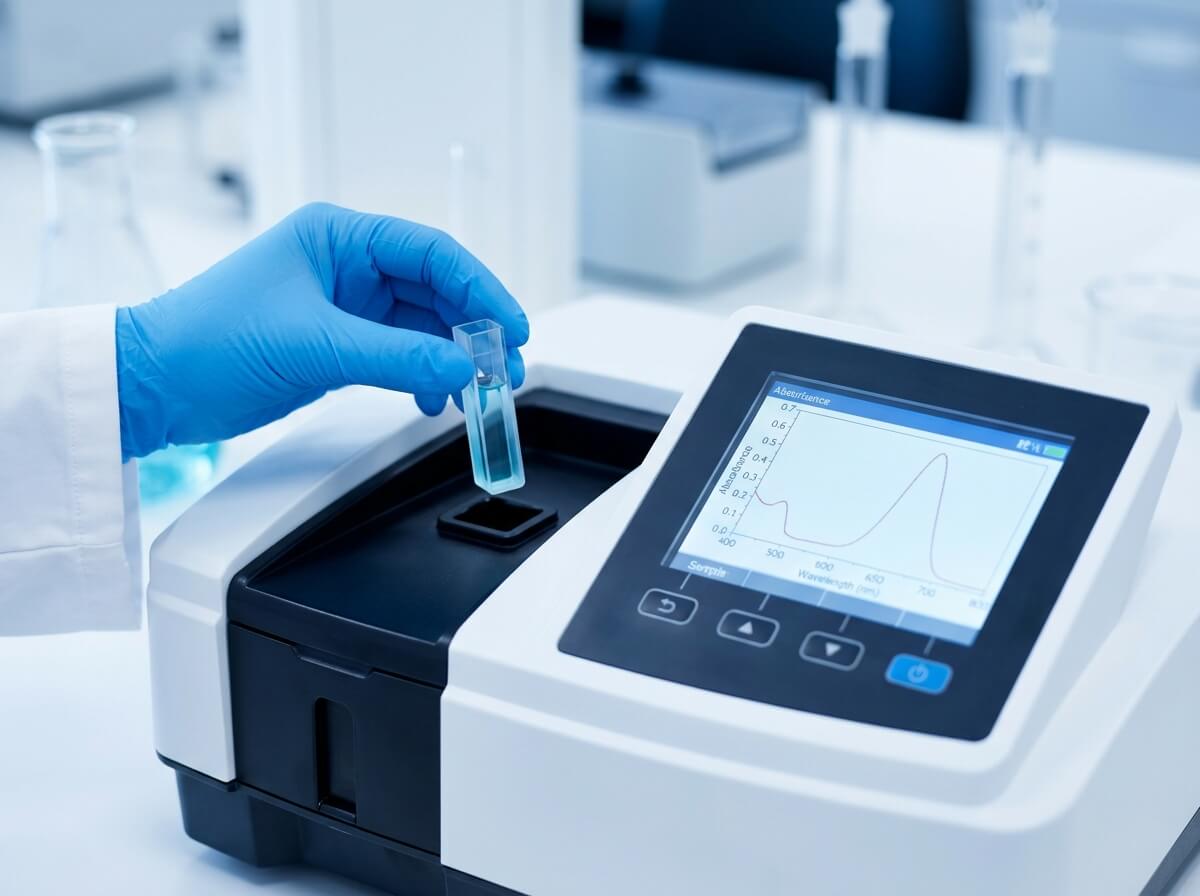
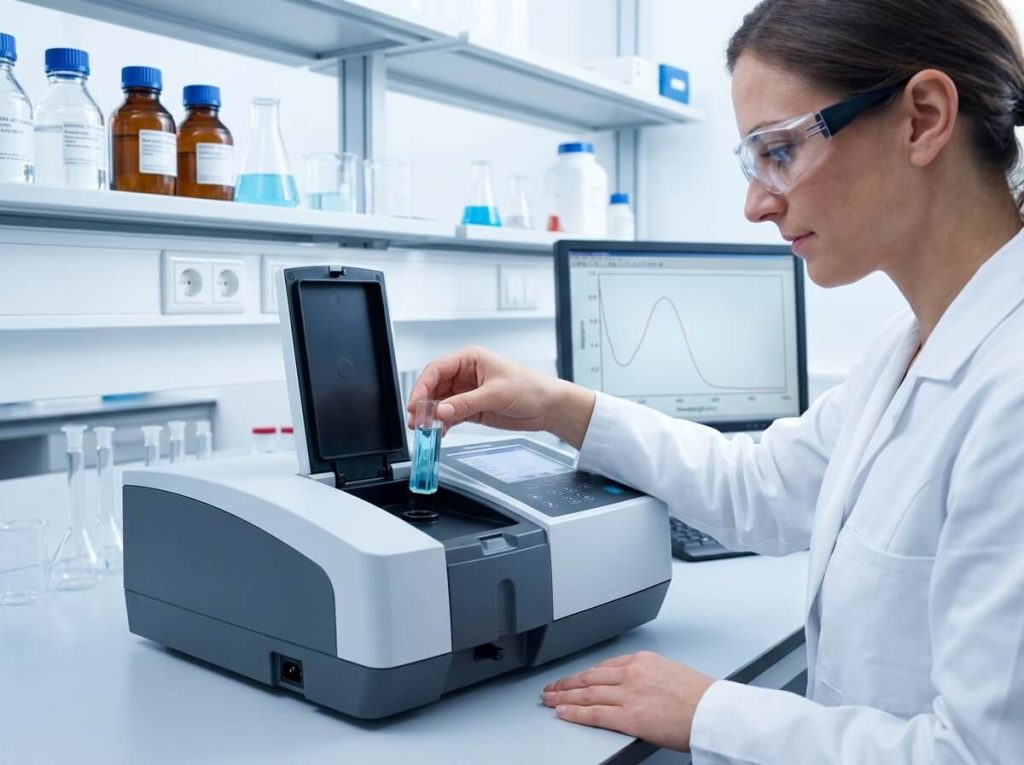
A UV-Vis spectrometer measures optical signals in the ultraviolet and visible spectral regions.
UV-Vis spectroscopy is one of the most widely used forms of optical analysis.
It can be used to study:
- absorbance
- transmittance
- reflectance
- concentration-related measurements
- optical characteristics
UV-Vis systems are widely used in:
- chemistry
- pharmaceuticals
- food testing
- environmental analysis
- life sciences
- materials research
- quality control
Shimadzu describes UV-Vis-NIR spectrophotometry as a technique that can provide information such as concentration, color, and optical characteristics from transmitted or reflected light, with applications across pharmaceuticals, environmental science, food safety, and materials research.
UV Spectrometer
A UV spectrometer focuses on ultraviolet wavelengths.
UV spectroscopy can be useful for:
- molecular absorption studies
- chemical analysis
- biological research
- pharmaceutical testing
The actual usable wavelength range depends on the optical system, detector, light source, and instrument design.
Visible Spectrometer
A visible spectrometer measures visible light.
Typical applications include:
- color measurement
- LED testing
- lamp testing
- light-source characterization
- optical research
Compact commercial spectrometers may be designed specifically for visible wavelengths and applications such as color measurement and LED characterization.
UV-Vis Spectrometer vs UV Spectrometer
These terms are related but not identical.
A UV spectrometer emphasizes the ultraviolet region.
A UV-Vis spectrometer covers both ultraviolet and visible wavelengths.
For example:
UV
→ ultraviolet measurements
UV-Vis
→ ultraviolet + visible measurements
The choice depends on the wavelength range of the target measurement.
UV-Vis vs UV-Vis-NIR
A UV-Vis-NIR spectrometer extends the measurement range beyond visible wavelengths into the near-infrared region.
This wider range can be useful when a single instrument needs to examine:
- ultraviolet signals
- visible light
- near-infrared signals
Some commercial spectrometer systems are specifically configured for ranges such as UV, UV-Vis, VIS-NIR, and UV-Vis-NIR.
When choosing between UV-Vis and UV-Vis-NIR, ask:
Do I actually need the NIR region?
A broader wavelength range can be useful, but the application should determine the required range.
NIR Spectrometer
NIR means Near Infrared.
A NIR spectrometer measures spectral information in the near-infrared region.
NIR spectroscopy is commonly used for:
- food analysis
- agricultural testing
- pharmaceutical analysis
- chemical analysis
- polymer identification
- raw material inspection
- process monitoring
- quality control
NIR is especially useful when rapid measurements of bulk materials are required.
Ocean Optics describes NIR spectroscopy as useful for obtaining information about subsurface sample characteristics and notes applications involving moisture and composition-related measurements.
What Is NIR Spectroscopy Used For?
NIR spectroscopy can be used for measurements related to:
- moisture
- protein
- fat
- carbohydrates
- raw materials
- polymers
- agricultural products
- pharmaceutical materials
In many applications, NIR calibration models are built using reference samples with known properties. The spectral patterns are then correlated with the target property to provide routine analysis.
This makes NIR particularly interesting for industrial and quality-control applications.
NIR vs FTIR
NIR and FTIR are frequently compared.
Both use infrared radiation, but they work in different spectral regions and can serve different analytical purposes.
NIR
NIR generally uses the near-infrared region.
It can be useful for:
- rapid measurements
- bulk material analysis
- agricultural products
- food
- pharmaceutical raw materials
- process monitoring
FTIR
FTIR operates in the mid-infrared region.
It is commonly used for:
- molecular fingerprinting
- compound identification
- material characterization
- laboratory analysis
Ocean Optics notes that FTIR generally offers stronger and sharper molecular absorption features, while NIR can penetrate more deeply into samples and often requires less sample preparation.
So the practical question is not:
NIR or FTIR?
It is:
Is my application better suited to near-infrared bulk measurement or mid-infrared molecular analysis?
FTIR Spectrometer
FTIR stands for Fourier Transform Infrared.
An FTIR spectrometer is designed to measure infrared spectra using a Fourier transform optical approach.
FTIR spectroscopy is widely used in:
- chemistry
- pharmaceuticals
- polymers
- materials science
- research
- contamination analysis
- quality control
FTIR can provide a spectral “fingerprint” that helps users identify or characterize materials.
Shimadzu includes FTIR among its molecular spectroscopy platforms and identifies applications across areas such as pharmaceuticals, electronics, energy, semiconductors, and life sciences.
What Is FTIR Used For?
Common FTIR applications include:
- material identification
- polymer identification
- chemical analysis
- pharmaceutical testing
- raw material verification
- surface analysis
- contamination analysis
- research
FTIR is especially useful when the goal is to understand molecular absorption features.
Different FTIR accessories can also support different sample types, including liquids, powders, solids, and surfaces.
For example, ATR accessories can allow some solid or liquid samples to be analyzed with limited sample preparation.
Shimadzu application material demonstrates the use of FTIR and Raman techniques for direct measurement of some solid and powder samples as part of molecular spectroscopy workflows.
FTIR vs Infrared Spectrometer
An infrared spectrometer is a broad term for a spectrometer that operates in the infrared region.
An FTIR spectrometer specifically refers to an infrared spectrometer using Fourier transform technology.
Therefore:
Infrared spectrometer
is the broader category.
FTIR spectrometer
is a specific type.
Raman Spectrometer
A Raman spectrometer measures Raman scattering produced when a sample is illuminated by a laser.
The resulting Raman spectrum can provide information about molecular structure and chemical composition.
Raman spectroscopy is used in:
- pharmaceuticals
- chemistry
- materials science
- geology
- mineral analysis
- forensic science
- research
- quality control
Raman systems can be found in different formats:
- laboratory Raman spectrometer
- portable Raman spectrometer
- handheld Raman spectrometer
- fiber-coupled Raman spectrometer
- Raman microscope
What Is a Raman Spectrometer Used For?
Raman spectroscopy can support:
- material identification
- chemical identification
- pharmaceutical raw material verification
- polymer analysis
- mineral identification
- research
- quality control
One advantage is that Raman can often analyze samples without extensive preparation, depending on the sample and instrument configuration.
However, fluorescence background and sample characteristics can affect Raman measurements.
The laser wavelength also matters.
Common Raman excitation wavelengths include:
- 532 nm
- 638 nm
- 785 nm
- 1064 nm
Commercial Raman light-source systems are available at several of these wavelengths, illustrating how laser wavelength is an important part of Raman system selection.
Raman vs FTIR
Raman and FTIR are both molecular spectroscopy techniques, but they provide complementary information.
Raman
Measures Raman scattering.
Often useful for:
- molecular vibrations
- material identification
- aqueous or packaged samples
- portable identification
FTIR
Measures infrared absorption.
Often useful for:
- molecular fingerprinting
- organic compounds
- polymers
- chemical identification
The best choice depends on:
- sample type
- target material
- water content
- fluorescence
- sample preparation
- required sensitivity
- measurement environment
Raman and FTIR are frequently used as complementary techniques rather than direct replacements for each other.
Raman vs NIR
Raman and NIR can both be used for material and chemical analysis, but they provide different information.
Raman
Based on inelastic scattering from laser excitation.
NIR
Based on absorption in the near-infrared region.
NIR can be attractive for rapid bulk analysis and process measurements, while Raman can be useful for molecular identification and chemical characterization.
Choose between them according to the analytical task rather than simply comparing instrument prices.
Fluorescence Spectrometer
A fluorescence spectrometer measures light emitted by a sample after excitation.
It may also be called a:
- spectrofluorometer
- fluorescence spectrometer
- fluorescence analyzer
- fluorometer
The basic process is:
Excitation light → Sample → Fluorescence emission → Detector
The excitation wavelength causes the sample to emit light at different wavelengths.
The instrument measures that emitted spectrum.
What Is a Fluorescence Spectrometer Used For?
Fluorescence spectroscopy is used in:
- biochemistry
- molecular biology
- pharmaceutical research
- chemistry
- life sciences
- environmental analysis
- materials science
Applications can include:
- fluorescent compounds
- biomolecules
- molecular interactions
- fluorescence intensity
- emission spectra
Fluorescence measurements can involve relatively weak signals, so detector sensitivity and optical throughput can be important.
High-sensitivity spectrometer systems are commonly marketed for applications such as fluorescence and Raman, particularly where weak optical signals need to be detected.
Fluorescence Spectrometer vs UV-Vis Spectrometer
This is another common comparison.
UV-Vis
Often measures how much light is absorbed or transmitted by a sample.
Fluorescence
Measures light emitted by the sample after excitation.
Therefore:
UV-Vis → absorption/transmission
Fluorescence → emission after excitation
Some samples can be analyzed using both techniques, but the measurement principles are different.
Emission Spectrometer
An emission spectrometer measures light emitted by an excited source or sample.
The excitation may be produced by:
- plasma
- flame
- electrical discharge
- thermal excitation
- laser excitation
Emission spectroscopy can provide characteristic spectral lines associated with elements or materials.
Common applications include:
- elemental analysis
- plasma monitoring
- material analysis
- laboratory research
- industrial testing
Optical Emission Spectrometer
An optical emission spectrometer, often abbreviated OES, is designed to analyze emitted optical radiation.
OES systems are commonly used in analytical laboratories and industrial environments.
Potential applications include:
- metals analysis
- elemental composition
- alloy identification
- process control
- quality inspection
For industrial use, buyers may focus on:
- wavelength range
- resolution
- sensitivity
- calibration
- sample handling
- software
- analysis library
Plasma Emission Spectrometer
A plasma emission spectrometer measures light emitted from an excited plasma.
The emitted spectrum can contain characteristic lines associated with different elements.
Plasma-based spectroscopy is widely used for elemental analysis.
The instrument configuration depends on:
- plasma source
- optical system
- detector
- wavelength coverage
- sensitivity
- sample introduction
A spectrometer designed for plasma emission can therefore be very different from a compact UV-Vis or NIR spectrometer.
Mass Spectrometer
A mass spectrometer is an important type of spectrometry instrument, but it is fundamentally different from an optical spectrometer.
Instead of separating light by wavelength, a mass spectrometer separates ions according to their mass-to-charge ratio (m/z).
A simplified workflow is:
Sample → Ionization → Ion separation → Detection → Mass spectrum
Mass spectrometry is used in:
- analytical chemistry
- pharmaceuticals
- proteomics
- metabolomics
- clinical research
- environmental analysis
- food analysis
Mass spectrometers can be integrated with chromatography systems such as:
- GC-MS
- LC-MS
- LC-MS/MS
Because the measurement principle is different, an optical spectrometer and mass spectrometer should not be compared simply by asking which one is “better.”
Optical Spectrometer vs Mass Spectrometer
| Feature | Optical Spectrometer | Mass Spectrometer |
|---|---|---|
| Main signal | Optical radiation | Ions |
| Main variable | Wavelength/frequency | Mass-to-charge ratio |
| Typical output | Optical spectrum | Mass spectrum |
| Common applications | Light, molecular and material analysis | Molecular and elemental analysis |
| Typical components | Grating, optics, detector | Ion source, mass analyzer, detector |
Choose the technology according to the type of information you need.
Portable Spectrometer
A portable spectrometer is designed to be moved between measurement locations.
Portable systems can be useful for:
- field testing
- environmental analysis
- agriculture
- material identification
- industrial inspection
- on-site quality control
Portable does not necessarily mean low performance.
A compact spectrometer can still be designed for demanding applications, depending on its detector, optics, wavelength range, and software.
Commercial miniature spectrometers are available for applications including absorbance, fluorescence, color measurement, LED characterization, material reflectance, and plasma monitoring.
Handheld Spectrometer
A handheld spectrometer is an even more compact form designed for direct field operation.
Potential applications include:
- material identification
- raw material screening
- field chemistry
- agricultural testing
- environmental testing
- industrial inspection
Handheld instruments are useful when samples need to be measured where they are located instead of being transported to a laboratory.
Important considerations include:
- battery
- weight
- measurement time
- wavelength range
- sample interface
- ruggedness
- software
- connectivity
Fiber Optic Spectrometer
A fiber optic spectrometer uses an optical fiber to transfer light into the spectrometer.
This can be useful when:
- the sample is far from the instrument
- direct access is difficult
- the measurement point is inside equipment
- remote optical measurement is required
Potential applications include:
- industrial monitoring
- process analysis
- light-source measurement
- laboratory spectroscopy
- environmental measurements
When selecting a fiber optic spectrometer, check:
- fiber connector
- fiber type
- spectral range
- input configuration
- optical coupling
- detector
- resolution
Microspectrometer
A microspectrometer is a compact spectrometer designed to occupy very little physical space.
These instruments can be attractive for:
- OEM integration
- portable instruments
- embedded measurement systems
- compact laboratory equipment
- industrial sensors
Modern miniature spectrometers are available with different spectral configurations, such as UV, visible, and NIR ranges, and can be integrated into other instruments.
This makes the microspectrometer category particularly relevant for equipment manufacturers developing their own analytical or optical products.
CCD vs CMOS Spectrometer
Two detector technologies frequently appear in compact optical spectrometers:
CCD
and
CMOS
Both can be used in array-based spectral detection.
CCD Spectrometer
CCD detectors have traditionally been widely used in spectroscopy.
They can offer strong spectral measurement performance depending on the detector design.
CMOS Spectrometer
CMOS detectors can provide compact electronics and integration advantages.
Some miniature spectrometers use CMOS detectors for applications requiring small size and rapid measurements.
The decision should be based on:
- wavelength range
- sensitivity
- noise
- speed
- dynamic range
- pixel architecture
- size
- application
Silicon vs InGaAs Spectrometer
Detector material should match the target wavelength range.
Silicon
Silicon detectors are widely used for UV-visible and visible-near-infrared applications depending on the specific design.
InGaAs
InGaAs detectors are commonly used for near-infrared measurements.
This means:
Silicon → commonly associated with shorter optical wavelengths
InGaAs → commonly associated with NIR
The exact range depends on the detector architecture and instrument design.
For example, current compact NIR spectrometer products use InGaAs detector arrays for ranges extending into the near-infrared.
UV-Vis vs NIR Spectrometer
Both are optical spectrometers, but they operate in different wavelength regions.
UV-Vis
Commonly used for:
- absorbance
- concentration-related analysis
- optical measurements
- chemical analysis
- color
NIR
Commonly used for:
- moisture
- bulk material
- food
- agriculture
- pharmaceuticals
- polymer analysis
The sample and analytical objective should determine the choice.
NIR vs FTIR Spectrometer
A practical comparison is:
| Feature | NIR | FTIR |
|---|---|---|
| Spectral region | Near infrared | Mid infrared |
| Typical goal | Rapid material/composition analysis | Molecular identification |
| Sample penetration | Relatively deeper | More surface-sensitive depending on method |
| Sample preparation | Often limited | Can vary by method |
| Common industries | Food, agriculture, pharma, process | Chemistry, materials, pharma |
| Typical use | Routine and process analysis | Fingerprinting and characterization |
NIR can be particularly attractive where rapid and minimally prepared bulk measurements are required, while FTIR is often valuable when detailed molecular absorption features are the goal.
FTIR vs Raman Spectrometer
Both are commonly used for molecular characterization.
FTIR
Measures infrared absorption.
Raman
Measures Raman scattering.
They can provide complementary information.
A laboratory may use both techniques when a material is difficult to characterize with only one method.
When choosing between them, evaluate:
- sample type
- water content
- fluorescence
- required sensitivity
- preparation
- available accessories
- spectral information required
The correct choice depends on the measurement objective.
UV-Vis vs Fluorescence Spectrometer
The main difference is the type of signal measured.
UV-Vis
Usually studies how a sample interacts with transmitted, reflected, or absorbed light.
Fluorescence
Measures light emitted after optical excitation.
Fluorescence can offer high sensitivity for suitable fluorescent molecules, but the instrument design and detector requirements are different.
If the target compound naturally fluoresces or can be tagged with a fluorescent marker, a fluorescence system may be appropriate.
Raman vs Fluorescence Spectrometer
These techniques can both involve optical excitation and emitted light, but the origin of the signal is different.
Raman
→ inelastic scattering
Fluorescence
→ emission following excitation
A Raman instrument uses a laser and detects Raman-shifted light.
A fluorescence instrument typically uses an excitation wavelength and measures fluorescence emission.
Sample fluorescence can also interfere with Raman measurements, which is one reason laser wavelength selection matters.
Which Spectrometer Should I Choose?
Start with the application.
Choose UV-Vis When:
You need:
- absorbance
- transmittance
- concentration analysis
- visible optical measurements
Choose NIR When:
You need:
- rapid bulk analysis
- moisture measurement
- food analysis
- agricultural analysis
- raw material screening
Choose FTIR When:
You need:
- molecular fingerprinting
- material identification
- polymer analysis
- chemical characterization
Choose Raman When:
You need:
- molecular identification
- material identification
- pharmaceutical screening
- portable chemical analysis
Choose Fluorescence When:
You need:
- fluorescence emission
- weak fluorescent signals
- biochemical fluorescence analysis
Choose Emission/OES When:
You need:
- elemental emission
- plasma analysis
- metals or alloy analysis
Choose Mass Spectrometry When:
You need:
- mass-to-charge analysis
- molecular identification
- high-level molecular characterization
The measurement objective should come first.
How to Select Between Different Spectrometer Types
Ask these questions:
1. What sample am I measuring?
Is it:
- liquid
- solid
- powder
- gas
- biological material
- polymer
- metal
- food
- agricultural material?
2. What information do I need?
Do you need:
- concentration
- composition
- material identification
- wavelength
- fluorescence
- molecular structure
- elemental composition?
3. What wavelength range is required?
Possible ranges include:
- UV
- visible
- UV-Vis
- NIR
- infrared
- Raman-related spectral regions
4. How fast must the measurement be?
Laboratory research may allow longer integration times.
Industrial process monitoring may require rapid acquisition.
Some compact spectrometers are specifically designed for high-speed measurements and process applications.
5. Is the instrument portable?
Choose a portable or handheld design when field measurements are required.
6. How weak is the signal?
Weak fluorescence, Raman, or emission signals can require higher sensitivity.
High-sensitivity spectrometers may use cooled or back-thinned detectors and other approaches designed for low-light measurements.
Spectrometer Types by Application
| Application | Common Spectrometer Types |
|---|---|
| Chemical analysis | UV-Vis, FTIR, Raman |
| Pharmaceutical | UV-Vis, NIR, FTIR, Raman |
| Food analysis | NIR, UV-Vis, FTIR |
| Agriculture | NIR, optical spectrometer |
| Material identification | FTIR, Raman |
| LED testing | Visible spectrometer |
| Laser testing | Optical spectrometer |
| Fluorescent analysis | Fluorescence spectrometer |
| Plasma analysis | Emission spectrometer |
| Elemental analysis | Emission, X-ray, mass spectrometry |
| Field identification | Portable/handheld Raman or NIR |
| Process monitoring | NIR, optical emission, compact spectrometer |
This table is only a general guide. The correct instrument depends on the actual analytical method.
Why Wavelength Range Matters When Choosing a Spectrometer
The first question for many optical measurements should be:
What wavelength do I need to measure?
A spectrometer cannot provide useful information outside the range supported by its optical system and detector.
The usable range can depend on:
- detector sensitivity
- diffraction grating
- optical coatings
- slit
- filters
- light source
- optical configuration
Ocean Optics notes that a spectrometer’s wavelength range depends on both detector response and diffraction-grating characteristics.
Therefore, do not select a spectrometer by detector type alone.
Why Detector Type Matters
Different spectral regions favor different detectors.
Examples include:
Silicon
→ UV/visible-related systems
CCD
→ broad optical array applications
CMOS
→ compact and fast digital systems
InGaAs
→ near-infrared
TE-cooled CCD
→ low-light applications
The detector should match both:
wavelength
and:
sensitivity requirements
A detector with an appropriate wavelength range but insufficient sensitivity may still be unsuitable for a weak-signal application.
Why Resolution Matters
Different applications require different levels of spectral resolution.
A broad-spectrum measurement may not require extremely fine resolution.
A laser measurement or emission-line analysis may need much finer separation between nearby spectral features.
Important factors include:
- grating
- slit width
- detector pixel size
- optical design
- wavelength range
A high-resolution spectrometer may sacrifice some optical throughput, depending on its design.
Therefore, choose resolution based on the spectral features you actually need to distinguish.
Why Sensitivity Matters
Sensitivity becomes important when signals are weak.
Examples include:
- fluorescence
- Raman
- plasma emission
- low-concentration analysis
- low-light optical measurements
A highly sensitive spectrometer may use:
- high-efficiency optics
- optimized detector
- detector cooling
- low-noise electronics
- longer integration time
High sensitivity can be useful, but the required level depends on the application.
Why Speed Matters
Some measurements require only one spectrum every few seconds.
Others may need:
- real-time monitoring
- millisecond measurements
- fast process control
- LED flicker testing
- dynamic event measurement
Some commercial high-speed spectrometers specify very short integration times and are marketed for applications including quality-control sorting and dynamic-event measurement.
Therefore:
laboratory research → resolution and sensitivity may dominate
industrial monitoring → speed may dominate
The correct balance depends on the application.
Why Portability Matters
A laboratory spectrometer can provide extensive functionality but may not be convenient for field work.
A portable or handheld spectrometer can make measurements easier when the sample cannot be transported.
Portability is particularly useful for:
- environmental testing
- agricultural inspection
- remote material analysis
- field research
- industrial maintenance
- incoming material inspection
Important portable-spectrometer specifications include:
- size
- weight
- battery
- durability
- wireless connectivity
- software
- sample interface
Spectrometer Selection Mistakes
Mistake 1: Choosing Only by Price
Two spectrometers can have very different measurement capabilities.
Mistake 2: Choosing the Widest Spectral Range
A wider range is not necessarily better if the application requires only a narrow region.
Mistake 3: Choosing Only by Resolution
High resolution may not be useful if the target signal is broad.
Mistake 4: Ignoring Detector Technology
The detector should match the required wavelength and sensitivity.
Mistake 5: Ignoring the Sample
A spectrometer should be matched to how the sample is measured.
Mistake 6: Ignoring Software
Data acquisition and analysis are important parts of a modern spectroscopy system.
Mistake 7: Ignoring the Operating Environment
A laboratory instrument may not be suitable for harsh field or industrial conditions.
Spectrometer Type Comparison
| Spectrometer Type | Main Measurement | Common Applications |
|---|---|---|
| UV Spectrometer | UV optical signal | Chemical research, UV analysis |
| Visible Spectrometer | Visible light | Color, LED, lighting |
| UV-Vis Spectrometer | UV + visible | Chemistry, pharma, laboratory analysis |
| NIR Spectrometer | Near-infrared | Food, agriculture, pharma, materials |
| FTIR Spectrometer | Infrared absorption | Materials, chemistry, polymers |
| Raman Spectrometer | Raman scattering | Material and chemical identification |
| Fluorescence Spectrometer | Fluorescence emission | Biochemistry, pharma, life sciences |
| Emission Spectrometer | Emitted light | Elemental and plasma analysis |
| OES | Optical emission | Metals and industrial analysis |
| Mass Spectrometer | Mass-to-charge ratio | Molecular and analytical chemistry |
| Portable Spectrometer | Varies | Field and on-site measurements |
| Handheld Spectrometer | Varies | Mobile identification and screening |
Frequently Asked Questions
How many types of spectrometers are there?
There are many types because spectrometers can be classified by measurement principle, wavelength region, detector, optical configuration, and application.
What is the most common type of spectrometer?
There is no single type that dominates every field. UV-Vis, NIR, FTIR, Raman, fluorescence, emission, and mass spectrometry are all important for different applications.
What is a UV-Vis spectrometer used for?
UV-Vis spectrometers are commonly used for absorbance, transmittance, concentration-related analysis, and optical measurements.
What is a NIR spectrometer used for?
NIR spectrometers are commonly used for food, agriculture, pharmaceutical, chemical, polymer, and bulk material analysis.
What is an FTIR spectrometer used for?
FTIR spectrometers are commonly used for molecular fingerprinting, material identification, chemical analysis, polymer testing, and research.
What is a Raman spectrometer used for?
Raman spectrometers are commonly used for molecular and material identification, pharmaceutical analysis, chemical testing, and research.
What is a fluorescence spectrometer used for?
It measures fluorescence emitted by a sample after excitation and is commonly used in chemistry, biochemistry, pharmaceuticals, and life science research.
What is an emission spectrometer used for?
It measures light emitted by an excited sample or source and can be used for elemental and material analysis.
What is an optical emission spectrometer?
An optical emission spectrometer analyzes emitted optical radiation and is commonly used for elemental and industrial analysis.
What is a mass spectrometer used for?
A mass spectrometer analyzes ions according to mass-to-charge ratio and is widely used in analytical chemistry, pharmaceuticals, life sciences, and research.
What is the difference between a spectrometer and a mass spectrometer?
An optical spectrometer measures radiation by wavelength or related optical properties, while a mass spectrometer measures ions by mass-to-charge ratio.
What is the difference between UV-Vis and NIR?
UV-Vis works primarily in the ultraviolet and visible regions, while NIR measures near-infrared spectral information.
What is the difference between NIR and FTIR?
NIR uses the near-infrared region and is often useful for rapid bulk analysis. FTIR uses infrared absorption for detailed molecular and material characterization.
What is the difference between Raman and FTIR?
Raman measures Raman scattering, while FTIR measures infrared absorption. They can provide complementary molecular information.
What is the difference between Raman and NIR?
Raman measures inelastic scattering from laser excitation, while NIR measures near-infrared absorption patterns.
What is the difference between UV-Vis and fluorescence?
UV-Vis commonly measures absorption or transmission, while fluorescence spectroscopy measures light emitted after excitation.
What is a portable spectrometer?
A portable spectrometer is designed to be transported between measurement locations for field, industrial, or on-site testing.
What is a handheld spectrometer?
A handheld spectrometer is a compact spectroscopy instrument designed for direct field operation.
What is a fiber optic spectrometer?
A fiber optic spectrometer uses optical fiber to transfer light between the sample or measurement point and the spectrometer.
What is a CCD spectrometer?
A CCD spectrometer uses a CCD detector array to measure spectral information.
What is a CMOS spectrometer?
A CMOS spectrometer uses a CMOS-based detector or sensor architecture for spectral measurement.
Is CCD better than CMOS for spectroscopy?
Neither is automatically better. The choice depends on wavelength range, sensitivity, speed, noise, dynamic range, and application.
What is an InGaAs spectrometer?
An InGaAs spectrometer uses an indium gallium arsenide detector and is commonly associated with near-infrared measurements.
Which spectrometer is best for chemical analysis?
UV-Vis, FTIR, Raman, NIR, emission, or mass spectrometry may all be appropriate depending on the chemical information required.
Which spectrometer is best for food analysis?
NIR is commonly used for rapid food and agricultural analysis, while UV-Vis and FTIR can also be suitable for specific tests.
Which spectrometer is best for pharmaceutical analysis?
UV-Vis, NIR, FTIR, Raman, fluorescence, and mass spectrometry can all be used in pharmaceutical applications, depending on the analytical task.
Which spectrometer is best for material identification?
FTIR and Raman are frequently considered for material identification, although NIR and other techniques can also be useful.
Which spectrometer is best for LED testing?
A visible or UV-Vis optical spectrometer can be suitable for LED spectral characterization, depending on the LED wavelength range.
Which spectrometer is best for laser measurement?
A high-resolution optical spectrometer with an appropriate wavelength range can be suitable for measuring laser wavelength and spectral characteristics.
Which spectrometer should I buy?
Start with the measurement objective, then select the appropriate technique, wavelength range, resolution, sensitivity, detector, sample interface, speed, and operating format.
How to Choose the Right Spectrometer Type
A simple decision process can help.
Need UV or Visible Absorption?
Consider:
UV-Vis spectrometer
Need Rapid Bulk Material Analysis?
Consider:
NIR spectrometer
Need Molecular Fingerprinting?
Consider:
FTIR spectrometer
Need Chemical or Material Identification?
Consider:
Raman spectrometer
Need Fluorescence Measurement?
Consider:
Fluorescence spectrometer
Need Elemental Emission Analysis?
Consider:
Emission or optical emission spectrometer
Need Mass-to-Charge Analysis?
Consider:
Mass spectrometer
Need Field Measurements?
Consider:
Portable or handheld spectrometer
This simple approach can reduce the number of instruments that need to be compared.
Conclusion
The term spectrometer covers a wide range of analytical instruments.
The main categories include:
UV spectrometers
visible spectrometers
UV-Vis spectrometers
NIR spectrometers
FTIR spectrometers
Raman spectrometers
fluorescence spectrometers
emission spectrometers
optical emission spectrometers
mass spectrometers
portable spectrometers
handheld spectrometers
Each type is designed for a different measurement principle or application.
UV-Vis is widely associated with optical absorption and transmission measurements.
NIR is often used for rapid analysis of bulk materials and composition-related measurements.
FTIR is commonly used for molecular fingerprinting and material characterization.
Raman is useful for molecular and material identification through Raman scattering.
Fluorescence systems measure emitted light following excitation.
Emission spectrometers analyze radiation from excited sources.
Mass spectrometers measure ions according to mass-to-charge ratio rather than optical wavelength.
For this reason, the best spectrometer is not necessarily the instrument with the widest range, highest resolution, or highest sensitivity.
The correct instrument is the one that matches the:
sample → analytical objective → spectral range → resolution → sensitivity → detector → speed → environment → software
For a laboratory buyer, identifying the measurement technique first can make the rest of the purchasing decision much easier.
For a distributor or industrial equipment buyer, it is also useful to consider whether the supplier offers different detector technologies, wavelength configurations, accessories, software, OEM/ODM options, and technical support.
Before requesting a quotation, define exactly what you need to measure.
Then compare the appropriate spectrometer category rather than comparing unrelated instruments simply because they all contain the word “spectrometer.”
The right spectrometer starts with the right measurement method.