A spectrometer is more than a laboratory instrument. Today, spectroscopy is used across many industries to identify materials, measure chemical properties, evaluate product quality, monitor processes, and study light.
This wide range of applications is one reason the search term spectrometer can lead to many different products.
A chemistry laboratory may need a UV-Vis spectrometer.
A pharmaceutical company may use NIR, FTIR, Raman, or UV-Vis spectroscopy.
A food manufacturer may use NIR spectroscopy for rapid raw-material and product analysis.
A materials laboratory may choose an FTIR spectrometer or Raman spectrometer.
An LED manufacturer may need a visible optical spectrometer.
An industrial company may require a compact spectrometer for process monitoring or quality control.
This article explains where spectrometers are used, what they can measure, and what buyers should consider when selecting a spectroscopy instrument for a specific industry.
What Are Spectrometers Used For?
In simple terms, spectrometers are used to obtain information from a spectrum.
Depending on the instrument and analytical technique, spectroscopy can support:
material identification
chemical analysis
concentration measurement
quality control
raw material verification
composition analysis
light-source characterization
process monitoring
environmental testing
research
product inspection
Different industries use different spectral techniques.
Some measurements focus on absorption.
Others focus on reflection, transmission, fluorescence, Raman scattering, or emission.
Therefore, the first step is to understand the application.
Spectrometer Applications in Chemistry
Chemistry is one of the largest application areas for spectroscopy.
A chemical analysis spectrometer can be used to study:
compounds
solutions
reactions
materials
raw materials
chemical composition
Common techniques include:
UV-Vis spectroscopy
FTIR spectroscopy
Raman spectroscopy
fluorescence spectroscopy
NIR spectroscopy
emission spectroscopy
Spectrometer for Chemical Analysis
The appropriate system depends on the analytical question.
For example:
UV-Vis may be useful for absorption-based measurements.
FTIR may help identify molecular functional groups and materials.
Raman can provide complementary molecular information.
NIR can support rapid analysis of bulk materials.
A chemistry laboratory should therefore start with:
What information do we need from the sample?
rather than:
Which spectrometer should we buy?
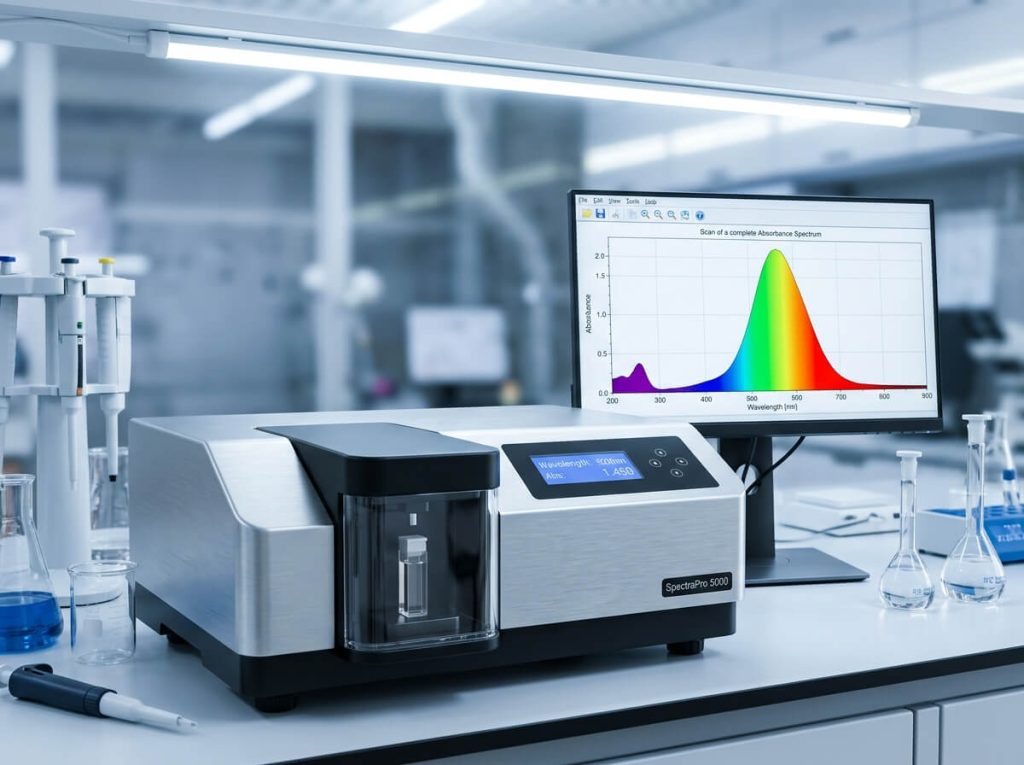
Automated laboratory spectrophotometer featuring a digital control screen alongside a monitor showing full-spectrum absorbance curves.
Spectrometer for Chemical Identification
One important spectroscopy application is material or chemical identification.
Different substances can produce different spectral patterns.
A reference spectrum can sometimes be compared with a measured spectrum to help identify an unknown material.
Applications include:
raw material verification
polymer identification
chemical screening
contamination investigation
unknown sample analysis
quality control
FTIR and Raman spectroscopy are particularly relevant to many material-identification workflows.
The exact technique should depend on the material and required measurement information.
Spectrometer for Pharmaceutical Analysis
The pharmaceutical industry uses spectroscopy in research, development, quality control, raw-material testing, and process monitoring.
Possible applications include:
raw material identification
formulation analysis
active ingredient evaluation
tablet analysis
content uniformity studies
process monitoring
product quality testing
Common spectroscopy techniques include:
UV-Vis
NIR
FTIR
Raman
fluorescence
mass spectrometry
The appropriate technology depends on whether the goal is:
identification
concentration
composition
molecular characterization
process monitoring
NIR Spectrometer for Pharmaceutical Industry
NIR spectroscopy can be useful for rapid pharmaceutical analysis.
It can support measurements related to:
raw materials
powders
tablets
moisture
composition
manufacturing processes
One attraction of NIR is the ability to analyze some materials with limited sample preparation.
For production environments, speed can also be valuable.
A pharmaceutical NIR spectrometer may therefore be used as part of a quality-control or process-monitoring workflow.
Important specifications can include:
spectral range
resolution
detector
acquisition speed
calibration
software
sample interface
Raman Spectrometer for Pharmaceutical Applications
Raman spectroscopy can be useful for pharmaceutical material identification and chemical characterization.
Potential applications include:
raw material verification
active pharmaceutical ingredient identification
polymorph studies
process monitoring
packaging-related analysis
chemical identification
A Raman system may also be useful when measurements need to be performed through certain transparent containers or packaging, depending on the sample and measurement setup.
A pharmaceutical Raman spectrometer should be selected according to:
excitation wavelength
spectral range
spectral resolution
fluorescence background
sensitivity
sample interface
laser power
software
FTIR Spectrometer for Pharmaceuticals
FTIR spectroscopy is commonly used for:
raw material identification
chemical fingerprinting
contamination analysis
polymer analysis
formulation research
An FTIR instrument with ATR accessories can simplify analysis of certain solid and liquid samples.
For pharmaceutical laboratories, sample handling and software can be just as important as the basic optical specifications.
Spectrometer Applications in Food Analysis
The food industry is another major spectroscopy market.
A food analysis spectrometer can support:
composition analysis
moisture testing
ingredient verification
quality control
raw material inspection
product consistency
NIR spectroscopy is particularly relevant to food and agricultural products because it can provide rapid information about bulk material properties.
Applications can include:
grain analysis
flour analysis
meat analysis
dairy analysis
fruit and vegetable analysis
oil analysis
feed analysis
NIR Spectrometer for Food Analysis
NIR spectroscopy is widely associated with food and agricultural analysis.
Potential measurements include:
moisture
protein
fat
carbohydrate
fiber
other composition-related properties
A NIR food spectrometer can be used in:
laboratories
production lines
raw-material receiving
quality-control departments
portable testing
NIR measurements commonly rely on calibration models developed from reference data.
This means software and calibration can be especially important when selecting a food spectroscopy system.
Spectrometer for Food Quality Control
Food manufacturers may use spectroscopy to monitor consistency between:
batches
suppliers
production runs
raw materials
Potential applications include:
raw-material inspection
product grading
composition monitoring
moisture control
quality screening
For industrial environments, rapid measurement can be more important than extremely high spectral resolution.
Therefore, a production-line spectrometer may have different specifications from a research laboratory system.
Spectrometer for Agriculture
Spectroscopy can also support agricultural testing.
Possible applications include:
soil analysis
plant analysis
crop testing
grain quality
feed analysis
fruit quality
moisture measurement
NIR is frequently considered for rapid agricultural measurements because it can analyze some materials without extensive sample preparation.
A portable NIR spectrometer can also be useful for field work.
Important considerations include:
wavelength range
portability
battery
calibration
sample interface
software
environmental protection
Spectrometer for Soil Analysis
A soil analysis spectrometer can be used to investigate spectral features associated with soil properties.
Possible objectives include:
soil classification
moisture estimation
organic matter assessment
agricultural research
field surveys
The exact measurement capability depends on the spectroscopy technique and calibration model.
For field use, buyers should also consider:
temperature
dust
portability
battery
ruggedness
data storage
Environmental Spectrometer Applications
Environmental testing is another important field for spectroscopy.
A spectrometer for environmental testing may be used for:
water analysis
air analysis
soil analysis
pollutant screening
environmental research
monitoring
Possible spectroscopy technologies include:
UV-Vis
fluorescence
Raman
NIR
infrared
emission spectroscopy
The most appropriate method depends on the target substance and required detection capability.
Spectrometer for Water Analysis
Spectroscopy can support water-quality measurements related to:
chemical concentration
dissolved compounds
organic matter
pollutants
color
fluorescence
UV-Vis spectroscopy is often used in water-analysis workflows because many substances absorb light in UV or visible regions.
A water-analysis spectrometer may therefore be used in:
environmental laboratories
water treatment facilities
research institutions
industrial wastewater testing
The required wavelength range and sample path length depend on the analytical method.
Spectrometer for Air and Gas Analysis
Optical spectroscopy can also be used for gas-related measurements.
Depending on the technique, applications may include:
gas identification
gas concentration
combustion analysis
emissions monitoring
atmospheric research
Possible technologies include:
infrared spectroscopy
UV spectroscopy
laser spectroscopy
emission spectroscopy
For industrial monitoring, a process spectrometer may need to operate continuously rather than only for occasional laboratory measurements.
Spectrometer for Environmental Monitoring
Environmental monitoring often involves measurements outside a traditional laboratory.
This can increase the value of:
portable spectrometers
handheld spectrometers
fiber optic spectrometers
battery-powered systems
A field instrument may need:
lightweight design
battery
data storage
ruggedness
wireless communication
GPS or location support
simple software
However, portability should not be chosen at the expense of required analytical performance.
Spectrometer Applications in Materials Science
Materials science uses spectroscopy to understand composition, structure, and chemical characteristics.
Applications include:
polymer analysis
coating analysis
semiconductor research
ceramics
minerals
composites
metals
adhesives
Common techniques include:
FTIR
Raman
NIR
UV-Vis
optical emission spectroscopy
FTIR Spectrometer for Polymer Analysis
FTIR is frequently used for polymer identification and characterization.
It can help users compare spectral features between:
plastic materials
polymer grades
coatings
adhesives
rubber
packaging
Applications include:
incoming material inspection
failure analysis
contamination analysis
quality control
research
A library of reference spectra can help users identify unknown polymer materials.
Raman Spectrometer for Material Identification
Raman spectroscopy is another useful tool for material identification.
Possible targets include:
minerals
pigments
polymers
pharmaceuticals
carbon materials
chemicals
Portable Raman systems can extend material identification beyond the laboratory.
This can be useful for:
field geology
industrial inspection
incoming material screening
research
forensic applications
Spectrometer for Semiconductor Industry
Spectroscopy is widely used in advanced materials and semiconductor research.
Potential applications include:
thin-film analysis
material characterization
optical property measurement
defect investigation
process monitoring
The exact instrument depends on the material and target parameter.
Optical spectrometers can be used for:
reflectance
transmission
emission
photoluminescence
Other specialized analytical instruments may be selected when elemental or molecular information is required.
Spectrometer for Metals and Alloy Analysis
Metals and alloys can be analyzed using techniques such as optical emission spectroscopy.
An optical emission spectrometer can help determine elemental composition in suitable samples.
Potential applications include:
alloy identification
incoming material inspection
production quality control
metal sorting
foundry analysis
In an industrial environment, buyers may prioritize:
measurement speed
repeatability
calibration
software
element library
sample preparation
ruggedness
Optical Emission Spectrometer for Quality Control
An optical emission spectrometer (OES) can be useful when elemental composition needs to be measured from suitable materials.
Industrial applications can include:
steel
aluminum
copper
nickel
titanium
other alloys
A quality-control laboratory may use OES to verify whether a material meets a defined composition specification.
The actual capability depends on the instrument, sample preparation, calibration, and analytical method.
Spectrometer for LED Testing
LED and lighting manufacturers use optical spectrometers to characterize light sources.
Applications include:
LED spectrum measurement
spectral power distribution
wavelength measurement
color-related testing
lamp characterization
lighting research
A spectrometer for LED testing should typically be selected according to:
wavelength range
wavelength accuracy
spectral resolution
dynamic range
optical input
measurement speed
Visible spectrometers are commonly used for LED characterization.
Spectrometer for Lighting Analysis
Lighting companies may need to measure:
visible spectrum
spectral power distribution
wavelength
color-related properties
intensity
A fiber optic spectrometer can be useful when the light source needs to be measured remotely.
An integrating sphere may also be used in some optical measurement setups where total output or related photometric/radiometric information is required.
The appropriate system depends on the measurement standard and test method.
Spectrometer for Laser Measurement
Laser testing is another important optical application.
A spectrometer can be used to investigate:
center wavelength
spectral width
spectral distribution
side modes
wavelength stability
For laser measurement, the spectrometer should be selected based on:
target wavelength
required spectral resolution
optical input power
detector sensitivity
dynamic range
attenuation requirements
A spectrometer designed for general light measurement may not be suitable for high-power laser testing without appropriate optical attenuation and input protection.
Spectrometer for Fiber Optic Testing
Optical spectrometers can be combined with fiber-optic inputs to analyze light transmitted through optical fibers.
Applications include:
telecom research
fiber-optic component testing
laser characterization
LED testing
optical communications
laboratory optics
Important specifications may include:
optical connector
spectral range
resolution
detector
sensitivity
input numerical aperture
Spectrometer Applications in Research Laboratories
Research laboratories may use several types of spectroscopy equipment simultaneously.
A university, research institute, or industrial R&D center may use:
UV-Vis
NIR
FTIR
Raman
fluorescence
optical emission
mass spectrometry
The same laboratory may need different instruments for different research questions.
For example:
UV-Vis → absorption
FTIR → molecular fingerprinting
Raman → molecular/material characterization
Fluorescence → emission from excited samples
Mass spectrometry → molecular mass-related information
This is why a laboratory should first define the analytical objective.
Spectrometer for Quality Control
Quality control is one of the most commercially important spectroscopy applications.
A quality control spectrometer can be used to compare a product or material against an expected standard.
Potential applications include:
raw material inspection
finished product testing
batch comparison
color measurement
composition analysis
contamination screening
supplier verification
The exact instrument depends on what needs to be controlled.
A food company may use NIR.
A polymer manufacturer may use FTIR.
A metals company may use optical emission spectroscopy.
A lighting company may use a visible optical spectrometer.
Spectrometer for Process Monitoring
Some industries need continuous measurements rather than occasional laboratory tests.
A process spectrometer can be used to monitor changes during production.
Potential applications include:
chemical processes
pharmaceutical manufacturing
food processing
polymer production
combustion
industrial material processing
Process spectroscopy can support:
real-time monitoring
process control
quality consistency
early detection of changes
For these systems, important requirements may include:
acquisition speed
stability
calibration
communication
software
environmental protection
integration with control systems
Online Spectrometer vs Laboratory Spectrometer
An online or in-line spectrometer is used near the production process.
A laboratory spectrometer is generally used in a controlled laboratory environment.
Feature
Online / In-Line
Laboratory
Location
Production process
Laboratory
Main priority
Speed and continuous monitoring
Analytical performance
Environment
Industrial
Controlled
Automation
Often important
Varies
Sample handling
Often automated
Often manual
Integration
Process control
Laboratory workflow
Neither type is universally better.
The intended application determines the design.
Spectrometer for Pharmaceutical Quality Control
A pharmaceutical quality-control department may use spectroscopy for:
incoming raw materials
product identification
composition checks
formulation analysis
process monitoring
Important procurement questions include:
What substances need to be measured?
Is the measurement qualitative or quantitative?
Is sample preparation acceptable?
Is the system for laboratory or production use?
How fast does the measurement need to be?
What software and calibration support are required?
Spectrometer for Food Quality Control
For food production, spectroscopy may support:
raw-material grading
moisture analysis
composition testing
product consistency
quality screening
Production environments often require fast measurements.
For this reason, NIR can be attractive for certain food applications.
However, the instrument should be matched to the target property and validated measurement method.
Spectrometer for Pharmaceutical Raw Materials
Raw-material verification is a practical application of spectroscopy.
A pharmaceutical manufacturer may need to confirm that an incoming material matches the expected reference.
Possible technologies include:
NIR
Raman
FTIR
UV-Vis
The best option depends on:
material type
packaging
measurement method
required speed
identification criteria
For example, a portable Raman instrument may be useful for some material-identification workflows where opening the packaging is undesirable, depending on the sample and optical conditions.
Spectrometer for Academic Education
Spectrometers are also used in:
universities
colleges
schools
training laboratories
Educational applications can include:
light and optics experiments
emission spectra
absorption spectra
LED testing
laser measurements
chemistry experiments
For teaching laboratories, important factors may include:
ease of use
safety
software
affordability
portability
educational demonstrations
A compact digital spectrometer can be useful when students need to observe spectra directly on a computer.
Portable Spectrometer for Field Testing
Field spectroscopy allows measurements to be performed close to the sample.
Common applications include:
environmental testing
agriculture
mineral identification
material inspection
industrial maintenance
incoming material verification
Important portable-system specifications include:
weight
battery life
ruggedness
measurement speed
wavelength range
data storage
connectivity
A field spectrometer should be selected based on both the measurement and the environment.
Handheld Spectrometer Applications
Handheld spectroscopy can help users identify or screen materials directly at the measurement location.
Potential users include:
field researchers
environmental inspectors
agricultural technicians
industrial technicians
quality-control staff
Possible applications include:
material identification
raw-material screening
environmental analysis
field research
product inspection
A handheld instrument should provide an appropriate balance between portability and analytical capability.
Fiber Optic Spectrometer Applications
Fiber optics can separate the spectrometer from the sample location.
This is useful when direct instrument placement is difficult.
Potential applications include:
remote light measurement
industrial process monitoring
LED testing
laboratory optics
environmental sensing
laser testing
Before purchasing a fiber optic spectrometer, confirm the required connector, fiber type, optical input, wavelength range, and detector.
How to Select a Spectrometer by Application
A simple selection process can prevent many purchasing mistakes.
Step 1: Identify the Sample
Ask whether the sample is:
liquid
solid
powder
gas
biological material
metal
polymer
food
agricultural material
Step 2: Identify the Target Information
Do you need:
concentration?
composition?
material identification?
emission?
fluorescence?
reflectance?
transmission?
wavelength?
Step 3: Choose the Spectroscopy Technique
Possible options include:
UV-Vis
NIR
FTIR
Raman
fluorescence
emission
mass spectrometry
Step 4: Define the Operating Environment
Will the instrument be used in:
laboratory
factory
field
mobile vehicle
production line?
Step 5: Define Performance Requirements
Compare:
wavelength range
resolution
sensitivity
detector
acquisition speed
accuracy
software
This method is more reliable than starting with a product catalog.
Which Spectrometer Is Best for Chemical Analysis?
There is no single answer.
UV-Vis
Useful when absorption or concentration-related measurements are required.
FTIR
Useful for molecular fingerprinting and material identification.
Raman
Useful for molecular and material characterization.
NIR
Useful for rapid bulk and composition-related measurements.
Mass Spectrometry
Useful when mass-to-charge information is required.
The correct choice depends on the chemical question.
Which Spectrometer Is Best for Food Analysis?
NIR is commonly considered for rapid food and agricultural analysis.
Other techniques may be appropriate when the target measurement involves:
specific absorption
molecular characterization
fluorescence
elemental information
The final choice depends on the analytical method, calibration, sample type, and required speed.
Which Spectrometer Is Best for Pharmaceutical Analysis?
Possible options include:
UV-Vis
NIR
FTIR
Raman
fluorescence
mass spectrometry
The choice depends on whether the objective is:
identity
composition
concentration
molecular structure
process monitoring
trace analysis
Which Spectrometer Is Best for Environmental Testing?
Depending on the target, environmental testing may use:
UV-Vis
fluorescence
NIR
infrared
Raman
emission spectroscopy
Water analysis, gas analysis, soil analysis, and pollutant monitoring can require very different techniques.
Which Spectrometer Is Best for Material Identification?
FTIR and Raman are frequently considered for material identification.
However, NIR, visible spectroscopy, X-ray spectroscopy, and other analytical technologies can also be useful depending on the material.
The correct technology depends on:
material type
surface condition
sample preparation
target information
required sensitivity
Which Spectrometer Is Best for Industrial Quality Control?
Industrial quality control can use many spectroscopy technologies.
The choice depends on the product.
Examples include:
Food → NIR
Polymers → FTIR
Materials → Raman
Metals → OES
Lighting → optical spectrometer
Chemical processes → NIR/IR/other process spectroscopy
The main point is to match the instrument to the production requirement.
Spectrometer Application Comparison
Application
Common Spectrometer Type
Main Purpose
Chemical analysis
UV-Vis / FTIR / Raman
Chemical characterization
Pharmaceutical
UV-Vis / NIR / Raman / FTIR
QC and material analysis
Food
NIR / UV-Vis / FTIR
Composition and quality
Agriculture
NIR
Crop, soil, and material analysis
Water testing
UV-Vis / fluorescence
Chemical and optical measurements
Environmental
UV-Vis / IR / Raman
Monitoring and analysis
Polymer analysis
FTIR / Raman
Material identification
Metals
OES
Elemental composition
LED testing
Visible spectrometer
Spectral characterization
Laser testing
Optical spectrometer
Wavelength and spectrum
Process monitoring
NIR / IR / optical
Continuous measurement
Field analysis
Portable / handheld
On-site testing
Research
Multiple types
Specialized analysis
Education
Compact optical
Teaching and experiments
What Makes a Spectrometer Suitable for Industrial Use?
Industrial spectroscopy has different requirements from laboratory research.
An industrial spectrometer may need:
stable measurement
fast acquisition
robust housing
easy calibration
software integration
communication interfaces
long operating periods
environmental protection
Depending on the environment, buyers may also need to consider:
temperature
vibration
dust
humidity
continuous operation
The correct industrial spectrometer is therefore defined by both the analytical target and the operating environment.
What Makes a Spectrometer Suitable for Field Use?
Field instruments may prioritize:
small size
low weight
battery
ruggedness
simple operation
data storage
wireless communication
But portability should not replace measurement capability.
Before selecting a field spectrometer, confirm:
required wavelength range
sensitivity
resolution
calibration
sample interface
environmental protection
Common Mistakes When Choosing a Spectrometer for an Application
Choosing by Product Name
A product called “spectrometer” may not perform the measurement you need.
Choosing the Widest Range
A wider spectral range is not always useful.
Choosing Only by Resolution
Extremely high resolution may not be necessary for broad spectral features.
Ignoring the Sample
Sample properties can strongly influence measurement methods.
Ignoring Calibration
Some applications rely heavily on calibration models or reference standards.
Ignoring Workflow
A laboratory instrument may not be practical for continuous production monitoring.
Ignoring Software
Data processing and reporting are part of the measurement workflow.
Ignoring Environment
A field instrument and laboratory instrument can require different physical designs.
Frequently Asked Questions
What are spectrometers used for?
Spectrometers are used to measure and analyze spectral information for applications such as chemical analysis, material identification, food testing, pharmaceutical analysis, environmental monitoring, lighting, laser testing, and industrial quality control.
What industries use spectrometers?
Industries include pharmaceuticals, food, agriculture, chemicals, environmental testing, materials, metals, lighting, semiconductors, manufacturing, research, and education.
What is a spectrometer used for in chemistry?
It can be used for chemical identification, concentration-related analysis, molecular characterization, reaction studies, and quality control.
What is a spectrometer used for in pharmaceuticals?
It can support raw-material identification, formulation analysis, quality control, process monitoring, and research.
What is a spectrometer used for in food?
It can support composition analysis, moisture measurement, raw-material inspection, grading, and quality control.
What is a NIR spectrometer used for?
NIR spectrometers can be used for rapid analysis of food, agriculture, pharmaceuticals, polymers, raw materials, and other bulk materials.
What is an FTIR spectrometer used for?
FTIR spectrometers are commonly used for molecular fingerprinting, material identification, polymer analysis, chemical characterization, and research.
What is a Raman spectrometer used for?
Raman spectrometers can support material identification, pharmaceutical analysis, chemical characterization, geology, and research.
What is a UV-Vis spectrometer used for?
UV-Vis instruments are commonly used for absorbance, transmission, concentration-related measurements, and optical analysis.
What spectrometer is used for food analysis?
NIR is commonly used for rapid food composition and quality measurements, although UV-Vis and FTIR can also be used for specific applications.
What spectrometer is used for pharmaceutical testing?
UV-Vis, NIR, FTIR, Raman, fluorescence, and mass spectrometry can all be used depending on the analytical objective.
What spectrometer is used for soil analysis?
NIR and other optical spectroscopy methods can be used for soil analysis depending on the target property and calibration.
What spectrometer is used for water analysis?
UV-Vis, fluorescence, and other optical spectroscopy systems may be used depending on the target compounds and measurement method.
Can a spectrometer identify materials?
Some spectroscopy techniques can help identify materials by comparing their spectral characteristics with reference data.
Can a spectrometer measure concentration?
Yes. Certain spectroscopic methods can be used for quantitative concentration analysis when an appropriate calibration or analytical method is available.
Can a spectrometer be used for quality control?
Yes. Spectrometers can support raw-material verification, composition analysis, product comparison, and process monitoring.
Can a spectrometer be used in a factory?
Yes. Spectrometers can be used for industrial quality control, process monitoring, material identification, and optical testing.
What is a process spectrometer?
A process spectrometer is designed to perform measurements near or within a production process, often with an emphasis on continuous or rapid analysis.
What is an online spectrometer?
An online spectrometer is integrated into an industrial process for measurements performed continuously or at defined intervals.
What is a portable spectrometer used for?
Portable spectrometers are used for field testing, environmental analysis, agricultural measurements, material identification, and industrial inspection.
What is a handheld spectrometer used for?
A handheld spectrometer provides compact on-site spectral analysis for applications such as material screening and field measurements.
What is a spectrometer used for in LED testing?
It can measure LED wavelength, spectral distribution, and other optical characteristics.
Can a spectrometer measure a laser?
Yes. An appropriate optical spectrometer can measure laser wavelength and spectral characteristics within its supported range.
Can a spectrometer be used for polymer testing?
Yes. FTIR and Raman spectroscopy are commonly considered for polymer identification and characterization.
Can a spectrometer be used for metals?
Yes. Optical emission spectrometers are widely used for elemental composition analysis of suitable metal samples.
Can a spectrometer be used for agriculture?
Yes. NIR and other spectroscopy techniques can support soil, crop, grain, feed, and agricultural-product analysis.
Can spectroscopy be used for environmental monitoring?
Yes. Spectroscopy can support water, soil, air, pollutant, and other environmental measurements depending on the analytical technique.
How do I choose a spectrometer for my application?
Start with the sample and measurement objective, then determine the required spectroscopy technique, wavelength range, resolution, sensitivity, speed, detector, sample interface, software, and operating environment.
This checklist can make spectrometer purchasing much easier.
Conclusion
Spectrometers are used in many industries because spectral information can provide useful clues about light sources, materials, chemicals, and products.
Major application areas include:
chemistry
pharmaceuticals
food analysis
agriculture
environmental testing
materials science
metals and alloys
LED and lighting
laser measurement
industrial quality control
process monitoring
research
education
The important point is that different applications require different spectroscopy techniques.
For food and agriculture, NIR spectrometers can be useful for rapid composition-related analysis.
For molecular and material identification, FTIR and Raman spectrometers are common choices.
For absorption and concentration-related measurements, UV-Vis spectrometers are widely used.
For elemental emission analysis, optical emission spectrometers may be appropriate.
For field work, portable and handheld spectrometers can provide greater flexibility.
For industrial production, online and process spectrometers may support continuous monitoring.
Therefore, the correct purchasing process should begin with the application:
A spectrometer selected in this way is more likely to match the real measurement requirement.
For hospitals, laboratories, universities, research institutions, manufacturers, distributors, and industrial users, understanding the application before comparing instruments can save time and prevent the common mistake of purchasing a spectrometer based only on price or a single specification.
The best spectroscopy instrument is the one that matches the sample, the measurement, and the working environment.