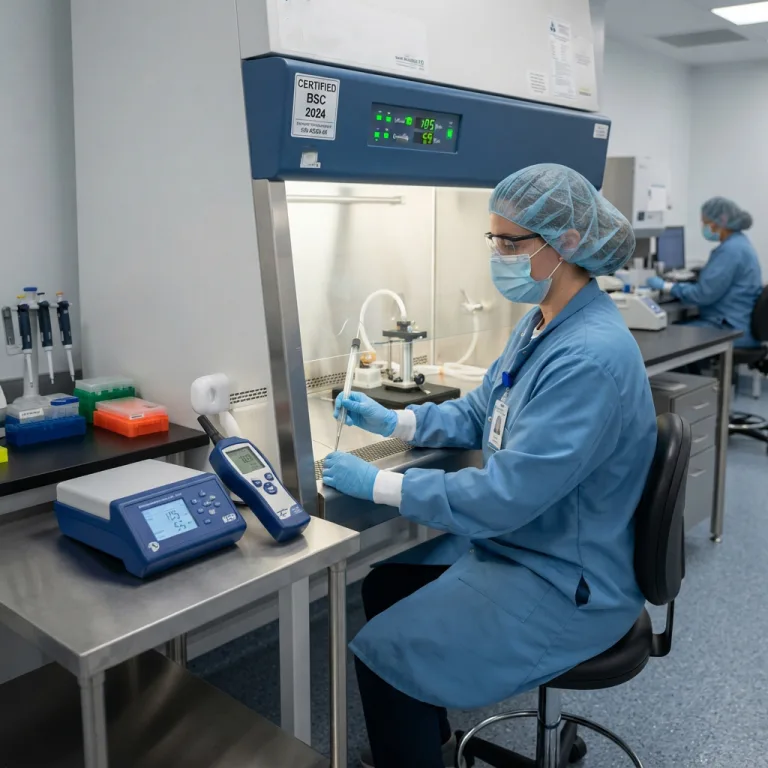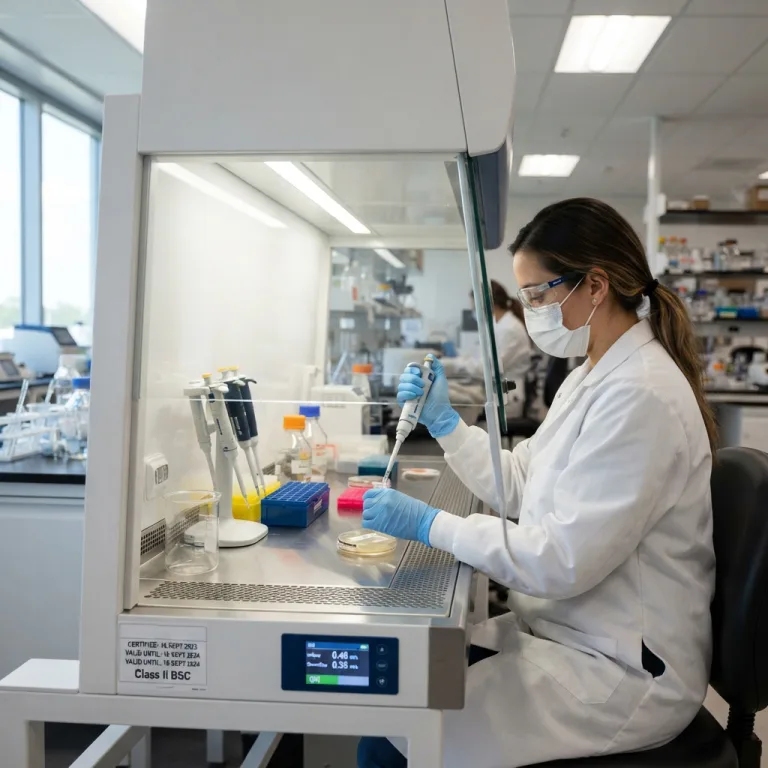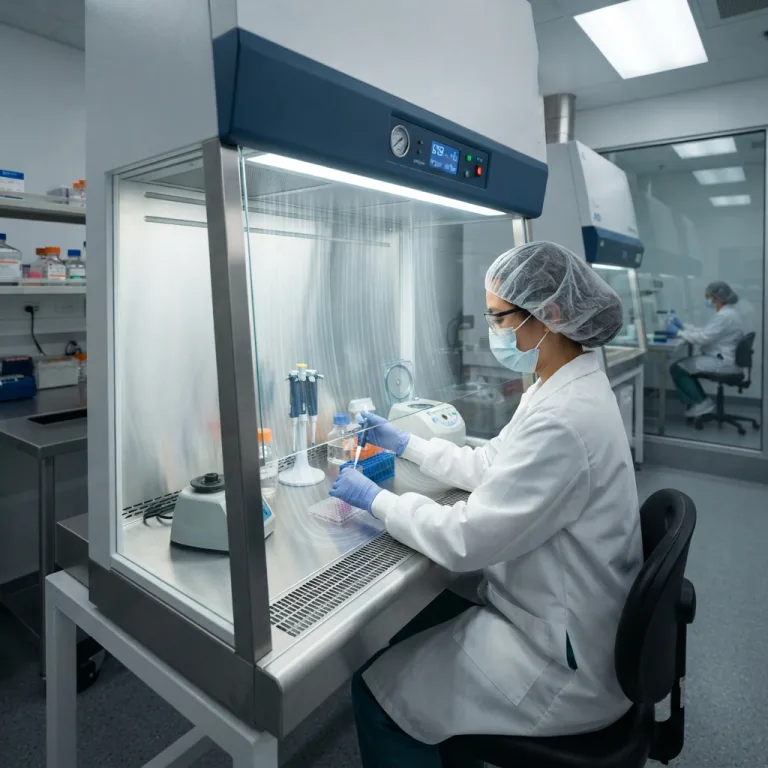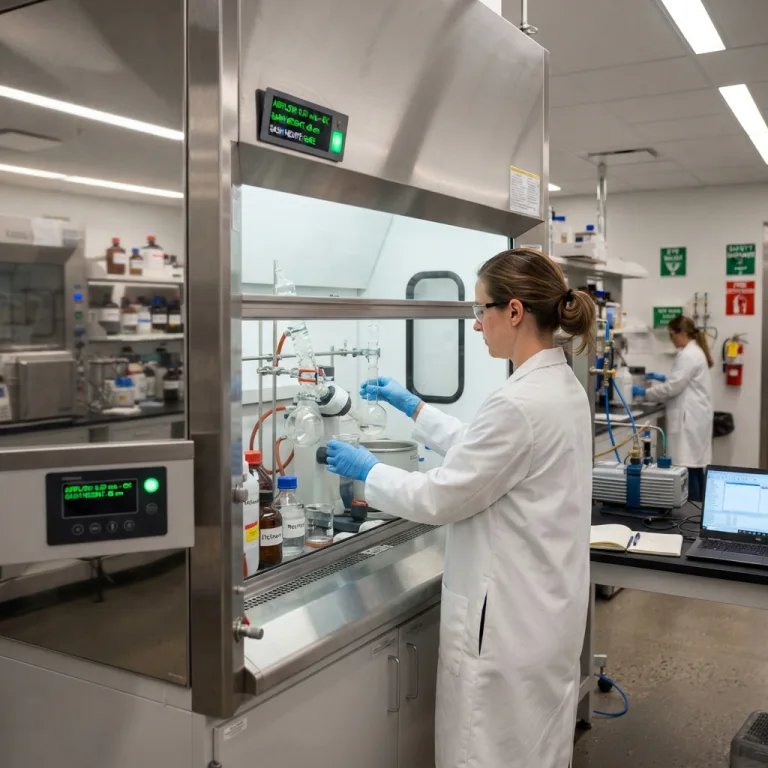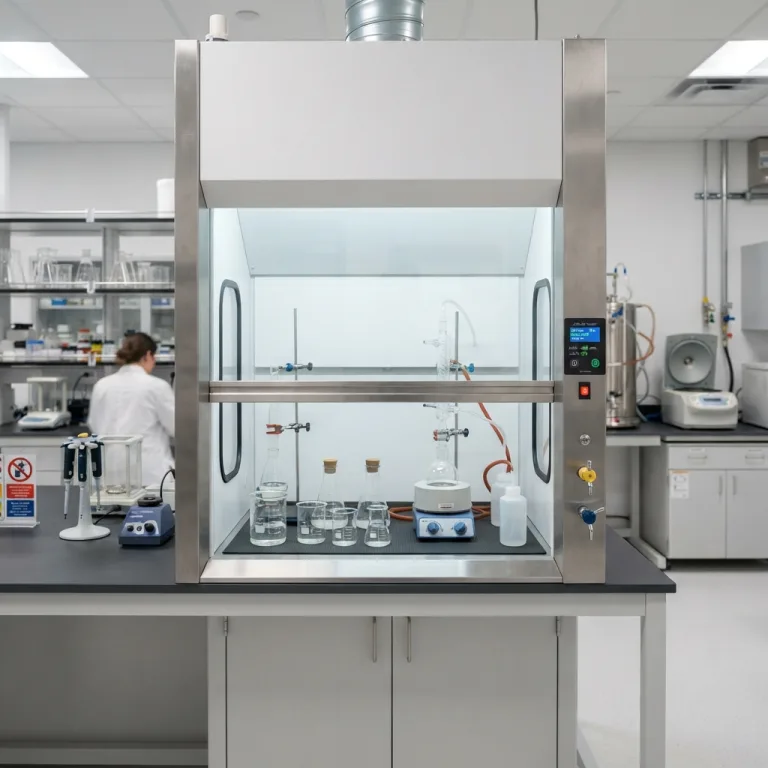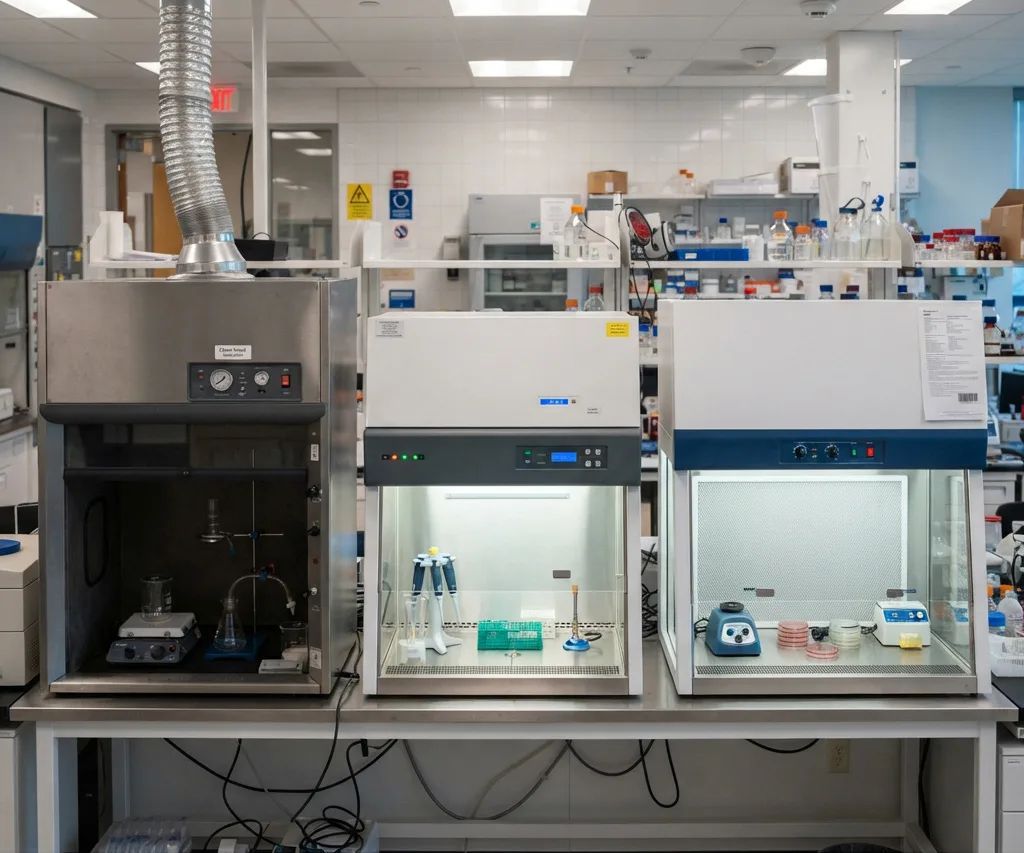
Three Cabinets, Three Different Jobs
A chemical fume hood, a microbiological safety cabinet and a laminar flow clean bench may look similar in a laboratory equipment catalog. All three can have an enclosed workspace, a fan or airflow system, and a front opening.
However, they are designed for different protection objectives.
A chemical fume hood is primarily intended to control exposure to hazardous chemical vapors, fumes and other airborne contaminants.
A biological safety cabinet, or BSC, provides biological containment according to its class and configuration. A typical Class II BSC is designed to protect the operator, the work and the surrounding environment from biological aerosols.
A clean bench uses filtered airflow to protect the product or work area from airborne particles. It is not designed to protect the operator from hazardous materials.
University laboratory safety guidance makes this distinction clear: a fume hood, a biological safety cabinet and a laminar flow clean bench are not interchangeable, even when their external appearance is similar.
For laboratory managers, hospital procurement teams, pharmaceutical companies, research institutes and equipment distributors, the correct purchasing decision should begin with one question:
What needs to be protected: the operator, the product, the environment, or some combination of these?
The answer determines which laboratory safety equipment should be considered.
1. Fume Hood vs BSC vs Clean Bench: Quick Comparison
This table compares a conventional chemical fume hood, a common Class II biosafety cabinet and a standard clean bench. Other configurations may have different capabilities.
| Feature | Chemical Fume Hood | Class II Biosafety Cabinet | Laminar Flow Clean Bench |
|---|---|---|---|
| Primary purpose | Control chemical exposure | Biological containment | Protect the product or work |
| Operator protection | Yes, for intended applications when properly designed and operated | Yes, when properly selected, installed and certified | No |
| Product protection | Not its primary purpose | Yes | Yes |
| Environmental protection | Controls contaminants through the exhaust design | Yes, through appropriate containment and filtration | No biological containment |
| Typical airflow | Air enters the opening and contaminants are exhausted | Inward airflow at the opening plus HEPA-filtered downflow | Filtered air flows horizontally or vertically over the work |
| Main filtration approach | Usually exhaust ventilation; not ordinarily a HEPA-filtered biological containment system | HEPA-filtered supply and exhaust, depending on design | Commonly HEPA-filtered supply air |
| Typical applications | Chemical handling, solvent work, acid digestion | Microbiology, clinical specimens, suitable cell culture work | Nonhazardous clean assembly and particle-sensitive work |
| Hazardous chemical vapors | Appropriate fume hood configuration required | Not a general replacement for a fume hood | Not suitable for containment of chemical vapors |
| Potentially infectious materials | Not the standard biological containment solution | Appropriate BSC class selected through risk assessment | Not suitable when biological containment is required |
| Typical buyer | Chemical laboratory or research facility | Clinical, biological or research laboratory | Electronics, optical assembly or suitable clean-work application |
The core rule is simple:
Chemical exposure control → Fume hood
Biological containment → Appropriate biosafety cabinet
Clean work requiring product protection → Clean bench
This is a starting point, not a substitute for a task-specific risk assessment. A laboratory that handles both biological materials and hazardous chemicals may need different equipment for different steps in the same workflow.
2. What Does a Chemical Fume Hood Protect?
A chemical fume hood is a type of laboratory exhaust equipment designed to help control exposure to airborne chemical contaminants.
It typically draws room air through the front opening, across the working area, and into an exhaust system.
This airflow helps capture and remove contaminants generated during laboratory procedures.
Typical applications include:
-
Chemical preparation
-
Solvent handling
-
Acid and alkali work
-
Chemical synthesis
-
Analytical chemistry
-
Sample digestion
-
Pharmaceutical research involving hazardous chemicals
-
Industrial laboratory testing
-
University chemistry experiments
-
Quality control procedures
The exact application depends on the chemical hazards and hood design.
How does fume hood airflow work?
The hood draws air inward through the front opening. The exhaust system then carries contaminated air away from the working area.
Several factors influence performance:
-
Sash position
-
Face velocity
-
Baffle arrangement
-
Exhaust capacity
-
Room ventilation
-
Equipment placement
-
Operator movement
-
Air currents near the hood opening
A chemical fume hood does not automatically provide a safe working environment simply because its fan is operating. It needs appropriate airflow, correct installation and suitable maintenance.
ASHRAE Standard 110-2016 (RA 2025) provides a test method for evaluating laboratory fume hood containment, including quantitative and qualitative performance testing.
Ducted vs ductless fume hood
A ducted fume hood connects to a building exhaust system.
A ductless fume hood uses an appropriate chemical filtration arrangement for defined applications. It must be evaluated against the actual chemicals, filter compatibility, capacity and replacement requirements.
Neither configuration should be selected solely according to price or installation convenience.
Does a fume hood protect the product?
Not usually. A conventional chemical fume hood is intended primarily to control exposure, rather than maintain a clean product environment.
Air entering the hood comes from the laboratory, and that air is not necessarily HEPA-filtered.
For this reason, a chemical fume hood is generally not the right choice for a process that requires protection from airborne particle contamination.
Related search terms: laboratory fume hood, chemical fume hood, laboratory exhaust hood, ducted fume hood, ductless fume hood, chemical laboratory hood, fume hood airflow, face velocity, fume hood containment, fume hood testing, laboratory ventilation equipment.
3. What Does a Microbiological Safety Cabinet Protect?
A microbiological safety cabinet, also called a biological safety cabinet, biosafety cabinet or BSC, is designed to provide primary containment for appropriate biological laboratory procedures.
Its purpose differs from that of a chemical fume hood.
A BSC uses a defined airflow pattern and filtration system to reduce exposure to biological aerosols and, depending on the cabinet class, protect the material being handled and the surrounding environment.
However, the protection provided varies by BSC class.
A Class I BSC primarily provides personnel and environmental protection, while a typical Class II BSC provides personnel, product and environmental protection. Class III cabinets use a fully enclosed design with glove ports for specialized high-containment applications.
How does a Class II BSC work?
A common Class II biosafety cabinet combines two airflow functions.
Inward airflow: Air enters through the front opening, helping prevent biological aerosols from escaping toward the operator.
HEPA-filtered downflow: Filtered air moves downward through the working area, helping protect the material being handled from airborne contamination.
Exhaust filtration provides an additional component of biological particle control.
The combination of inward airflow and HEPA-filtered air is what makes a Class II BSC different from a clean bench.
What is a biosafety cabinet used for?
Depending on the risk assessment and cabinet configuration, applications may include:
-
Clinical specimen handling
-
Microbiological procedures
-
Cell culture
-
Molecular biology
-
Biotechnology research
-
Diagnostic laboratory work
-
Public health laboratory procedures
-
Pharmaceutical biological research
-
Other procedures requiring biological containment
Not every procedure in these laboratories requires the same BSC. Selection should be based on the biological materials, aerosol-generating activities, exposure risks and required protection.
Can a BSC replace a chemical fume hood?
Not automatically.
HEPA filtration is designed to remove airborne particles. It does not remove volatile chemical gases and vapors in the same way as an appropriate chemical exhaust or filtration system.
Some BSC configurations can accommodate limited chemical applications under defined conditions. However, an ordinary Class II BSC should not be treated as a general chemical fume hood.
When a procedure involves both biological materials and hazardous chemicals, the laboratory should evaluate whether a specific BSC configuration, a separate chemical fume hood or another engineered solution is required.
Related search terms: microbiological safety cabinet, biological safety cabinet, biosafety cabinet, BSC, Class II biosafety cabinet, Class II A2 BSC, Class II B2 BSC, Class III biosafety cabinet, HEPA filtration, biological containment, BSC airflow, biosafety cabinet certification.
4. What Does a Clean Bench Protect?
A clean bench, also known as a laminar flow clean bench, laminar airflow cabinet or clean air workstation, is designed primarily to protect the work from airborne particles.
Filtered air flows across the work area, helping create a cleaner local environment.
Clean benches are commonly considered for suitable applications such as:
-
Electronics assembly
-
Optical component handling
-
Precision component inspection
-
Nonhazardous clean assembly
-
Selected laboratory preparation tasks
-
Dust-sensitive manufacturing
-
Certain medical device assembly operations
The correct application depends on the process and the level of cleanliness required.
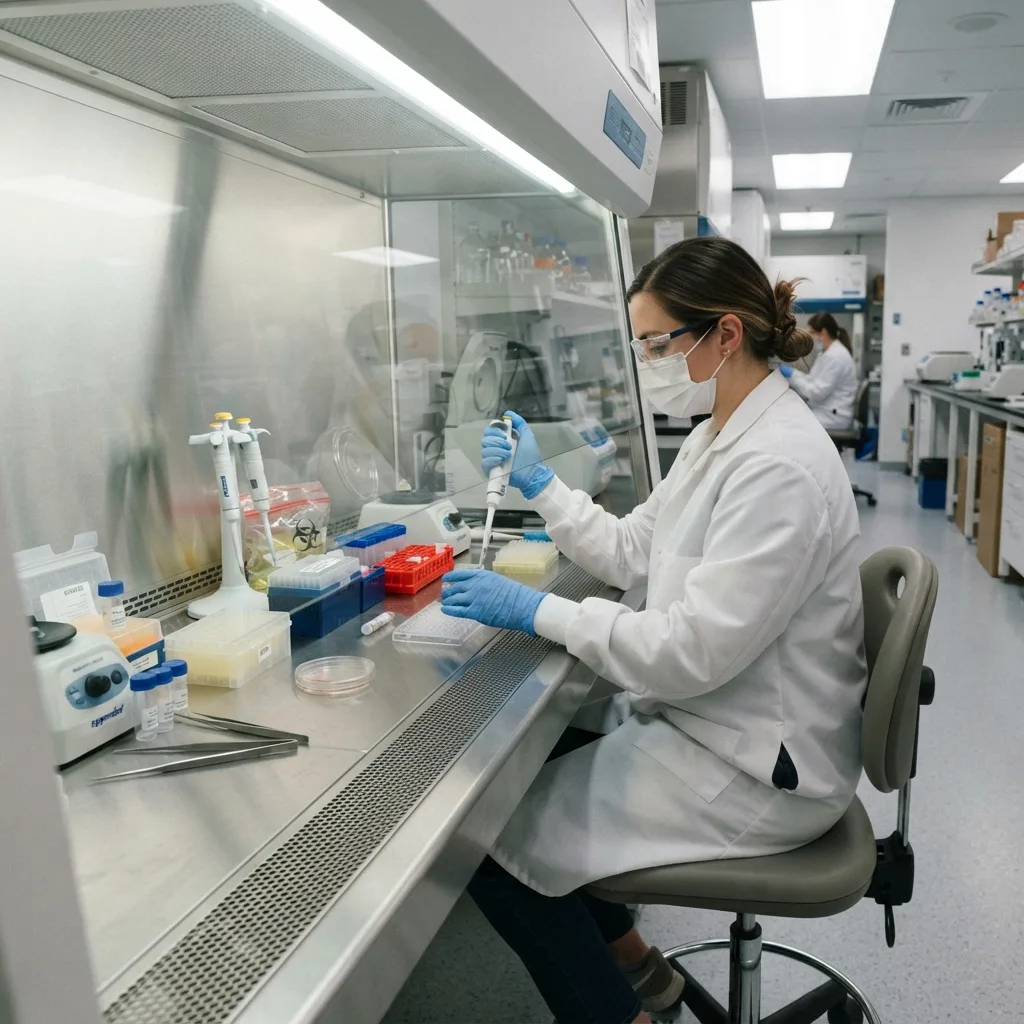
Horizontal laminar flow clean bench
In a horizontal-flow configuration, filtered air usually moves from the rear of the unit toward the front opening.
The arrangement can be useful for selected clean assembly and product-handling tasks.
However, because the airflow moves toward the operator, the device does not provide biological containment.
Vertical laminar flow clean bench
A vertical-flow clean bench generally supplies filtered air downward from above the work surface.
This can suit certain workpiece shapes and clean assembly arrangements.
However, downward airflow does not automatically mean that the cabinet provides operator protection. A standard clean bench remains a product-protection device.
Can a clean bench be used for infectious biological materials?
A clean bench should not be used when the procedure requires protection against hazardous biological material.
The filtered air can move contaminants toward the operator rather than containing them.
University of New Hampshire laboratory safety guidance explicitly distinguishes clean benches from BSCs and warns against using clean benches for potentially hazardous biological materials, hazardous chemicals or other processes that require containment.
Related search terms: clean bench, laminar flow clean bench, laminar flow hood, clean air workstation, horizontal laminar flow cabinet, vertical laminar flow cabinet, HEPA clean bench, cleanroom workbench, clean bench for electronics, clean bench for precision assembly.
5. Fume Hood vs BSC: Which One Should a Laboratory Buy?
The key distinction is the type of hazard.
Choose a fume hood for appropriate chemical exposure control
A chemical fume hood may be suitable when a process generates hazardous chemical vapors, fumes or airborne contaminants that need to be captured and exhausted.
Examples include certain solvent-handling procedures, acid work and chemical synthesis.
The specific hood and exhaust arrangement must match the chemicals and operating requirements.
Choose a BSC for biological containment
A properly selected BSC is appropriate when biological procedures require containment of potentially hazardous aerosols or other biological exposure risks.
The correct BSC class and type depend on the work and the required protection.
What if the procedure involves both?
This requires a more detailed assessment.
For example, a laboratory may handle biological specimens that also require chemical fixation. The biological and chemical steps may have different exposure-control requirements.
One cabinet should not be assumed to provide all forms of protection simply because it has HEPA filters.
The laboratory should assess each procedure separately and determine whether the workflow needs separate workstations, a particular exhaust arrangement or another suitable engineering control.
Buyer decision example
Chemical synthesis or solvent handling
Evaluate a suitable chemical fume hood and its exhaust system
Biological work requiring primary containment
Assess the appropriate biosafety cabinet class and configuration.
Clean assembly of nonhazardous components
Consider a clean bench where localized product protection is sufficient.
This decision framework is a useful starting point for laboratory procurement, but the final choice should be supported by the laboratory’s risk assessment and relevant safety requirements.
6. BSC vs Clean Bench: Why They Are Not Interchangeable
This is one of the most important comparisons for buyers searching for laboratory equipment online.
Both a BSC and a clean bench may use HEPA filtration. Both can provide filtered airflow across a work area. Both may have a front opening, transparent panels and a stainless steel work surface.
The difference is their protective function.
A standard clean bench directs filtered air toward or across the work, but it does not provide the containment needed to protect personnel from hazardous materials.
A Class II BSC is designed around inward airflow at the front opening and HEPA-filtered airflow within the working zone.
The table below summarizes the difference.
| Purchasing question | Clean Bench | Class II BSC |
|---|---|---|
| Is filtered air supplied to the work? | Yes | Yes |
| Is the operator protected from biological aerosols? | No | Yes, when correctly selected and operated |
| Is the environment protected from biological aerosols? | No | Yes, through the cabinet’s containment and filtration design |
| Is it suitable for nonhazardous clean assembly? | Often | May be unnecessary for that task |
| Is it suitable for potentially infectious material requiring containment? | No | May be appropriate following risk assessment |
| Is HEPA filtration sufficient by itself to determine suitability? | No | No |
A buyer should never choose a clean bench instead of a BSC simply because the clean bench is less expensive.
Likewise, using a BSC for a nonhazardous assembly task that only requires clean airflow may add unnecessary equipment cost and operating complexity.
The correct equipment is the one that matches the actual protection requirement.
7. Airflow and Filtration: What Buyers Need to Understand
Airflow is central to all three equipment categories, but the airflow performs different jobs.
Fume hood airflow
The airflow draws chemical contaminants away from the operator and toward the exhaust system.
Important procurement terms include:
-
Face velocity
-
Sash position
-
Airflow containment
-
Exhaust volume
-
Room air balance
-
VAV airflow control
-
Fume hood testing
For ducted chemical fume hoods, the exhaust system and laboratory HVAC design are important parts of the overall performance.
Biosafety cabinet airflow
For a common Class II BSC, airflow must support both personnel containment and product protection.
Important terms include:
-
Inflow velocity
-
Downflow velocity
-
HEPA filter integrity
-
Airflow smoke pattern
-
Cabinet pressure
-
Exhaust arrangement
-
Certification
-
Alarm monitoring
The appropriate testing program depends on the cabinet type and applicable requirements.
Clean bench airflow
A clean bench supplies filtered air to reduce particles around the work.
Important terms include:
-
Horizontal airflow
-
Vertical airflow
-
Airflow uniformity
-
Particle cleanliness
-
HEPA filter
-
ULPA filter
-
Work-zone performance
-
Filter replacement
A clean bench should be chosen according to the required work-zone cleanliness rather than the assumption that more airflow or a more expensive filter will always produce a better result.
What does HEPA filtration actually mean?
HEPA filtration is important for airborne particle control, including the removal of biological particles carried in the air.
However, HEPA filters do not automatically remove volatile chemical gases and vapors.
That is why filtration type alone cannot determine whether a fume hood, BSC or clean bench is appropriate.
8. Standards and Testing: What Should International Buyers Check?
Different equipment categories are associated with different standards and testing methods.
The exact requirements depend on the product design, destination market, project specification and local regulations.
Chemical fume hood
ASHRAE Standard 110-2016 (RA 2025) provides a method for testing laboratory fume hood containment. It covers conventional, bypass, auxiliary-air and variable-air-volume fume hoods.
It can support evaluation of performance in factory, installation or use conditions, depending on the testing program. ASHRAE itself develops and publishes the standard; it does not directly certify every individual fume hood.
Biosafety cabinet
For Class II BSCs, NSF/ANSI 49 is a major reference for design, construction and performance, including testing and field-certification provisions.
In Europe, buyers may encounter the EN 12469 family of standards for microbiological safety cabinets.
The applicable standard edition and certification requirements should be confirmed for each project rather than assuming that all cabinets have the same compliance status.
Clean bench
Clean benches should be evaluated according to their intended application and specified work-zone performance.
Where a process requires cleanroom-classified conditions, ISO 14644-1 provides a classification framework based on airborne particle concentration. However, the use of a HEPA filter does not by itself mean that a clean bench or its surrounding room meets a specific ISO cleanliness class.
Questions to ask suppliers
Before ordering, ask:
-
Which standard or test method applies to this model?
-
What documentation is supplied?
-
Is testing performed at the factory, on-site or both?
-
Does the project require independent certification?
-
Who will perform installation and commissioning?
-
What performance verification is needed after relocation or maintenance?
-
Which local requirements apply in the destination market?
These questions help buyers compare suppliers on more than the product name.
9. How to Choose Equipment for Different Laboratory Applications
The same type of laboratory may need different equipment for different procedures. The process and hazard are more important than the laboratory’s name.
| Application | Equipment to Evaluate | Important Consideration |
|---|---|---|
| Chemical synthesis | Chemical fume hood | Chemical hazards and exhaust design |
| Solvent handling | Suitable chemical fume hood | Volatility, flammability and compatibility |
| Microbiology procedures involving biological hazards | Appropriate BSC | Risk assessment and containment |
| Cell culture | Appropriate BSC or other specified control | Cell type, procedure and contamination risk |
| Electronics assembly | Clean bench or cleanroom workstation | Particle cleanliness requirements |
| Optical component inspection | Clean bench or controlled clean area | Dust sensitivity and workpiece size |
| Medical device assembly | Clean bench, cleanroom or other control | Product and process requirements |
| Pharmaceutical research | Application-specific equipment | Biological and chemical hazards may differ |
| Chemical preparation of biological specimens | Separate or specialized controls as appropriate | Each procedure’s combined hazards |
| General laboratory instrument work | Depends on the work | Confirm whether any containment is needed |
This framework helps explain why a laboratory equipment catalog should not be used as the only basis for selection.
A purchasing team should document the task, expected hazards, protection requirements, work area and installation conditions before asking suppliers to quote.
10. What Should You Compare When Buying From China?
International buyers searching for a laboratory fume hood manufacturer, biosafety cabinet supplier or clean bench manufacturer in China should compare the technical offer rather than only the headline price.
A practical supplier evaluation can include the following.
Product configuration
Does the supplier offer the correct type, class, airflow arrangement and working dimensions?
Technical specifications
Are the performance requirements clearly stated rather than described only through general marketing language?
Manufacturing capability
Can the supplier explain its production process, quality-control procedures and customization options?
Testing and documentation
Can it provide relevant test reports, manuals, installation drawings and other project documents?
Standards and certifications
Are claims specific, verifiable and relevant to the actual model and destination market?
Installation requirements
Does the supplier identify electrical needs, exhaust requirements, service clearance and other installation conditions?
Replacement parts
Are filters, sensors, controls and other service components available?
After-sales support
Can the supplier help resolve technical questions after shipment?
Export experience
Can the supplier support overseas packaging, shipping coordination and project documentation?
Total project cost
Compare equipment, delivery, installation, testing, maintenance and spare parts together.
These questions are especially useful for hospital equipment distributors, university procurement departments, laboratory project contractors and medical equipment importers.
11. Common Equipment Selection Mistakes
Mistake 1: Choosing the Product With the Lowest Price
A cheaper unit is not a better purchase if it lacks the required protection or performance.
Always compare equivalent configurations.
Mistake 2: Assuming HEPA Filtration Makes Equipment Safe for Every Application
HEPA filtration controls airborne particles. It does not automatically provide chemical vapor control or personnel containment.
Mistake 3: Using a Clean Bench for Hazardous Materials
A standard clean bench does not provide the required personnel or environmental containment for hazardous biological work.
Mistake 4: Treating Every BSC as the Same
Biosafety cabinets differ by class and type. The buyer must confirm the exact configuration needed.
Mistake 5: Choosing a Fume Hood Without Reviewing Exhaust Requirements
The hood and building ventilation system need to be considered together.
Mistake 6: Ignoring Installation and Certification
A product’s factory specifications do not remove the need for appropriate installation and performance checks.
Mistake 7: Buying Before Defining the Work
A clear description of the procedure, hazards and required protection is a better starting point than choosing a model from a photograph.
Final Recommendation: Choose by Protection Requirement, Not Appearance
A chemical fume hood, biosafety cabinet and clean bench can look similar, but the three solve different laboratory problems.
A chemical fume hood is primarily for controlling exposure to chemical contaminants.
A properly selected biosafety cabinet provides biological containment, with the exact protection depending on its class and configuration.
A clean bench creates a cleaner working zone to help protect nonhazardous products or components from airborne particles.
The most reliable procurement process follows this sequence:
Define the task → Assess the hazard → Identify what must be protected → Select the equipment → Confirm specifications → Plan installation → Verify performance → Arrange maintenance.
This approach helps avoid a common purchasing error: selecting a device because it looks suitable or has a HEPA filter, without confirming what protection it actually provides.
For international laboratory equipment buyers, it also creates a clearer specification for suppliers and makes quotations easier to compare.
The goal is not to buy the most complicated piece of equipment. It is to purchase the right laboratory safety or clean-air system for the work, with verified performance and suitable support throughout its operating life.
Frequently Asked Questions
1. What is the difference between a fume hood, biosafety cabinet and clean bench?
A fume hood controls exposure to chemical contaminants, a biosafety cabinet provides biological containment according to its class, and a clean bench provides a clean work zone primarily to protect the product.
2. Which is better, a fume hood or a biosafety cabinet?
Neither is universally better. A suitable fume hood is normally considered for hazardous chemical vapors, while a suitable BSC is considered for biological work requiring containment.
3. What is the difference between a BSC and a laminar flow clean bench?
A BSC is designed for biological containment. A clean bench directs filtered air across the work to help protect the product but does not provide equivalent personnel or environmental protection.
4. Can a clean bench be used instead of a biosafety cabinet?
No, not when the procedure requires biological containment or personnel protection. A clean bench should be limited to appropriate work where product protection is the primary requirement.
5. Can a biosafety cabinet replace a chemical fume hood?
Not generally. HEPA filters remove airborne particles but do not remove volatile chemical gases and vapors. Certain specialized BSC configurations have defined chemical-use conditions, but buyers should not treat a standard BSC as a general fume hood.
6. Which equipment is suitable for a chemistry laboratory?
A chemical fume hood may be appropriate for procedures generating hazardous vapors or fumes. Other equipment may be needed for particular processes, depending on the hazard assessment.
7. Which equipment is suitable for a microbiology laboratory?
A BSC may be appropriate for microbiological procedures requiring primary containment. The cabinet class should be selected based on the biological material, task and risk assessment.
8. Which equipment is suitable for electronics assembly?
A clean bench may be considered when the process requires local particle control and does not require hazardous-material containment. More demanding processes may require a cleanroom or another controlled environment.
9. Do all three types of equipment use HEPA filters?
No. Many BSCs and clean benches use HEPA filtration. Conventional chemical fume hoods generally rely on exhaust ventilation, although specific filtered or ductless configurations exist.
10. Does HEPA filtration remove chemical vapors?
HEPA filtration is designed for airborne particles, not general removal of volatile chemical gases and vapors. Chemical vapor control needs an appropriate exhaust or filtration solution.
11. What is the difference between horizontal and vertical laminar flow?
Horizontal laminar flow usually moves from the rear toward the front of a clean bench. Vertical laminar flow generally moves downward from above the work area.
12. Can a clean bench provide a sterile environment?
A clean bench can help reduce airborne particle contamination, but it does not independently guarantee sterility. The complete process may require additional controls.
13. What is a Class II biosafety cabinet?
A Class II BSC combines inward airflow at the front opening and HEPA-filtered airflow through the work area to provide personnel, product and environmental protection when correctly selected and operated.
14. What is ASHRAE 110?
ASHRAE Standard 110-2016 (RA 2025) is a method for testing the containment performance of laboratory fume hoods.
15. What standards should I check when buying laboratory safety equipment?
Requirements depend on the equipment and market. Buyers may need to examine relevant fume hood test methods, BSC standards such as NSF/ANSI 49 or EN 12469, or cleanliness requirements for cleanroom-related applications.
16. How do I compare laboratory fume hood manufacturers?
Compare application suitability, hood type, airflow design, construction materials, test documentation, installation support, spare parts and after-sales service.
17. How do I compare biosafety cabinet manufacturers?
Check cabinet class, airflow configuration, filter arrangement, applicable certification, field testing, documentation, maintenance access and long-term service support.
18. How do I compare clean bench suppliers?
Review horizontal or vertical airflow, work-zone dimensions, filtration, required particle cleanliness, construction materials, filter availability and performance documentation.
19. What information should I include in a laboratory equipment RFQ?
Provide the intended application, hazards, protection requirements, work area dimensions, airflow configuration, local electrical requirements, installation conditions, standards, documentation needs and delivery destination.
20. How much does laboratory safety equipment cost?
Prices vary by equipment type, configuration, dimensions, filtration, controls, accessories, certification, installation and shipping. Compare products with equivalent specifications rather than headline price alone.