The Rise of Application-Specific Centrifugation
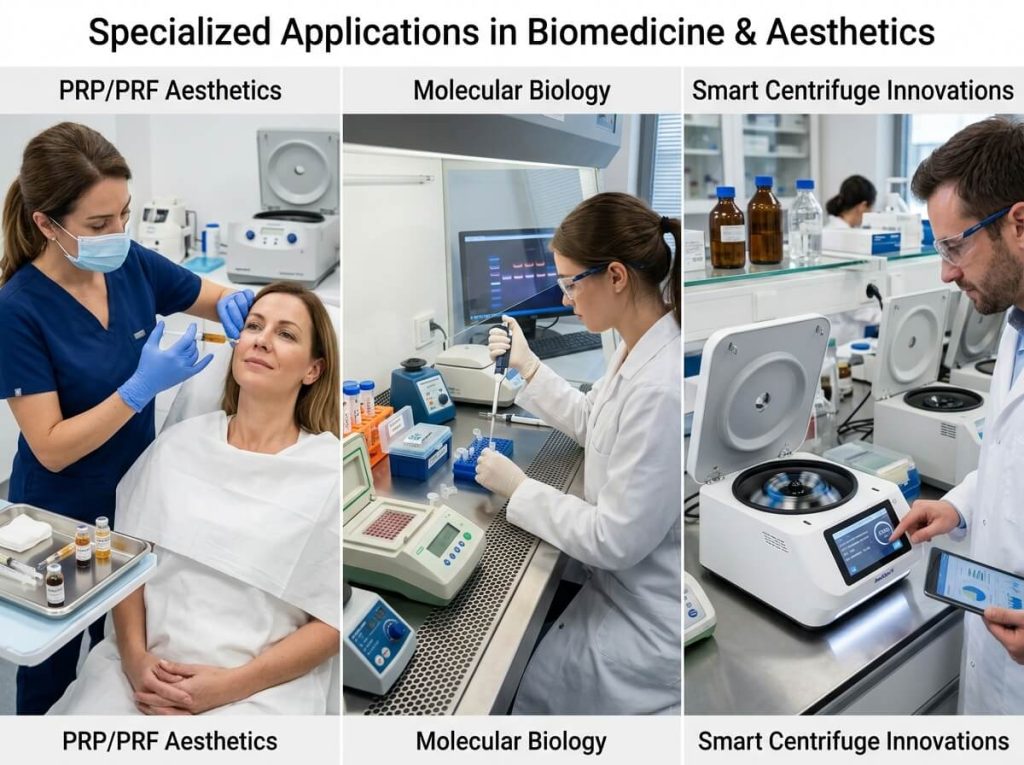
While general-purpose centrifuges handle standardized sample processing, specialized fields demand dedicated equipment tailored to specific physical dynamics. Applications ranging from autologous cellular therapies in aesthetic clinics to high-throughput genomic extraction in biotech hubs require targeted operational parameters.
Modern manufacturers address these requirements by designing dedicated centrifugation platforms equipped with specialized rotor geometries, precise low-or-high $g$-force controls, customizable braking curves, and digital data-logging firmware.
+-----------------------------------------------------------------------------------+
|               SPECIALIZED CENTRIFUGATION APPLICATION SPECTRUM                     |
+-----------------------------------------------------------------------------------+
|  1. Regenerative Medicine  | PRP & PRF preparation (Controlled low-g separation)  |
|  2. Genomics & Molecular   | DNA/RNA spin-column isolation (High-speed micro-runs)|
|  3. Cell Culture & Bio     | Mammalian cell harvesting(Gentle temperature-chilled)|
|  4. Smart Connectivity     | GLP/GMP digital tracking, touchscreens, USB export   |
+-----------------------------------------------------------------------------------+
2. Regenerative Medicine: Platelet-Rich Plasma (PRP) & Platelet-Rich Fibrin (PRF)
Autologous blood concentrate therapies are widely used in aesthetic dermatology, hair restoration, orthopedics, and dental implantology. Preparing high-yield Platelet-Rich Plasma (PRP) and Platelet-Rich Fibrin (PRF) depends entirely on exact centrifugal separation.
                      PRP vs. PRF CENTRIFUGATION DYNAMICS
                                       |
       +-------------------------------+-------------------------------+
       |                                                               |
PRP Protocol (Double Spin / Hard Spin)          PRF Protocol (Single Spin / Low-G)
- Higher speed & RCF (~1,200–1,500 x g)        - Ultra-low speed & RCF (~200–700 x g)
- Requires anticoagulant additives              - 100% natural, no chemical additives
- Separates clear plasma from red cells         - Forms rich fibrin matrix gel for grafts
Platelet-Rich Plasma (PRP) Protocols
-
Mechanism: Uses a two-step “soft spin” and “hard spin” method to isolate platelets from whole blood while removing dense red blood cells (RBCs).
- Key Considerations: Swing-bucket rotors are preferred over fixed-angle rotors for PRP because horizontal swinging prevents platelet accumulation along the tube side wall, producing a distinct buffy coat layer.
Platelet-Rich Fibrin (PRF) & Advanced PRF (A-PRF) Protocols
-
Mechanism: Employs low centrifugal force (the Low-Speed Centrifugation Concept, or LSCC) without anticoagulants, preserving leukocytes, growth factors, and a dense fibrin mesh.
-
Equipment Requirements: Smooth acceleration and gentle braking curves are critical. Sudden deceleration disrupts the delicate fibrin clot matrix.
-
Clinical Applications: Facial skin rejuvenation, osteoarthritic joint injections, and dental bone graft stabilization.
3. Molecular Biology, Genomics & Cellular Research Protocols
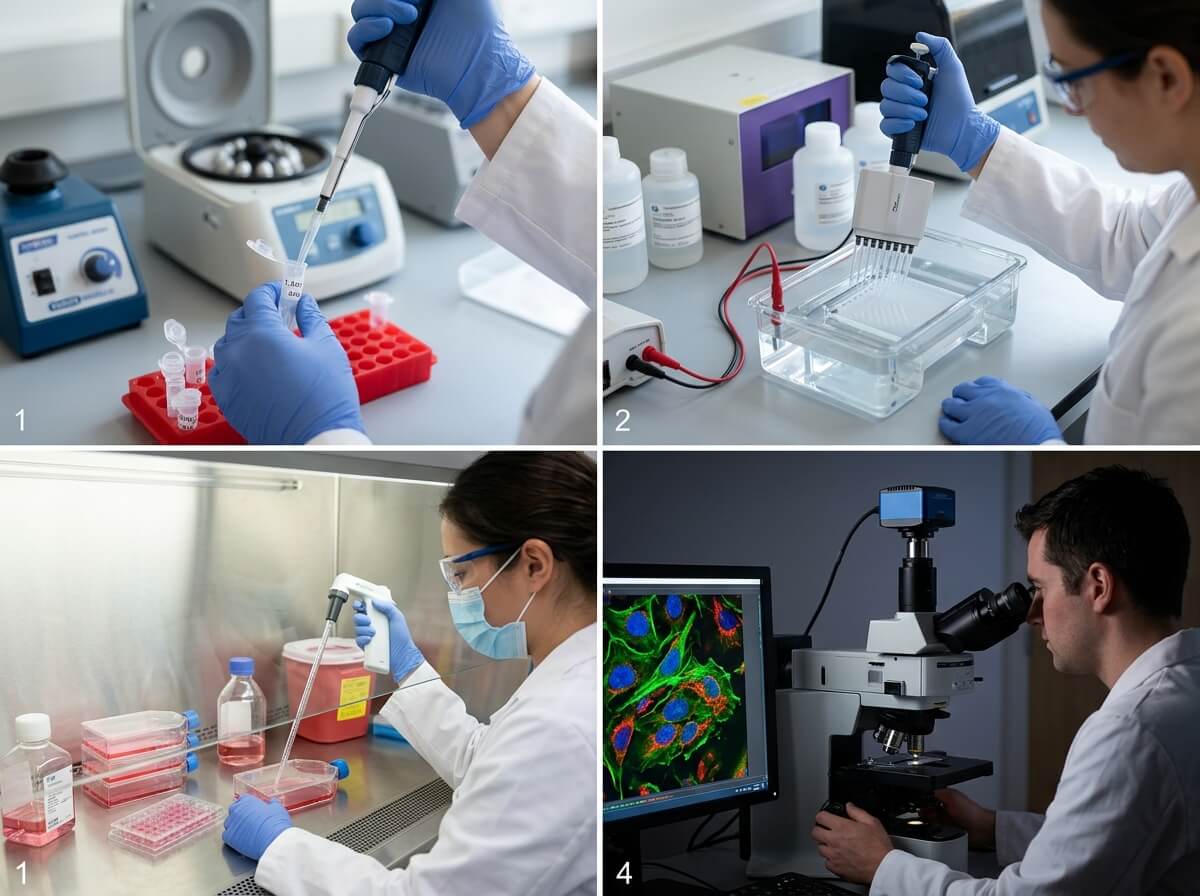
Life science laboratories require specialized microcentrifuges engineered for delicate biological molecules and live cells.
                  BIOTECH CENTRIFUGATION REQUIREMENTS
                                       |
       +-------------------------------+-------------------------------+
       |                                                               |
Nucleic Acid Extraction (DNA/RNA)               Mammalian Cell Culture Separation
- High speed / high force (14,000–21,000 x g)  - Low speed / gentle force (200–400 x g)
- Fixed-angle rotors for mini spin columns      - Temperature control strictly at 4°C
- Rapid acceleration for quick pelleting        - Smooth deceleration (no brake / soft brake)
DNA & RNA Extraction via Spin Columns
-
Protocol Demands: High RCF ratings (14,000× g to 21,000 × g) are needed to force lysate through silica-membrane spin columns and wash away cellular debris.
-
Rotor Requirements: Specialized fixed-angle rotors engineered with deep rim clearances accommodate open-cap spin column tubes without snapping off filter lids during high-speed rotation.
Mammalian Cell Culture Harvest & Passaging
-
Protocol Demands: Extremely gentle handling is required to pellet delicate cell suspensions (e.g., CHO cells, stem cells, T-cells) without rupturing cell membranes.
-
Equipment Features: Centrifuges must maintain low forces with precise control down to single $g$-force increments, combined with 4°C refrigeration to prevent cell heat shock.
4. Next-Generation Innovations: Smart Drives, Touchscreens & Automation
Modern laboratory centrifuges incorporate advanced electronic systems, digital interfaces, and connected features.
                      SMART CENTRIFUGE INNOVATIONS
                                       |
       +-------------------------------+-------------------------------+
       |                                                               |
Brushless DC Motors (Maintenance-Free)          Digital Connectivity & Compliance
- Zero carbon dust generation                   - Color touchscreen with custom profiles
- Whispering quiet operation (< 55 dBA)          - USB / Wi-Fi export for GLP/GMP audits
- Rapid, precise RPM/RCF acceleration           - Auto-rotor recognition & lock
Brushless DC Induction Motors
-
Zero Carbon Contamination: Eliminates traditional wear-prone carbon brushes, preventing carbon dust contamination in cleanrooms and biosafety cabinets.
-
Acoustic & Operational Efficiency: Runs quietly, generates minimal drive friction, and delivers maintenance-free performance over long operational lifespans.
Touchscreen Interfaces & Programmed Profiles
-
Pre-Set One-Touch Protocols: Allows operators to save custom multi-step runs (storing speed, time, temperature, and acceleration curves) for consistent clinical and research protocols.
-
Visual Status Monitoring: Bright color displays show real-time RCF, chamber temperature graphs, and countdown timers visible across the laboratory.
Digital Compliance & GLP/GMP Data Logging
-
Exportable Run Logs: Modern smart centrifuges feature integrated USB ports or Wi-Fi modules to export run parameters (user ID, time stamp, target RCF, thermal curve, and error logs).
-
Audit Trail Readiness: Provides full traceability for regulated pharmaceutical manufacturing, clinical diagnostics, and ISO-certified research environments.
5. Application Matching Matrix
| Application Field | Target Force Range (×g) | Recommended Rotor Type | Ideal Temperature | Essential Feature / Innovation |
| Aesthetic PRP / PRF | 200 × g to 1,500 × g | Swing-bucket or $45° Fixed | 20°C to 22°C (Ambient) | Soft braking profiles, PRP tube adapters |
| DNA/RNA Extraction | 14,000 × g to 21,000 × g | Fixed-angle spin column | 4°C (Refrigerated) | Aerosol-tight lid, spin-column rim rotor |
| Cell Culture Pellet | 100 × g to $400 × g | Swing-bucket conical | 4°C (Pre-cooled) | Low $g$-force accuracy, gentle acceleration |
| High-Throughput QA | 3,000 × g to 6,000 × g | Microplate / Deep-well | Ambient or 4°C | Touchscreen, GLP USB data export |
| Routine Blood Serum | 1,000 × g to 3,000 × g | Swing-bucket clinical | Ambient | Brushless motor, auto lid lock |
6. Buyer’s Decision Checklist for Specialized Applications
When selecting a specialized or smart centrifuge system, evaluate these operational requirements:
-
Match Rotor Geometry to Vessel Type: Ensure swing-bucket adapters accommodate specialized PRP tubes, mini spin columns, microplates, or conical cell culture tubes.
-
Verify Low $g$-Force Precision: For PRF and cell culture work, confirm the motor drive can hold precise speeds at low forces without surging or stalling.
-
Assess Data Logging Requirements: If operating under GLP/GMP or ISO standards, choose units with digital export features for audit compliance.
-
Evaluate Noise and Footprint Limits: Select maintenance-free brushless models designed for low-noise output when placing equipment in small treatment rooms or crowded lab benches.
7. Frequently Asked Questions (FAQ)
Q1: Why is a swing-bucket rotor preferred over a fixed-angle rotor for clinical PRP blood separation?
Swing-bucket rotors allow blood tubes to rotate horizontally. This sends red blood cells straight to the bottom of the tube and creates a clear, horizontal separation layer, making it easy to extract the platelet-rich buffy coat without disturbing adjacent cell layers.
Q2: What is the primary advantage of a brushless DC motor in a specialized lab centrifuge?
Brushless DC motors operate without carbon brushes, eliminating carbon dust particles that can contaminate sensitive cleanrooms or cell cultures. They are also quieter, require zero routine motor brush maintenance, and deliver precise speed control.
Q3: How does soft deceleration braking benefit delicate cell separation protocols?
Standard dynamic motor braking stops the rotor quickly, which can create turbulence inside the tube and re-suspend delicate cell pellets or break soft PRF fibrin meshes. Soft braking uses customized deceleration ramps that gently bring the rotor to a complete stop without disturbing sample layers.