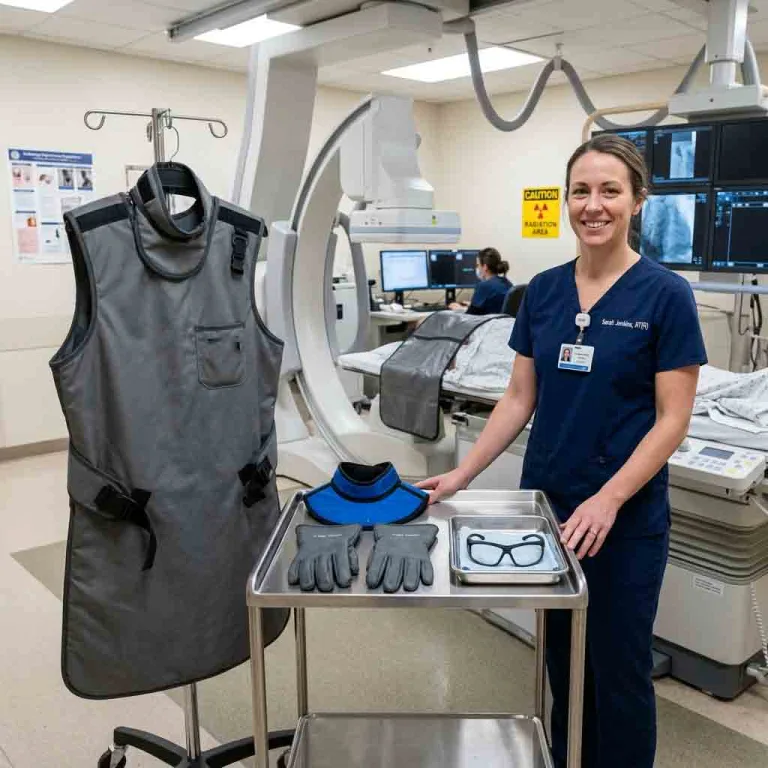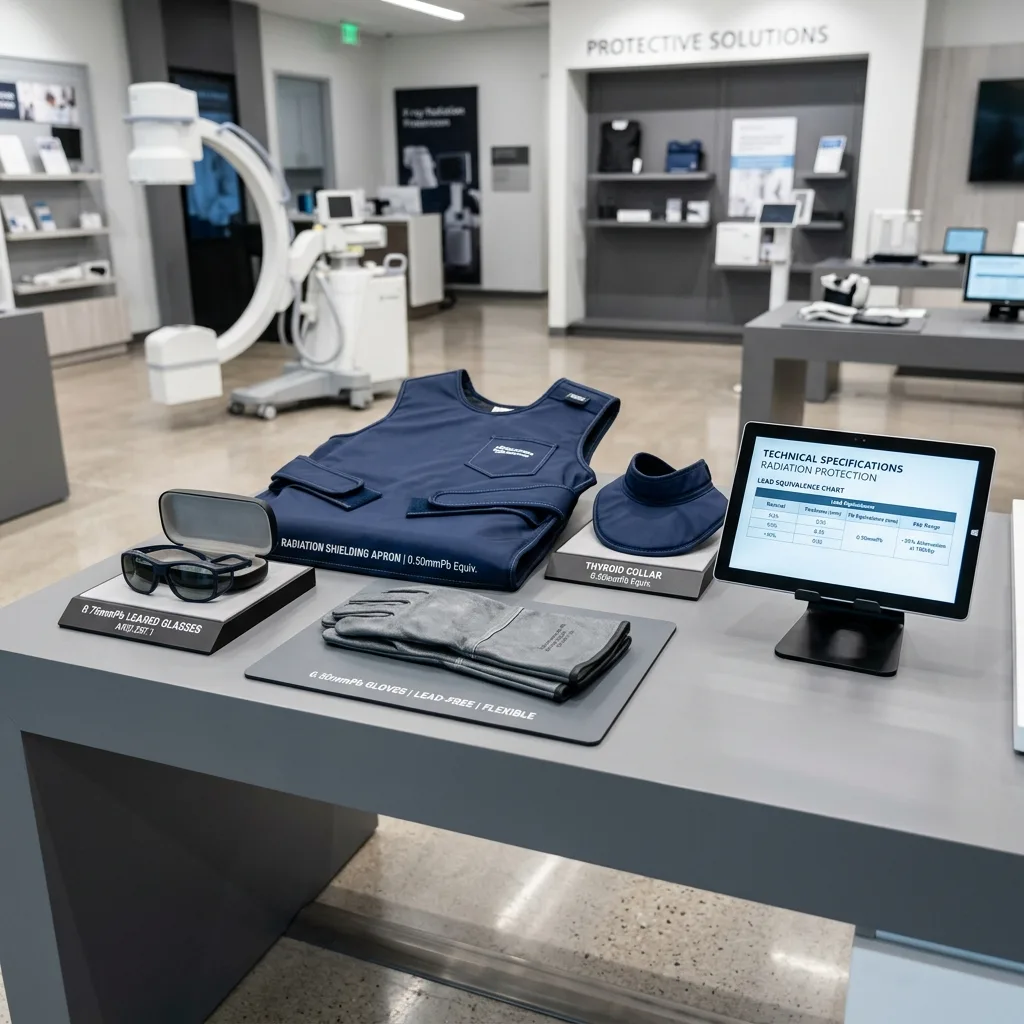
What Is Lead Equivalence?
One of the most common terms in X-ray protection product specifications is lead equivalence.
It describes the shielding performance of a protective material in relation to a specified thickness of lead under defined test conditions.
It is commonly expressed as:
mmPb
where Pb refers to lead.
For example, a product specification may state a lead-equivalent value such as:
- 0.25 mmPb
- 0.35 mmPb
- 0.50 mmPb
- 0.55 mmPb
However, buyers should not compare these numbers without checking the relevant test conditions and documentation.
A larger number should not be interpreted as a universal indication that one product is appropriate for every application.
The applicable protection requirement depends on the intended use and relevant standards or regulations.
IEC 61331-3 covers protective devices such as aprons, thyroid collars, gloves and other protective devices against diagnostic medical X-radiation and includes requirements related to attenuation, design, materials, sizing and marking. (webstore.iec.ch)
Why Lead Equivalence Alone Is Not Enough
Suppose two aprons both state a similar lead-equivalent value.
That does not necessarily mean they will feel or perform identically in actual use.
Other factors include:
- protective area
- overlap
- garment design
- material distribution
- flexibility
- weight
- size
- fit
- closure system
- seams
- inspection requirements
A buyer should therefore ask the supplier for the complete technical specification instead of comparing one number.
For international purchasing, this is especially important because terminology and testing practices can vary between markets.
Lead, Lead-Free and Composite Materials
Modern X-ray protective clothing can use different shielding materials.
The major categories include:
Lead-Based Materials
Lead has long been used for radiation shielding because of its high density and effective attenuation of diagnostic X-rays.
Search terms include:
- lead X-ray apron
- lead protective clothing
- lead apron manufacturer
- lead radiation protection
- lead X-ray protection
Lead-Free Materials
Lead-free products use alternative materials rather than metallic lead.
Common SEO terms include:
- lead free X-ray apron
- lead-free radiation protection
- non lead X-ray apron
- lead free radiation protection clothing
- eco-friendly X-ray apron
The phrase lead-free does not mean that the product provides no radiation protection.
It means that lead is not used as the primary shielding material.
Composite Materials
Composite protective materials can combine different high-density elements to produce radiation attenuation.
Searches include:
- composite X-ray apron
- composite radiation protection
- lightweight composite X-ray apron
- non-lead composite apron
When comparing these materials, buyers should focus on documented protection performance rather than the material name alone.
Is Lead-Free Better Than Lead?
This is a common procurement question, but it is not useful to answer it as a simple yes or no.
Lead-free materials can provide advantages in certain applications, particularly where weight, environmental considerations or handling requirements are important.
Lead-based products remain widely used and can provide effective shielding when appropriately designed and manufactured.
The relevant questions are:
- What is the protection specification?
- What is the weight?
- How flexible is the garment?
- How durable is it?
- What testing supports the specification?
- Is it suitable for the intended procedure?
- What are the applicable market requirements?
This approach gives buyers more useful information than choosing based solely on the words lead or lead-free.
Weight Matters More Than Many Buyers Expect
An X-ray protective apron is not just a radiation shielding product.
It is also a garment that someone may need to wear while standing, walking, bending or assisting during a procedure.
Weight therefore becomes an important ergonomic consideration.
This is particularly relevant for:
- interventional radiology
- fluoroscopy
- C-arm surgery
- cardiac procedures
- long operating-room procedures
A product that is unnecessarily heavy may make the working environment less comfortable.
At the same time, reducing weight should not mean ignoring protection requirements.
The buyer should compare:
Protection + coverage + weight + usability
rather than weight alone.
How to Compare X-Ray Apron Weight
When comparing different products, make sure the measurements are comparable.
Check:
- garment size
- garment style
- protection specification
- front versus wrap-around coverage
- material
- whether the collar is included
- whether the stated weight includes accessories
A small apron and a full wrap-around apron cannot be fairly compared simply by looking at their total weight.
For procurement documents, it is useful to specify both:
size
and
maximum acceptable weight, when appropriate.
Coverage: Front Protection vs Wrap-Around Protection
X-ray protective aprons are available in different designs.
Common configurations include:
- front protection apron
- back protection apron
- wrap-around apron
- vest and skirt
- front-opening vest
- full-body protective garment
The appropriate configuration depends on the working position.
A person who normally faces the radiation source may have different coverage requirements from someone who frequently changes position around the patient.
For buyers, useful search terms include:
- front protection lead apron
- wrap around lead apron
- full coverage X-ray apron
- X-ray vest and skirt
- radiation protection vest
- radiation protection skirt
- full body radiation protection
The important point is to define which parts of the body require protection and from which directions.
How to Choose the Right X-Ray Apron Size
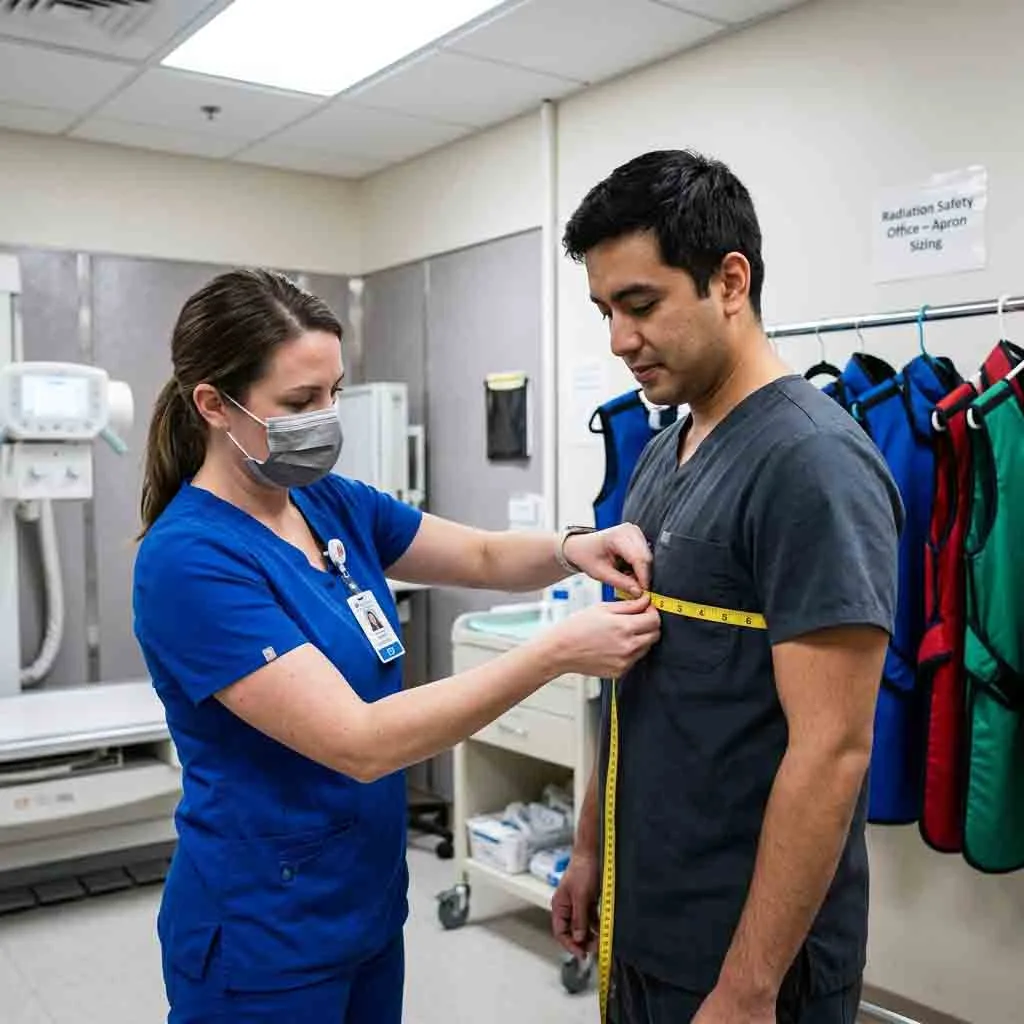
Size affects both comfort and coverage.
Common sizes may include:
- small
- medium
- large
- extra large
- pediatric sizes
Some manufacturers also provide custom dimensions.
When ordering, buyers may need to provide:
- chest measurement
- waist measurement
- height
- preferred garment length
- shoulder dimensions
- apron style
For hospitals purchasing multiple units, it is often better to create a size distribution based on actual users rather than ordering one standard size for everyone.
Why Fit Matters
An oversized garment can be difficult to move in.
An undersized garment may not provide adequate coverage.
Fit also affects how the weight is distributed.
For frequently used protective clothing, ergonomic design can become an important procurement factor.
Useful buyer questions include:
- Does the apron fit different body types?
- Is the weight evenly distributed?
- Is the closure adjustable?
- Is the vest comfortable during standing procedures?
- Does the skirt provide sufficient overlap?
- Is the thyroid collar compatible with the apron?
These questions can generate valuable long-tail searches such as:
- comfortable X-ray lead apron
- lightweight radiation apron
- adjustable X-ray apron
- ergonomic radiation protection clothing
- X-ray apron for long procedures
Thyroid Collar Specifications
A thyroid shield is a smaller product, but its specification still matters.
Buyers can compare:
- lead equivalence
- coverage
- neck circumference
- fastening
- overlap
- material
- flexibility
- weight
- compatibility with apron
Search terms include:
- thyroid collar lead equivalence
- X-ray thyroid shield specification
- radiation thyroid collar
- thyroid protection for fluoroscopy
- lead thyroid shield
- thyroid radiation protection
IEC 61331-3 specifically includes thyroid collars within its scope for protective devices against diagnostic medical X-radiation. (webstore.iec.ch)
Radiation Protection Glasses: What Should Buyers Compare?
Protective eyewear has its own procurement criteria.
Look at:
- lens material
- shielding specification
- side protection
- frame design
- weight
- optical quality
- fit
- prescription compatibility
- cleaning requirements
Common product searches include:
- X-ray protective glasses
- radiation protection glasses
- lead glasses
- leaded radiation glasses
- fluoroscopy glasses
- radiation safety eyewear
- X-ray safety glasses
For personnel working close to patients during fluoroscopy, eye protection can be an important part of the overall radiation protection strategy.
Protective Gloves: Important Specifications
Protective gloves need a different balance between shielding and dexterity.
Buyers should review:
- size
- flexibility
- finger movement
- hand coverage
- material
- protection specification
- intended application
- surface finish
- cleaning instructions
Search terms include:
- X-ray protective gloves
- radiation protection gloves
- lead X-ray gloves
- fluoroscopy gloves
- radiology protective gloves
- radiation shielding gloves
One important safety point is that protective gloves should not be used to justify placing hands directly into the primary X-ray beam.
Good radiation protection practice still relies on positioning, distance, exposure control and appropriate shielding.
X-Ray Protective Products for the Operating Room
Operating-room products require additional attention to mobility.
A typical protection package may include:
- lead apron
- thyroid collar
- radiation glasses
- mobile radiation barrier
- ceiling-suspended shield
- table-mounted protective curtain
For these products, buyers should evaluate how easily the equipment can be moved around:
- operating tables
- C-arms
- surgical instruments
- anesthesia equipment
- medical staff
A technically suitable shield that interferes with the surgical workflow may be difficult to use consistently.
Therefore, ergonomics and workflow compatibility are legitimate procurement criteria.
How to Choose a Mobile X-Ray Barrier
A mobile radiation barrier should be evaluated differently from clothing.
Important specifications may include:
Shielding Area
A larger screen can provide more physical coverage, but size also affects movement and storage.
Height
The screen should be suitable for the intended operator position.
Width
The width influences the amount of shielding provided from different directions.
Mobility
Check:
- wheels
- caster design
- locking mechanism
- turning radius
- movement resistance
Stability
The barrier should remain stable during normal use.
Viewing Area
Some designs include transparent radiation-protective viewing sections.
Storage
Hospitals should consider where the screen will be stored when not in use.
Search terms include:
- mobile X-ray protective screen
- movable radiation barrier
- portable X-ray shield
- mobile radiation protection screen
- X-ray rolling barrier
- radiation protection mobile screen
Lead Glass: Key Specifications
Radiation protection glass should be evaluated as part of the room design.
Common specifications include:
- glass dimensions
- thickness
- lead equivalence
- optical clarity
- frame design
- installation method
- viewing area
Search terms include:
- X-ray lead glass
- radiation protection glass
- leaded glass X-ray window
- X-ray shielding glass
- radiation protection window
- lead glass for radiology room
- X-ray room viewing window
A glass product should be matched to the intended shielding design rather than selected solely by thickness.
The surrounding wall construction, frame and installation also matter.
Protective Curtains: What to Check
Radiation protection curtains may be used around imaging tables and other equipment.
Buyers should check:
- curtain dimensions
- shielding specification
- material
- flexibility
- attachment system
- movement
- cleaning
- durability
- replacement options
Search terms include:
- X-ray protective curtain
- radiation shielding curtain
- lead curtain
- fluoroscopy lead curtain
- C-arm lead curtain
- X-ray table curtain
- radiology protective curtain
Because curtains are repeatedly moved or touched, mechanical durability can be just as relevant to daily usability as the shielding specification.
Standards and Compliance
Medical radiation protection products are often sold internationally.
A buyer may encounter different requirements depending on the destination market.
Relevant standards can include IEC 61331-3, which covers protective devices against diagnostic medical X-radiation. Its scope includes protective clothing and certain protective devices, with requirements related to protection, design, materials, sizing, marking and conformity. (webstore.iec.ch)
For a procurement project, buyers should distinguish between:
Manufacturer claims
and
documented conformity or test information.
A product page may state a protection value, but the buyer may also need technical documents supporting the claim.
The exact documentation required depends on the destination market, product classification and procurement project.
CE Marking and International Purchasing
International medical equipment buyers often search for:
- CE certified X-ray apron
- CE X-ray protective clothing
- CE radiation protection products
- medical X-ray protection supplier
- certified X-ray protective products
However, “CE” should not be treated as a universal substitute for checking the actual product documentation.
Buyers should ask the supplier to provide relevant conformity information for the exact product being purchased.
This is particularly important when purchasing through international B2B marketplaces.
How to Check an X-Ray Protective Product Supplier
The supplier is as important as the product.
A buyer can evaluate:
Product Range
Does the supplier offer only aprons, or can it also supply:
- thyroid collars
- eyewear
- gloves
- mobile barriers
- protective curtains
- lead glass
- other radiation protection products?
Technical Documents
Can the supplier provide:
- datasheets
- specifications
- test reports
- conformity documentation
- instructions for use?
Customization
Can the manufacturer provide:
- custom sizes
- custom colors
- private labeling
- packaging customization
- OEM production?
Production Capability
Ask about:
- manufacturing facilities
- quality control
- production capacity
- inspection procedures
- export experience
After-Sales Support
Check:
- warranty
- spare parts
- replacement products
- technical support
- complaint handling
Manufacturer vs Trading Company
A common sourcing question is whether to buy directly from a factory or through a trading company.
Both models can exist in the medical equipment market.
A manufacturer may provide:
- direct technical communication
- customization
- production information
- factory documentation
A trading company may provide:
- broader product sourcing
- consolidated orders
- multiple brands
- procurement convenience
The important issue is not simply the label factory or trading company.
Verify what the supplier can actually provide.
For example:
Can they provide the technical documentation?
Can they support custom orders?
Can they maintain consistent specifications across repeat orders?
Can they provide after-sales support in your market?
What Does OEM Mean for X-Ray Protective Products?
OEM is frequently searched by distributors and medical equipment companies.
Common keywords include:
- X-ray protective clothing OEM
- radiation protection OEM
- lead apron OEM
- X-ray apron private label
- radiation protection private label
- custom X-ray protective products
- OEM radiation protection products
OEM projects may involve:
- logo
- label
- packaging
- product color
- product size
- product configuration
Before placing an OEM order, buyers should confirm whether the manufacturer has experience with the exact product and destination market.
Product Inspection Before Shipment
For international B2B orders, inspection can help reduce procurement risk.
Buyers may check:
- product quantity
- model
- size
- dimensions
- labeling
- packaging
- visible defects
- stitching
- closures
- wheels and locks for barriers
- accessories
- documentation
For protective clothing, special attention should be paid to visible physical damage.
The product should also be handled and stored according to the manufacturer’s instructions.
Storage and Maintenance of X-Ray Protective Clothing
Protective garments need appropriate handling.
Incorrect storage can damage protective materials.
For example, FDA dental guidance states that protective aprons and thyroid shields should be hung or laid flat rather than folded, and recommends periodic inspection for damage. (fda.gov)
This creates another useful group of long-tail search terms:
- how to store X-ray lead apron
- X-ray apron storage
- how to clean lead apron
- lead apron inspection
- X-ray protective clothing maintenance
- radiation apron care
- lead apron damage inspection
The exact cleaning method should follow the manufacturer’s instructions.
How to Inspect an X-Ray Apron
Routine inspection can include checking for:
- cracks
- tears
- damaged seams
- damaged fasteners
- abnormal folding
- visible surface damage
- signs of material deterioration
If damage is suspected, the facility should follow its radiation safety and inspection procedures to determine whether the product remains suitable for use.
For high-use departments, an inspection schedule can be incorporated into the facility’s equipment management process.
How to Compare Two X-Ray Protective Aprons
Instead of asking which apron is “better,” create a comparison table.
| Specification | Product A | Product B |
|---|---|---|
| Intended application | ||
| Material | ||
| Lead equivalence | ||
| Size | ||
| Weight | ||
| Coverage | ||
| Closure | ||
| Thyroid collar | Included / Optional | Included / Optional |
| Standard | ||
| Test documentation | ||
| Warranty | ||
| MOQ | ||
| OEM | Yes / No | Yes / No |
| Packaging |
This gives procurement teams a much clearer basis for comparison.
What Should Be Included in an RFQ?
A clear RFQ can save considerable time.
For example:
Product: X-ray protective apron
Application: Fluoroscopy / C-arm
Quantity: [Required quantity]
Size: Mixed sizes
Design: Wrap-around
Protection specification: [Required specification]
Material: Lead / lead-free / composite
Additional products: Thyroid collars, protective eyewear, gloves
Documentation: Technical datasheet, applicable conformity documentation and test information
Customization: Logo / packaging / none
Destination: [Country]
Quotation terms: EXW / FOB / CIF
The same format can be adapted for mobile barriers, curtains and other radiation protection products.
X-Ray Protective Clothing Buying Checklist
Before ordering, check:
Application
- General radiography
- Fluoroscopy
- C-arm
- Interventional
- Dental
- Mobile X-ray
- Veterinary
Product
- Apron
- Vest and skirt
- Thyroid collar
- Glasses
- Gloves
- Curtain
- Mobile barrier
- Lead glass
Technical
- Protection specification
- Material
- Coverage
- Size
- Weight
- Flexibility
- Durability
Compliance
- Applicable standard
- Test information
- Conformity documentation
- Labeling
Commercial
- MOQ
- Unit price
- OEM
- Warranty
- Packaging
- Lead time
- Shipping terms
This checklist can also be converted into an internal hospital procurement form.
Frequently Asked Questions
What should I look for when buying an X-ray lead apron?
Consider the intended application, protection specification, coverage, material, weight, size, fit, durability, applicable standards and supplier documentation.
Is a higher lead equivalence always better?
Not necessarily. Lead equivalence must be considered together with the intended application, coverage, weight, design and relevant testing requirements.
What is the difference between lead and lead-free X-ray aprons?
Lead aprons use lead as a shielding material. Lead-free aprons use alternative shielding materials. Both should be evaluated based on documented protection performance and suitability for the intended application.
What lead equivalence is used for X-ray aprons?
Products can be available with different protection specifications. The appropriate specification depends on the application and applicable requirements rather than one universal value.
Are lightweight X-ray aprons safe?
Weight alone does not determine protection. Buyers should check the manufacturer’s documented protection specification and applicable testing information.
How do I choose an X-ray apron size?
Choose a size that provides suitable coverage while allowing normal movement. Hospitals purchasing multiple units should consider the body sizes of actual users.
What is a wrap-around X-ray apron?
A wrap-around apron is designed to provide protective coverage around more of the body than a front-only garment, depending on its construction and specification.
What are X-ray protective glasses used for?
They are designed to reduce radiation exposure to the eyes in situations where staff may be exposed to scattered radiation.
Are X-ray protective gloves used to put hands in the beam?
No. Protective gloves should not be treated as permission to place hands directly in the primary X-ray beam.
How should a lead apron be stored?
Follow the manufacturer’s instructions. FDA guidance for dental radiography states that protective aprons and thyroid shields should be hung or laid flat rather than folded. (fda.gov)
How often should an X-ray apron be inspected?
Facilities should establish inspection procedures appropriate to their equipment and usage. Protective garments should be checked for physical damage, with additional testing performed according to applicable facility procedures and manufacturer guidance.
What documents should an X-ray protection supplier provide?
Depending on the product and market, buyers may request a technical datasheet, protection specification, test information, conformity documentation, instructions for use and warranty information.
Can X-ray protective clothing be customized?
Many manufacturers offer options such as different sizes, designs, colors, labels and packaging. OEM availability should be confirmed for the specific product.
Should I buy X-ray protection directly from a manufacturer?
Direct factory purchasing can be useful for technical communication and customization, while distributors or trading companies may provide broader sourcing services. The supplier should be evaluated based on verified capabilities and documentation.
Final Takeaway
Choosing X-ray protective clothing is not simply a matter of selecting the highest protection number or the heaviest garment.
A useful purchasing decision considers several factors together:
Application → Protection → Coverage → Material → Weight → Fit → Usability → Documentation → Supplier
For wearable products, buyers should pay particular attention to:
- lead equivalence
- shielding material
- coverage
- size
- weight
- flexibility
- ergonomic design
- durability
- storage
- inspection
For non-wearable products such as mobile barriers, curtains and lead glass, the priorities change toward:
- shielding area
- dimensions
- mobility
- stability
- installation
- visibility
- room compatibility
The same principle applies across the entire X-ray protective products market: the correct specification depends on the actual application.
For hospitals and distributors, a structured RFQ and side-by-side supplier comparison can make purchasing much easier than comparing product photographs or unit prices alone.
The next step in this content cluster is the commercial side of the market: X-ray protective clothing and product prices, China manufacturers, suppliers, wholesale purchasing, OEM, shipping and how to evaluate a quotation.