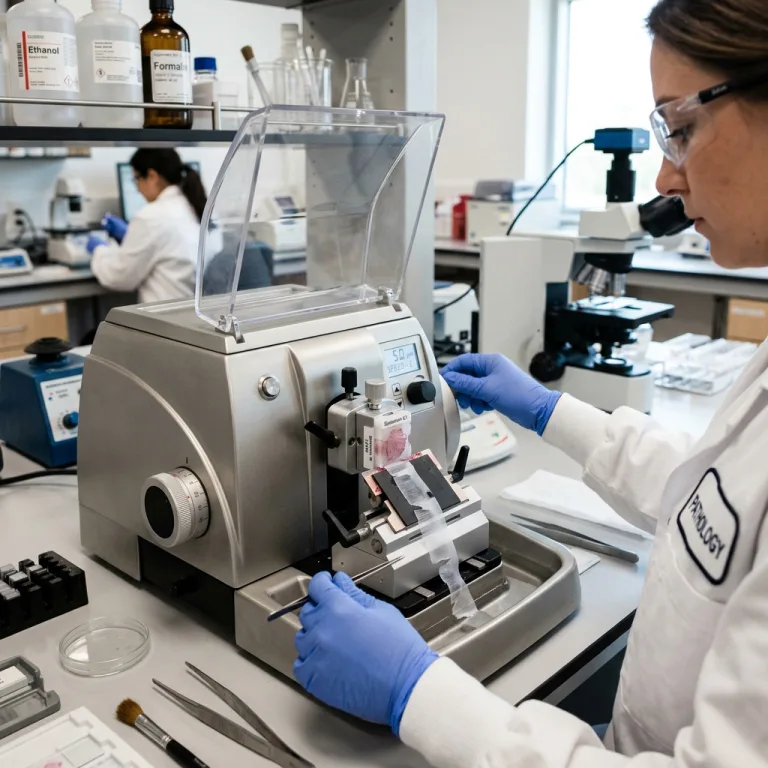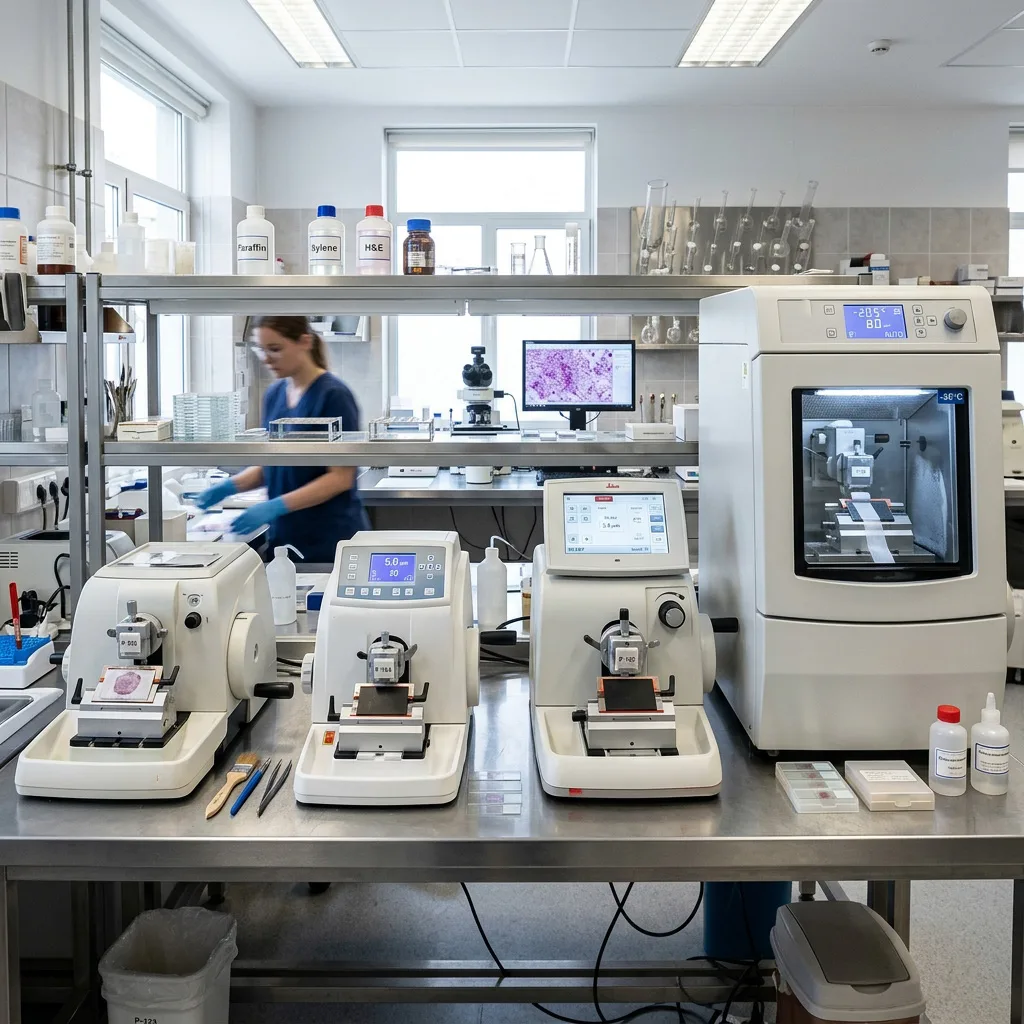
Manual vs Semi-Automatic vs Automatic Microtome
One of the most common microtome purchasing questions is:
Should I buy a manual, semi-automatic or automatic microtome?
The answer depends mainly on workload, operator preference, sectioning consistency and budget.
Manual Microtome
A manual microtome relies heavily on the operator for cutting movement and specimen advancement.
It can be suitable for:
- routine histology
- small laboratories
- teaching laboratories
- low to moderate workloads
- laboratories that prefer straightforward mechanical operation
Manual operation can provide direct control over the cutting process.
It can also be attractive when the laboratory wants a relatively simple instrument without unnecessary automation.
However, repeated handwheel movement can place physical demands on the operator during long working periods. Microtome safety and ergonomics are therefore important considerations even for manual systems.
What Is a Semi-Automatic Microtome?
A semi-automatic microtome combines manual control with some automated functions.
Depending on the model, automation may support:
- specimen feed
- trimming
- section thickness setting
- motor-assisted functions
- specimen positioning
- sectioning control
The exact configuration varies by manufacturer.
Semi-automatic systems can be useful for laboratories that want more workflow assistance while retaining a degree of direct operator control.
For many buyers, this creates a middle position between a basic manual microtome and a fully automated system.
What Is an Automatic Microtome?
An automatic microtome uses motorized systems to automate some or much of the cutting and specimen-feed process.
Automation can help provide:
consistent movement
repeatable sectioning
reduced manual handwheel operation
more controlled workflow
greater operator convenience
Research guidance from Leica Biosystems notes that motorized specimen feed can improve consistency and reproducibility, while fully automated systems can automate specimen feed and handwheel movement for higher-throughput workflows.
However, automation does not mean that the operator no longer matters.
The specimen still needs to be properly processed, embedded, oriented and prepared.
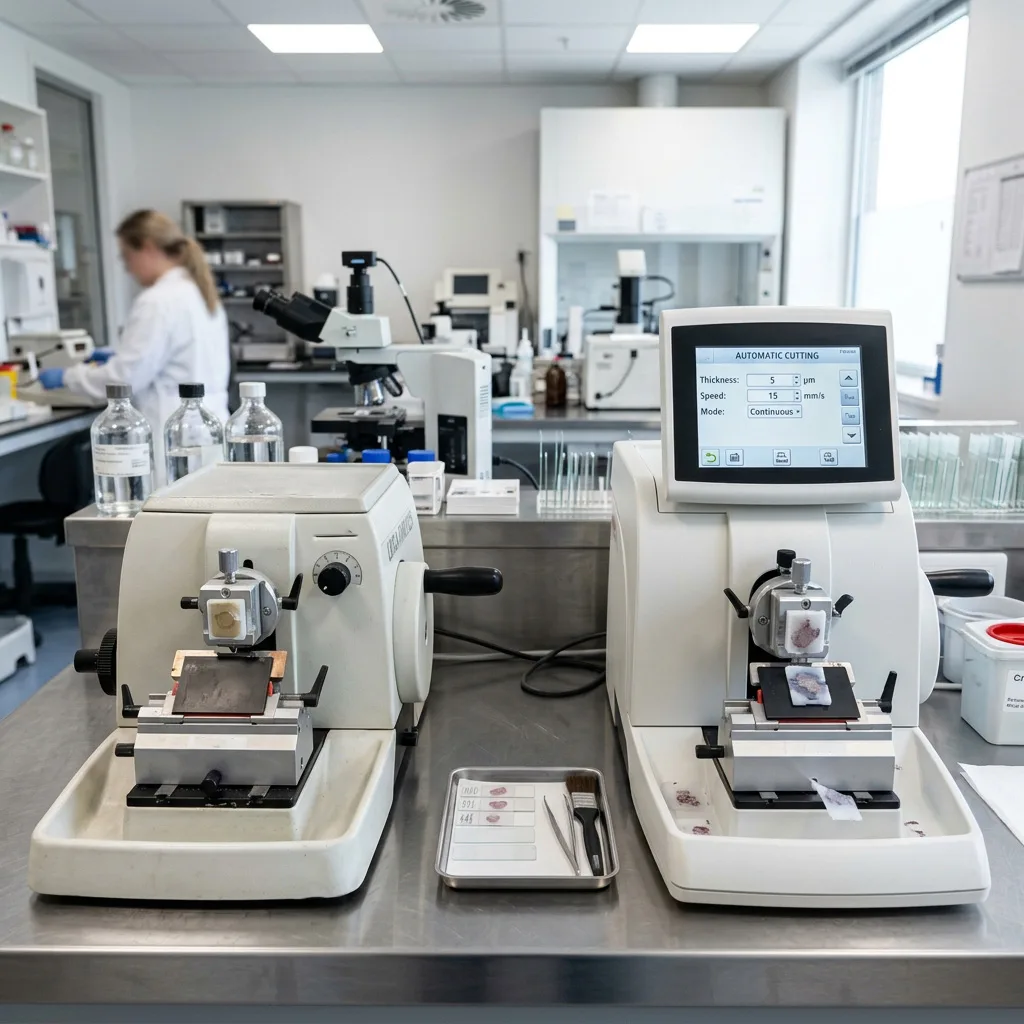
Manual vs Automatic Microtome: A Practical Comparison
| Feature | Manual | Semi-Automatic | Automatic |
|---|---|---|---|
| Operator control | High | High to medium | Medium |
| Motorized movement | Usually no | Partial | Yes |
| Workflow automation | Low | Medium | High |
| Routine workloads | Suitable | Suitable | Suitable |
| High-volume workloads | Depends on operator | Often suitable | Often useful |
| Physical handwheel use | Higher | Lower | Lower or minimized |
| Reproducibility | Operator dependent | Improved | More consistent |
| Purchase complexity | Lower | Medium | Higher |
| Training requirement | Basic to moderate | Moderate | Moderate |
This comparison is a general purchasing framework.
Actual capabilities vary by model, so buyers should confirm the manufacturer’s specifications before ordering.
Rotary Microtome or Cryostat Microtome?
This is another major selection decision.
The two machines can both produce thin tissue sections, but their workflows are different.
Rotary Microtome
A rotary microtome is commonly used for:
- paraffin-embedded tissue
- routine histology
- histopathology
- surgical pathology
- research specimens using compatible embedding media
Cryostat Microtome
A cryostat is designed for:
- frozen tissue
- frozen section workflows
- selected histology applications
- histochemistry
- immunohistochemistry
- research
A cryostat places the sectioning mechanism inside or within a refrigerated environment so that the specimen remains frozen during cutting. Thermo Fisher’s cryotome documentation identifies controlled specimen temperature, microtome adjustment and blade condition as important factors for frozen section quality.
So the purchasing question should be:
Does the laboratory primarily need paraffin sectioning, frozen sectioning, or both?
That answer often determines the equipment category before other specifications are considered.
Microtome Section Thickness: What Should Buyers Check?
A section thickness setting is one of the most important specifications on a microtome.
But buyers should not simply choose a model because it advertises the smallest available number.
The important questions are:
What thickness range does the machine support?
How is thickness adjusted?
How stable is the feed mechanism?
Is the selected thickness repeatable?
Is the thickness range suitable for the laboratory’s actual applications?
Routine paraffin histology generally uses sections in the few-micrometer range, but research and specialized applications may require different section thicknesses.
A microtome with a wide nominal thickness range is not automatically more useful.
What matters is whether the equipment can reliably produce the sections required by the laboratory.
Leica’s research microtome guidance similarly emphasizes the relationship between precise specimen feeding, reproducible sectioning and the intended research application.
Precision Feed and Specimen Advancement
The specimen feed mechanism controls how the specimen advances toward the blade.
This is one of the mechanical features worth investigating carefully.
A good feed mechanism should support:
- controlled advancement
- repeatable section thickness
- stable movement
- accurate positioning
- smooth operation
Small mechanical inconsistencies can become more visible when a laboratory produces many consecutive sections.
For buyers, useful questions include:
Is the specimen feed manual or motorized?
How is feed thickness selected?
Is the adjustment easy to read?
Does the mechanism remain stable during long-term use?
Can the specimen be quickly retracted or repositioned?
Leica identifies precision feeding and microtome stability as important contributors to consistent section quality.
Specimen Orientation and Block Alignment
A microtome can be mechanically precise, but section quality can still suffer when the tissue block is badly aligned.
A useful specimen orientation system should make it easier to:
- align the tissue block
- adjust the cutting plane
- correct the specimen angle
- repeat a previous orientation
- reduce unnecessary block movement
This is especially important when a laboratory works with samples that have defined anatomical orientation.
A strong specimen clamp and stable block mounting system can also help prevent unwanted movement during sectioning.
When comparing machines, buyers should therefore look beyond “micron setting” and inspect the complete specimen clamping and orientation system.
Blade Holder and Microtome Blade Compatibility
The blade system is another important part of microtome selection.
Buyers should ask:
Which blades are compatible?
Disposable or reusable?
High-profile or low-profile?
Is the blade holder easy to adjust?
Can the blade be changed safely?
Are compatible blades readily available in the destination market?
Blade availability matters because a machine that requires difficult-to-source consumables can create long-term operating problems.
The blade holder should also provide stable positioning and allow practical adjustment.
For routine laboratories, disposable blades are often convenient because the cutting edge can be replaced without sharpening a reusable knife.
For specialized applications, however, different knife materials and cutting systems may be preferred.
Microtome Safety Should Be a Purchasing Criterion
A microtome contains a sharp cutting edge, so safety should not be treated as an accessory.
Important features can include:
handwheel lock
blade guard
safe blade changing system
blade ejector
emergency stop on motorized systems
controlled motor start
stable specimen clamping
Leica’s microtome purchasing guidance specifically highlights handwheel locks, blade guards, blade removal tools, emergency stops and other safety features as factors worth evaluating.
The exact safety features depend on the model.
When comparing suppliers, buyers should ask the manufacturer to identify the actual safety mechanisms rather than accepting a general statement such as “safe operation.”
Microtome Ergonomics: A Detail That Matters Every Day
A laboratory may use a microtome for several hours each working day.
That makes ergonomics important.
Consider:
handwheel position
handwheel resistance
operator posture
coarse feed control
control-panel location
visibility
working height
access to the specimen
ease of blade replacement
cleaning access
A machine may perform well in a technical demonstration but still be inconvenient if operators need to work in an awkward position for long periods.
Leica notes that repeated handwheel movement can contribute to operator discomfort, and its current microtome portfolio places safety, ergonomics and efficiency among the major design considerations.
For a procurement team, ergonomics should therefore be considered part of equipment productivity rather than merely a comfort feature.
How Important Is Vibration?
Microtome vibration can affect sectioning behavior.
The instrument needs sufficient mechanical stability to keep the specimen and cutting system controlled during sectioning.
Potential sources of unwanted movement include:
- unstable installation
- loose components
- specimen movement
- blade holder issues
- unsuitable cutting conditions
- mechanical wear
Leica’s technical purchasing guidance identifies microtome stability and precision components as important factors for consistent section quality.
For buyers, it is useful to inspect the machine during a demonstration rather than relying only on a specification sheet.
Ask the supplier to show actual sectioning with a suitable tissue block.
Automatic Microtome: Does Automation Always Mean Better?
Automation can be useful, but more automation does not automatically mean a better fit for every laboratory.
An automatic microtome may provide:
- repeatable movement
- automated specimen feed
- reduced manual operation
- higher workflow consistency
- additional controls
But it can also involve:
- higher purchase cost
- more electronic components
- greater system complexity
- additional training requirements
- different maintenance needs
A small teaching laboratory may not need all of these functions.
A higher-volume pathology department may value them more.
So the right purchasing principle is:
Buy the automation level that matches the workflow.
This avoids paying for features that the laboratory rarely uses.
What About a Used Microtome?
Used laboratory equipment can sometimes appear attractive because the initial purchase price may be lower.
However, buyers should investigate:
age
usage history
service history
mechanical condition
electronic condition
availability of spare parts
availability of compatible accessories
remaining manufacturer support
calibration or inspection status
A used microtome may look clean externally while having mechanical wear that is not obvious from photographs.
For a clinical laboratory, the cost of unexpected downtime should also be considered.
A lower acquisition price does not necessarily equal a lower total ownership cost.
Microtome Maintenance Requirements
Before purchasing, ask:
Who will service the machine after installation?
A good procurement decision includes the maintenance plan.
Useful questions include:
What routine cleaning is required?
Which parts are consumables?
Which components have recommended replacement intervals?
Can basic maintenance be performed locally?
Is remote technical support available?
Are spare parts stocked?
How quickly can replacement parts be shipped?
Is technician training provided?
Microtome maintenance commonly involves keeping the instrument clean, removing paraffin debris, checking the mechanical system and following the manufacturer’s instructions.
The exact maintenance schedule should always come from the equipment’s service documentation.
Microtome Price: Why Can Two Similar Machines Cost Very Different Amounts?
Buyers often search:
microtome machine price
histology microtome price
rotary microtome price
automatic microtome price
cryostat microtome price
But comparing prices without specifications can be misleading.
The quotation can depend on:
- microtome type
- automation level
- sectioning mechanism
- cooling system
- digital controls
- accessories
- blade holder
- specimen clamps
- shipping
- packaging
- warranty
- after-sales service
- certification
- customization
A manual rotary microtome and a fully automated cryostat should not be compared only by unit price.
The correct process is:
define the specification → request comparable quotations → calculate total cost → evaluate service
What Is Total Cost of Ownership?
Total cost of ownership, or TCO, considers more than the initial equipment price.
For a microtome, the longer-term cost may include:
purchase price
shipping
installation
training
blades
accessories
replacement parts
maintenance
service
downtime
electricity, where relevant
A machine with a lower purchase price may require more manual labor or more frequent maintenance.
A more automated machine may cost more initially but reduce repetitive manual work.
The correct comparison depends on the laboratory’s actual workflow.
How to Compare Two Microtome Suppliers
Suppose two suppliers quote similar prices.
Instead of immediately choosing the lower quotation, compare:
| Category | Supplier A | Supplier B |
|---|---|---|
| Microtome type | ||
| Manual / automatic | ||
| Section thickness range | ||
| Feed system | ||
| Specimen orientation | ||
| Blade holder | ||
| Safety features | ||
| Ergonomics | ||
| Accessories | ||
| Warranty | ||
| Technical support | ||
| Spare parts | ||
| Packaging | ||
| Lead time | ||
| Certification | ||
| Total delivered cost |
This creates a much clearer comparison than:
Supplier A = $X
Supplier B = $Y
What Should a Microtome RFQ Include?
A professional microtome RFQ should be specific enough for different suppliers to quote the same type of equipment.
You can write:
Product: Rotary microtome
Application: Routine paraffin histology
Operation: Manual / semi-automatic / automatic
Required section thickness: Specify laboratory requirement
Specimen type: Paraffin-embedded tissue
Blade: Disposable blade system
Required accessories: Specimen clamps, blade holder, waste tray, etc.
Quantity: Specify quantity
Destination: Country / port
Certification: Required market documentation
Warranty: Required period
Support: Online technical support / spare parts
Shipping term: EXW / FOB / CIF / DAP
This reduces the chance of receiving five quotations for five different product configurations.
What Should a Laboratory Ask a Microtome Manufacturer?
Before ordering, ask the supplier:
About the machine
- What type of microtome is it?
- Is it manual, semi-automatic or automatic?
- What specimens is it designed for?
- What section thickness range is available?
- What type of blades can be used?
About safety
- Is there a handwheel lock?
- Is there a blade guard?
- How is the blade changed?
- Are there emergency-stop features on motorized models?
About workflow
- Is specimen orientation adjustable?
- How easy is trimming?
- How easy is block repositioning?
- Can the machine be used comfortably for long working periods?
About service
- What is the warranty?
- Are spare parts available?
- Is online support available?
- Can training be provided?
- What is the estimated service response process?
About the commercial order
- What is the MOQ?
- What is the lead time?
- What accessories are included?
- What packaging is used?
- Which documents are supplied?
How to Evaluate a Cryostat Microtome
A cryostat requires several additional questions because refrigeration becomes part of the equipment.
Important factors include:
temperature range
temperature stability
freezing speed
chamber size
specimen stage
defrost system
microtome mechanism
blade holder
waste management
ergonomics
cleaning
maintenance
condensation management
Thermo Fisher’s Cryotome documentation identifies controlled temperature, correct microtome adjustment, suitable blade sharpness and correct blade angle as important factors in frozen sectioning.
So a buyer should evaluate both sides of the machine:
refrigeration performance + microtome performance
A cryostat is not simply a normal microtome placed inside a cold cabinet.
UMY Medical’s Cryostat Microtome as a Buyer Example
UMY Medical Equipment Co., Ltd. currently lists an Advanced Cryostat Microtome with Intelligent Refrigeration and Stable Sectioning, SKU UMY-MI-002.
The current product information lists:
- Class II
- electric power
- one-year warranty
- ISO 13485 quality system
- online technical support
- spare-parts support
- carton or wooden-case transport packaging
- MOQ of one
- production capacity listed at 2,000 sets per year
The product specifications also include a large freezing shelf, Peltier fast freezing down to minus 60°C, dual compressors, multi-position defrosting, an independent refrigerated specimen head, precision feeding and a large touch display.
For a buyer, however, the useful lesson is not simply that these features exist.
The buyer should ask:
Which features actually matter to my laboratory?
For example, a laboratory focused on frozen-section work may pay more attention to temperature stability, chamber design and specimen freezing than to display size.
A laboratory with several operators may care more about workflow, controls and repeatability.
This is the correct way to use a product specification during procurement.
Microtome Manufacturer vs Microtome Supplier
These terms are sometimes used interchangeably, but they can represent different business models.
A microtome manufacturer may control product design and production.
A microtome supplier may manufacture the equipment, distribute it, or work with manufacturing partners.
A distributor can provide useful access to several brands.
A direct manufacturer may provide greater control over:
- customization
- technical specifications
- OEM
- replacement parts
- production schedules
- repeat orders
The buyer should therefore ask about the actual supply relationship.
What Makes a Good Microtome Supplier?
A reliable supplier should be able to answer practical questions clearly.
Look for:
clear specifications
consistent product information
technical documentation
sample or demonstration availability where appropriate
transparent quotation
defined warranty
spare-part support
after-sales service
export experience
responsive communication
A supplier that only gives a price but cannot explain the configuration may not be suitable for a technical laboratory purchase.
Microtome Buying Checklist
Before placing an order, confirm:
| Question | Check |
|---|---|
| What specimen will be sectioned? | ☐ |
| Paraffin or frozen workflow? | ☐ |
| Manual, semi-automatic or automatic? | ☐ |
| Required section thickness range? | ☐ |
| Blade compatibility? | ☐ |
| Specimen orientation system? | ☐ |
| Feed mechanism? | ☐ |
| Safety system? | ☐ |
| Ergonomic design? | ☐ |
| Stability and vibration control? | ☐ |
| Accessories included? | ☐ |
| Warranty? | ☐ |
| Spare parts? | ☐ |
| Technical support? | ☐ |
| Certification documents? | ☐ |
| Packaging? | ☐ |
| Lead time? | ☐ |
| Final delivered cost? | ☐ |
Common Microtome Purchasing Mistakes
Buying based only on price
Price matters, but equipment specifications and long-term service also affect the real cost.
Choosing a machine that is too complex
A laboratory may not need every available automation feature.
Choosing a machine that is too basic
A high-volume laboratory may spend too much operator time on a manual process.
Ignoring blade availability
A machine is only practical when compatible consumables can be supplied reliably.
Ignoring ergonomics
The instrument may be used every working day. Operator comfort matters over the long term.
Failing to check service support
A technical instrument should have a clear plan for maintenance and spare parts.
Comparing different specifications as though they were identical
A manual rotary microtome and a cryostat should never be compared only by price.
Microtome Selection by Laboratory Type
A simple starting framework can be useful.
Small Histology Laboratory
Possible priorities:
simple operation
routine paraffin sectioning
reasonable cost
easy maintenance
local or remote technical support
A manual rotary microtome may be suitable depending on workload.
Medium Pathology Laboratory
Possible priorities:
higher throughput
repeatable sectioning
operator ergonomics
efficient specimen handling
A semi-automatic or automatic system may be considered depending on workload.
High-Volume Pathology Department
Possible priorities:
workflow consistency
automation
operator efficiency
reproducibility
service availability
scalability
Automatic sectioning features may become more valuable in this environment.
Research Laboratory
Possible priorities depend strongly on the research model.
The lab may need:
paraffin sectioning
frozen sectioning
resin sectioning
specialized thickness ranges
advanced specimen orientation
research-specific accessories
Therefore, a research laboratory should define the specimen and microscopy method before selecting the equipment.