Buying a hematology analyzer is an important decision for a hospital, clinic, diagnostic laboratory, medical center, or laboratory equipment distributor.
The market includes compact 3-part hematology analyzers, advanced 5-part hematology analyzers, automated CBC analyzers, high-throughput laboratory systems, and specialized configurations. Prices and specifications can vary significantly between models.
For a buyer, however, the most expensive analyzer is not automatically the right choice.
The better approach is to match the analyzer to the laboratory’s:
- Daily sample volume
- Required CBC parameters
- WBC differential needs
- Sample volume
- Throughput
- Reagent system
- Automation level
- Laboratory workflow
- LIS requirements
- Maintenance capability
- Budget
- Local service support
This guide explains how to evaluate a hematology analyzer for sale, compare specifications, estimate operating costs, evaluate suppliers, and prepare a practical purchasing checklist.
What Is a Hematology Analyzer?
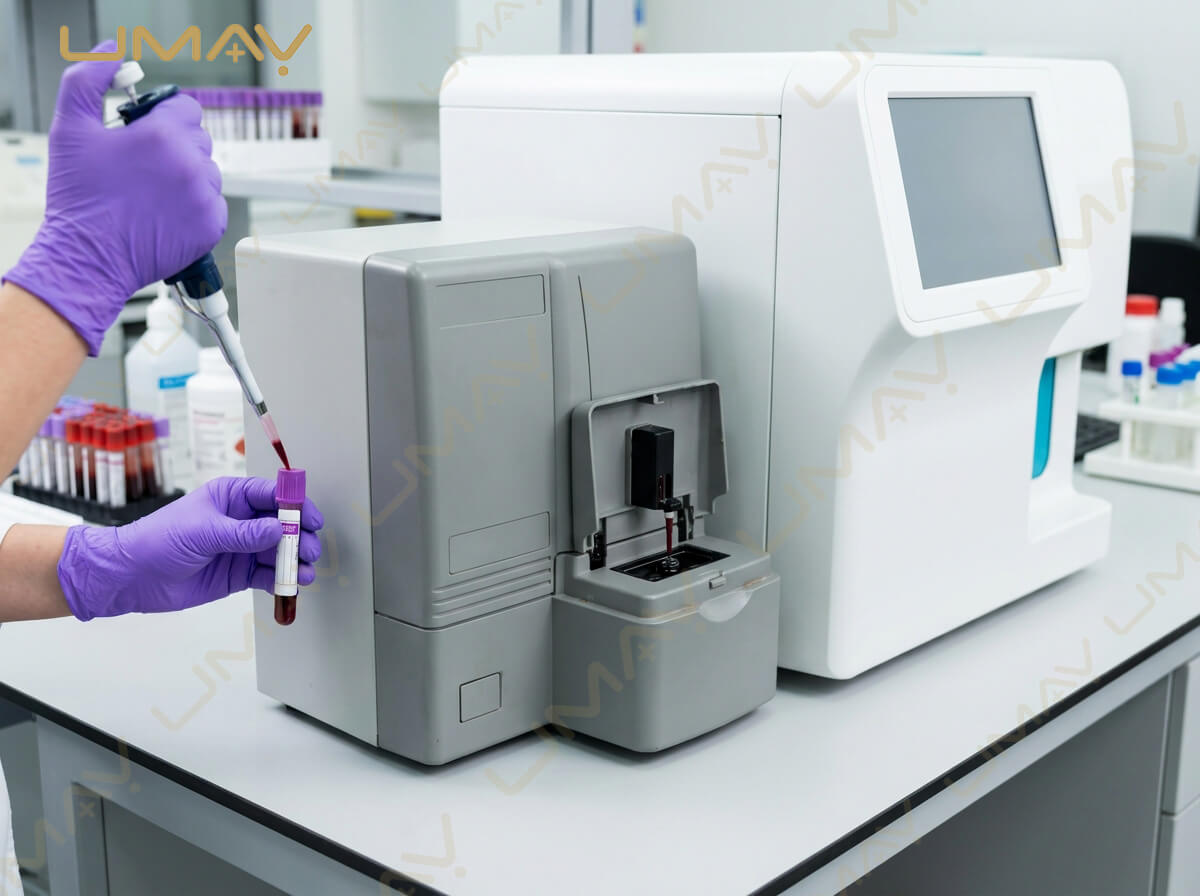
A hematology analyzer is an automated laboratory instrument used to count and analyze blood cells.
Depending on the model, it may provide routine CBC parameters such as:
- WBC
- RBC
- HGB
- HCT
- MCV
- MCH
- MCHC
- RDW
- PLT
- MPV
More advanced systems can also provide detailed WBC differentials, additional platelet parameters, histograms, scattergrams, flags, and other specialized measurements.
The exact parameter menu depends on the analyzer’s design, software, reagents, and intended use.
For procurement teams, this means that the phrase “hematology analyzer” alone is not enough to compare products.
The complete specification matters.
What Should You Consider Before Buying a Hematology Analyzer?
A useful purchasing decision can be divided into ten areas:
- Laboratory workload
- Required parameters
- 3-part or 5-part differential
- Throughput
- Sample volume
- Reagents and consumables
- Automation
- Connectivity
- Maintenance and service
- Total cost of ownership
Starting with these areas can make a complicated equipment comparison much easier.
1. Determine Your Laboratory Testing Volume
Before comparing brands, determine how many CBC tests your laboratory actually performs.
Start with:
Average tests per day
Then calculate:
Peak tests per day
Also consider future growth.
For example, a small clinic may process only a limited number of CBC samples every day, while a diagnostic center may handle hundreds or thousands of samples.
This difference can completely change the type of hematology analyzer you need.
Low-Volume Laboratory
Typical priorities may include:
- Compact design
- Simple operation
- Low sample volume
- Easy maintenance
- Affordable reagent consumption
- Moderate throughput
A compact 3-part CBC analyzer may be worth considering.
Medium-Volume Laboratory
Important factors may include:
- Higher throughput
- More detailed differential analysis
- Better workflow automation
- Data storage
- LIS connectivity
- Reagent management
Both 3-part and 5-part analyzers may be suitable depending on requirements.
High-Volume Laboratory
Look closely at:
- Maximum throughput
- Automatic loading
- Continuous sample processing
- Reagent capacity
- Waste management
- STAT sample handling
- LIS integration
- Automated maintenance
- Service support
A higher-throughput 5-part hematology analyzer may be appropriate where detailed differential analysis is required.
2. Decide Between a 3-Part and 5-Part Hematology Analyzer
One of the most important buying decisions is whether you need a 3-part or 5-part hematology analyzer.
3-Part Hematology Analyzer
A 3-part system typically classifies white blood cells into three populations:
- Lymphocytes
- MID or mixed cells
- Granulocytes
It can also provide core CBC parameters.
A 3-part analyzer can be suitable for:
- Small clinics
- Primary care laboratories
- Small hospitals
- Routine CBC testing
- Lower-volume laboratories
5-Part Hematology Analyzer
A 5-part analyzer typically separates:
- Neutrophils
- Lymphocytes
- Monocytes
- Eosinophils
- Basophils
A 5-part system may therefore be more suitable where detailed WBC differential information is required.
For a detailed comparison, see:
3-Part vs 5-Part Hematology Analyzer: Differences, Parameters, Technology, Cost, Applications and How to Choose
3. Check the Required CBC Parameters
Do not choose a machine simply because a supplier says it provides “20 parameters” or “30 parameters.”
Ask what those parameters actually are.
Core CBC Parameters
Check for:
- WBC
- RBC
- HGB
- HCT
- MCV
- MCH
- MCHC
- RDW
- PLT
- MPV
WBC Differential
For a 5-part system, check:
- NEUT%
- NEUT#
- LYM%
- LYM#
- MONO%
- MONO#
- EOS%
- EOS#
- BASO%
- BASO#
Additional Parameters
Depending on your laboratory requirements, you may also consider:
- PDW
- PCT
- P-LCR
- Reticulocyte parameters
- Additional WBC indices
- Specialized cell measurements
The exact parameter list varies by analyzer.
For a detailed explanation of hematology parameters, see:
Hematology Analyzer Parameters Explained: WBC, RBC, HGB, HCT, MCV, MCH, MCHC, PLT and CBC Results
4. Evaluate Analyzer Throughput
Throughput is usually expressed as samples per hour.
It is one of the most important specifications for larger laboratories.
But higher throughput is not always better.
Suppose a clinic processes 40 CBC tests per day.
Buying a system designed around a much larger workload may add unnecessary cost and complexity.
A busy laboratory, however, may have a different requirement.
When comparing throughput, ask:
- What is the rated throughput?
- Is the stated speed based on CBC testing?
- Can samples be loaded continuously?
- Is STAT testing supported?
- How long does startup take?
- How long does shutdown or cleaning take?
- What happens when the system encounters a flagged result?
The real workflow capacity may be more useful than the headline samples-per-hour number.
5. Consider Sample Volume
Sample volume can be important, especially where sample quantities are limited.
Ask the supplier:
- What is the required sample volume?
- What is the minimum aspiration volume?
- Is there dead volume?
- Does the analyzer support whole-blood mode?
- Is predilution available?
- Can it process small-volume samples?
Low sample volume may be particularly useful for:
- Pediatric testing
- Outpatient clinics
- Small-volume specimens
- Resource-limited laboratories
Do not compare this number without checking how the manufacturer defines it.
6. Open-Tube or Closed-Tube Sampling?
Sampling configuration affects workflow.
Open-Tube Hematology Analyzer
The operator opens the tube and places the sample in the aspiration position.
Potential advantages:
- Simple workflow
- Flexible sampling
- Convenient for lower-volume laboratories
Closed-Tube Hematology Analyzer
The instrument can sample while the tube remains closed, depending on the configuration.
Potential advantages:
- Reduced manual handling
- More automation
- Workflow convenience
- Potentially better suited to larger laboratories
For procurement, ask whether the system supports:
- Open tube
- Closed tube
- Autoloader
- Barcode identification
- Continuous loading
- STAT sampling
7. Understand Hematology Analyzer Reagents
Reagents can become one of the most important recurring operating expenses.
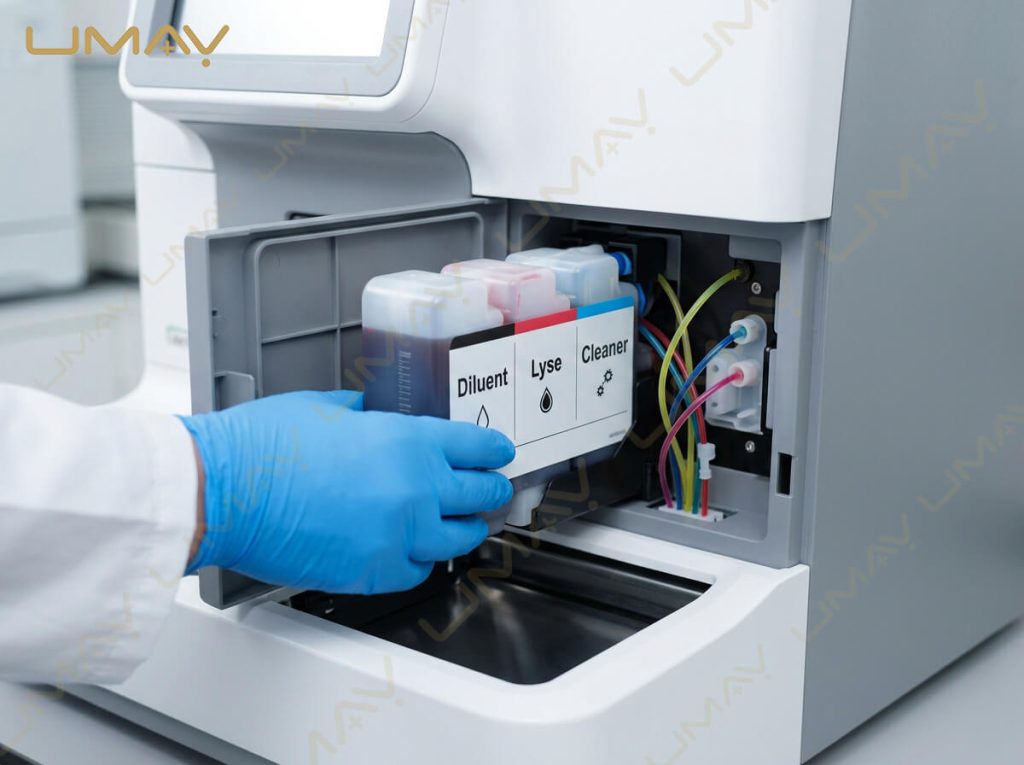
Typical hematology analyzer reagents may include:
- Diluent
- Lyse
- Cleaner
- Rinse solution
- Probe cleaner
- Specialized reagents
The exact reagent system depends on the analyzer’s measurement technology.
When comparing a hematology analyzer supplier, ask for:
Reagent Consumption
How much reagent is used per CBC test?
Reagent Pack Capacity
How many tests can one pack perform?
Reagent Shelf Life
How long can unopened and opened reagents be stored?
Storage Conditions
Does the laboratory need refrigerated storage?
Local Availability
Can replacement reagents be delivered reliably?
Cost Per Test
What is the estimated reagent cost for one CBC?
This last number is especially useful for procurement teams.
How to Calculate Hematology Analyzer Reagent Cost
A simple calculation can be:
Reagent Cost Per Test = Reagent Pack Price ÷ Number of Reported Tests
For example, if one reagent pack costs $300 and supports 1,000 tests:
$300 ÷ 1,000 = $0.30 per test
This is only an example. Actual cost depends on the analyzer, reagent configuration, wastage, cleaning cycles, and testing volume.
When comparing suppliers, ask for the expected cost per CBC test, not just the reagent pack price.
8. Consider Automation Level
Automation can significantly influence workflow.
Basic systems may require more manual sample handling.
Advanced hematology analyzers may offer:
- Automatic sample loading
- Barcode scanning
- Continuous loading
- Automatic dilution
- Automatic cleaning
- Automated rerun functions
- Automatic reflex functions
- Integrated quality control
- LIS communication
The correct level of automation depends on laboratory workload.
A small clinic may prefer simplicity.
A high-volume laboratory may benefit from more automation because it can reduce repetitive manual steps.
9. Check LIS Connectivity
LIS means Laboratory Information System.
LIS connectivity allows the hematology analyzer to exchange laboratory information with the facility’s information system.
For a small standalone clinic, this may not be a priority.
For a hospital or diagnostic center, LIS integration can be much more important.
Ask the supplier:
- Does the analyzer support LIS?
- Which communication interfaces are available?
- Is bidirectional communication supported?
- Can patient information be imported?
- Can results be transmitted automatically?
- Is barcode identification available?
- Is additional software required?
Do not assume that every analyzer supports the same LIS functions.
10. Review Data Management Features
A modern CBC analyzer may store:
- Patient records
- QC results
- Calibration records
- Histograms
- Scattergrams
- Flags
- Maintenance records
- Error logs
Before purchasing, ask:
How many patient results can the system store?
Also check whether data can be:
- Exported
- Printed
- Backed up
- Transferred through USB
- Connected through a network
- Integrated with LIS
These features can become increasingly important as laboratory volume grows.
Hematology Analyzer Price: What Determines the Cost?
A common search term is:
hematology analyzer price
But there is no universal market price because system configurations vary considerably.
Important price factors include:
- 3-part or 5-part technology
- Throughput
- Number of parameters
- Automation
- Sample handling
- Reagent system
- Software
- QC functions
- LIS connectivity
- Optional modules
- Installation
- Warranty
- Training
- Technical support
- Country and distribution channel
Recent market commentary illustrates the wide spread in hematology analyzer pricing, especially between entry-level and higher-throughput systems. However, quoted prices can differ substantially by configuration and region, so public price ranges should be treated as indicative rather than as a universal benchmark.
Should You Buy Based on Equipment Price?
No.
The purchase quotation is only one part of the cost.
A better purchasing model considers:
Equipment Cost + Reagents + Consumables + Maintenance + Service + Training + Downtime
This is commonly described as total cost of ownership (TCO).
For a laboratory expecting to use the analyzer for several years, TCO can be much more useful than the initial equipment quotation.
Total Cost of Ownership Example
Imagine two analyzers.
Analyzer A
Lower initial price
But:
- Higher reagent consumption
- More frequent consumable replacement
- Limited local service
- Higher manual workload
Analyzer B
Higher initial price
But:
- Lower reagent consumption
- Better automation
- Stronger local support
- Better workflow
- Easier maintenance
Analyzer A may look more attractive on the quotation.
Analyzer B may be more economical over the full operating period.
The correct answer depends on actual laboratory usage.
New vs Refurbished Hematology Analyzer
Some buyers also consider refurbished or used hematology analyzers.
The comparison should include more than purchase price.
New Analyzer
Potential advantages:
- New components
- Manufacturer warranty
- New installation
- Current software
- Current documentation
- Easier long-term support
Refurbished Analyzer
Potential advantages:
- Lower initial acquisition cost
- Access to established models
- Potentially suitable for budget-limited laboratories
Important questions include:
- Who refurbished the machine?
- Which components were replaced?
- Is calibration documented?
- What warranty is offered?
- Are spare parts available?
- Are reagents still supported?
- Is the model still actively serviced?
- What is the expected remaining service life?
A cheap refurbished analyzer is not necessarily a cost-effective analyzer.
Hematology Analyzer Warranty
Warranty terms can differ significantly between suppliers.
Before signing a purchase agreement, check:
- Warranty period
- Covered parts
- Covered labor
- Travel costs
- Consumables
- Software support
- Remote technical support
- On-site service
- Response time
- Exclusions
A supplier may offer a longer warranty but exclude many important components.
Read the actual terms rather than comparing warranty length alone.
Installation and Training
Installation is often overlooked during equipment procurement.
Ask whether the quotation includes:
- Delivery
- Installation
- Commissioning
- Calibration support
- Operator training
- Maintenance training
- Application training
Training may be especially important when the laboratory is purchasing a new analytical technology.
CLSI guidance for automated hematology systems places emphasis on validation, verification, calibration, quality assurance, and quality control during implementation and use.
For laboratories, this means purchasing should not end when the machine is delivered.
Validation, Verification, Calibration and QC
Before implementing a new hematology analyzer, laboratories should consider appropriate procedures for:
- Installation
- Verification
- Validation where applicable
- Calibration
- Quality control
- Reference intervals
- Routine maintenance
- Documentation
CLSI’s H26 guidance specifically addresses validation, verification, calibration, quality assurance, and quality control for automated hematology analyzers.
The exact requirements will depend on the laboratory, intended use, jurisdiction, and applicable regulations.
A supplier should therefore be able to provide the technical and documentation package needed by the laboratory.
What Documentation Should a Supplier Provide?
Before purchasing a hematology analyzer, request a complete documentation package.
This may include:
- Product datasheet
- User manual
- Technical specifications
- Reagent instructions
- Maintenance instructions
- QC information
- Calibration information
- Performance specifications
- Installation requirements
- Electrical requirements
- Environmental requirements
- Warranty terms
- Regulatory documentation
- Certificates applicable to the destination market
For regulated markets, verify the specific regulatory status of the exact model rather than relying on general statements about the manufacturer’s product range.
For example, FDA records continue to show hematology analyzers under the Counter, Differential Cell classification, including recent 510(k) decisions.
How to Evaluate Hematology Analyzer Performance
Do not evaluate a machine from marketing phrases alone.
Look for measurable specifications such as:
Precision
How consistently does the analyzer produce results?
Carryover
How much can material from one sample affect another?
Linearity
Over what measurement range does the analyzer maintain its specified performance?
Throughput
How many samples can be processed per hour?
Sample Volume
How much blood does the system require?
Analytical Parameters
Which parameters are included?
Flagging
What types of result alerts are available?
QC
What quality-control functions are built in?
When evaluating an analyzer, use documented manufacturer performance claims and the laboratory’s verification process rather than relying on general claims such as “high accuracy.”
What Is Carryover?
Carryover refers to the possibility that material from one sample may influence the result of a subsequent sample.
It can be an important specification when comparing automated laboratory analyzers.
For procurement teams, ask the supplier:
- What is the carryover specification?
- How is carryover tested?
- Is the performance documented?
- Under what conditions was the specification established?
The exact acceptable criteria depend on the analyzer and applicable laboratory requirements.
What Is Analyzer Linearity?
Linearity describes the analyzer’s performance across a specified analytical range.
For example, a manufacturer may provide a defined measurement range for a parameter.
When comparing products, look at the published analytical measurement range for the parameters important to your laboratory.
Do not compare one generic “linearity” number between two machines without checking which parameter and testing conditions the number represents.
Maintenance Requirements
A hematology analyzer requires regular care.
Typical maintenance activities can include:
- Probe cleaning
- System cleaning
- Reagent replacement
- Waste management
- Background checks
- QC testing
- Scheduled preventive maintenance
- Consumable replacement
- Error inspection
Ask your supplier:
What must the operator do every day?
What maintenance is required every week?
What preventive maintenance is required by the service engineer?
This information helps estimate the real workload of the analyzer.
For more detailed maintenance information, see:
Hematology Analyzer Applications, Maintenance and Troubleshooting: Reagents, QC, Calibration and Common Problems
What Is the Cost Per CBC Test?
For many procurement teams, this is more meaningful than the equipment price.
A simplified model is:
Cost Per Test = Reagents + Consumables + Maintenance + Other Variable Costs
For example, if the analyzer uses expensive reagents but has a low acquisition price, the long-term cost may still be significant.
Ask the supplier to estimate:
- Reagent cost per CBC
- Consumable cost per CBC
- Expected maintenance cost
- Recommended replacement schedule
Then calculate the expected annual cost based on your actual testing volume.
How to Compare Two Hematology Analyzers
Use a comparison table instead of comparing brochures page by page.
| Specification | Analyzer A | Analyzer B |
|---|---|---|
| Differential | 3-part / 5-part | 3-part / 5-part |
| Parameters | — | — |
| Throughput | — | — |
| Sample Volume | — | — |
| Reagent System | — | — |
| Reagent Cost/Test | — | — |
| Sample Mode | — | — |
| LIS | — | — |
| QC | — | — |
| Data Storage | — | — |
| Dimensions | — | — |
| Power | — | — |
| Warranty | — | — |
| Training | — | — |
| Service | — | — |
| Spare Parts | — | — |
| Total Estimated Cost | — | — |
This format makes it easier for a procurement team to identify the actual differences.
How to Choose a Hematology Analyzer for a Small Laboratory
A small laboratory may prioritize:
- Simple operation
- Compact size
- Low sample volume
- Routine CBC parameters
- Affordable reagent cost
- Easy maintenance
- Local technical support
A compact 3-part hematology analyzer may fit this environment.
However, if the laboratory expects expansion or needs detailed WBC differential analysis, a 5-part system may be worth considering.
How to Choose a Hematology Analyzer for a Hospital
Hospitals may have broader requirements.
Consider:
- 5-part differential
- Higher throughput
- Advanced flagging
- QC functions
- LIS connectivity
- Barcode support
- Automated sample handling
- Service response
- Spare parts
- Reagent availability
- Long-term operating cost
Hospital procurement should also involve laboratory users, biomedical engineers, IT staff, and purchasing teams where appropriate.
How to Choose a Hematology Analyzer for a Diagnostic Center
A diagnostic laboratory should pay particular attention to workflow.
Consider:
- Daily sample volume
- Peak sample volume
- Turnaround expectations
- Throughput
- Continuous loading
- Sample identification
- LIS integration
- Reagent consumption
- Rerun and reflex workflows
- Maintenance requirements
- Service support
At higher volumes, even small differences in cost per test or operator time can accumulate significantly.
How to Choose a Hematology Analyzer Supplier
The supplier is as important as the equipment.
A reliable hematology analyzer supplier should be able to provide clear information about:
- Product specifications
- Intended use
- Reagents
- Installation
- Training
- Warranty
- Spare parts
- Technical support
- Documentation
- Lead time
- Export packaging
- Regulatory documentation
For international buyers, also check:
- Export experience
- Destination-country requirements
- Local distributor network
- Remote support
- Replacement part availability
- Reagent logistics
A low product price is less attractive when the supplier cannot support the machine after delivery.