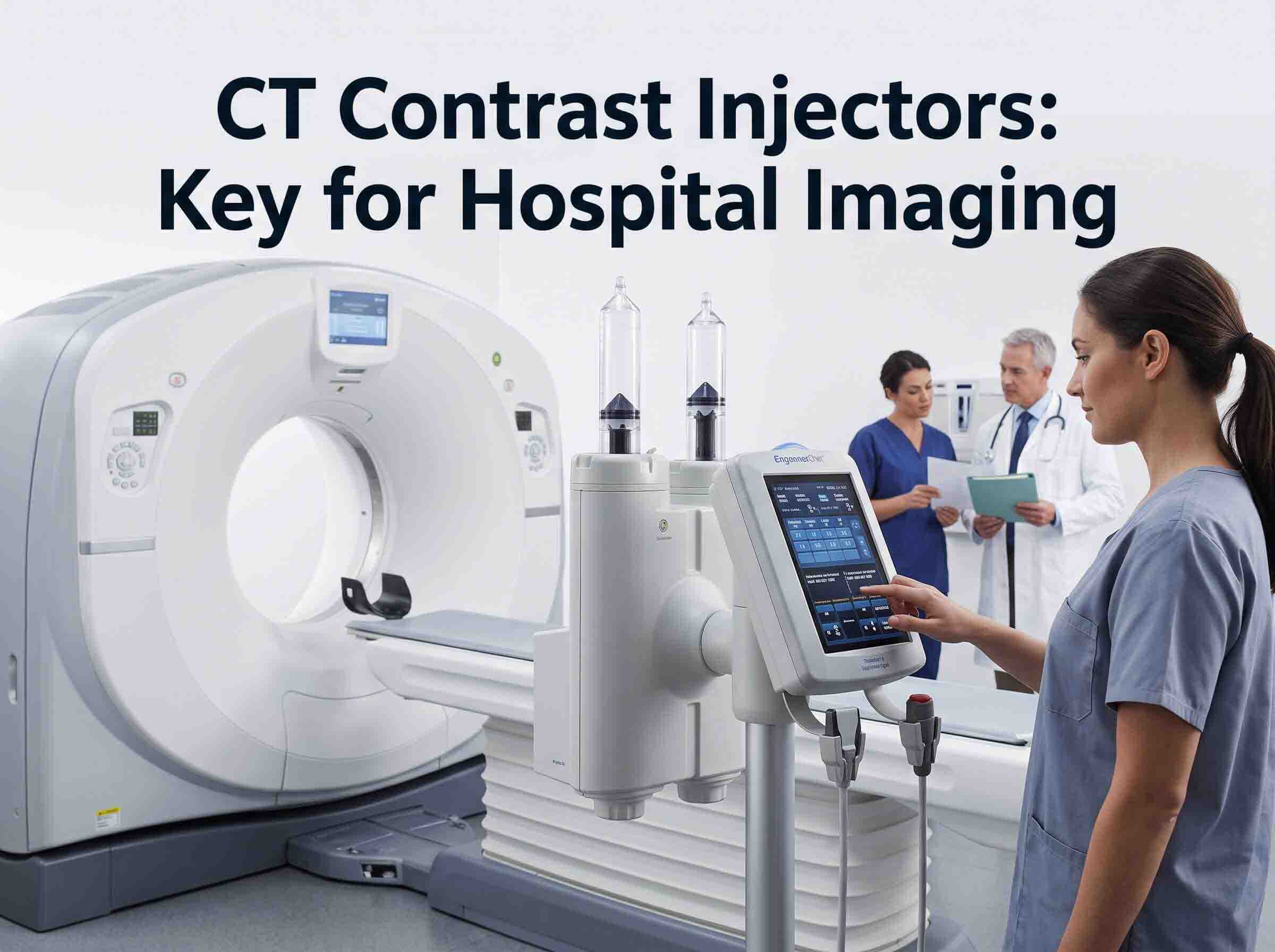
Matching Contrast Injection Technology to Diagnostic Modalities
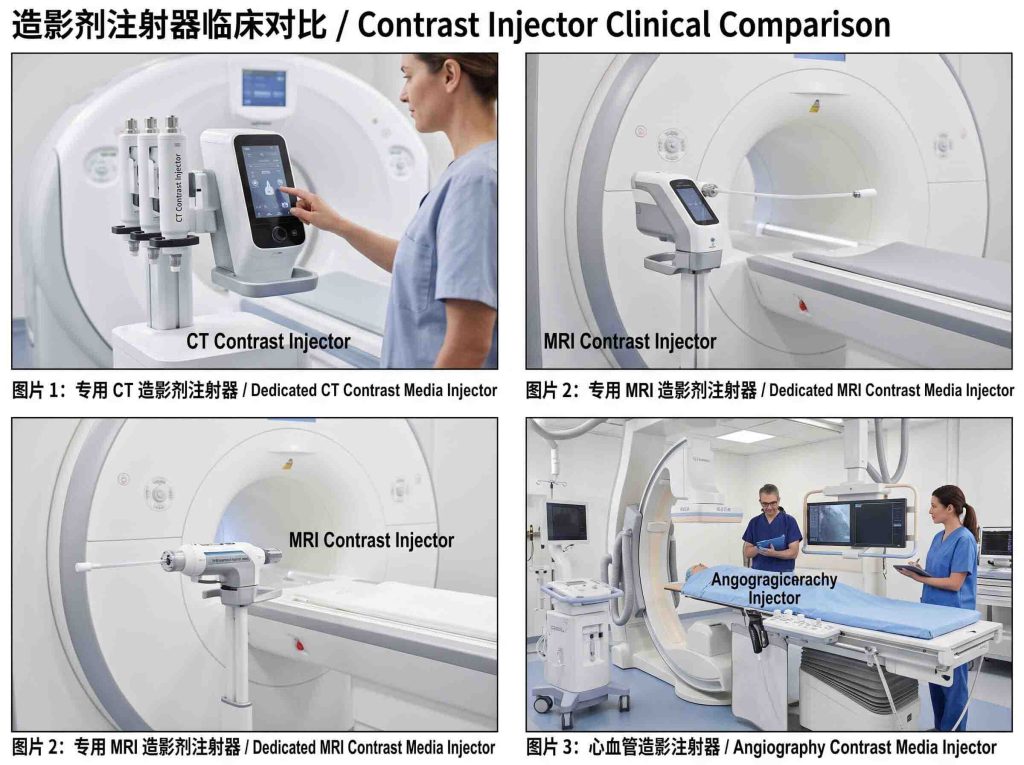
In modern diagnostic radiology and interventional medicine, contrast media delivery is not a one-size-fits-all process. The physical demands of imaging soft tissues in Computed Tomography (CT), capturing high-contrast vascular maps in Digital Subtraction Angiography (DSA), and operating within strong magnetic fields in Magnetic Resonance Imaging (MRI) require vastly different mechanical engineering solutions.
Mismatched equipment or improper pressure and flow configurations can lead to compromised image quality, line ruptures, catheter displacement, or vascular extravasation. This guide provides an in-depth technical specification and clinical comparison across CT, MRI, and Angiography contrast injectors to help biomedical engineers, radiology directors, and procurement teams select the exact system for their clinical environment.
1. CT Contrast Injectors: Precision Flow & Bolus Tracking
Computed Tomography (CT) demands rapid contrast delivery to capture dynamic vascular phases (arterial, venous, and delayed phases) before the contrast agent diffuses into tissues.
                           CT DUAL-HEAD INJECTION CYCLE
+----------------------------------------------------------------------------------+
| Phase 1: Pre-Saline Test Inject   -->  Verifies vein patency & baseline pressure |
| Phase 2: Contrast Agent Bolus     -->  Pushes iodine contrast at high flow rate  |
| Phase 3: Saline Bolus Chase       -->  Tightens contrast column & clears catheter|
+----------------------------------------------------------------------------------+
Key Clinical Applications
-
CT Angiography (CTA): Requires precise high-flow injections to visualize coronary, carotid, or pulmonary arteries.
-
Triple-Rule-Out Protocols: Evaluates coronary artery disease, pulmonary embolism, and aortic dissection in emergency departments.
-
Oncology Scanning: Multi-phase liver and pancreatic scans where exact timing between injection and scan start (bolus tracking) is crucial.
Essential Features to Look For
-
Saline Bolus Chase: Pushes contrast remaining in peripheral veins into central circulation, improving signal-to-noise ratio and saving contrast agent.
-
Integrated Syringe Warmers: Maintains contrast agent temperature at 37°C to reduce viscosity and injection resistance.
-
Auto-Fill & Auto-Purge: Accelerates workflow during busy scan shifts by automatically purging air bubbles during filling cycles.
2. MRI Contrast Injectors: Non-Magnetic Precision & Low Volume Control
Magnetic Resonance Imaging (MRI) presents a unique physical challenge: operating in proximity to powerful static magnetic fields ($1.5\text{T}$ to $3.0\text{T}$ or higher) without creating projectile hazards or electromagnetic RF interference that distorts MRI images.
+---------------------------------------------------------------------------------+
|                           MRI INJECTOR SAFETY DESIGN                            |
|                                                                                 |
|  [ Non-Ferrous Alloys ] + [ Ultrasonic Motors ] + [ RF-Shielded Electronics ]   |
|                                         |                                       |
|                                         v                                       |
|                  Safe Operation inside 1.5T & 3.0T MRI Suites                   |
+---------------------------------------------------------------------------------+
Key Clinical Applications
-
Neuro-Imaging (Brain MRI): Delineation of blood-brain barrier disruptions, brain tumors, and vascular malformations.
-
Cardiac MRI (CMR): Myocardial perfusion scans and late gadolinium enhancement (LGE) protocols.
-
MRA (MR Angiography): High-resolution contrast-enhanced arterial imaging without ionizing radiation.
Essential Features to Look For
-
MR-Conditional Certification: Ensures no magnetic attraction force and zero image artifact interference in high-field MRI environments.
-
Micro-Dosing Accuracy: Gadolinium contrast agents are administered in smaller, precise doses based on patient body weight. Precision servo motors prevent over-dosing.
-
Dual-Head Saline Flushing: Essential for pushing low-volume gadolinium boluses completely out of connecting tubing into the venous system.
3. Angiography / DSA Injectors: High-Pressure & Rapid Intra-Arterial Injection
Digital Subtraction Angiography (DSA) and interventional radiology procedures involve direct arterial access via thin catheters. Delivering contrast into high-pressure arterial flows demands far higher delivery pressures than standard intravenous CT injections.
+---------------------------------------------------------------------------------+
|                       ANGIOGRAPHY / DSA PRESSURE PROFILE                        |
|                                                                                 |
|  CT Pressure Limit: [=== 300 PSI ===]                                           |
|  DSA Pressure Limit: [======================= 1200 PSI =======================] |
+---------------------------------------------------------------------------------+
Key Clinical Applications
-
Cardiac Catheterization (Coronary Angiography): Visualizes coronary artery blockages during percutaneous coronary intervention (PCI).
-
Peripheral & Aortic DSA: High-volume injection into the abdominal aorta or lower extremity arteries.
-
Neuro-Interventional Radiology: Subselective cerebral angiography requiring micro-injection control.
Essential Features to Look For
-
Pressure-Jacketed Syringe Holders: Transparent, reinforced protective sleeves that enclose the high-pressure syringe barrel to prevent explosion under $1200 \text{ PSI}$ loads.
-
Hand Switch & Foot Pedal Integration: Allows interventional cardiologists or radiologists to trigger injections hands-free while manipulating guide wires under fluoroscopy.
-
Real-Time Pressure Limit Auto-Stop: Instantly cuts off injection motor drive if vascular resistance exceeds safety thresholds.
4. Direct Technical Specification Comparison Matrix
The table below details the technical distinctions across CT, MRI, and DSA contrast media injectors:
| Technical Parameter | CT Contrast Injector | MRI Contrast Injector | DSA / Angiography Injector |
| Primary Imaging Modality | Computed Tomography (CT/CTA) | Magnetic Resonance (1.5T / 3.0T) | Cath Lab / Fluoroscopy (DSA) |
| Max Operating Pressure | 300 – 325 PSI | 150 – 200 PSI | Up to 1200 PSI |
| Flow Rate Range | 0.1 to 10.0 mL/s | 0.1 to 10.0 mL/s | 0.1 to 40.0+ mL/s |
| Syringe Configuration | Single or Dual-Head | Dual-Head | Single-Head |
| Contrast Media Type | Iodinated Contrast | Gadolinium-Based Contrast | High-Viscosity Iodinated Contrast |
| MRI Safety Rating | Standard / Non-MR Safe | MR-Conditional (Up to 3.0T) | Standard / Non-MR Safe |
| Primary Route of Access | Peripheral Venous (IV Line) | Peripheral Venous (IV Line) | Central Arterial / Catheter |
| Heating Mechanism | Integrated Heater Jacket | Non-Magnetic Warmer Strip | Heavy-Duty Heating Collar |
| Primary Target Market | Radiology & Emergency Depts | MRI Suites & Diagnostic Labs | Cath Labs & Interventional Suites |
5. Fluid Dynamics & Viscosity Management in High-Pressure Injections
Understanding fluid dynamics ensures patient safety and prevents tube disconnection during injection. The relationship governing fluid flow through an intravenous line or catheter is defined by the Hagen-Poiseuille equation:
                          VISCOSITY REDUCTION IMPACT
+---------------------------------------------------------------------------------+
| Room Temp Contrast (20°C): [ Viscosity: High (~10.0 mPa·s)  | Pressure: HIGH ]  |
| Warmed Contrast (37°C):    [ Viscosity: Low  (~4.5 mPa·s)   | Pressure: LOW  ]  |
+---------------------------------------------------------------------------------+
Why Temperature Control Matters
-
Viscosity Reduction: Warming iodinated contrast media from room temperature to body temperature reduces its viscosity by up to 50%.
-
Pressure Drop Control: Lower viscosity dramatically decreases the driving pressure needed to achieve high flow rates, protecting catheter lines and patient blood vessels.
-
Patient Comfort: Injecting warm contrast significantly minimizes cold sensation, arm discomfort, and vasospasm reactions in patients.
6. Why UMY Medical Equipment Co Ltd Leads Across All Three Modalities
Engineering high-pressure injectors that perform reliably across CT, MRI, and Cath Lab suites requires extensive medical device design expertise and rigorous quality control. UMY Medical Equipment Co Ltd delivers world-class performance across all three product lines.
                      UMY MEDICAL INJECTOR ADVANTAGES
                                     |
    +--------------------------------+--------------------------------+
    |                                |                                |
    v                                v                                v
[ CT Dual Injector ]        [ MRI Conditional ]            [ DSA High-Pressure ]
- Auto Saline Chase         - Non-Magnetic Construction    - 1200 PSI Pressure Rating
- Real-Time PSI Curve       - Micro-Dosing Accuracy        - Reinforced Steel Stand
- Custom Scan Protocols     - Zero RF Signal Artifacts     - Foot Pedal Control
UMY Medical Engineering Features:
-
Advanced Servo-Motor Control: Ensures exact flow rate accuracy across all density levels and viscosity scales.
-
Dual Ultrasonic Air Sensor System: Real-time air bubble monitoring detects micro-bubbles down to 25 mu L, protecting patients against air embolisms.
-
Cross-Brand CT & Scanner Sync: UMY injectors seamlessly connect via relay interfaces with global CT scanner brands—including GE, Siemens, Philips, Canon/Toshiba, Neusoft, and United Imaging.
-
Robust Pressure Jackets & Syringes: High-tensile, crystal-clear PET syringe barrels tested to withstand up to 1400 PSI burst limits, guaranteeing maximum clinician and patient safety.
-
Global Quality Certifications: Fully certified under ISO 13485 quality management systems and marked with CE compliance for international healthcare markets.
Frequently Asked Questions (FAQ)
Q1: Can I use a CT contrast injector in an MRI scan suite?
No. Standard CT contrast injectors contain ferrous metals (magnetic components) and electronic circuits that will react violently with the strong magnetic field of an MRI scanner. This poses severe safety hazards and creates severe image artifacts. Only certified MR-conditional injectors (like UMY Medical’s MRI series) should be brought into an MRI room.
Q2: Why does an Angiography (DSA) injector require up to 1200 PSI, while CT only needs 300 PSI?
DSA injections deliver contrast directly into high-pressure arterial systems through thin, long vascular catheters. According to fluid dynamics, smaller catheter internal diameters ($r^4$) create exponential resistance. A much higher pressure limit is required to force contrast through these thin tubes at adequate speeds.
Q3: What is the benefit of an integrated contrast warmer on a power injector?
A contrast warmer heats contrast media to 37°C, reducing dynamic viscosity by roughly 50%. This allows high flow rates at significantly lower pressure levels, protecting vascular access sites, preventing catheter detachment, and increasing patient comfort.
Q4: How does a dual-head CT injector lower total contrast consumption?
In a single-head injector, the contrast remaining in the extension tubing is wasted after every procedure. A dual-head system uses normal saline to push the contrast agent completely out of the delivery tubing into the patient’s system, saving up to 20% of contrast agent per patient scan.
Q5: How can biomedical managers source UMY Medical contrast injectors for their hospital?
Biomedical managers and healthcare procurement officers can contact UMY Medical Equipment Co Ltd directly to review technical datasheets, order OEM customized models, or arrange direct factory delivery.