1. The High Cost of Unplanned CT Scanner Downtime
In modern diagnostic facilities and hospitals, a computed tomography (CT) scanner is a primary revenue driver and clinical workhorse. When a CT scanner experiences unexpected component failure or unexpected downtime, the financial and operational fallout is immediate. A single day of CT scanner downtime can result in $5,000 to $15,000 in lost scan revenue, delayed emergency department triage, dissatisfied patients, and diverted emergency transports.
Implementing a rigorous preventive maintenance (PM) protocol and managing high-wear components—specifically the CT X-ray tube and cooling system—is essential to maintaining a target system uptime of 98% or higher. This guide breaks down CT tube management, routine calibration routines, and service contract options for healthcare operations managers and biomedical technicians.
2. CT X-Ray Tube Lifecycle Management & Cost Optimization
The X-ray tube is the most critical, heavily taxed, and expensive consumable component in any CT scanner. Understanding how tube wear accumulates allows clinical managers to budget effectively and prevent sudden catastrophic tube failure.
Understanding Mega-Heat Units (MHU) and Exposure Counts
CT X-ray tubes are rated by their thermal heat storage capacity, expressed in Mega-Heat Units (MHU), ranging from 3.5 MHU on basic systems up to 8.0 or 10.0+ MHU on premium cardiac scanners. As the tube generates X-rays, the rotating tungsten anode undergoes thermal stress. Tube life is measured through:
-
Accumulated Exposure Seconds: Total time the X-ray beam is active.
-
Slice Count / Rotation Count: Physical rotations executed under high voltage.
-
Thermal Cycles: Heating up from cold standby to operational scanning temperatures.
Early Warning Signs of Impending CT Tube Failure
Catching tube degradation early prevents damage to high-voltage generators and sensitive detector electronics. Watch for these clinical indicators:
-
High-Voltage Arcing Errors: Electrical discharge across the tube housing caused by tungsten vapor buildup or oil degradation.
-
Increased Image Noise & Ring Artifacts: Output instability during high-mAs exposures.
-
Audible Anode Bearing Noise: High-pitched grinding or whining sounds during gantry spin-up, indicating mechanical bearing wear.
-
Cooling System Temperature Alarms: Thermal sensors triggering frequent heat-dissipation delays between patient studies.
Operational Rules to Extend CT Tube Lifespan
-
Enforce Daily Tube Warm-Up Protocols: Never initiate full diagnostic scans on a cold tube. Always execute the automated manufacturer warm-up sequence every morning.
-
Optimize Low-Dose Scan Protocols: Utilize automated dose modulation (AEC) and low-kV settings where clinically appropriate to minimize unnecessary thermal load.
-
Maintain Strict HVAC Climate Control: Ensure ambient scan room temperature stays strictly between 18°C and 22°C to assist heat dissipation.
-
Inspect Chiller Oil and Water Levels Monthly: Prevent cooling pump failures by checking fluid clarity, pressure levels, and filter cleanliness.
-
Avoid Rapid Back-to-Back High-mAs Scans: Allow short thermal dissipation pauses during heavy trauma scanning sessions.
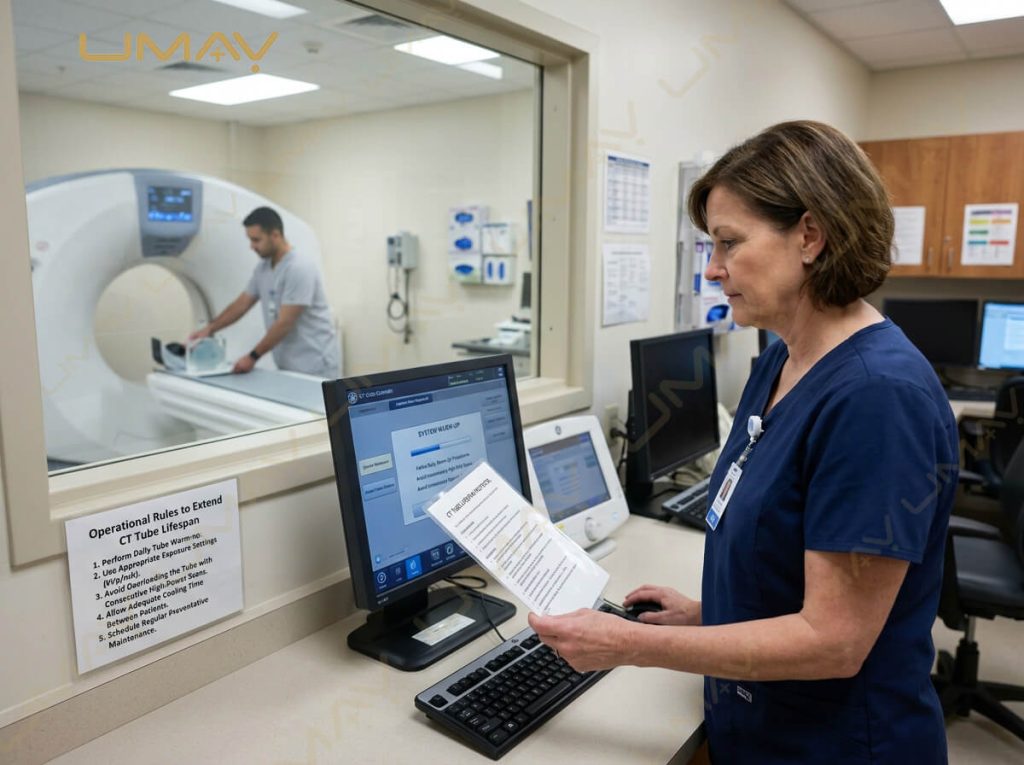
Radiologic technologist reading warm-up protocol guidelines and CT tube lifespan extension rules at the control station.
3. Preventive Maintenance (PM) Checklist & Schedule
Preventive maintenance ensures regulatory compliance, radiation accuracy, and mechanical safety. Below is a standard maintenance schedule used by certified biomedical service engineers.
| Maintenance Interval | Core Inspection & Calibration Tasks | Responsible Personnel |
| Daily Routine |
• System tube warm-up protocol execution.
• Air calibration (removing background detector noise).
• Daily Quality Assurance (QA) phantom scan checking CT number accuracy (Water = 0 HU). |
Radiologic Technologist |
| Monthly Check |
• Visual inspection of gantry covers, emergency stop buttons, and laser alignment lights.
• Cleaning optical sensors, dust filters, and gantry air intakes.
• Inspecting patient table movement smoothness and belt tension. |
In-House Biomedical Tech |
| Quarterly / Semi-Annual |
• High-voltage cable inspection and re-greasing.
• Detailed phantom calibration (spatial resolution, noise level, slice thickness verification).
• Inspection of slip rings and carbon brushes (cleaning graphite dust accumulation).
• Precision cooling system fluid change and pump pressure check. |
Certified Field Service Engineer |
| Annual Audit |
• Comprehensive radiation protection and dose audit (CTDIvol / DLP measurement).
• Full electrical safety ground resistance and leakage current testing.
• Structural mechanical bolt torque verification on gantry floor mounts. |
Medical Radiation Physicist & OEM/ISO Tech |
4. Service Contracts: OEM vs. Independent Service Organizations (ISO)
Post-warranty service coverage is one of the largest ongoing operational expenses for diagnostic imaging departments. Choosing the right service structure requires balancing financial risk against guaranteed operational uptime.
| Contract Feature | OEM Service Agreement | Independent Service Org (ISO) | In-House / Shared Risk |
| Annual Cost Range | $45,000 – $95,000+ / year | $25,000 – $55,000 / year | $12,000 – $25,000 (PM only) |
| Parts Availability | Direct factory inventory (100% original) | Certified OEM/Aftermarket parts | Sourced as-needed (higher lead time) |
| Tube Coverage | Usually 100% full coverage included | Full coverage or Pro-rated options | Excludes tube replacement cost |
| Response Time SLA | 2 to 4 Hours On-Site | 2 to 6 Hours On-Site | Depends on internal team availability |
| Best Suited For | High-volume hospitals, 128+ slice cardiac systems | Community hospitals, diagnostic centers, 16/64-slice systems | Large health systems with certified internal biomeds |
SLA Negotiation Tip: When signing a CT service contract, insist on a Guaranteed Uptime Clause (minimum 98%) with penalty credits applied to your annual service fee if downtime exceeds agreed thresholds.
5. Water-Cooled vs. Air-Cooled CT System Maintenance
CT scanners utilize either direct air cooling or liquid-chiller cooling loops to regulate gantry heat. Each architecture requires specific maintenance care:
Air-Cooled CT Systems
Common on 16-slice and mid-range 64-slice scanners. Heat is blown directly into the scan room. Maintenance focuses on clean room air filter replacement, ensuring proper room HVAC airflow, and preventing dust build-up on gantry heat sinks.
Water-Cooled CT Systems
Essential for high-power 128-slice to 320-slice scanners. Uses a closed-loop water/glycol chiller circuit. Maintenance requires checking coolant PH levels, monitoring for micro-leaks around quick-disconnect fittings, replacing water filters, and cleaning outdoor heat exchanger condenser coils every 6 months.
6. Frequently Asked Questions (FAQ)
Q1: How much does it cost to replace a CT scanner X-ray tube?
A new CT X-ray tube costs between $50,000 and $130,000+ depending on system slice count and MHU rating. Certified pre-owned or reconditioned tubes can be acquired for $25,000 to $60,000.
Q2: What is the main cause of CT arcing errors?
Arcing errors occur when high-voltage electricity jumps across non-intended pathways inside the tube or high-voltage cable sockets. This is typically caused by tungsten sediment accumulating inside the tube casing, oil breakdown, or moisture/dirt contamination in cable grease fittings.
Q3: Why is daily CT air calibration necessary?
Air calibration measures baseline radiation values through air without any object in the gantry. Performing this daily allows the system software to compensate for small detector sensitivity shifts, preventing ring artifacts in patient images.
Q4: Is an ISO service contract safe for high-slice CT scanners?
Yes, provided the ISO employs certified engineers trained specifically on your system brand (e.g., GE, Siemens, Philips, Canon) and maintains immediate access to local stock of critical replacement parts and tubes.