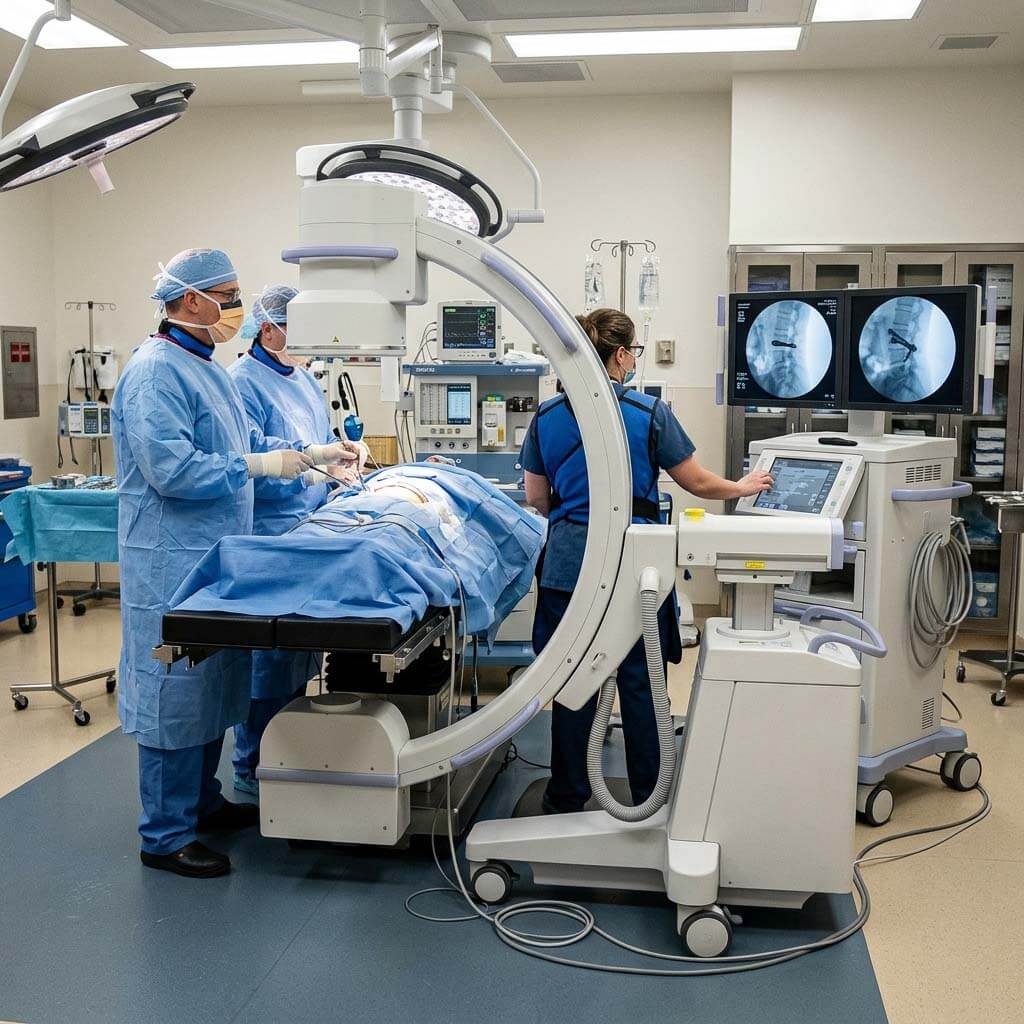
A C-arm X-ray system is mainly used when doctors need X-ray or fluoroscopic imaging during a procedure. Its mobile design allows the imaging system to be positioned around the patient and operating table.
Common applications include:
- orthopedic surgery
- trauma surgery
- spine procedures
- urology
- pain management
- vascular and interventional procedures
- general surgery
- emergency procedures
- operating-room imaging
The exact capabilities depend on the C-arm model. Some systems are designed for general surgical imaging, while others are optimized for specific applications such as extremity surgery or more advanced interventional procedures.
The FDA describes mobile C-arm systems as being used for diagnostic, surgical, and interventional procedures, with examples including orthopedic, urologic, vascular, neurologic, emergency, and other clinical applications.
C-Arm Applications by Medical Specialty
A C-arm is not selected simply because a hospital “needs fluoroscopy.” The more useful question is:
What procedures will the C-arm support?
The procedure determines the required detector coverage, movement, imaging modes, working space, and other system features.
The major application areas are discussed below.
C-Arm for Orthopedic Surgery
Orthopedic surgery is one of the most common applications for mobile C-arms.
During orthopedic procedures, surgeons may need repeated X-ray images to check the position of bones, implants, screws, plates, or other fixation devices.
Common applications include:
- fracture fixation
- bone alignment
- implant placement
- screw positioning
- plate positioning
- joint procedures
- extremity surgery
- orthopedic trauma
- intraoperative verification
A C-arm allows the surgical team to obtain images during the procedure without moving the patient to a separate radiography room.
Why Is a C-Arm Useful in Orthopedics?
Orthopedic surgery often requires imaging from more than one angle.
The C-arm can be repositioned to obtain different projections while the patient remains on the operating table.
This can help the surgical team assess whether:
- the fracture is properly aligned
- an implant is positioned correctly
- screws are located as intended
- fixation is satisfactory
- the surgical result meets the planned objective
For orthopedic departments, important procurement factors can include:
movement range + detector coverage + image quality + operating-room clearance
C-Arm for Fracture Surgery
Fracture surgery is a major use of intraoperative fluoroscopy.
Depending on the procedure, imaging may be used during:
- fracture reduction
- internal fixation
- intramedullary fixation
- plate fixation
- screw placement
- final implant verification
The surgeon may need multiple images at different stages.
A mobile C-arm can remain in the operating room and provide these images as required.
For fracture surgery, buyers should pay attention to the system’s:
- positioning flexibility
- field of view
- detector performance
- image display
- movement range
C-Arm for Hand and Wrist Surgery
Hand and wrist procedures are commonly associated with mini C-arms and other compact systems.
Typical applications include:
- fracture fixation
- tendon-related procedures
- joint procedures
- implant positioning
- foreign-body localization
- extremity imaging
A compact system may be attractive when the anatomical region is relatively small and the procedure room has limited space.
This is one reason mini C-arms are often considered for orthopedic clinics and ambulatory surgery environments.
FDA-cleared mini C-arm systems have intended uses that include diagnostic, surgical, orthopedic, and emergency imaging of the upper and lower extremities.
C-Arm for Foot and Ankle Surgery
The same compact approach can be useful for:
- foot surgery
- ankle surgery
- fracture fixation
- orthopedic implant procedures
For these applications, a buyer may prioritize:
- compact footprint
- easy positioning
- detector coverage
- image quality
- mobility
The right system depends on whether the facility only performs extremity procedures or also needs broader surgical imaging.
C-Arm for Trauma Surgery
A trauma C-arm is used when intraoperative X-ray guidance is required during trauma procedures.
Trauma applications can include:
- fracture fixation
- pelvic procedures
- extremity trauma
- implant positioning
- emergency orthopedic surgery
Trauma patients may have limited mobility, making bedside or operating-room imaging particularly useful.
A mobile C-arm can be brought to the procedure rather than moving the patient to another imaging department.
What Matters in a Trauma C-Arm?
Trauma departments may prioritize:
- fast setup
- mobility
- broad application range
- positioning flexibility
- image quality
- reliable workflow
The equipment should also fit the available trauma or operating-room space.
C-Arm for Spine Surgery
Spine procedures can require imaging from different projections.
A C-arm may support selected procedures involving:
- spinal fixation
- vertebral procedures
- screw positioning
- interventional spine procedures
- intraoperative verification
For spine applications, the C-arm needs to work effectively around the operating table.
Important considerations include:
- orbital movement
- vertical movement
- horizontal travel
- detector field of view
- image quality
- table compatibility
A full-size mobile C-arm is generally more suitable for broader spine applications than a mini C-arm designed mainly for extremities.
C-Arm for Urology
C-arm fluoroscopy can support various urological procedures.
Potential applications include:
- stone-related procedures
- catheter positioning
- stent-related procedures
- urinary-tract interventions
- contrast-guided procedures
A mobile C-arm may allow the imaging system to be positioned according to the procedure and operating table.
For urology, a hospital may need to consider:
- fluoroscopic imaging
- detector coverage
- positioning range
- monitor visibility
- image storage
- workflow
The exact requirements depend on the procedure.
C-Arm for Pain Management
C-arm imaging is also used for selected image-guided pain procedures.
Applications may include:
- spinal injections
- epidural procedures
- facet-related procedures
- nerve-related interventions
- other fluoroscopy-guided procedures
A compact mobile C-arm can be useful when the procedure room has limited space.
For pain-management facilities, practical considerations may include:
- easy positioning
- compact dimensions
- clear image display
- appropriate field of view
- fluoroscopy controls
C-Arm for Vascular Procedures
Some C-arms can support selected vascular and interventional procedures.
Potential uses include imaging for:
- vascular access
- catheter positioning
- device placement
- image-guided interventions
However, the term vascular C-arm can describe very different system requirements.
A basic mobile surgical C-arm should not automatically be considered equivalent to a dedicated high-end interventional imaging system.
For complex vascular procedures, buyers should carefully review:
- detector technology
- field of view
- imaging modes
- image processing
- dose-management functions
- workflow
- system positioning
FDA-cleared mobile C-arm examples include systems intended for certain vascular and interventional applications, while their precise indications differ by model.
C-Arm for Interventional Procedures
Interventional C-arm imaging uses X-ray guidance while a clinician performs a procedure.
Depending on the system, applications may include:
- device positioning
- catheter guidance
- contrast procedures
- vascular access
- image-guided interventions
For buyers, it is important to distinguish between:
general surgical fluoroscopy
and:
advanced interventional imaging
The latter may require additional imaging capabilities and a different system configuration.
C-Arm for General Surgery
A mobile C-arm can also support selected general surgical procedures when intraoperative X-ray guidance is required.
The exact use depends on the procedure.
Potential applications include:
- intraoperative verification
- device positioning
- foreign-body localization
- image-guided procedures
- selected abdominal or other fluoroscopic procedures
Before purchasing, the surgical department should create a list of procedures rather than choosing equipment based only on the general term “C-arm.”
C-Arm for Gynecology
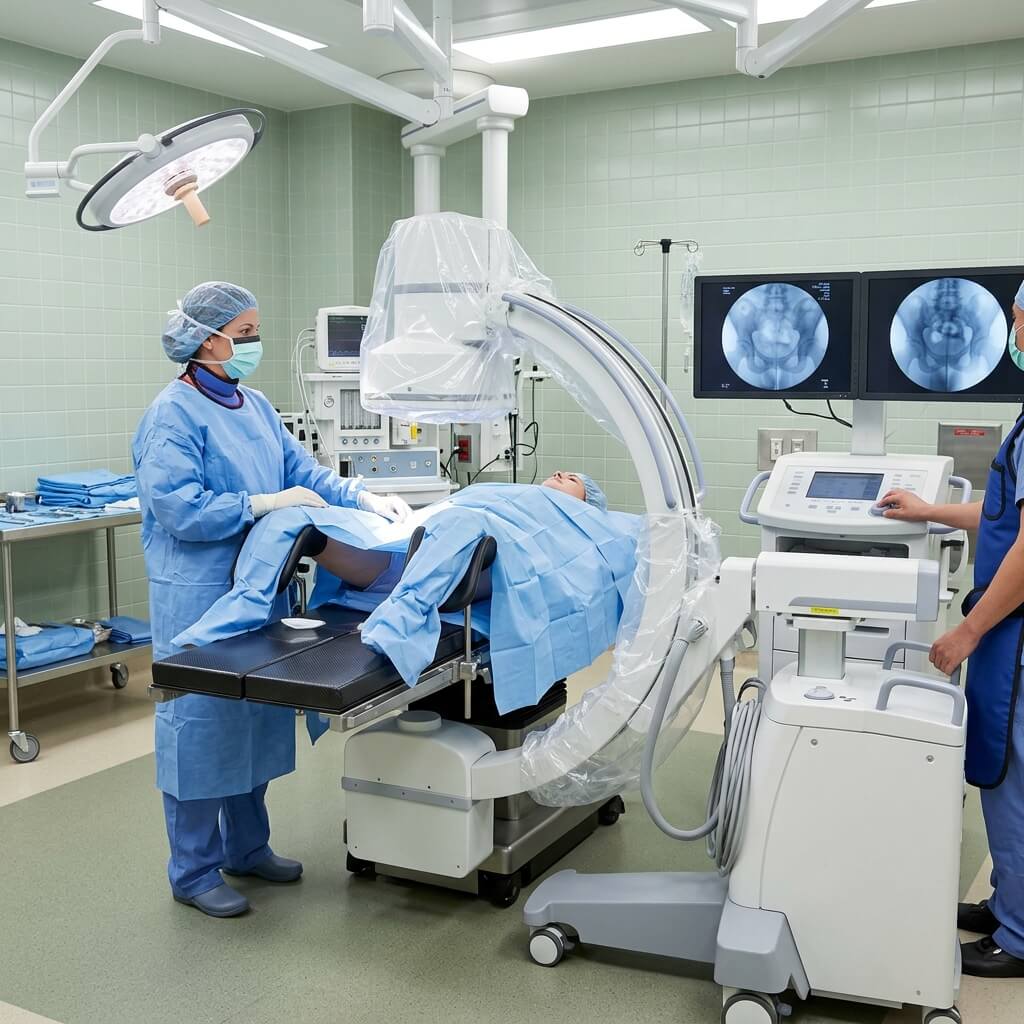
Some C-arm systems can be used for selected gynecological procedures.
The actual applications depend on the system’s configuration and clinical indication.
When a hospital is considering a C-arm for gynecology, it should evaluate:
- patient positioning
- operating-room space
- detector coverage
- fluoroscopy
- image display
- workflow
UMY Medical’s current C-arm portfolio includes an FPD-based mobile system listed for orthopedics, urology, and gynecology applications.
C-Arm for Emergency Procedures
Emergency departments may need imaging when a patient cannot be easily transferred.
Potential applications include:
- emergency orthopedic procedures
- trauma
- fracture treatment
- bedside imaging
- urgent surgical procedures
In these situations, equipment mobility can be particularly valuable.
A mobile C-arm can move into the required treatment or operating area.
For emergency use, buyers may prioritize:
- rapid positioning
- system mobility
- easy operation
- image display
- battery or power management
- durability
C-Arm for Operating Rooms
A C-arm needs to share space with many other devices.
Typical operating-room equipment can include:
- operating table
- surgical lights
- anesthesia machine
- surgical instruments
- monitoring equipment
- other mobile equipment
Therefore, operating-room integration is an important part of C-arm selection.
Before purchasing, measure:
- door width
- room width
- table dimensions
- available clearance
- equipment storage area
- C-arm travel area
A system that fits on paper may still be difficult to maneuver in a crowded room.
C-Arm for Ambulatory Surgery Centers
Ambulatory surgery centers may perform selected procedures without long inpatient stays.
A compact or mobile C-arm can support procedures that require intraoperative imaging.
Potential applications include:
- orthopedic procedures
- extremity surgery
- pain procedures
- selected general surgery
- trauma-related procedures
The most important consideration is whether the equipment matches the center’s actual procedure mix.
C-Arm for Specialty Clinics
Specialty clinics may have a narrower range of procedures than hospitals.
For example:
Orthopedic Clinic
May prioritize:
- mini C-arm
- compact design
- extremity imaging
Pain Clinic
May prioritize:
- compact mobile system
- easy positioning
- fluoroscopy
Urology Clinic
May require:
- broader imaging coverage
- fluoroscopic workflow
- appropriate patient positioning
The procedure list should come before the equipment specification.
C-Arm for Veterinary Surgery
C-arms are also relevant to veterinary environments where intraoperative imaging is needed.
Potential veterinary applications include:
- fracture repair
- orthopedic procedures
- implant positioning
- extremity imaging
Veterinary environments can place additional emphasis on:
- mobility
- cleaning
- positioning flexibility
- durability
- suitable detector size
The correct configuration depends on the animals and procedures being treated.
C-Arm for Orthopedic Trauma Centers
An orthopedic trauma center may need to cover both planned and emergency procedures.
A full-size mobile C-arm can potentially support:
- long-bone procedures
- fracture fixation
- implant positioning
- trauma surgery
- intraoperative verification
The system should offer enough mobility and imaging coverage for the center’s clinical workload.
A mini C-arm may still be useful as a separate system for extremity-focused procedures.
C-Arm for Neurosurgery
Some mobile C-arm systems are cleared for selected neurologic or neurosurgical procedures, depending on their specific indications.
The requirements can include:
- precise positioning
- image quality
- appropriate detector coverage
- operating-room compatibility
The FDA database includes mobile C-arm systems with intended applications that encompass neurologic procedures, illustrating that the exact clinical scope varies by system.
Because neurosurgical applications can be more specialized, the purchasing team should verify the exact intended use and technical specifications.
C-Arm for Gastrointestinal Procedures
Some C-arm systems may support selected gastrointestinal or contrast-guided procedures.
Applications can include:
- endoscopic imaging support
- contrast studies
- cholangiography
- selected gastrointestinal interventions
Not every mobile C-arm is designed for all GI applications.
For procurement, verify the manufacturer’s stated applications and imaging capabilities.
FDA documentation for some mobile fluoroscopy systems includes gastrointestinal procedures such as endoscopy and cholangiography among possible clinical applications.
C-Arm for Critical Care
In critical-care environments, patients may not be suitable for routine transfer.
Mobile imaging equipment can therefore provide an alternative way to bring X-ray capability closer to the patient.
Depending on the system and clinical workflow, C-arm use can extend into selected critical-care or emergency applications.
For this environment, consider:
- mobility
- positioning
- room clearance
- cleaning
- image workflow
- electrical requirements
C-Arm Applications by Procedure
| Procedure / Specialty | Potential C-Arm Application | Typical Priority |
|---|---|---|
| Orthopedic surgery | Fracture fixation, implants | Image quality, movement |
| Hand surgery | Extremity imaging | Compact size |
| Foot surgery | Extremity imaging | Positioning |
| Trauma surgery | Fracture and implant guidance | Mobility |
| Spine surgery | Intraoperative guidance | Coverage, movement |
| Urology | Fluoroscopy-guided procedures | Imaging workflow |
| Pain management | Image-guided injections | Compact positioning |
| Vascular procedures | Selected interventions | Imaging capability |
| General surgery | Intraoperative imaging | Versatility |
| Gynecology | Selected fluoroscopic procedures | Positioning |
| Emergency | Urgent intraoperative imaging | Fast setup |
| Veterinary surgery | Orthopedic and other procedures | Mobility, durability |
The actual clinical indications depend on the individual C-arm model and applicable regulations.
Mini C-Arm Applications vs Full-Size C-Arm Applications
This is an important purchasing distinction.
Mini C-Arm
Usually associated with:
- hands
- wrists
- feet
- ankles
- extremity procedures
Full-Size Mobile C-Arm
Often selected for:
- general orthopedics
- trauma
- spine
- urology
- broader surgical procedures
The decision can be summarized as:
Extremity-focused → consider mini C-arm
Broad surgical applications → consider full-size mobile C-arm
A hospital with both types of procedures may benefit from a combination of systems, depending on workload and budget.
How to Choose a C-Arm for Your Procedure
Instead of beginning with the product catalog, begin with the procedure.
Step 1: List the Procedures
For example:
- fracture fixation
- spine surgery
- urology
- pain management
Step 2: Identify the Anatomy
Is the target:
- hand
- foot
- limb
- spine
- pelvis
- abdomen
- another region?
Step 3: Determine the Imaging Requirement
Do you need:
- fluoroscopy
- radiography
- both
- specific imaging sequences?
Step 4: Determine the Required Coverage
Does the procedure require a small or broad field of view?
Step 5: Check the Operating Room
Confirm:
- table
- space
- clearance
- access
- storage
Step 6: Define the Workflow
Determine whether you require:
- workstation
- image storage
- DICOM
- PACS
- image export
Only after these requirements are clear should you compare individual C-arm models.
Matching C-Arm Type to Healthcare Setting
Different facilities can have different priorities.
| Healthcare Setting | Common Requirement |
|---|---|
| Large hospital | Versatile mobile C-arm |
| Orthopedic center | Mini or full-size C-arm |
| Trauma center | Full-size mobile C-arm |
| Urology department | Mobile fluoroscopy system |
| Pain clinic | Compact mobile C-arm |
| Ambulatory surgery | Compact/mobile system |
| Veterinary clinic | Portable or mobile system |
| Rural facility | Flexible mobile system |
| Dedicated procedure room | Fixed or specialized system |
These are general planning guidelines. The final configuration should be based on actual clinical use.
How UMY Medical Supports C-Arm Applications
UMY Medical Equipment Co., Ltd. currently lists a range of mobile C-arm X-ray machines for different medical imaging and surgical applications.
Its current portfolio includes:
- 5 kW mobile C-arm fluoroscopy systems
- FPD mobile C-arm systems
- portable high-frequency C-arms
- high-frequency mobile C-arms
- digital C-arm systems
The product range includes configurations listed for applications such as orthopedics, urology, gynecology, angiography, and medical imaging, depending on the model.
This product range is useful from a procurement perspective because different hospitals may have very different application requirements.
For example, a buyer looking for an FPD C-arm for orthopedic and urological applications may need a different configuration from a clinic looking for a compact extremity-focused solution.
UMY Medical’s broader business covers medical imaging and other hospital equipment, allowing C-arm projects to be considered as part of wider medical-equipment procurement where appropriate. The company states that it serves hospitals, clinics, universities, veterinary institutions, and international healthcare markets.
What Should Hospitals Tell a C-Arm Supplier?
A supplier can make a more useful recommendation when the inquiry contains actual application information.
Instead of:
We need a C-arm. Please send the price.
Provide:
Application: Orthopedic trauma
Procedure: Fracture fixation
Anatomy: Lower limb
Facility: Hospital OR
Detector: FPD preferred
Imaging: Fluoroscopy + radiography
Quantity: 2 units
Digital Workflow: DICOM/PACS required
This gives the supplier a much clearer picture of the project.
C-Arm Application Checklist
Before contacting manufacturers, identify:
Clinical
□ Main procedures
□ Anatomical areas
□ Patient types
□ Expected workload
Imaging
□ Fluoroscopy
□ Radiography
□ Detector type
□ Field of view
Physical
□ Operating-room size
□ Table dimensions
□ Required movement
□ Storage area
Digital
□ Monitor
□ Workstation
□ Image storage
□ DICOM
□ PACS
Commercial
□ Quantity
□ Budget
□ Warranty
□ Training
□ Installation
□ After-sales support
This checklist can make the procurement process faster and more accurate.
Frequently Asked Questions
What is a C-arm used for?
A C-arm is used to provide X-ray or fluoroscopic imaging during surgical, diagnostic, and selected interventional procedures.
What is the most common use of a C-arm?
Orthopedic and trauma procedures are among the common applications of mobile C-arms, although systems can also be used in urology, spine, pain management, and other procedures.
Can a C-arm be used for orthopedic surgery?
Yes. C-arms are widely used for orthopedic procedures such as fracture fixation and implant positioning.
Can a C-arm be used for fracture surgery?
Yes. Intraoperative fluoroscopy can help the surgical team check fracture alignment and fixation.
Can a C-arm be used for hand surgery?
Yes. Mini C-arms are commonly associated with hand, wrist, and other extremity procedures.
Can a C-arm be used for foot surgery?
Yes. Compact C-arms can be used for selected foot and ankle procedures.
Can a C-arm be used for spine surgery?
Yes. Some mobile C-arms are designed for selected spine procedures requiring intraoperative imaging.
Can a C-arm be used for trauma surgery?
Yes. Mobile C-arms can provide imaging during trauma and orthopedic procedures.
Can a C-arm be used for urology?
Yes. C-arm fluoroscopy can support selected urological procedures.
Can a C-arm be used for pain management?
Yes. Fluoroscopy can provide imaging guidance for selected pain-management procedures.
Can a C-arm be used for vascular procedures?
Some systems can support selected vascular and interventional applications, depending on the device’s intended use and configuration.
Can a C-arm be used for gynecology?
Some C-arm systems are designed for selected gynecological procedures. Verify the intended use of the specific model.
Can a C-arm be used in an operating room?
Yes. Mobile C-arms are specifically designed for use around operating tables and other procedural environments.
Can a C-arm be used in an emergency room?
Some mobile C-arms have indications that include emergency procedures.
Can a C-arm be used in veterinary surgery?
Some C-arm systems can support veterinary imaging where the system’s specifications and intended use are appropriate.
What is a mini C-arm best for?
Mini C-arms are generally suited to extremity applications such as hand, wrist, foot, and ankle procedures.
What is a full-size C-arm best for?
Full-size mobile C-arms can support a broader range of surgical procedures, including orthopedics, trauma, spine, and urology.
Can a mini C-arm replace a full-size C-arm?
Not for every procedure. Mini C-arms are generally designed around extremity imaging and may not provide the coverage required for larger procedures.
What is an FPD C-arm used for?
An FPD C-arm uses a flat panel detector for digital X-ray image acquisition and can be configured for various surgical and fluoroscopic applications.
Which C-arm is best for orthopedic surgery?
The appropriate type depends on the procedure. A mini C-arm can suit extremity-focused work, while a full-size mobile C-arm can provide broader orthopedic coverage.
Which C-arm is best for urology?
A mobile C-arm with appropriate fluoroscopy, detector coverage, positioning, and imaging workflow can be suitable for urological procedures.
Which C-arm is best for pain management?
A compact mobile C-arm can be appropriate for selected pain-management procedures, subject to the clinical workflow and system specifications.
Which C-arm is best for trauma?
A full-size mobile C-arm is often considered when trauma procedures require broader anatomical coverage and flexible positioning.
What should I consider when buying a C-arm for a specific procedure?
Start with the procedure and anatomy, then evaluate detector coverage, imaging modes, movement, operating-room space, workflow, software, and service.
How do I choose between a mini and full-size C-arm?
Choose a mini system when your workload is mainly extremity-focused. Choose a full-size system when you require broader surgical applications.
Does every C-arm support the same procedures?
No. Clinical indications and capabilities vary by model. Always check the manufacturer’s intended use and applicable regulatory documentation.