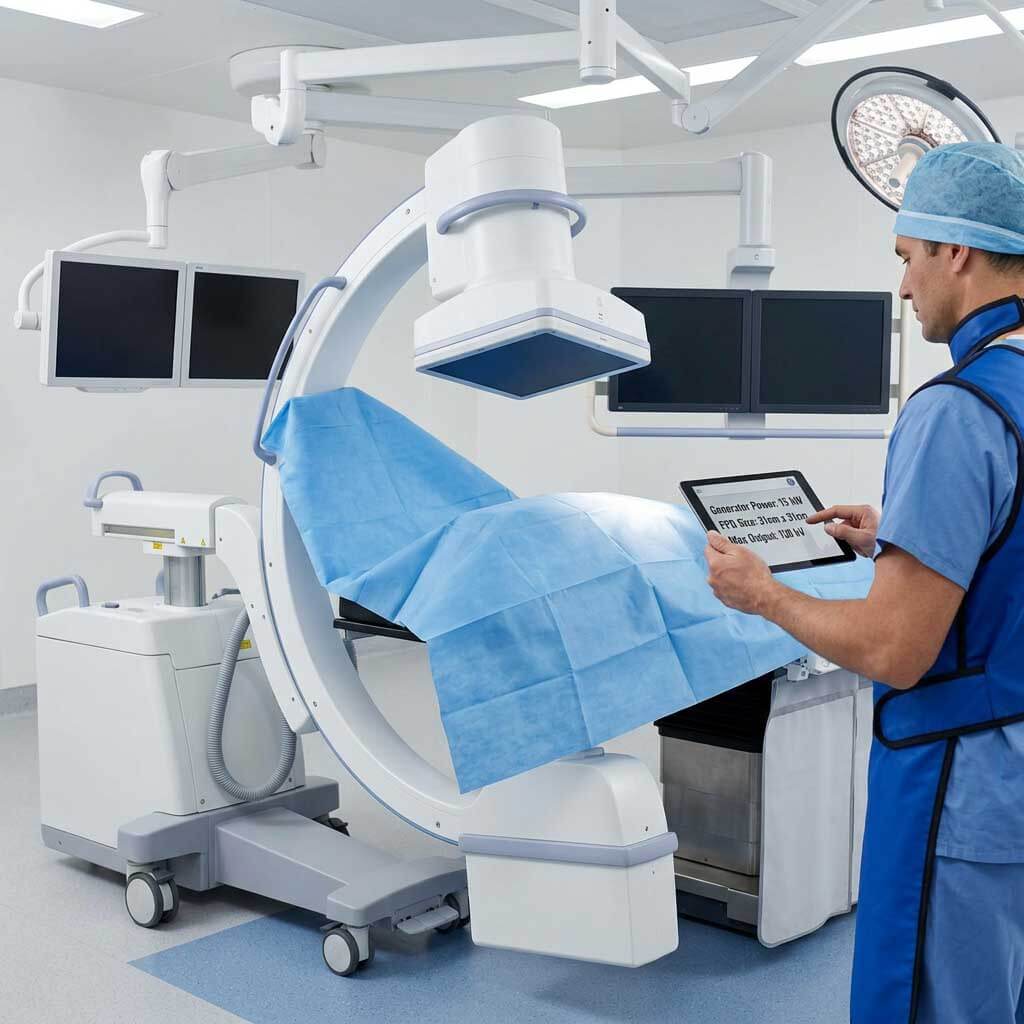
1. Start With the Clinical Workload, Not the Price
One of the common mistakes when buying a C-arm is comparing machines only by price or generator power.
Two C-arm X-ray machines can have similar generator ratings but provide different workflow experiences because of differences in detector technology, software, mechanical movement, display systems, dose-management functions and service support.
Before requesting quotations, define:
- What procedures will the C-arm support?
- How many procedures are expected per day?
- Will the machine be shared between departments?
- What patient sizes are expected?
- Is the equipment for a general operating room or a specialized department?
- How much floor space is available?
- Is mobile use required?
- Does the hospital already have PACS or DICOM infrastructure?
- What local electrical and regulatory requirements apply?
- What technical service is available after installation?
A good specification comparison begins with these questions.
2. C-Arm Generator Power: Why kW Matters
C-arm generator power is one of the first specifications buyers usually see. It is commonly expressed in kilowatts (kW).
Generator power affects the system’s ability to produce appropriate X-ray output for different imaging conditions. However, generator power should not be evaluated independently.
For example, a procurement team may compare:
- 3 kW C-arm
- 5 kW C-arm
- Higher-power C-arm
The practical question is not simply which number is larger. Instead, ask whether the generator provides the required output for the facility’s expected patient sizes, anatomical regions and imaging workflow.
What should buyers ask about the generator?
Request information about:
- Maximum generator power
- kV range
- mA range
- Fluoroscopy operating modes
- Pulsed fluoroscopy capability
- Continuous fluoroscopy, where applicable
- Exposure control
- Maximum exposure time
- Generator cooling and operating limitations
- Electrical input requirements
Some UMY C-arm models currently listed on its product range include 5 kW mobile C-arm configurations, alongside other high-frequency and portable C-arm systems.
The generator should therefore be compared as part of the complete imaging chain rather than as a standalone number.
3. X-Ray Tube Specifications
The X-ray tube is another important component because it directly affects X-ray production and system performance.
When evaluating a C-arm, ask the supplier for detailed tube information rather than only asking whether the system uses a “high-frequency generator.”
Relevant specifications may include:
- Tube type
- Focal spot size
- Anode type
- Heat capacity
- Anode cooling characteristics
- Maximum tube voltage
- Tube current range
- Tube operating limits
- Tube warranty
- Expected service conditions
Why does focal spot size matter?
A smaller focal spot can support higher spatial resolution under appropriate exposure conditions, while a larger focal spot can provide greater heat-handling capability.
The correct configuration depends on the imaging task and operating conditions.
Instead of asking only:
“What is the focal spot size?”
A procurement team should also ask:
“What image quality can be achieved at the exposure conditions used for our procedures?”
That produces a more meaningful comparison.
4. Detector Type: FPD vs Image Intensifier
For modern digital C-arm procurement, detector technology is a major decision point.
Two broad configurations commonly encountered are:
Flat Panel Detector (FPD)
and
Image Intensifier (II).
An FPD-based system converts X-ray information into digital image data and is widely used in modern digital imaging systems.
When comparing an FPD C-arm, look beyond the term “flat panel.”
Important specifications include:
- Detector size
- Pixel pitch
- Active area
- Spatial resolution
- Dynamic range
- Image acquisition rate
- Detector material or technology
- Detector protection
- Image processing capabilities
Detector size matters
A larger detector can provide a larger field of view, which may be useful for certain anatomical regions.
A smaller detector can provide advantages where access, compactness or positioning flexibility are more important.
Therefore, a larger detector should not automatically be treated as the correct solution.
The procurement team should compare detector size with:
- Target anatomy
- Patient positioning
- Operating-room space
- Required field of view
- C-arm geometry
- Surgical workflow
5. Pixel Pitch and Spatial Resolution
Pixel pitch is commonly expressed in micrometers (µm).
In general, a smaller pixel pitch can support higher spatial sampling, but detector pixel pitch alone does not determine final clinical image quality.
When comparing two digital C-arms, evaluate the complete imaging chain:
X-ray tube → generator → detector → image processing → display
rather than selecting equipment based on one number.
Ask suppliers to provide:
- Pixel pitch
- Matrix size
- Active detector area
- Spatial resolution
- Contrast resolution information
- Image processing functions
- Acquisition frame rate
A useful supplier quotation should make it possible to compare these specifications side by side.
6. Image Quality: Do Not Judge It by One Specification
For procurement purposes, “high image quality” is too general.
Image quality should be evaluated in terms of the clinical task.
Important factors include:
Spatial resolution
Helps distinguish small structures or edges.
Contrast resolution
Important when structures have relatively small differences in X-ray attenuation.
Noise
Lower image noise can make anatomical structures easier to evaluate, but noise reduction should not come at the expense of clinically useful information.
Dynamic range
Affects the system’s ability to represent different signal levels within an image.
Image processing
Modern C-arms may use software processing for noise reduction, edge enhancement, contrast optimization, image averaging and other functions.
When assessing a supplier, ask for actual image samples and technical documentation rather than relying only on marketing descriptions.
7. Fluoroscopy Modes and Frame Rate
Fluoroscopy is central to C-arm operation because it provides real-time X-ray imaging during procedures.
For procurement, check which fluoroscopy modes are available.
Potential specifications include:
- Continuous fluoroscopy
- Pulsed fluoroscopy
- Low-dose fluoroscopy modes
- High-quality imaging modes
- Frame rate
- Last-image-hold
- Roadmap functions where supported
- Digital subtraction functions where applicable
- Image capture modes
The appropriate frame rate depends on the intended procedure.
A higher frame rate may be useful for applications requiring rapid image updates, while lower pulse rates can support dose-management strategies when clinically appropriate.
The key question is:
Which imaging modes are available, and what are their operating parameters?
8. Radiation Dose Management Should Be a Core Buying Criterion
Radiation management is not an optional feature to consider at the end of the purchasing process.
Fluoroscopy uses ionizing radiation, and patient dose varies with procedure type, exposure conditions, patient size and fluoroscopy time. The FDA recommends using the lowest radiation exposure that produces image quality adequate for the clinical task and emphasizes optimization and quality assurance.
When comparing C-arm systems, ask about:
- Dose display
- Fluoroscopy time display
- Pulsed fluoroscopy
- Low-dose modes
- Last-image-hold
- Dose monitoring
- Exposure parameter display
- Automatic or assisted exposure controls, where available
- Dose reporting and data export
The FDA identifies dose displays and last-image-hold among features used to support radiation management in fluoroscopy systems.
Last-image-hold
This feature allows the operator to review the most recent fluoroscopic image without continuing X-ray exposure.
For a procurement team, this is important not because a feature name sounds advanced, but because it can contribute to a workflow in which unnecessary additional exposure is avoided.
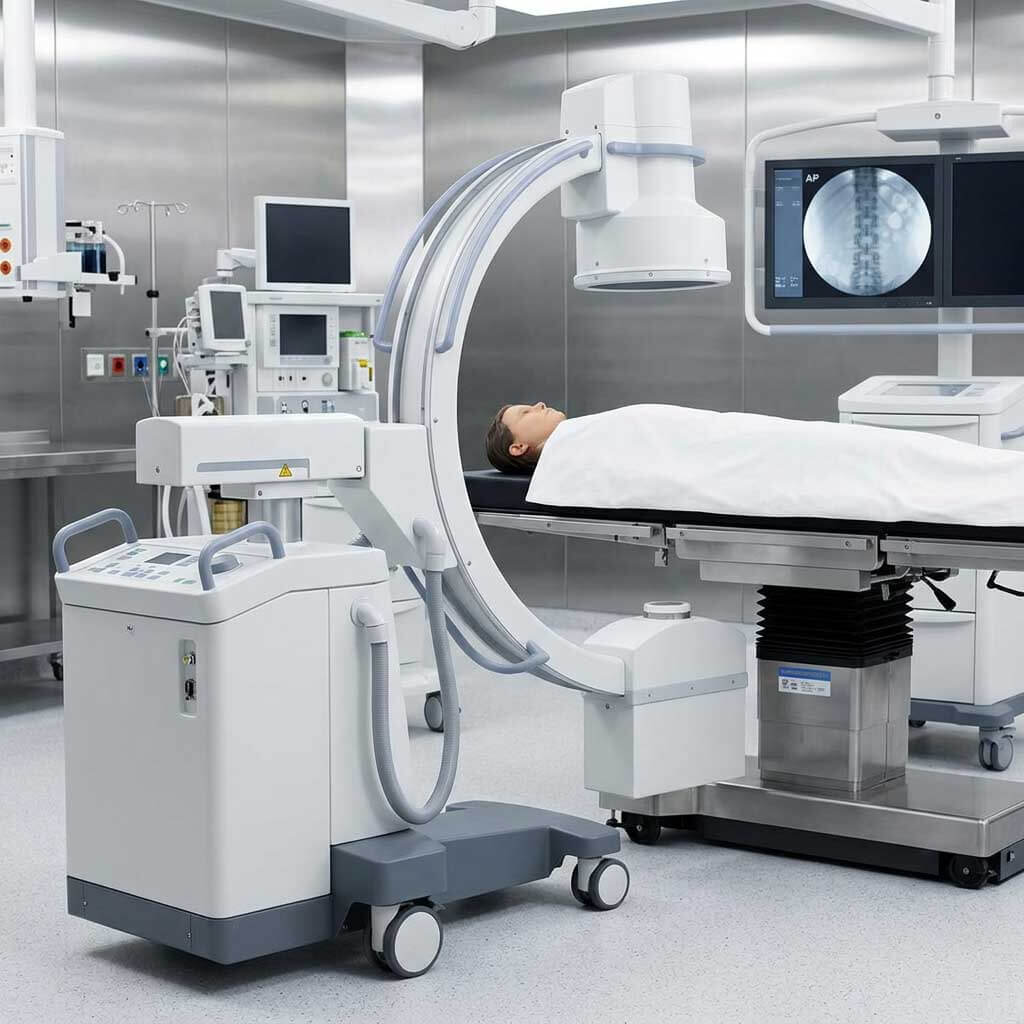
9. C-Arm Movement and Mechanical Design
A C-arm can have strong imaging specifications but still be inconvenient to use if its mechanical movement does not match the operating room.
Important mechanical specifications include:
- Orbital rotation
- Angulation
- Vertical movement
- Horizontal travel
- C-arm rotation
- Source-to-image distance
- Source-to-object distance
- C-arm depth
- C-arm opening
- Wheel design
- Locking mechanisms
- Steering
- Positioning controls
Why movement matters
Intraoperative imaging often requires the C-arm to be positioned around the patient while preserving access for surgeons, nurses and other equipment.
A useful C-arm should therefore provide sufficient positioning flexibility for the intended workflow.
The buyer should check the actual movement ranges in the technical specification sheet, rather than relying on descriptions such as “flexible movement” or “easy positioning.”
10. C-Arm Size and Operating Room Space
Before purchasing equipment, measure the operating environment.
Consider:
- Door width
- Elevator dimensions
- Storage area
- Operating-table clearance
- Ceiling height
- Power socket location
- Cable routes
- Space for the monitor cart
- Space around the patient
- Movement path between rooms
A compact C-arm may be easier to maneuver in smaller environments.
A larger system may provide different detector, generator or mechanical capabilities.
Therefore, equipment dimensions are not just logistics data; they are part of clinical workflow planning.
11. Monitor and Workstation Specifications
The monitor is where clinicians interact with the acquired images, so display characteristics should be included in the purchasing checklist.
Check:
- Monitor size
- Resolution
- Number of monitors
- Brightness
- Adjustable monitor arm
- Touchscreen control, if applicable
- Image controls
- Image storage
- Patient information interface
- Keyboard or touchscreen operation
- Remote controls
- Footswitch configuration
A multi-monitor setup may be useful when the operator needs to review images while simultaneously viewing live fluoroscopy.
A touchscreen interface can simplify access to frequently used controls, but the actual workflow should be evaluated through a demonstration whenever possible.
12. DICOM and PACS Connectivity
Hospital imaging systems increasingly depend on digital data exchange.
Before buying a C-arm, confirm how the machine integrates with the facility’s existing information infrastructure.
Ask about:
- DICOM compatibility
- DICOM image storage
- PACS connectivity
- Worklist support
- Image transfer
- Patient demographics
- Network configuration
- Storage formats
- Export options
- DICOM conformance statement
DICOM supports interoperability between medical imaging devices and other healthcare information systems, but DICOM compliance alone does not guarantee that two systems will work together exactly as required. The DICOM standard itself recommends comparing conformance information and validating the intended interoperability.
Therefore, before placing an order, provide the supplier with your hospital’s PACS and network requirements.
13. Storage Capacity and Image Management
A C-arm may generate a large number of images during repeated procedures.
Important questions include:
- How many images can the system store?
- Is cine-loop storage supported?
- Can images be deleted or archived?
- Can images be exported?
- What file formats are supported?
- Can images be transferred to PACS?
- Is patient information stored with the image?
- How is patient data protected?
This becomes especially important when one C-arm serves multiple departments.
A procurement team should evaluate not only image acquisition but also image management after acquisition.
14. Battery and Power Requirements
For mobile equipment, power management can significantly affect workflow.
Ask whether the C-arm includes:
- Rechargeable battery
- Battery-backed movement
- Emergency operation
- Battery charging time
- Expected battery operating time
- Battery replacement requirements
- Power cable length
- Input voltage
- Frequency requirements
Electrical configuration is particularly important for international buyers because hospitals in different countries can have different mains power requirements.
The supplier should confirm the exact electrical configuration available for the destination country before shipment.
15. Mobility: Wheels, Brakes and Positioning
For a mobile C-arm, mobility is part of the equipment’s practical performance.
Evaluate:
Wheels
Are they easy to steer?
Brakes
Can the machine remain stable during imaging?
Handles
Can staff move the system safely?
Cable management
Are cables positioned so they are less likely to interfere with workflow?
Transport
Can the equipment move through the hospital’s doors and elevators?
A demonstration or installation-site assessment can provide more useful information than a catalog photograph.
16. What Specifications Matter Most for Different Buyers?
Not every hospital needs the same configuration.
General Hospital
Prioritize:
- Balanced generator performance
- Reliable digital imaging
- Practical detector size
- Flexible C-arm movement
- DICOM/PACS connectivity
- Easy operation
- Service availability
Orthopedic-Focused Facility
Pay particular attention to:
- Detector size
- Image resolution
- C-arm positioning range
- Orbital movement
- Access around the operating table
- Image storage
Urology-Focused Facility
Consider:
- Imaging field of view
- Patient positioning
- C-arm movement
- Fluoroscopy modes
- Image quality
- Dose management
Pain Management
A compact and maneuverable system may be more important than a large detector configuration.
Important specifications can include:
- Positioning flexibility
- Compact footprint
- Image quality
- Fluoroscopy control
- Dose-management functions
High-Volume Surgical Department
Consider the complete workflow:
- Heat capacity
- Generator performance
- Image acquisition speed
- Storage
- Workflow software
- Ease of movement
- Service response
- Spare-part availability
17. Warranty and After-Sales Service
Before signing the purchase contract, clarify:
- Warranty period
- What components are covered
- X-ray tube warranty
- Detector warranty
- Generator warranty
- Software support
- Remote technical support
- On-site service
- Spare-parts availability
- Preventive maintenance
- Installation support
- Operator training
Ask the manufacturer to provide these terms in writing.
A professional quotation should clearly distinguish between standard warranty coverage and optional service packages.
18. Installation and Training Requirements
A C-arm is not simply a product that can be delivered and plugged in.
Installation may involve:
- Site preparation
- Electrical inspection
- Equipment assembly
- System calibration
- Image-quality testing
- Network configuration
- PACS connection
- Operator training
- Radiation-safety procedures
The buyer should determine who is responsible for each stage before ordering.
Training should normally cover basic operation, patient information entry, image acquisition, image review, storage, network transfer and routine safety procedures.
19. Certification and Regulatory Documentation
Medical imaging equipment may be subject to regulatory and conformity requirements that vary by destination market.
When evaluating an overseas supplier, request relevant documentation such as:
- Product registration documentation where applicable
- Quality-management certifications
- Test reports
- Electrical safety documentation
- EMC documentation
- Declaration of conformity
- User manual
- Service manual where appropriate
- DICOM conformance statement
- Packing list and shipping documents
The exact documentation required depends on the destination country and purchasing organization.
Do not assume that a certificate valid in one market automatically satisfies another market’s registration requirements.
20. How UMY Medical Approaches C-Arm Configuration
UMY Medical’s current C-arm product range includes several configurations, including 5 kW mobile C-arm fluoroscopy systems, FPD-based all-in-one mobile C-arms, portable high-frequency C-arms and other digital mobile C-arm systems.
This type of product range can be useful when a hospital needs to compare different configurations rather than selecting a single standardized machine for every department.
For procurement, the more important step is to match the model configuration to the hospital’s actual requirements.
A buyer can provide the supplier with:
- Intended applications
- Required detector size
- Desired generator power
- Operating-room dimensions
- PACS requirements
- Electrical requirements
- Target budget
- Expected daily workload
- Destination country
The supplier can then propose a configuration that fits those requirements.
21. A Practical C-Arm Buying Checklist
Before requesting a final quotation, confirm the following:
Imaging
□ Detector type
□ Detector size
□ Pixel pitch
□ Spatial resolution
□ Image processing
□ Image storage
□ Monitor resolution
Generator
□ Generator power
□ kV range
□ mA range
□ Fluoroscopy modes
□ Pulse rate
□ X-ray tube specifications
Dose Management
□ Dose display
□ Fluoroscopy time
□ Last-image-hold
□ Low-dose modes
□ Dose reporting capabilities
Mechanical
□ Orbital movement
□ Angulation
□ Vertical travel
□ Horizontal travel
□ Rotation
□ Source-to-image distance
□ Overall dimensions
□ Weight
Connectivity
□ DICOM
□ PACS
□ Worklist
□ Network connection
□ Image export
Procurement
□ Warranty
□ Installation
□ Training
□ Spare parts
□ Technical support
□ Certification documents
□ Delivery terms
22. Five Questions to Ask a C-Arm Manufacturer Before Buying
Instead of sending only:
“Please send me your C-arm price.”
A more useful RFQ would ask:
1. What C-arm configuration is suitable for our intended procedures and patient volume?
2. What are the complete generator, tube and detector specifications?
3. What fluoroscopy modes and dose-management functions are included?
4. Does the system support our DICOM/PACS workflow?
5. What are the warranty, installation, training, spare-parts and after-sales support terms?
These questions make it easier to compare suppliers on both technical and commercial factors.
25. Final Decision: Which C-Arm Should You Choose?
There is no single specification that determines whether a C-arm is appropriate.
A practical purchasing decision should consider five areas together:
Image quality
Does the detector and image-processing system provide the required information?
Workflow
Can the C-arm be positioned easily in the available operating environment?
Radiation management
Does the system provide functions that support appropriate dose optimization?
Connectivity
Can images and patient information integrate with the hospital’s digital workflow?
Total cost of ownership
Can the hospital support the system throughout its expected service life?
The right C-arm X-ray machine is therefore not necessarily the one with the highest generator power or the longest specification sheet. It is the configuration that provides an appropriate balance of imaging performance, movement, workflow, dose management, connectivity, reliability and service support.
For hospitals and medical equipment distributors comparing C-arm suppliers, requesting a complete technical specification sheet and a standardized quotation is one of the most effective ways to make a purchasing decision.
C-Arm X-Ray Machine FAQ
What generator power should a C-arm have?
The required generator power depends on the intended procedures, patient sizes, imaging requirements and system configuration. Compare generator power together with the X-ray tube, detector and fluoroscopy specifications.
Is a 5 kW C-arm suitable for a hospital?
A 5 kW configuration may be suitable for many mobile C-arm applications, but suitability depends on the clinical workload and complete system configuration. UMY Medical currently lists several 5 kW C-arm models.
Is an FPD C-arm better than an image intensifier C-arm?
FPD and image-intensifier systems use different detector technologies. The better choice depends on the hospital’s required image quality, workflow, budget, maintenance requirements and clinical applications.
What detector size should I choose?
Detector size should match the anatomy, field of view and available operating-room space. A larger detector is not automatically the appropriate choice for every procedure.
Why is pixel pitch important?
Pixel pitch describes the spacing of detector elements and is related to spatial sampling. It should be evaluated together with detector size, matrix, image processing and measured image performance.
What is last-image-hold?
Last-image-hold allows the operator to review the most recent fluoroscopic image without continuing X-ray exposure. It is one of the features used to support radiation-management practices.
Does a C-arm need DICOM?
A C-arm does not necessarily need every DICOM service, but DICOM compatibility can be important for hospitals that need to transfer images into PACS or other imaging systems. The exact DICOM functions required should be confirmed before purchase.
What should I compare besides C-arm price?
Compare generator, tube, detector, image quality, fluoroscopy modes, dose-management functions, mechanical movement, DICOM/PACS, warranty, spare parts, installation and after-sales support.
Should I choose a mobile or portable C-arm?
The decision depends on mobility requirements, available space, expected workload and required imaging performance. Compare the complete specifications rather than relying on the product name alone.