A Patient Room Is More Than a Bed and a Mattress
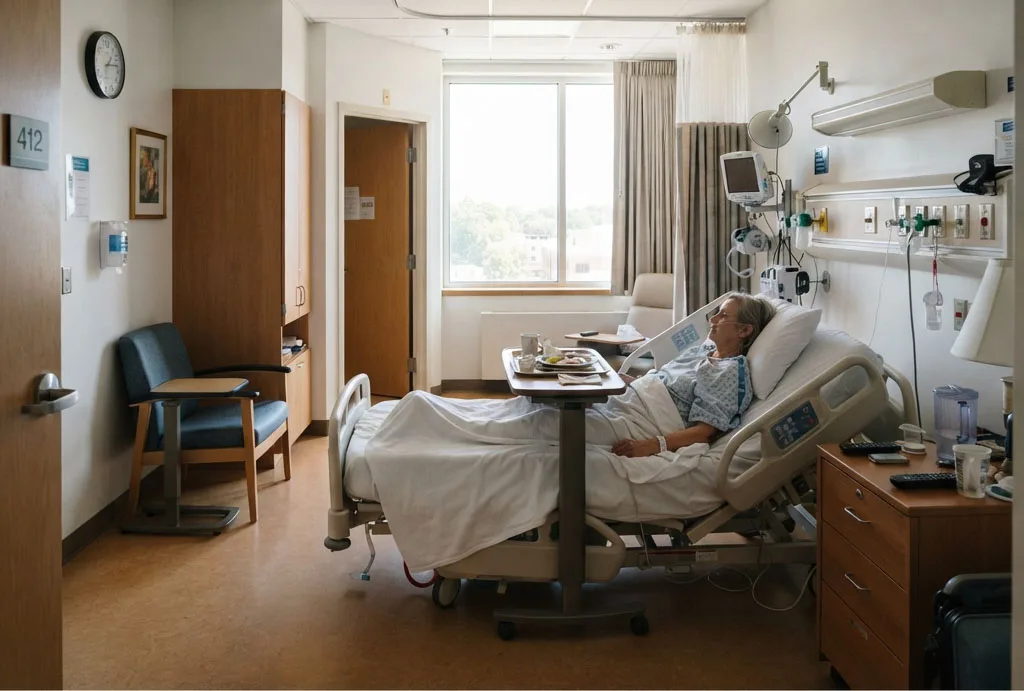
When planning a hospital patient room, the hospital bed is usually the first item on the purchasing list. However, the furniture surrounding the bed is equally important for everyday patient care.
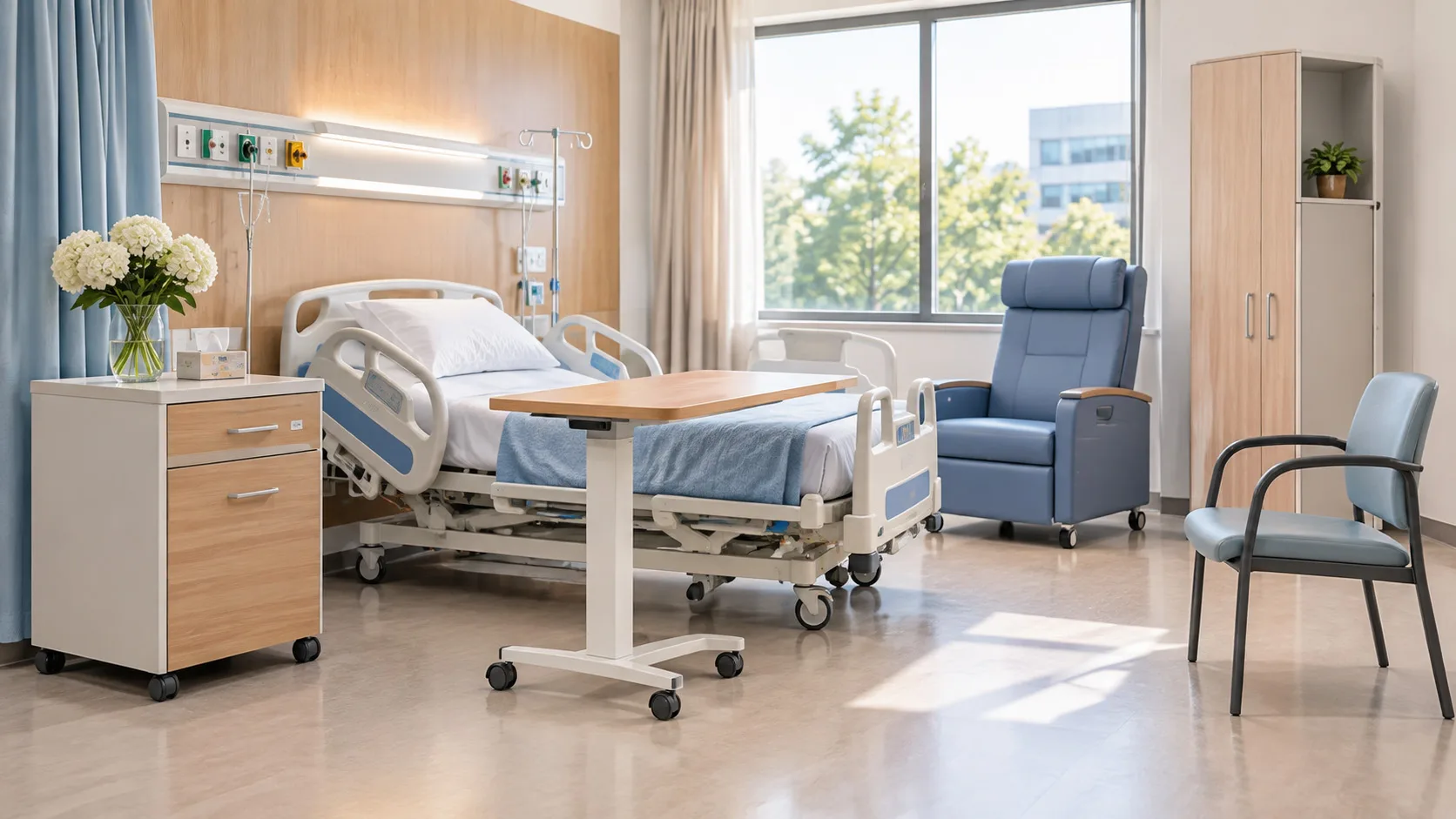
A bedside cabinet provides personal storage. An overbed table gives patients a convenient surface for meals and daily activities. A patient chair offers a place to sit outside the bed, while a visitor chair provides seating for family members. Additional storage cabinets, wardrobes and privacy screens help organize the room and support daily hospital operations.
These items work together to create a practical patient room.
For hospital procurement teams, medical furniture distributors, hospital construction contractors and healthcare project managers, selecting the right hospital furniture involves more than comparing appearance and prices.
The purchasing decision should consider:
- Patient comfort
- Staff accessibility
- Furniture dimensions
- Storage capacity
- Cleaning and disinfection
- Material durability
- Space utilization
- Maintenance
- Product compatibility
- Long-term operating costs
This guide explains the main types of hospital room furniture, their functions, important purchasing specifications and how to plan a complete patient room furniture package.
1. What Furniture Is Needed in a Hospital Patient Room?
A hospital patient room normally includes several pieces of furniture designed to support patients, visitors and healthcare personnel.
The exact configuration depends on the hospital type, room size, patient population and level of care.
Common hospital room furniture includes:
| Furniture | Main Purpose |
|---|---|
| Bedside cabinet | Personal belongings and bedside storage |
| Overbed table | Meals, reading and daily activities |
| Patient chair | Patient seating and selected recovery activities |
| Visitor chair | Seating for family members and visitors |
| Patient recliner | Adjustable seating for patient comfort |
| Hospital wardrobe | Clothing and personal storage |
| Storage cabinet | Supplies and additional room storage |
| Privacy screen | Visual separation and patient privacy |
| Bedside table | Convenient surface for items near the bed |
| Medical equipment cart | Storage and movement of selected medical equipment |
Not every patient room requires every item.
For example, a private hospital room may include a visitor sofa and additional personal storage, while a smaller general ward may use a more compact furniture arrangement.
The goal is to select furniture according to the actual room layout and patient-care workflow.
2. Hospital Bedside Cabinets: Essential Storage for Patient Rooms
A hospital bedside cabinet, also known as a bedside locker, medical bedside cabinet or hospital nightstand, is one of the most common pieces of hospital room furniture.
It is normally positioned beside the patient bed and provides convenient access to personal belongings and frequently used items.
Although its design may look simple, a bedside cabinet needs to meet several practical requirements.
What Is a Hospital Bedside Cabinet Used For?
A bedside cabinet can provide storage for:
- Personal belongings
- Clothing
- Books and reading materials
- Drinking containers
- Personal care products
- Small everyday items
- Other permitted patient belongings
Some designs include several compartments, drawers, shelves or lockable storage areas.
Depending on the hospital’s procedures, certain storage areas may also be used for designated patient-related supplies.
Types of Hospital Bedside Cabinets
Standard Bedside Cabinet
A standard hospital bedside cabinet is designed for everyday storage beside a patient bed.
Common features include a cabinet body, drawer, lower storage compartment and tabletop.
This type may be suitable for general hospital wards, private patient rooms and healthcare facilities.
Bedside Cabinet with Drawers
A bedside cabinet with drawers provides additional organized storage.
It may be useful where patients need separate spaces for clothing, accessories and personal belongings.
Buyers should check drawer movement, handle design, load capacity and ease of cleaning.
Bedside Cabinet with Lockable Storage
Some medical bedside cabinets include lockable compartments.
These may be useful for designated personal belongings or controlled storage arrangements.
The locking system, key management and access policy should be considered according to the facility’s procedures.
Bedside Cabinet with Wheels
A mobile bedside cabinet can be moved when cleaning the room or rearranging the furniture.
Common features include swivel casters and wheel brakes.
Before purchasing, check the cabinet’s stability when its drawers are open and whether the wheel-locking system is easy to operate.
Bedside Cabinet with Integrated Tray
Some bedside cabinets incorporate an additional tray or adjustable surface.
The exact arrangement varies by product.
This type can provide extra convenience where the patient needs an accessible surface for everyday activities.
What Should Buyers Check Before Purchasing?
When comparing hospital bedside cabinets, consider:
- Overall dimensions
- Storage capacity
- Number of drawers
- Lockable compartments
- Material and surface finish
- Handle design
- Wheel configuration
- Brake system
- Weight capacity
- Cleaning compatibility
- Spare parts availability
A good bedside cabinet should be practical, stable and easy to maintain.
3. Hospital Overbed Tables: A Practical Part of Patient Room Furniture
An overbed table is a movable table designed to provide a convenient surface above or beside a hospital bed.
It is commonly used for meals, reading, writing and other daily activities.
Overbed tables are also known as:
- Hospital overbed table
- Medical overbed table
- Adjustable overbed table
- Hospital bed table
- Bedside overbed table
- Patient overbed table
- Hospital meal table
- Adjustable medical table
These terms are useful for buyers researching different product types and suppliers.
What Is an Overbed Table Used For?
An overbed table can support:
Meals and drinking
It provides a surface for food trays and drinks when the patient is resting in bed.
Reading and writing
Patients can use the table for books, documents and other lightweight personal items.
Daily activities
It offers a convenient working surface without requiring the patient to move to another table.
Patient convenience
The movable structure allows the tabletop to be positioned according to the user’s needs.
Types of Hospital Overbed Tables
Height-Adjustable Overbed Table
A height-adjustable overbed table allows users or healthcare staff to change the tabletop height.
Adjustment mechanisms vary by design.
Some use manual adjustment, while others have different mechanical arrangements.
C-Shaped Overbed Table
A C-shaped overbed table has a base designed to extend under the bed while the tabletop is positioned above the patient.
This arrangement can make it easier to position the table close to the bed.
U-Shaped Overbed Table
A U-shaped overbed table uses a base configuration designed to accommodate the bed structure.
The actual clearance depends on the dimensions of the base and the hospital bed.
Electric Overbed Table
Some specialized medical tables offer powered height adjustment.
This function may be useful in particular care environments, although it is not necessary for every patient room.
What Makes a Good Hospital Overbed Table?
Important specifications include:
- Adjustable height range
- Tabletop dimensions
- Tabletop material
- Base design
- Wheel configuration
- Stability
- Weight capacity
- Edge design
- Cleaning compatibility
- Ease of movement
The tabletop should provide enough usable space without unnecessarily restricting access around the bed.
A stable base is also important because the table may be moved repeatedly during the day.
Buyers should consider whether the table can fit under the intended hospital bed and whether its base will interfere with the bed’s wheels or other components.
Hospital Overbed Table vs Bedside Table
These two products are sometimes confused.
A bedside table normally stands beside the bed and provides a fixed or movable surface for personal belongings.
An overbed table is designed to move above the mattress area and provide a working surface within the patient’s reach.
Both can be useful in the same patient room, but they serve different purposes.
4. Patient Chairs and Hospital Recliner Chairs
Patient seating is another important part of hospital room furniture.
Not every patient wants to remain in bed throughout the day. Depending on their condition and care plan, a suitable chair can provide an alternative place to sit and support selected daily activities.
Common products include:
- Hospital patient chair
- Medical patient chair
- Hospital recliner chair
- Medical recliner chair
- Patient recovery chair
- Adjustable patient chair
- Hospital visitor chair
Standard Hospital Patient Chair
A standard patient chair is designed for seating in healthcare environments.
It may be positioned near the bed, beside a window or in a designated patient seating area.
Important features include:
- Stable frame
- Comfortable seat
- Back support
- Armrests
- Suitable seat height
- Cleanable surfaces
- Appropriate weight capacity
The seat should be easy for the intended patient population to use.
Armrests may provide useful support when sitting down or standing up, but the overall design must match the user’s mobility and clinical needs.
Hospital Recliner Chair
A hospital recliner chair provides adjustable seating positions.
Depending on the model, it may include:
- Adjustable backrest
- Extendable footrest
- Multiple reclining positions
- Locking mechanisms
- Movable wheels
- Armrests
- Removable or adjustable cushions
Recliner chairs may be considered for selected hospital wards, recovery areas, outpatient treatment spaces and long-term care environments.
Buyers should distinguish between a standard leisure recliner and a medical patient recliner designed for healthcare use.
The latter should be evaluated for cleaning, durability, stability and suitability for the intended setting.
Patient Transfer Chairs
Some specialized patient chairs have features that support assisted transfers.
Examples may include removable or drop-down armrests, adjustable sections and other mobility-related functions.
These products are different from ordinary patient seating and should be specified according to the transfer requirements of the facility.
Detailed patient transportation and transfer equipment will be covered separately in Post 4.
What Should Buyers Consider?
When selecting patient chairs for hospitals, assess:
- Seat height and depth
- Backrest support
- Armrest configuration
- Weight capacity
- Frame material
- Upholstery
- Wheel options
- Braking system
- Cleaning requirements
- Replacement cushions and parts
The best patient chair is not necessarily the softest or largest. It should provide an appropriate balance between comfort, support, accessibility and maintenance.
5. Hospital Visitor Chairs and Companion Chairs
Hospital rooms are used by more than patients and healthcare staff.
Family members, visitors and companions may spend significant time in the room.
A suitable visitor chair can help make the environment more comfortable without interfering with staff access or patient care.
What Is a Hospital Visitor Chair?
A hospital visitor chair is designed to provide seating for family members and visitors.
Common designs include:
- Standard visitor chair
- Padded visitor chair
- Armrest visitor chair
- Stackable hospital visitor chair
- Metal-frame hospital chair
- Vinyl upholstered visitor chair
- Lounge-style visitor seating
The choice depends on the available space, expected use and cleaning requirements.
What Is a Hospital Companion Chair?
A companion chair is designed for a family member or caregiver who stays with a patient.
Some models have a reclining or folding configuration to support extended stays.
Certain designs can be converted into a sleeping surface, depending on the product.
This type of medical furniture may be considered for private hospital rooms, maternity wards, pediatric departments and other areas where family accommodation is important.
Visitor Chair vs Companion Chair
| Feature | Visitor Chair | Companion Chair |
|---|---|---|
| Primary use | Shorter visitor seating | Longer companion stays |
| Design | Standard chair | May recline or fold |
| Sleeping function | Usually unavailable | Available on selected models |
| Space requirement | Generally smaller | May require more space |
| Main selection factor | Comfort and cleanability | Comfort, function and storage space |
When ordering, confirm the chair’s folded and unfolded dimensions, operating mechanism, upholstery material and load capacity.
6. Hospital Wardrobes and Storage Cabinets
Patients may stay in hospitals for different lengths of time.
A suitable personal storage arrangement helps keep clothing, bags and everyday belongings organized.
This is where hospital wardrobes and storage cabinets become useful.
Hospital Wardrobe
A hospital wardrobe is a storage unit designed for clothing and personal items.
Depending on the model, it may include:
- Hanging space
- Shelves
- Drawers
- Lockable compartments
- Doors
- Adjustable storage areas
Hospital wardrobes may be used in private patient rooms, rehabilitation centers, nursing homes and long-term care facilities.
Medical Storage Cabinet
Medical storage cabinets may be used for designated supplies, equipment or other approved materials.
They should be distinguished from personal patient lockers and from clinical storage systems that require specific control arrangements.
Potential configurations include:
- Single-door cabinet
- Double-door cabinet
- Drawer storage cabinet
- Wall-mounted cabinet
- Mobile storage cabinet
- Lockable hospital cabinet
- Stainless steel storage cabinet
The correct design depends on what will be stored and where the cabinet will be installed.
Hospital Locker
A hospital locker provides personal storage in designated rooms or staff areas.
Different designs may include individual compartments, lockable doors and shared storage arrangements.
When choosing a hospital locker, assess:
- Storage dimensions
- Locking mechanism
- Ventilation where needed
- Surface finish
- Security requirements
- Ease of cleaning
- Installation and stability
7. Privacy Screens and Hospital Room Partitions
Privacy is an important consideration in shared hospital rooms and treatment spaces.
A privacy screen helps separate areas visually without requiring permanent construction.
Hospital privacy screens can be movable, foldable, curtain-based or designed with other partition arrangements.
Types of Hospital Privacy Screens
Folding privacy screen
A folding medical privacy screen can be opened or repositioned when needed.
Mobile privacy screen
A mobile screen uses wheels to allow movement around the room.
Curtain privacy screen
A curtain-based system provides visual separation using a track and curtain arrangement.
Multi-panel hospital screen
Some designs contain multiple connected panels to provide a wider visual barrier.
What Should Buyers Consider?
- Number of panels
- Overall height
- Width when opened
- Base stability
- Wheel configuration
- Folding mechanism
- Curtain material, if applicable
- Cleaning and replacement requirements
A privacy screen should provide practical separation while maintaining sufficient space for patient care and staff movement.
8. Materials Used in Hospital Room Furniture
Material selection can affect furniture durability, cleaning, appearance and long-term maintenance.
Hospital furniture is used frequently and may come into contact with cleaning products, body fluids and other substances.
For this reason, material selection should be treated as a functional requirement rather than simply a design preference.
Stainless Steel
Stainless steel is used in various medical furniture applications.
Potential advantages include:
- Corrosion resistance, depending on the grade
- Smooth surfaces
- Durability
- Cleaning convenience
- Resistance to many common cleaning conditions
The appropriate grade should be selected according to the application and chemical exposure.
Powder-Coated Steel
Powder-coated steel is common in medical furniture frames.
It provides a finished surface and can be used in bedsides, tables, chairs and storage structures.
Buyers should review coating quality, surface integrity and resistance to the facility’s cleaning procedures.
ABS Plastic
ABS plastic may be used in cabinet bodies, panels, drawers and other furniture components.
Depending on its formulation and design, it can provide a relatively lightweight structure with convenient surface cleaning.
Chemical compatibility should be checked before use with specific disinfectants.
High-Pressure Laminate and Melamine Surfaces
Laminate and melamine-faced surfaces may be used in selected hospital furniture, particularly storage cabinets and tabletops.
The quality of the surface, edge sealing and joint construction are important.
Exposed or damaged edges may become more difficult to clean and maintain.
Vinyl Upholstery
Vinyl-covered seating is commonly considered for patient chairs and hospital recliners.
When selecting upholstered furniture, buyers should check whether the covering is:
- Fluid-resistant
- Non-porous
- Compatible with hospital cleaning products
- Resistant to cracking
- Suitable for regular wiping
- Easy to maintain
The specific performance should be supported by product information, not assumed from the material name alone.
9. Hospital Furniture Cleaning and Infection Control
Hospital furniture is used repeatedly by patients, visitors and healthcare personnel.
Surfaces such as bedside cabinets, overbed tables, chair armrests and storage handles may be touched frequently.
Therefore, cleaning and disinfection requirements should influence furniture selection from the beginning.
Why Is Easy Cleaning Important?
Furniture with difficult-to-access gaps, damaged surfaces or unsuitable upholstery can make routine cleaning more complicated.
A better design considers:
- Smooth surfaces
- Accessible corners
- Sealed edges
- Durable coatings
- Suitable upholstery
- Minimal unnecessary gaps
- Removable components where appropriate
The Asia Pacific Society of Infection Control’s 2024 environmental hygiene guidelines recommend choosing furnishings and equipment that can be cleaned easily and are compatible with healthcare cleaning and disinfecting agents.
They also emphasize maintenance, repair and appropriate material selection.
What Does Non-Porous Surface Mean?
A non-porous surface has limited absorption of liquids compared with porous materials.
In healthcare environments, smooth and suitable non-porous surfaces can make routine cleaning and disinfection more practical.
However, surface material alone does not guarantee infection prevention.
The complete furniture design, cleaning procedure, disinfectant compatibility and maintenance condition all matter.
How to Select Hospital Furniture for Easy Maintenance
Before purchasing, ask:
- Can the surface withstand the facility’s approved disinfectants?
- Are the corners and joints accessible for cleaning?
- Can the upholstery be wiped without damaging the material?
- Are there areas where liquid or dirt can accumulate?
- Can damaged components be replaced?
- Are cleaning and maintenance instructions available?
Hospital infection prevention and environmental services teams should be involved in furniture specification and approval.
10. How to Plan the Furniture Layout of a Hospital Patient Room
Buying good-quality hospital furniture is only part of the project.
The furniture must also fit into the room without restricting patient access or healthcare staff activities.
A patient room should balance three main areas:
Patient care area
The bed, bedside cabinet, overbed table and selected patient seating.
Visitor area
Visitor chairs, companion chairs, small tables and personal belongings storage.
Staff working area
Space for staff movement, supplies and access to patient-care equipment.
Research into medical and surgical patient-room design has highlighted the need to consider patients, visitors and healthcare workers together. Its room-design studies included patient chairs, visitor seating, bedside tables, overbed tables and patient storage as part of the room planning process.
General Layout Considerations
Place Furniture Near Its Intended User
A bedside cabinet should be accessible from the patient’s bed.
An overbed table should be able to move into position without blocking access.
Visitor chairs should be located where they do not interfere with patient care.
Keep Staff Access Clear
Furniture should not obstruct access to the bed, essential controls, utilities or other clinical equipment.
Consider Room Movement
Check whether furniture can be moved for cleaning, maintenance and room reorganization.
Avoid Excessive Furniture
Filling a small hospital room with too many cabinets, tables and chairs can restrict movement and reduce usability.
Coordinate With Other Equipment
Hospital furniture should be planned alongside electrical outlets, nurse-call systems, medical gas connections, headwalls and other built-in equipment.
A well-planned patient room is not simply a collection of furniture products. It is a functional environment.
11. What Hospital Furniture Is Needed in Different Departments?
Different healthcare departments have different furniture requirements.
General Hospital Ward
Common items may include:
- Hospital bed
- Bedside cabinet
- Overbed table
- Patient chair
- Visitor chair
- Wardrobe or personal storage
- Privacy curtain or screen
Private Hospital Room
A private room may require additional furnishings such as:
- Patient recliner
- Companion chair
- Visitor sofa
- Additional bedside storage
- Personal wardrobe
- Small visitor table
ICU and Critical Care Rooms
The furniture arrangement should prioritize space, cleaning, equipment access and staff workflow.
Additional patient seating or storage may be less important than adequate space around the bed and essential medical equipment.
Pediatric Ward
Patient rooms for children may need child-appropriate seating, storage and furniture configurations.
The design should consider both children and accompanying family members.
Maternity Ward
Maternity rooms may require companion seating, personal storage and additional furniture appropriate for patients and family members.
Rehabilitation and Long-Term Care
These environments may require more patient seating, wardrobes, accessible storage and furniture suitable for extended stays.
Furniture choices should be coordinated with patient mobility and the activities of the facility.
12. How to Compare Hospital Furniture Manufacturers and Suppliers
For international hospital furniture procurement, comparing suppliers involves more than selecting products from online catalogs.
Buyers should evaluate the manufacturer’s capabilities and the complete product specifications.
Product Range
Does the supplier provide bedside cabinets, overbed tables, patient chairs, wardrobes, visitor seating and other required furniture?
Can the supplier support a complete patient-room furniture order?
Material Specifications
Are frame materials, tabletop surfaces, upholstery and storage materials clearly identified?
Customization
Can the dimensions, colors, structure or accessories be adjusted for different hospital projects?
Manufacturing and Quality Control
If purchasing directly from a manufacturer, review its production capacity, inspection procedures and product consistency.
If purchasing through an integrated medical equipment supplier, clarify the actual manufacturer and the available documentation.
Product Documentation
Request:
- Product specifications
- Dimensions
- Material information
- Weight capacity
- Cleaning instructions
- Assembly instructions
- Applicable conformity documents
- Warranty information
After-Sales Support
Ask whether replacement components such as wheels, handles, tabletops, drawer slides and upholstery can be supplied.
Shipping and Packaging
Hospital furniture may require different packaging arrangements depending on size and construction.
Ask about:
- Assembly requirements
- Export packaging
- Shipping dimensions
- Container loading
- Product protection
- Delivery conditions
Total Cost
Compare the complete price, including optional accessories, shipping, installation, replacement parts and expected maintenance.
13. UMY Medical Equipment Co., Ltd. and Hospital Furniture Procurement
For international buyers, sourcing hospital furniture may be part of a much larger healthcare project involving beds, diagnostic equipment, laboratory instruments and other hospital supplies.
UMY Medical Equipment Co., Ltd. is a Guangzhou-based medical equipment supplier with a broad medical product portfolio.
According to its official company profile, UMY has operated since 2003 and reports serving more than 1,100 healthcare entities across more than 168 countries and regions. The company also describes a supply network involving more than 30 medical subsidiaries and 18 production bases, along with a portfolio of over 1,500 types of medical devices and consumables.
Its stated business capabilities include medical equipment sourcing, OEM/ODM coordination, international logistics and multilingual after-sales support.
These capabilities may be relevant to hospital contractors, distributors and procurement teams sourcing multiple product categories for healthcare projects.
UMY’s official Hospital Furniture category currently lists the Medical Equipment Rolling Cart, model UMH-TC01, for medical equipment storage and mobility.
For other hospital room furniture requirements, buyers should contact UMY to confirm current sourcing availability, product specifications, customization options and documentation for the specific items required.
You can also explore UMY Medical Equipment’s official website for its broader medical equipment portfolio.
14. Hospital Furniture Procurement Checklist
Before requesting quotations, prepare a complete furniture list.
Bedside Cabinets
- Required quantity
- Cabinet dimensions
- Number of drawers
- Lockable storage
- Wheel or fixed-base configuration
- Material and surface finish
Overbed Tables
- Tabletop dimensions
- Height-adjustment range
- C-shaped or U-shaped base
- Wheel and locking system
- Weight capacity
- Tabletop material
Patient and Visitor Chairs
- Chair type
- Seat dimensions
- Armrest configuration
- Upholstery
- Weight capacity
- Cleaning requirements
Hospital Wardrobes and Storage
- Overall dimensions
- Door and drawer arrangement
- Locking requirements
- Shelf configuration
- Material and finish
Privacy Screens
- Number of panels
- Overall dimensions
- Folding or mobile design
- Curtain material, where applicable
- Cleaning requirements
Project Information
- Hospital type
- Department
- Room quantity
- Floor plan
- Destination country
- Required delivery date
- Applicable product documents
- Packaging and shipping requirements
Providing this information helps suppliers prepare more accurate quotations.
Final Buying Advice: Plan the Complete Patient Room, Not Just Individual Furniture Items
Hospital room furniture should work together as one practical environment.
A bedside cabinet supports personal storage. An overbed table offers a convenient working surface. Patient chairs provide additional seating, while visitor chairs and companion furniture help accommodate family members.
Storage cabinets and wardrobes organize personal belongings, while privacy screens support visual separation.
However, purchasing decisions should also consider cleaning, durability, dimensions, staff access, patient needs and long-term maintenance.
For hospital projects, it is often more effective to create a standard patient-room furniture specification first and then adapt the package for different departments.
The ideal procurement process is:
Room planning → Furniture selection → Material evaluation → Cleaning requirements → Space coordination → Supplier comparison → Quotation → Delivery → Installation and maintenance.
This approach helps buyers move from purchasing individual hospital furniture products to developing a coordinated hospital room furniture solution.
Frequently Asked Questions
1. What furniture is needed in a hospital patient room?
Common items include a hospital bed, bedside cabinet, overbed table, patient chair, visitor chair, wardrobe or storage cabinet and privacy screen. The exact configuration depends on the room and healthcare department.
2. What is the difference between a bedside cabinet and an overbed table?
A bedside cabinet provides storage beside the bed, while an overbed table is a movable surface designed to be positioned above the bed for meals, reading and daily activities.
3. What is the difference between a hospital patient chair and a visitor chair?
A patient chair is designed for patient seating and may offer additional support or reclining functions. A visitor chair is primarily intended for family members and visitors.
4. What materials are suitable for hospital furniture?
Common materials include stainless steel, coated steel, plastics and specified cleanable upholstery. The correct material should be compatible with the facility’s cleaning products and intended use.
5. How do you choose hospital furniture that is easy to clean?
Look for smooth, accessible surfaces, suitable materials, durable finishes, sealed edges and upholstery compatible with approved hospital disinfectants. Cleaning procedures should follow the facility’s infection-control policies.
6. What should buyers consider when purchasing a hospital overbed table?
Check tabletop size, height adjustment, base configuration, stability, casters, weight capacity and compatibility with the hospital bed.
7. How do you plan furniture for a hospital patient room?
Consider patient access, staff workflow, visitor seating, storage, cleaning space, room dimensions and the location of essential medical equipment and utilities.
8. Can hospital room furniture be customized?
Some suppliers offer customization of dimensions, colors, materials and configurations. Confirm which modifications are available and whether they affect product documentation or safety requirements.
9. What should I ask a hospital furniture supplier before purchasing?
Ask about product dimensions, materials, cleaning compatibility, load capacity, customization, warranty, spare parts, applicable documents, export packaging and after-sales support.