
The Physics of the Crush: Why Speed Alters the Result
Imagine taking two identical aspirin tablets from the exact same manufacturing batch and testing them on two different hardness testers. Machine A pushes its crushing jaw forward very slowly and records a breaking force of 80 Newtons. Machine B slams its crushing jaw forward rapidly and records a breaking force of 95 Newtons.
Which machine is correct? Technically, both are measuring accurately based on their programmed mechanics, but they yield a massive 15 Newton discrepancy.
This happens because pharmaceutical tablets are not made of solid steel; they are composed of compressed powders and viscoelastic binders. When pressure is applied slowly, the binder matrix has time to microscopically deform, yield, and spread the stress before finally fracturing. When pressure is applied rapidly (an impact crush), the viscoelastic binders do not have time to yield, causing the tablet to act like a rigid, brittle solid that registers a significantly higher peak breaking force.
For laboratory procurement managers, pharmaceutical engineers, and scientific equipment distributors, understanding this physical phenomenon is the first step in buying the right equipment. You cannot simply buy the cheapest tablet crusher on the market; you must procure a system with hyper-precise motor controls that guarantee the exact same crushing dynamics today, tomorrow, and ten years from now.
This buyer’s guide explores the internal engineering of modern tablet hardness testers, the shift toward multi-parameter automation, and the strict software compliance requirements necessary to pass a regulatory audit.
1. The Drive Mechanics: Constant Speed vs. Constant Force
The United States Pharmacopeia (USP) chapter 1217 recognizes two distinct mechanical methods for driving the crushing platen (jaw) into the tablet. When writing a procurement tender, the laboratory must specify which drive system matches their historical batch records.
               THE TWO PHARMACOPEIA DRIVE PRINCIPLES
+-------------------------------------------------------------------------+
| METHOD A: CONSTANT SPEED DRIVE (Fixed Physical Velocity)                |
| - The jaw moves forward at an unchanging rate (e.g., 2.5 mm per minute).|
| - As the jaw makes contact and the tablet resists, the motor pushes     |
|   harder to maintain that exact physical speed until the tablet breaks. |
| - Advantage: Highly reproducible, standard for most modern QC labs.     |
|                                                                         |
| METHOD B: CONSTANT FORCE DRIVE (Fixed Loading Rate)                     |
| - The jaw applies force at an unchanging rate (e.g., 20 Newtons/second).|
| - If the tablet starts to yield/compress, the jaw must physically       |
|   accelerate (speed up) to maintain that 20 N/sec pressure curve.       |
| - Advantage: Mathematically pure stress testing.                        |
+-------------------------------------------------------------------------+
The Engineering Debate
Historically, many older generation machines used a simple swinging pendulum or uncontrolled electric motors, causing erratic loading rates. Modern systems use precision stepper motors.
-
Constant Speed is generally preferred by most modern formulation scientists because it is mechanically simpler and easier to calibrate.
-
Constant Force can sometimes cause problems with softer tablets: as the soft tablet yields, the stepper motor accelerates rapidly to maintain the programmed force rate, inadvertently turning the final crush into a high-speed impact rather than a smooth squeeze.
-
The Best Procurement Choice: Premium automated hardness testers offer Dual-Drive capability, allowing the QC manager to toggle the software between Constant Speed and Constant Force modes to perfectly match legacy drug monographs.
2. The Heart of the Tester: Strain Gauge Load Cells
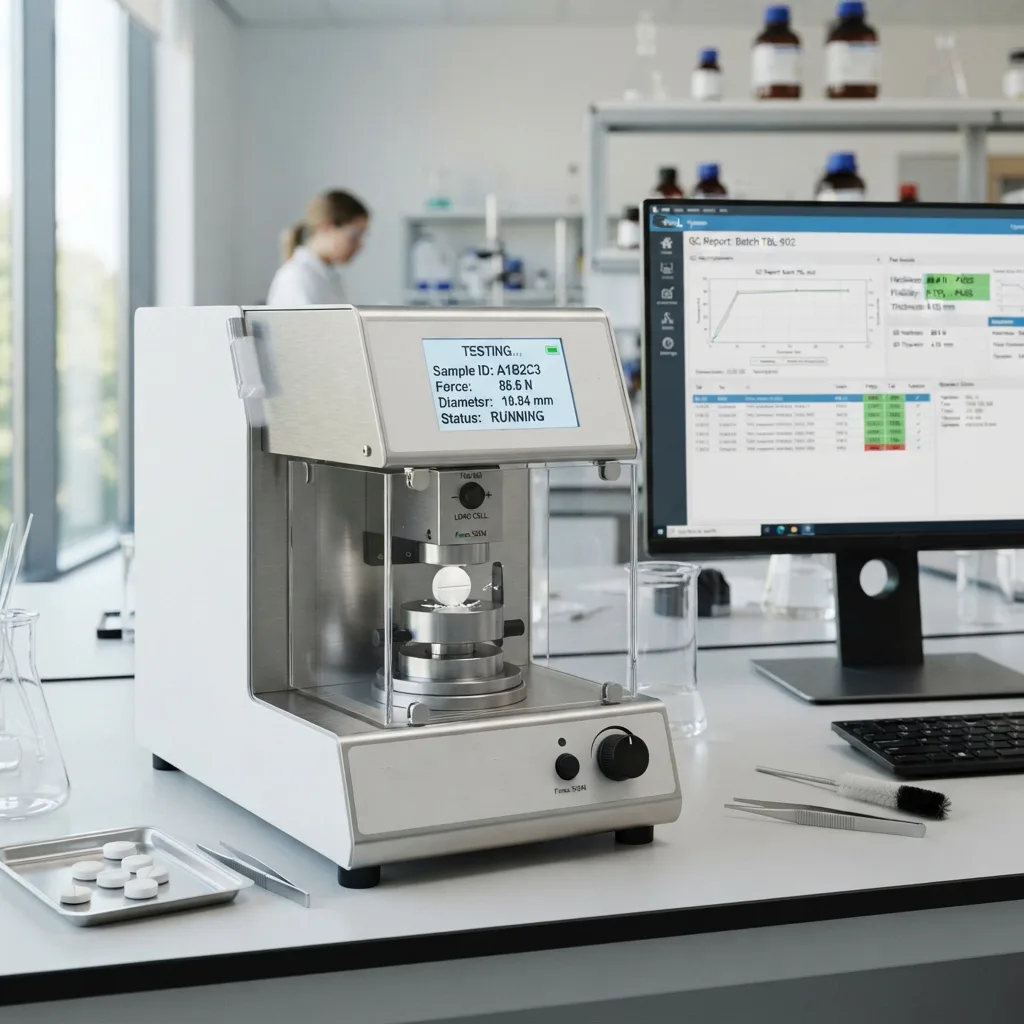
The motor provides the muscle, but the Load Cell provides the brain. A load cell is the electromechanical sensor sitting directly behind the stationary jaw. When the tablet is squeezed, it pushes back against the stationary jaw, and the load cell converts that physical pressure into a measurable electrical signal.
Precision Strain Gauges
High-end pharmaceutical testers utilize strain gauge load cells. Inside the sealed sensor, a microscopic metallic foil grid is bonded to a flexible metal block. As pressure bends the block infinitesimally, the foil grid stretches, changing its electrical resistance. A microprocessor measures this resistance change and converts it instantly into Newtons or Kiloponds.
Auto-Tare and Debris Management
During a shift of testing 500 tablets, powder and dust inevitably accumulate on the crushing jaw. If a machine does not account for this dust, the load cell will register the weight of the debris as pressure, slowly shifting the baseline zero point and artificially inflating hardness results.
-
When evaluating equipment, buyers must ensure the system features an Auto-Tare (Auto-Zero) function. Before the jaw begins moving for the next tablet, the software must electronically reset the load cell to true zero, entirely ignoring any accumulated powder on the platens.
-
Additionally, the physical architecture of the crushing arena should include a removable debris tray and specialized brushes that sweep broken tablet fragments into a waste bin after every crush, preventing jam-ups in the stepper motor track.
Static Weight Calibration
A load cell is only as accurate as its last calibration. Procurement tenders must mandate that the instrument supports multi-point static calibration. Using certified, traceable stainless steel dead weights (e.g., 5 kg, 10 kg, 15 kg), a metrology engineer physically hangs the weights onto the load cell using a specialized calibration bracket. The software must allow the engineer to adjust the linearity curve across at least three to five points to guarantee accuracy from very soft chewable tablets up to rock-hard veterinary boluses.
3. Hardware Tiers: From Manual Crushers to 5-in-1 Automation
Laboratory equipment budgets and daily testing volumes dictate the level of automation required. The market is divided into three distinct hardware tiers.
| Feature / Metric | Tier 1: Manual / Handheld Tester | Tier 2: Semi-Automated Standalone | Tier 3: Fully Automated Multi-Parameter Workstation |
| Primary Use Case | Small-scale R&D, educational labs | Routine production floor spot-checks | High-volume central QC laboratories |
| Parameters Tested | Hardness only | Hardness, Diameter, Thickness | Weight, Thickness, Width, Diameter, Hardness |
| Tablet Loading | Manual (One by one) | Manual placement on testing bed | Automated vibratory bowl / 20+ tablet feeder |
| Throughput Speed | Slow (Dependent on operator) | Moderate (5 to 10 tablets/minute) | High (Continuous unattended batch testing) |
| Data Integrity Risk | High (Often requires manual writing) | Moderate (Printed thermal receipts) | Zero (Direct secure network LIS/LIMS upload) |
| Built-in Balance | No | Optional external connection | Yes (Internal high-precision analytical balance) |
The Value of the 4-in-1 / 5-in-1 Automated Workstation
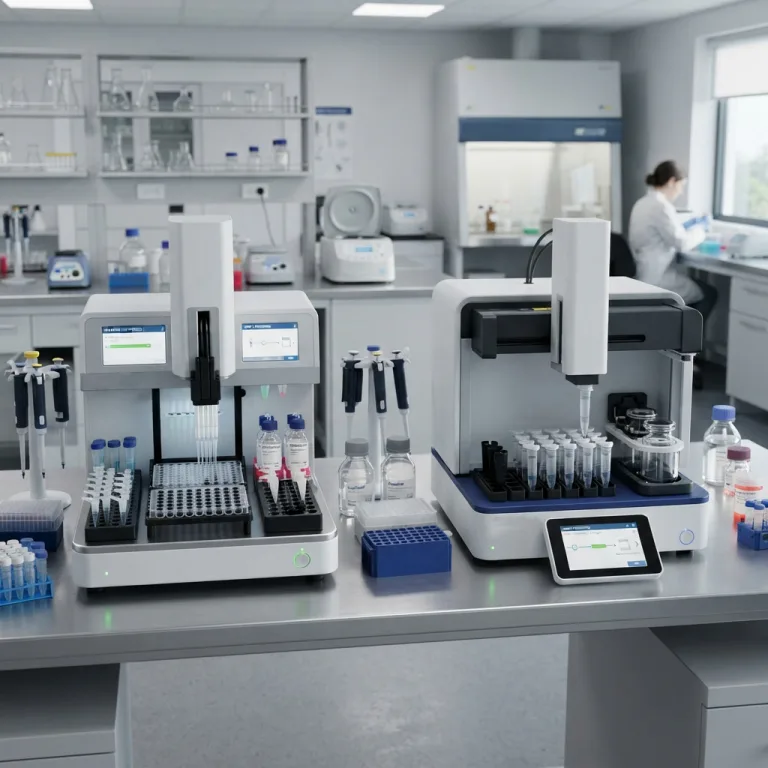
In a standard Tier 2 setup, a technician must weigh a tablet on a separate analytical scale, measure its thickness with a handheld micrometer, and then place it in the hardness tester. A Tier 3 Multi-Parameter Workstation consolidates this entire workflow:
-
The technician dumps a sample of 20 tablets into the top vibratory feeder bowl and presses “Start.”
-
The system drops one tablet onto an internal micro-balance to record Weight.
-
A motorized transport arm slides the tablet under a laser or physical caliper to measure Thickness.
-
The tablet is pushed into the crushing arena where the jaw closes gently to measure Diameter (and Width for oblongs).
-
The jaw continues closing until fracture to record Hardness (Breaking Force).
-
The broken debris is swept away, and the cycle repeats automatically for all 20 tablets.
By eliminating human handling between steps, multi-parameter testers drastically reduce testing time, prevent sample mix-ups, and generate a single unified report containing all physical attributes of the batch.
4. FDA 21 CFR Part 11 and Data Integrity Compliance
In the highly regulated pharmaceutical industry, mechanical perfection means nothing if the digital data cannot be trusted. Regulatory bodies like the FDA, EMA, and MHRA issue severe warning letters to pharmaceutical manufacturers who fail to protect their laboratory data from tampering, accidental deletion, or falsification.
When purchasing a tablet hardness tester for a GMP (Good Manufacturing Practice) facility, the embedded software or connected PC software must natively comply with FDA 21 CFR Part 11 (Electronic Records and Electronic Signatures).
Procurement officers must verify the following four software pillars:
A. ALCOA+ Principles
The software architecture must ensure that all generated data is Attributable, Legible, Contemporaneous, Original, and Accurate (ALCOA). The system must directly capture the load cell data in real-time; operators cannot have the ability to manually overwrite a failing breaking force result to make a batch “pass.”
B. Strict Multi-Level Access Control
The instrument must not have a generic “Admin” login that everyone shares. It must support Active Directory (LDAP) integration or internal unique credentials with at least three hierarchical roles:
-
Operator: Can only select pre-approved testing methods, run batches, and print reports. Cannot change system settings, alter time/date, or delete data.
-
Supervisor: Can create or edit testing methods, approve reports, and unlock operator accounts.
-
Administrator: Responsible for IT configurations, backup management, and maintaining the user database, but explicitly locked out from running clinical batches to ensure separation of duties.
C. The Incorruptible Audit Trail
Every single keystroke and system event must be logged in a hidden, unalterable background file known as the Audit Trail. If a supervisor logs in at 2:15 PM and changes the acceptable hardness range for “Aspirin 500mg” from 80 Newtons to 70 Newtons, the Audit Trail must record the user’s name, the exact timestamp, the old value, the new value, and prompt the user to type in a justification code for the change. During an FDA inspection, the auditor will review this trail to ensure no illicit manipulation occurred.
D. Electronic Signatures
Instead of printing a thermal paper receipt and signing it with a pen (which fades over time and gets lost in filing cabinets), the software must allow the operator to apply a cryptographically secure digital signature to the PDF batch report, followed by a secondary digital signature from the QA manager reviewing the data.
Frequently Asked Questions (FAQ)
Q1: Can a tablet hardness tester measure the breaking force of gelatin capsules?
No. Standard tablet hardness testers are designed for rigid solid dosage forms (compressed powders). Softgel capsules and hard gelatin capsules contain liquid or loose powder and possess highly elastic shells. Applying diametral compression to a capsule will merely squash it flat or cause it to burst, yielding erratic and clinically useless force data. Capsule mechanical integrity is evaluated using specialized rupture or tensile testing rigs, not standard tablet load cells.
Q2: How often should a pharmaceutical tablet hardness tester be calibrated?
In a GMP manufacturing environment, the instrument requires two levels of verification. First, a daily or weekly quick verification check using a validated mechanical “dummy tablet” (a precisely calibrated metal spring device that snaps at an exact known force, such as 100 N). Second, a full formal static weight calibration performed by a certified metrology technician every 6 to 12 months, utilizing traceable dead weights to adjust the load cell linearity.
Q3: Why does our hardness tester occasionally record a “Zero” or “Error” result on very soft tablets?
This usually occurs when the Touch Sensitivity Threshold is set incorrectly in the software. When the moving jaw approaches the tablet, it must detect a minimum resistance (e.g., 2 to 5 Newtons) to recognize that it has actually touched a pill and should start recording the crush curve. If a rapidly disintegrating chewable tablet is so soft that it fractures before reaching this 5 Newton detection threshold, the machine assumes the jaw closed on empty space and records an error. The operator must lower the touch sensitivity threshold in the settings.
Q4: Does the thickness of the tablet affect the hardness result?
Absolutely. A thicker tablet has more surface area in contact with the crushing platens and a larger internal volume of bonded granules to resist fracture. This is why multi-parameter (4-in-1) testers are so vital. If a batch shows a sudden 15% increase in breaking force, the QA manager must look at the thickness data. If the thickness also increased, it indicates the tableting press simply filled the die with more powder (a weight/thickness error) rather than an actual change in the compression formula.
Q5: Can automated testers handle highly unusual tablet shapes like hearts or triangles?
While automated vibratory bowls and transport tracks are highly efficient at handling standard rounds, ovals, and caplets, extreme geometric shapes (like sharp triangles, deep hollow rings, or animal shapes for pediatric/veterinary medicine) often jam inside automated feeder tracks. For highly irregular geometries, laboratories typically rely on Tier 2 semi-automated standalone testers where the technician manually positions the odd-shaped tablet perfectly between the jaws for each crush.
Purchasing a tablet hardness tester is a direct investment in the mechanical survivability and clinical efficacy of your pharmaceutical product. By stepping away from manual, unrecorded crushers and upgrading to FDA 21 CFR Part 11 compliant, multi-parameter (4-in-1) automated workstations, QC laboratories eliminate human handling errors, streamline batch reporting, and secure airtight data integrity ahead of their next regulatory audit.