1. Demystifying the Terminology: Hardness vs. Breaking Force
In metallurgy or mineralogy, “hardness” refers to a material’s resistance to surface indentation or scratching (such as the Mohs hardness scale). In pharmaceutical sciences, the term “tablet hardness” is actually a historical misnomer.
When a QC technician places a pill into a hardness tester, the machine does not scratch the surface. Instead, it squeezes the pill between two metal jaws until it snaps in half.
Therefore, modern pharmacopeias strictly refer to this metric as Tablet Breaking Force or Resistance to Crushing.
The Triad of Physical Tablet Testing
To fully understand the mechanical profile of a tablet, hardness testing is never evaluated in a vacuum. It is one part of a three-piece QC puzzle:
-
Friability (Surface Wear): Measures how much surface dust a tablet loses when tumbled inside a rotating drum. A tablet can have high crushing strength but still fail friability if its edges chip easily.
-
Disintegration (Fluid Breakdown): Measures how fast the tablet swells and breaks apart into smaller granules in a 37.0 degrees Celsius water bath.
-
Breaking Force (Structural Integrity): Measures the direct diametral force required to cause a catastrophic structural failure (fracture) across the tablet’s matrix.
The Golden Rule of Formulation: As breaking force increases, friability decreases (which is good for manufacturing), but disintegration time drastically increases (which is terrible for clinical drug absorption). QC scientists must establish a specific “Hardness Window” (e.g., 60 to 90 Newtons) for every unique drug recipe where all three parameters remain in harmony.
2. Regulatory Compliance: USP <1217> and Ph. Eur. 2.9.8
Because a slight variation in the crushing jaw speed or alignment can produce wildly different breaking force results, global regulatory bodies enforce strict mechanical guidelines to ensure that a tablet tested in a lab in Europe yields the exact same result if tested in a lab in North America.
The two primary global standards are the United States Pharmacopeia (USP) chapter 1217 and the European Pharmacopoeia (Ph. Eur.) chapter 2.9.8.
               PHARMACOPEIA HARDNESS TESTING REQUIREMENTS
+-------------------------------------------------------------------------+
| 1. PLATEN GEOMETRY & ALIGNMENT                                          |
|    - The moving jaw and stationary jaw (platens) must be perfectly flat,|
|      polished, and larger than the surface contact area of the tablet.  |
|    - The platens must remain strictly parallel during the entire crush. |
|                                                                         |
| 2. SAMPLE SIZE                                                          |
|    - A statistically significant batch must be tested.                  |
|    - Ph. Eur. 2.9.8 explicitly mandates testing a minimum of 10 tablets.|
|                                                                         |
| 3. CALIBRATION & VERIFICATION                                           |
|    - The load cell (sensor) must be routinely calibrated using certified|
|      static weights (dead weights) across its entire operational range. |
|                                                                         |
| 4. JAW MOVEMENT DYNAMICS                                                |
|    - The rate of force application must be uniform and documented.      |
|    - Systems must utilize either Constant Speed or Constant Force rates.|
+-------------------------------------------------------------------------+
The Importance of Platen Parallelism
If the two crushing jaws are misaligned by even a fraction of a degree, they will introduce a “shear” force (a twisting motion) rather than a pure diametral compression force. Shear forces cause tablets to fracture prematurely at much lower readings, leading the QC department to falsely reject a perfectly good batch of medication. USP <1217> strictly mandates rigorous parallelism verification during routine instrument maintenance.
3. Diagnosing Formulation and Tableting Press Defects
A tablet hardness tester does much more than generate a pass/fail number for a batch record. To an experienced formulation scientist, the way a tablet breaks and the consistency of the breaking force data act as an instant diagnostic window into the health of the high-speed rotary tableting press.
When manufacturing parameters—such as pre-compression force, main compression force, turret speed, or granule moisture content—drift out of spec, the hardness tester will flag the following characteristic defects:
A. Capping (The Top Separates)
-
What happens: The top crown of the tablet separates from the main body like a cap when the jaws squeeze the tablet.
-
What the hardness tester shows: An unexpectedly low breaking force accompanied by a clean horizontal break near the convex edge.
-
Root Cause: Air entrapment inside the die cavity. When the punches compress the powder too fast, air cannot escape. When the pressure is released, the trapped air expands, blowing the top off the tablet. It can also indicate that the granules are too dry (lack of moisture binder) or that the tableting press requires a slower dwell time.
B. Lamination (Horizontal Splitting)
-
What happens: The tablet splits apart into multiple distinct horizontal layers (like a deck of cards) during compression testing.
-
Root Cause: Over-compression. The manufacturer applied too much main compression force in an attempt to make the tablet harder. Paradoxically, extreme pressure crushes the granules so severely that they lose their interlocking lattice structure, causing the tablet to delaminate under stress.
C. Sticking and Picking
-
What happens: The hardness results across a 10-tablet sample show massive variance (High Relative Standard Deviation / RSD). Some tablets are 50 Newtons, while others are 110 Newtons.
-
Root Cause: Granules are sticking to the faces of the metal punches on the rotary press. Because material is being pulled away, each tablet has a slightly different weight and thickness, resulting in wildly erratic hardness values. This indicates a severe lack of magnesium stearate (lubricant) in the powder blend or high ambient humidity in the production room.
D. Soft Core / Over-Lubrication
-
What happens: The tablet consistently yields very low breaking force results (e.g., 20 to 30 Newtons) despite high compression pressure on the press.
-
Root Cause: Too much lubricant (magnesium stearate) or too long of a blending time. The hydrophobic lubricant has completely coated every individual granule, preventing the internal binders from fusing together during compression.

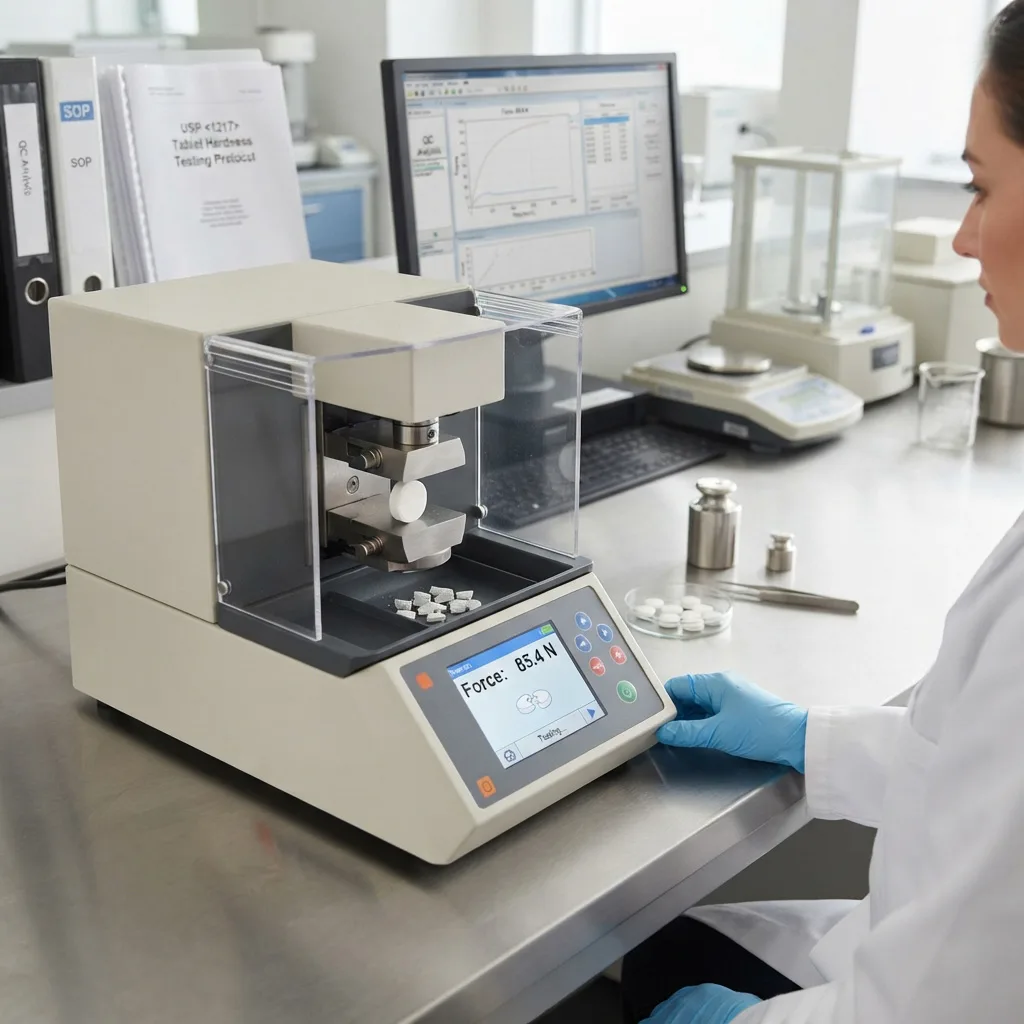
An automated tablet testing instrument designed for pharmaceutical quality assurance, measuring tablet breaking force and physical parameters.
4. Units of Measurement and Industry Conversions
While the International System of Units (SI) strictly uses the Newton (N) to measure force, the pharmaceutical industry is notoriously slow to abandon legacy measurements. Depending on the geographical region and the age of the drug monograph, QC laboratories still utilize several historical units.
Modern digital hardness testers allow technicians to swap between these units with a single button press, but understanding their origins is crucial for interpreting international batch records.
| Measurement Unit | Abbreviation | Scientific Definition & Pharmaceutical Context | Conversion Factor |
| Newton | N | The standard SI unit of force. (The force required to accelerate 1 kg of mass at 1 meter per second squared). The modern gold standard mandated by USP <1217> and Ph. Eur. | 1 N = 1 N |
| Kilopond | kp | A metric unit of force (also known as a kilogram-force, kgf). Represents the force exerted by one kilogram of mass in standard Earth gravity. Highly popular in European and older US labs. | 1 kp = 9.807 N |
| Strong-Cobb | Sc | A legacy unit derived from the original manual Strong-Cobb lever-operated hardness testers invented in the mid-20th century. Based on air pressure acting on a dial. | 1 Sc = ~6.86 N (varies slightly by machine calibration) |
| Pound-Force | lb / lbf | The imperial unit of force. Still occasionally seen in older North American nutritional supplement or veterinary compounding facilities. | 1 lb = 4.448 N |
Note: If a drug monograph specifies a minimum crushing strength of “10 kp”, the QC technician must ensure the tablet can withstand approximately 98 Newtons of force before failing.
5. Geometry Matters: Testing Scored, Oval, and Oblong Tablets
Testing a perfectly round, flat-faced aspirin tablet is straightforward: it does not matter how the tablet rolls into the crushing jaws, because the diameter is identical from every angle.
However, modern pharmaceuticals frequently utilize complex geometries—such as deep-convex ovals, elongated caplets (capsule-shaped tablets), and scored tablets (featuring a debossed break-line down the center so the patient can snap the pill in half).
The Orientation Rule (Long Axis vs. Short Axis)
If an elongated oval caplet is placed between the testing jaws lengthwise (end-to-end), it will yield a massively higher breaking force than if it is placed widthwise.
-
USP <1217> Guidance: The pharmacopeia dictates that shape-dependent tablets must be tested in a consistent, reproducible orientation.
-
The Industry Standard: Elongated oblongs and caplets are almost universally tested across their long axis (widthwise). This is because a tablet is naturally subjected to bending and snapping forces across its longest dimension when handled by a patient or pushed through a blister pack.
Handling Scored Tablets
Scored tablets present a unique physical challenge. The deep groove down the center acts as an intentional mechanical weak point (a stress concentrator).
-
If the score line is placed parallel to the moving jaw, the tablet will snap instantly along the score line at a very low force.
-
If the score line is placed perpendicular to the moving jaw, the tablet resists fracture much longer.
-
Standard Operating Procedure (SOP): The QC laboratory must establish a strict SOP documenting exactly how scored tablets are oriented in the jaws (usually perpendicular to the platen surface) and ensure every technician follows it perfectly to avoid artificial variance in the batch data. Modern automated hardness testers solve this by using vibrating alignment tracks that physically orient every caplet into the exact same axis before the jaws close.
6. The Shift Toward Multi-Parameter Automated Testing
In a traditional manual QC setup, evaluating a single tablet requires passing it through three different instruments:
-
The technician places the tablet on an analytical balance to record its Weight.
-
They pick it up and use a manual digital caliper to measure its Thickness and Diameter.
-
They place it in the hardness tester to measure its Breaking Force.
Doing this for 10 to 20 tablets per batch is incredibly tedious, prone to transcription errors, and violates the modern principles of Data Integrity (FDA 21 CFR Part 11), because handwritten numbers can be easily altered or miscopied.
To resolve this, modern pharmaceutical laboratories have almost entirely transitioned to Multi-Parameter Hardness Testers (4-in-1 or 5-in-1 Systems). These advanced workstations integrate a precision analytical load cell, a laser or mechanical thickness gauge, and a micro-balance into a single enclosure. The technician simply drops 20 tablets into a rotary feeder. The machine automatically aligns, weighs, measures, and crushes each tablet, generating a unified, tamper-proof, cryptographically signed PDF report that complies instantly with global regulatory audits.
Summary
Tablet hardness testing—strictly defined as Tablet Breaking Force under USP <1217>—is the mechanical gatekeeper of solid dosage manufacturing. By carefully measuring the diametral force required to fracture a pill in Newtons or Kiloponds, QC laboratories ensure that medications survive the brutal logistics of global shipping while remaining porous enough to dissolve in the human stomach.
Furthermore, this simple mechanical crush test serves as a powerful diagnostic tool, instantly alerting formulation scientists to dangerous manufacturing defects like capping, lamination, and binder failure before millions of defective tablets are produced.