What Does “3-Part” or “5-Part” Mean?
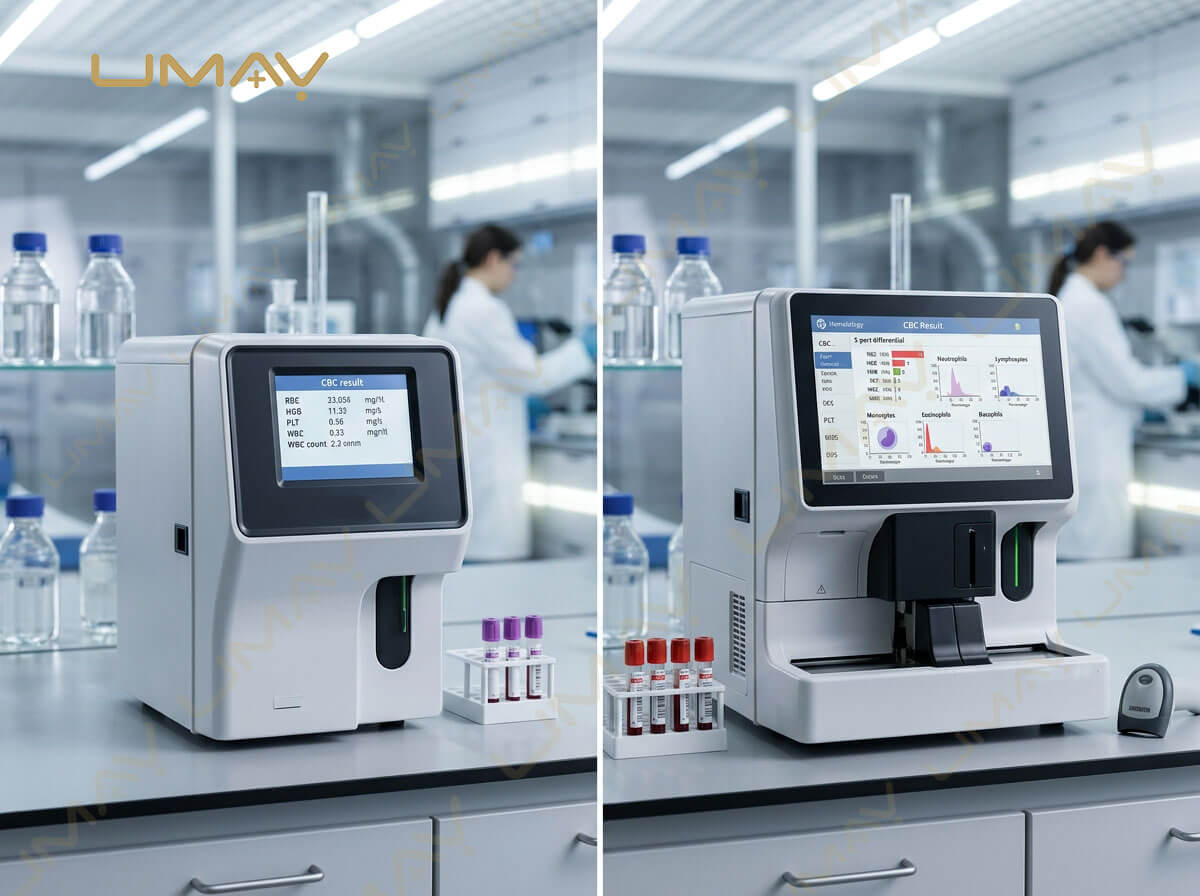
The words 3-part and 5-part mainly describe the analyzer’s white blood cell differential.
White blood cells are not one single cell population. A detailed differential can separate major leukocyte populations into different groups.
A typical 5-part differential reports:
- Neutrophils
- Lymphocytes
- Monocytes
- Eosinophils
- Basophils
A typical 3-part differential groups white blood cells into three major populations, commonly represented as:
- Lymphocytes
- Mid-sized or mixed cells
- Granulocytes
The exact terminology and internal classification can vary among analyzer manufacturers.
This is why the central question is not simply:
“Which machine has more parameters?”
A better question is:
“How much white blood cell differentiation does my laboratory need?”
What Is a 3-Part Hematology Analyzer?
A 3-part hematology analyzer is an automated blood cell analyzer that performs routine CBC testing and classifies white blood cells into three main groups.
In many systems, the three groups are based largely on cell size or volume.
The analyzer can typically provide routine hematology parameters such as:
- WBC
- RBC
- HGB
- HCT
- MCV
- MCH
- MCHC
- RDW
- PLT
- MPV
It may also provide WBC differential percentages and absolute counts, depending on the model.
Three-part systems are often designed around a relatively straightforward workflow and are commonly used in smaller or lower-volume laboratory environments. Beckman Coulter, for example, notes that low-volume laboratories and physician office laboratories have traditionally used 3-part differential analyzers for routine CBC screening.
How Does a 3-Part Hematology Analyzer Work?
Many 3-part analyzers rely primarily on electrical impedance for cell counting.
In a simplified explanation, blood cells suspended in a conductive liquid pass through a small opening. As each cell passes through the aperture, it causes a temporary change in electrical resistance.
The analyzer detects these changes and uses the resulting signals to estimate:
- Cell count
- Cell volume
- Cell distribution
For routine red blood cell, white blood cell, and platelet counting, impedance technology has long been used in automated hematology analyzers.
A 3-part analyzer can therefore provide valuable CBC information without requiring the same level of white-cell classification technology found in many 5-part systems.
What Is a 5-Part Hematology Analyzer?
A 5-part hematology analyzer provides a more detailed white blood cell differential by separating the major leukocyte populations into five groups.
The typical groups are:
- Neutrophils
- Lymphocytes
- Monocytes
- Eosinophils
- Basophils
Many 5-part systems use optical, laser-scatter, flow-cytometric, fluorescent, or combined technologies to distinguish white blood cell populations. The exact measurement method differs between manufacturers and models.
The result is a more detailed WBC profile than a basic 3-part differential.
This can be useful in laboratories that need more detailed hematology information or handle a broader range of samples.
How Does a 5-Part Hematology Analyzer Work?
A modern 5-part hematology analyzer may combine several analytical technologies.
For example, red blood cells and platelets may be measured through impedance, while a dedicated WBC channel may use optical or laser-based detection.
In optical analysis, cells interact with a light source and generate signals related to characteristics such as:
- Cell size
- Internal complexity
- Granularity
- Light scatter
The analyzer software then uses these signals to separate white blood cell populations.
This is one of the fundamental reasons that a 5-part system can distinguish neutrophils, lymphocytes, monocytes, eosinophils, and basophils separately.
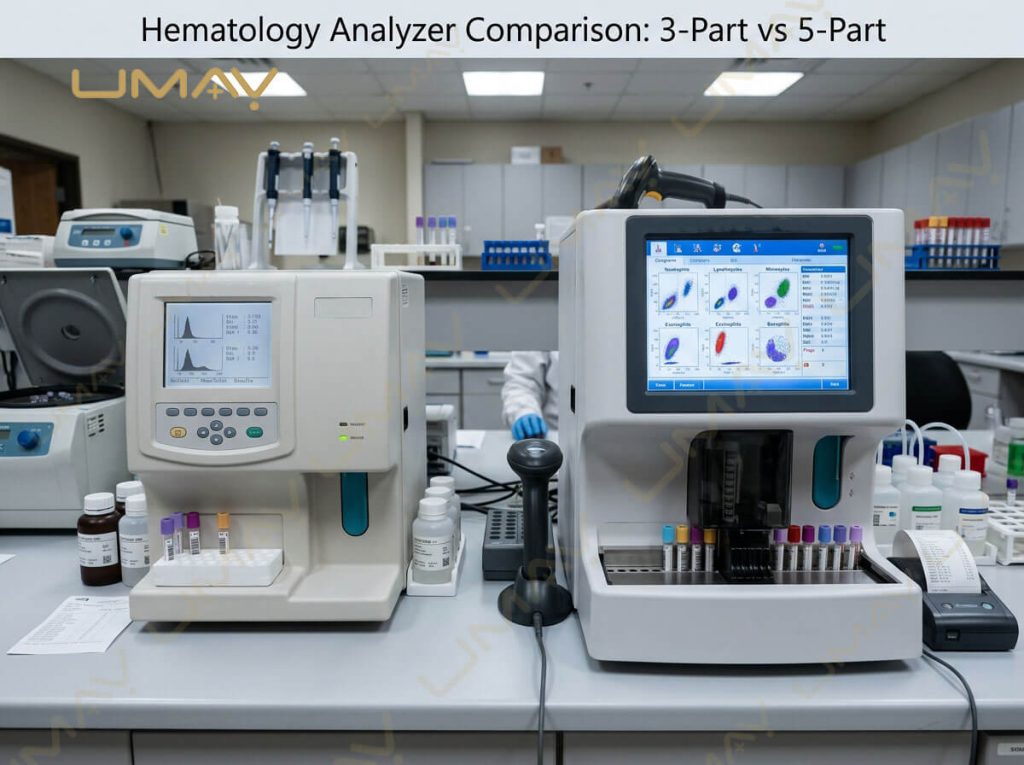
3-Part vs 5-Part: The Main Difference
The simplest way to understand the comparison is:
3-part = three WBC groups
5-part = five WBC groups
However, the practical differences go beyond the WBC differential.
| Feature | 3-Part Hematology Analyzer | 5-Part Hematology Analyzer |
|---|---|---|
| CBC testing | Yes | Yes |
| WBC count | Yes | Yes |
| RBC count | Yes | Yes |
| HGB | Yes | Yes |
| HCT | Yes | Yes |
| Platelet count | Yes | Yes |
| WBC differential | 3 groups | 5 groups |
| Neutrophils | Usually included in granulocyte group | Separate |
| Lymphocytes | Separate | Separate |
| Monocytes | Usually included in MID/mixed group | Separate |
| Eosinophils | Usually grouped | Separate |
| Basophils | Usually grouped | Separate |
| Typical system complexity | Lower | Higher |
| Common laboratory use | Routine, lower-volume testing | More detailed, broader laboratory applications |
| Typical purchasing priority | Simplicity and operating cost | Differential detail and workflow capability |
The exact parameters, throughput, flags, reagent requirements, and measurement channels depend on the individual analyzer model.
3-Part vs 5-Part WBC Differential
This is the most important technical difference.
3-Part WBC Differential
A 3-part analyzer generally separates WBCs into three regions:
Lymphocytes
The lymphocyte population forms one major group.
MID or Mixed Cells
The middle or mixed population may contain several types of cells, depending on the analyzer’s classification method.
Granulocytes
Granulocytes form another major group.
The analyzer does not provide the same separate five-way classification of neutrophils, lymphocytes, monocytes, eosinophils, and basophils that a 5-part system is designed to provide.
5-Part WBC Differential
A 5-part analyzer typically reports:
Neutrophils
Neutrophils are reported as a separate population.
Lymphocytes
Lymphocytes are separately identified.
Monocytes
Monocytes have their own differential category.
Eosinophils
Eosinophils can be separately measured.
Basophils
Basophils can also be separately measured.
This provides a more detailed picture of the WBC differential than a 3-part system.
For laboratories where separate eosinophil, basophil, or monocyte information is important, the 5-part configuration may therefore be preferable.
Does a 5-Part Analyzer Have More Parameters?
Often, yes.
A 5-part hematology analyzer may provide additional WBC differential parameters and other measurements, but the exact number of parameters depends entirely on the analyzer.
For example, one model may provide around 20 routine parameters, while another may provide more advanced parameters, additional channels, flags, or reticulocyte-related functions.
Therefore, buyers should not assume:
“5-part means exactly a certain number of parameters.”
Instead, review the manufacturer’s actual specification sheet.
Look for:
- Number of reportable parameters
- Differential parameters
- Absolute counts
- Percentage counts
- Histograms
- Scattergrams
- Flags
- Reticulocyte options
- Specialized channels
3-Part vs 5-Part: Technology Comparison
Electrical Impedance
Electrical impedance is commonly used for counting and sizing cells.
It is a well-established technology and is often found in 3-part systems.
Advantages can include:
- Straightforward measurement principle
- Established technology
- Practical routine operation
- Suitable for basic CBC applications
Laser and Optical Analysis
Many 5-part hematology analyzers use optical or laser-based technology for WBC differentiation.
Optical measurement can provide additional information about cell characteristics and help separate different WBC populations.
However, the exact technology varies from one instrument to another.
A 5-part analyzer should therefore not be judged solely by the label “laser.”
Buyers should ask:
- What detection technology is used?
- Which channels are included?
- How are WBC populations separated?
- Which parameters are reported?
- What flags are available?
- What are the sample and reagent requirements?
Which Analyzer Is More Accurate?
This question is often asked incorrectly.
It is tempting to say:
“5-part is always more accurate.”
That is too broad.
A better way to think about it is that 3-part and 5-part analyzers are designed for different levels of WBC differentiation.
A properly maintained and quality-controlled analyzer should operate according to its specifications and intended use.
A 5-part analyzer can provide greater WBC differentiation detail, but greater detail does not automatically mean that every laboratory needs it.
Instrument performance should be evaluated based on the manufacturer’s specifications, laboratory verification procedures, quality-control program, and intended application.
In practical terms, the question should be:
Do you need more detailed WBC differentiation?
If yes, a 5-part analyzer may be the more appropriate configuration.
3-Part vs 5-Part for Small Laboratories
For a small clinic or low-volume laboratory, the most important factors may include:
- Affordable acquisition
- Compact size
- Easy operation
- Low sample volume
- Simple reagent management
- Routine CBC testing
- Straightforward maintenance
- Local service availability
A 3-part hematology analyzer can be attractive in these environments because its workflow and test requirements may be simpler.
However, the laboratory should first determine the exact testing requirements before purchasing equipment.
3-Part vs 5-Part for Hospitals
Hospitals often have more varied laboratory requirements.
A hospital laboratory may need:
- Higher throughput
- More detailed WBC differential
- More sophisticated sample flagging
- Advanced data management
- LIS integration
- Broader parameter menus
- More comprehensive quality-control functions
For these environments, a 5-part hematology analyzer may be more suitable.
However, hospital laboratories vary greatly in size and workflow.
A small hospital outpatient laboratory does not necessarily require the same system as a major reference laboratory.
3-Part vs 5-Part for Diagnostic Centers
Diagnostic laboratories and medical testing centers may process a high number of CBC samples every day.
In this environment, buyers should pay special attention to:
- Samples per hour
- Walk-away time
- Loading capacity
- Sample handling
- Reagent consumption
- Flagging capability
- Repeat testing
- LIS connectivity
- Service response
- Uptime
A 5-part system may be attractive when detailed differential analysis and workflow efficiency are important.
But purchasing decisions should be based on workload and testing requirements rather than product category alone.
What About Throughput?
Throughput means the number of samples an analyzer can process during a specific period, often expressed as samples per hour.
For a low-volume clinic, high throughput may have little practical value.
For a busy diagnostic laboratory, throughput can be a major purchasing factor.
Consider three simple situations:
Small Clinic
If only a limited number of CBC tests are performed each day, a compact analyzer may be sufficient.
Medium Laboratory
A laboratory with a steady daily workload may benefit from faster sample processing and more automation.
High-Volume Laboratory
A large laboratory may need high-throughput hematology equipment, automated loading, larger reagent capacity, and integrated workflow solutions.
When comparing two analyzer models, look at the actual daily workload rather than choosing solely according to the highest advertised sample-per-hour number.
Sample Volume: 3-Part vs 5-Part
Sample volume is another important specification.
The amount of blood needed for a CBC depends on the analyzer design.
A lower required sample volume can be valuable in:
- Pediatric laboratories
- Small-volume samples
- Outpatient testing
- Resource-limited environments
- Situations where sample quantity is limited
However, the smallest sample volume is not necessarily the most important feature.
A buyer should consider sample volume together with:
- Aspiration method
- Sample mode
- Repeat testing
- Dead volume
- Open-tube operation
- Closed-tube operation
Always check the manufacturer’s specifications for the actual analyzer model.
Open-Tube vs Closed-Tube Sampling
When comparing a 3-part and 5-part analyzer, sampling configuration is also worth considering.
Open-Tube Sampling
The operator opens the sample tube and aspirates the sample.
Potential advantages include:
- Simple design
- Flexible sampling
- Useful for smaller laboratories
Closed-Tube Sampling
The analyzer can aspirate the sample through a closed tube or automated sampling mechanism.
Potential benefits may include:
- Reduced manual sample handling
- Improved workflow
- More automation
- Better suitability for higher-volume laboratories
Again, the available features depend on the model.
Reagent Requirements
Reagents are an important part of hematology analyzer operating costs.
A typical system may use:
- Diluent
- Lyse reagent
- Cleaner
- Rinse solution
- Probe cleaning solution
- Specialized reagents
A 5-part analyzer can have a more complex reagent or measurement system depending on its technology.
This does not mean that every 5-part analyzer automatically has higher reagent costs.
The correct approach is to ask suppliers for:
- Reagent consumption per test
- Reagent pack size
- Tests per reagent pack
- Reagent shelf life
- Storage conditions
- Monthly reagent cost
- Availability in the destination market
For purchasing managers, cost per test can be more useful than equipment price alone.
Hematology Analyzer Price: 3-Part vs 5-Part
A frequent Google search is:
“How much does a hematology analyzer cost?”
There is no single universal price.
The price of a hematology analyzer depends on:
- Analyzer type
- Throughput
- Parameter menu
- Automation
- WBC differential technology
- Sampling system
- Reagent configuration
- Software
- Accessories
- Installation
- Warranty
- Technical support
- Market and region
In general, the more sophisticated system may require a higher initial investment, but buyers should compare the total cost of ownership, not just the purchase quotation.
A lower-cost analyzer may be the practical choice for a small laboratory, while a higher-capability analyzer may make more sense for a larger diagnostic center.
Total Cost of Ownership
When comparing a 3-part and 5-part hematology analyzer, calculate more than the machine price.
A simple purchasing model is:
Total Cost of Ownership = Equipment + Reagents + Consumables + Maintenance + Service + Training + Installation
This approach helps buyers avoid focusing only on the initial purchase.
For example, a machine with a lower purchase price may have higher reagent consumption or more expensive consumables.
Another machine may have a higher purchase price but offer a workflow that is better suited to a high-volume laboratory.
Therefore, procurement teams should compare:
Purchase cost + operating cost + service cost + expected workload.
Maintenance Differences
Both 3-part and 5-part analyzers require regular maintenance.
Typical maintenance activities can include:
- Daily cleaning
- Probe cleaning
- Reagent checking
- Background checks
- Quality control
- Scheduled maintenance
- Consumable replacement
- Error review
5-part analyzers may involve more complex analytical channels and therefore may require additional operator training and technical support depending on the system.
However, maintenance requirements are model-specific.
The supplier should provide:
- Operator manual
- Maintenance schedule
- Cleaning instructions
- Troubleshooting guide
- Service procedures
- Recommended consumables
Histogram vs Scattergram
Another common difference between entry-level and advanced hematology analyzers is the way cell populations are displayed.
Histogram
A histogram visually represents the distribution of cells according to a measurement such as cell volume.
Histograms may be provided for:
- RBC
- WBC
- Platelets
The exact available graphs depend on the analyzer.
Scattergram
A scattergram plots cell populations according to optical or other measurement characteristics.
5-part analyzers may provide scattergrams to help visualize separated WBC populations.
For laboratories using advanced differential analysis, scattergram information can be useful as part of the instrument’s flagging and result-review workflow.
3-Part vs 5-Part: Which One Is Better for a Clinic?
For many smaller clinics, the first considerations are:
- Routine CBC requirements
- Number of daily tests
- Staff experience
- Available space
- Budget
- Reagent availability
- Local technical support
A 3-part analyzer can be a practical solution where detailed five-way WBC differentiation is not required.
But this is not a universal rule.
A clinic that performs a broader range of hematology work may benefit from a 5-part system.
The correct decision should come from the clinic’s actual workflow.
Which One Is Better for a Hospital Laboratory?
A hospital laboratory may benefit from a 5-part analyzer when it requires:
- Detailed WBC differentiation
- Higher sample volumes
- More advanced flagging
- Broader testing capabilities
- More sophisticated data management
- Integration with laboratory information systems
Still, not every hospital needs the same analyzer.
Ask the laboratory manager:
- How many CBC tests are performed each day?
- What WBC differential is required?
- How many parameters are needed?
- How much automation is expected?
- Is LIS connectivity required?
- What reagent supply is available locally?
- What service support is available?
These questions will usually provide a better answer than simply asking whether a 5-part analyzer is “better.”
Which One Is Better for a High-Volume Laboratory?
For high-volume laboratories, throughput and automation become increasingly important.
Look at:
- Maximum throughput
- Continuous loading
- Automatic sample handling
- STAT sample functions
- Reagent capacity
- Waste management
- Automatic cleaning
- LIS connection
- Data storage
- Error handling
- Operator workload
A 5-part analyzer may be attractive for a high-volume laboratory if its differential capability and workflow features match the laboratory’s requirements.
Some high-end systems also provide automated loading and additional workflow functions.
A Practical Selection Guide
The following simplified guide can help narrow down the choice.
| Laboratory Situation | Possible Choice |
| Small clinic | 3-part or compact system |
| Low-volume laboratory | 3-part may be suitable |
| Basic routine CBC testing | 3-part may be sufficient |
| Medium diagnostic laboratory | 3-part or 5-part depending on workload |
| Hospital laboratory | Often 5-part when detailed differential is needed |
| High-volume diagnostic center | 5-part with appropriate throughput |
| Detailed WBC differential required | 5-part |
| Advanced laboratory workflow | 5-part often deserves consideration |
| Limited budget | Compare 3-part total cost |
| Future laboratory expansion | Consider 5-part scalability |
This table is a starting point rather than a universal purchasing rule.
3-Part vs 5-Part: Pros and Cons
3-Part Hematology Analyzer
Advantages
- Straightforward operation
- Often compact
- Suitable for routine CBC work
- Can be practical for lower-volume laboratories
- Potentially lower equipment and operating complexity
- Easier for basic laboratory workflows
Limitations
- Less detailed WBC differentiation
- Limited separation of some WBC populations
- May be less suitable for laboratories requiring five-way differential information
- May offer fewer advanced workflow features, depending on model
5-Part Hematology Analyzer
Advantages
- More detailed WBC differential
- Separate major WBC populations
- More comprehensive laboratory information
- Suitable for a wider range of laboratory workflows
- May offer more advanced flagging and analytical functions
- Often suitable for hospitals and diagnostic centers
Limitations
- Potentially higher acquisition cost
- Potentially more complex reagent and maintenance requirements
- May require additional operator training
- Advanced features may not be useful for a low-volume laboratory
Common Mistakes When Choosing a Hematology Analyzer
Choosing by Price Alone
The cheapest analyzer may not provide the parameters or workflow needed by the laboratory.
Choosing 5-Part Only Because It Is “More Advanced”
More features do not automatically mean better value.
A small clinic may not need every advanced function.
Ignoring Reagent Costs
Reagents can become a major operating expense over time.
Ignoring Service Support
A laboratory cannot afford extended downtime because the machine cannot be serviced or spare parts are unavailable.
Looking Only at Maximum Throughput
Actual workload is more important than an impressive specification.
Ignoring LIS Connectivity
For a hospital or larger laboratory, connectivity may become increasingly important as the workflow grows.
How to Choose Between 3-Part and 5-Part Hematology Analyzer
A simple decision process is:
Choose a 3-Part Analyzer When:
Your laboratory mainly needs routine CBC testing, has relatively moderate or low sample volume, prefers a simpler workflow, and does not require a detailed five-way WBC differential.
Consider a 5-Part Analyzer When:
Your laboratory needs separate neutrophil, lymphocyte, monocyte, eosinophil, and basophil results, handles a broader laboratory workload, or requires more advanced differential analysis and workflow functions.
The final decision should always be based on the laboratory’s intended use, required performance, applicable regulations, and the actual specifications of the models being compared.
Frequently Asked Questions
What is the main difference between 3-part and 5-part hematology analyzers?
The main difference is WBC differential analysis. A 3-part analyzer groups white blood cells into three populations, while a 5-part analyzer separates them into five major populations.
Is a 3-part hematology analyzer enough for CBC?
For many routine CBC applications, a 3-part analyzer can provide the required basic CBC measurements. Whether it is sufficient depends on the laboratory’s intended use and testing requirements.
Is a 5-part hematology analyzer better than a 3-part analyzer?
Not automatically. A 5-part analyzer provides more detailed WBC differentiation, but a 3-part system can be a practical choice for laboratories that do not require that additional level of differential analysis.
What are the five parts of a hematology analyzer?
The five-part WBC differential commonly includes neutrophils, lymphocytes, monocytes, eosinophils, and basophils.
What are the three parts of a 3-part CBC analyzer?
The three groups are commonly lymphocytes, mid-sized or mixed cells, and granulocytes, depending on the analyzer’s classification method.
Which analyzer is cheaper?
Pricing varies by manufacturer and configuration. A 3-part analyzer may have a lower acquisition and operating complexity, but buyers should compare the complete total cost of ownership.
Which analyzer uses flow cytometry?
Many 5-part hematology analyzers use flow-based optical or laser technologies for WBC differentiation, although the exact measurement technology varies among manufacturers and models.
Which analyzer is better for a small clinic?
A 3-part analyzer can be a practical choice for many small clinics performing routine CBC testing, but the required differential and workload should determine the decision.
Which analyzer is better for a hospital?
A 5-part analyzer may be appropriate when a hospital laboratory requires detailed WBC differentiation, broader capabilities, or higher workflow capacity.
Does a 5-part analyzer require more reagents?
It may, depending on the instrument’s detection technology and configuration. Always compare the actual reagent list and consumption data for each model.
Can a 3-part analyzer provide WBC differential results?
Yes. A 3-part analyzer provides a three-group WBC differential. The important distinction is that it does not normally separate all five major WBC populations individually.
Can a 5-part analyzer perform a CBC test?
Yes. A 5-part hematology analyzer can perform routine CBC testing while also providing a more detailed WBC differential.