Why Buying an MRI Scanner Requires a Clear Strategy
Investing in a Magnetic Resonance Imaging (MRI) machine is one of the most significant equipment decisions a hospital, diagnostic imaging center, or private clinic will ever make. MRI scanners are high-value capital assets that expand clinical diagnostics, attract specialist doctor referrals, and generate long-term facility revenue.
However, buying an MRI scanner involves much more than selecting a machine from a product catalog. Equipment prices vary widely depending on magnet power, bore size, channel configurations, and software packages. Beyond the base equipment price, facilities must plan for room buildouts, radio-frequency (RF) shielding, cooling systems, power upgrades, and ongoing annual maintenance.
This comprehensive buying guide breaks down the selection process into simple, practical steps. Whether you are an executive CFO, a clinical procurement manager, or a practice owner, this guide will help you understand technical specifications, evaluate facility requirements, and choose the right MRI scanner for your patient volume and budget.
1. Understanding Magnetic Field Strength (Tesla Rating)
The core component of any MRI system is its magnet. MRI field strength is measured in Tesla (T). A higher Tesla rating creates a stronger magnetic field, which yields higher image resolution and faster scan speeds. However, higher Tesla systems also cost more to purchase, install, and service.
Low-Field MRI (0.2T to 0.5T)
Low-field systems generally utilize permanent magnets rather than liquid helium-cooled superconductive coils.
-
Primary Uses: Basic orthopedic imaging, joint scans, and general screening.
-
Advantages: Lower purchase price, minimal electricity consumption, zero liquid helium costs, and an open design that helps anxious or claustrophobic patients.
-
Limitations: Slower scan acquisition speeds and lower spatial image detail compared to high-field magnets.
Mid-Field & High-Field 1.5T MRI (The Industry Standard)
The 1.5T scanner is the global clinical workhorse for hospitals and outpatient centers. It provides an ideal balance between image quality, scan speed, and overall capital cost.
-
Primary Uses: Whole-body imaging, brain and spine scans, abdominal studies, oncology, and musculoskeletal exams.
-
Advantages: Supported by broad clinical protocols, fast scan times, excellent image clarity, and high resale liquidity on the secondary market.
-
Cost Range: Pre-owned and refurbished 1.5T units typically range from $150,000 to $450,000, while new systems range from $1 million to $1.8 million. However, our company only requires 500,000 US dollars.
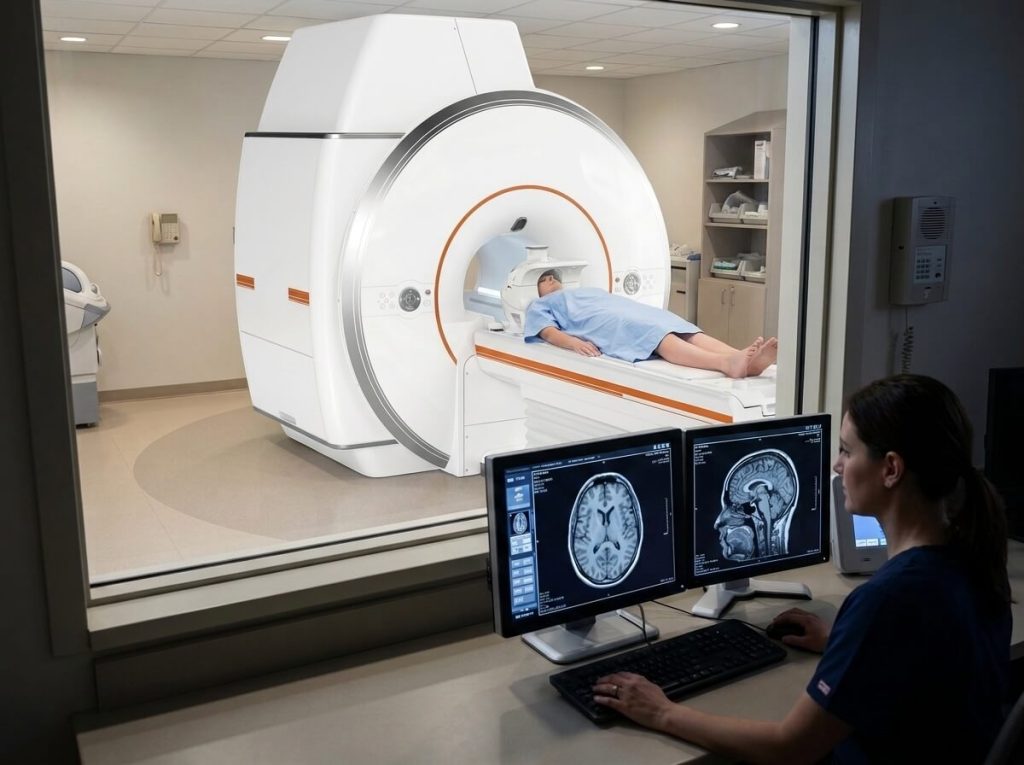
Radiology control room view showing a medical technician analyzing brain MRI scans on dual displays while monitoring a patient in the MRI scanning room.
High-Field 3.0T MRI (Advanced Clinical Precision)
3.0T systems produce double the magnetic signal strength of a 1.5T scanner, delivering exceptional spatial resolution and micro-structural detail.
-
Primary Uses: Advanced neuroradiology, functional brain mapping (fMRI), complex cardiac studies, small-joint musculoskeletal imaging, and specialized prostate oncology.
-
Advantages: Superior image detail, clear depiction of fine tissues, and reduced scan times for high-volume centers.
-
Cost Range: New 3.0T MRI systems cost between $2 million and $3 million or more, with refurbished units starting around $400,000 to $900,000.
2. Key Technical Components Decoded
Understanding the core technical hardware helps procurement teams compare vendor quotes accurately.
| Component | Function in the Scanner | Buying Recommendation |
| Radio-Frequency (RF) Coils |
Antennas placed on or around the patient body to transmit and receive signals.
|
Standard coil sets cover head, neck, spine, body, and knee. Ensure required coils are included in the vendor quote.
|
| Channel Count (4-Ch to 32-Ch+) |
Refers to the receiver channels processing signal data simultaneously.
|
Higher channel counts (16 to 32 channels) reduce scan acquisition times and produce cleaner images.
|
| Gradient System (Amplitude & Slew Rate) |
Magnetic gradients that spatially encode signals and dictate scan speed.
|
Stronger gradients improve image clarity and shorten scan times, which is critical for cardiac and neuro exams.
|
| Workstation & Reconstruction Engine |
The computer systems that process raw scanner data into diagnostic images.
|
Look for platforms supporting modern AI-assisted image reconstruction algorithms to speed up patient turnover.
|
3. MRI Machine Comparison: Low Field vs 1.5T vs 3T
| Feature | Low Field MRI | 1.5T MRI | 3T MRI |
|---|---|---|---|
| Cost | Lower | Medium | High |
| Image Quality | Basic | Excellent | Advanced |
| Installation | Easier | Moderate | Complex |
| Clinical Use | Basic | Wide | Advanced |
| Maintenance | Lower | Medium | Higher |
For most hospitals, 1.5T MRI remains the most practical choice.
4. Helium-Free and Zero Boil-Off Magnet Technologies
Superconductive magnets require ultra-cold liquid helium (-269°C) to maintain their magnetic field. How an MRI scanner manages liquid helium significantly impacts long-term operational costs.
-
Standard / Legacy Superconductive Magnets: Require periodic liquid helium refills as cryogens gradually boil off over time. Refills cost between $5,000 and $20,000 per service event, plus emergency risk in the event of a magnet quench.
-
Zero Boil-Off Magnets: Modern zero boil-off systems use coldhead re-condensers to continuously liquefy helium gas back into liquid form, preventing cryogen loss under normal operating conditions. This dramatically lowers long-term maintenance costs.
-
Sealed / Helium-Free Magnets: Next-generation magnets (such as Philips BlueSeal or GE Freelium platforms) use a fully sealed cooling system containing just 7 liters of liquid helium, compared to 1,500+ liters in conventional magnets. They eliminate helium refills, remove the requirement for external quench venting pipes, and allow easier installation on upper building floors.
5. Step-by-Step Buying Checklist for Procurement Officers
Follow this straightforward 6-step checklist to guide your MRI procurement project:
-
Step 1: Audit Clinical Needs: Survey referring doctors to determine expected scan types (general neurology, orthopedics, or cardiac).
-
Step 2: Choose Field Strength & Bore Size: Select a 1.5T wide-bore scanner for general versatility, or a 3.0T unit if specialized high-resolution imaging is required.
-
Step 3: Verify Site Logistics: Measure room dimensions, check floor weight support limits, and consult a biomedical structural engineer.
-
Step 4: Request Itemized Quotes: Ask suppliers to itemize equipment, RF room shielding, delivery, installation, and first-year service costs separately.
-
Step 5: Confirm Coil Packages: Verify that essential RF receiver coils (head, spine, knee, body) are included in the base package.
- Step 6: Evaluate Service Contracts: Review 5-to-10-year service maintenance agreements (AMC/CMC) and confirm local technician response times.
FAQ: MRI Machine Buying Questions
Q1: What is the best MRI machine for a hospital?
For most hospitals, a 1.5T MRI scanner is considered the best balance between image quality, clinical capability, and investment cost.
Q2: How long does an MRI machine last?
A well-maintained MRI system can typically operate for 10-15 years or longer.
Q3: Is MRI better than CT?
MRI provides better soft tissue imaging and does not use radiation, while CT is usually faster and better for emergency situations.
Q4: Can small clinics buy MRI machines?
Yes. Low-field MRI systems are suitable for smaller clinics and diagnostic centers with limited budgets.
Q5: How do I choose an MRI supplier?
Choose suppliers with:
- Manufacturing experience
- International certifications
- Installation support
- Reliable after-sales service
Conclusion
Buying an MRI machine is a long-term investment that requires careful evaluation.
Hospitals should consider:
- Clinical needs
- Patient volume
- Budget
- Installation conditions
- Supplier experience
- After-sales support
A properly selected MRI scanner can improve diagnostic capability, increase hospital competitiveness, and provide long-term value.
When searching for an MRI machine supplier, buyers should not only compare prices but also evaluate technology, reliability, service capability, and global experience.