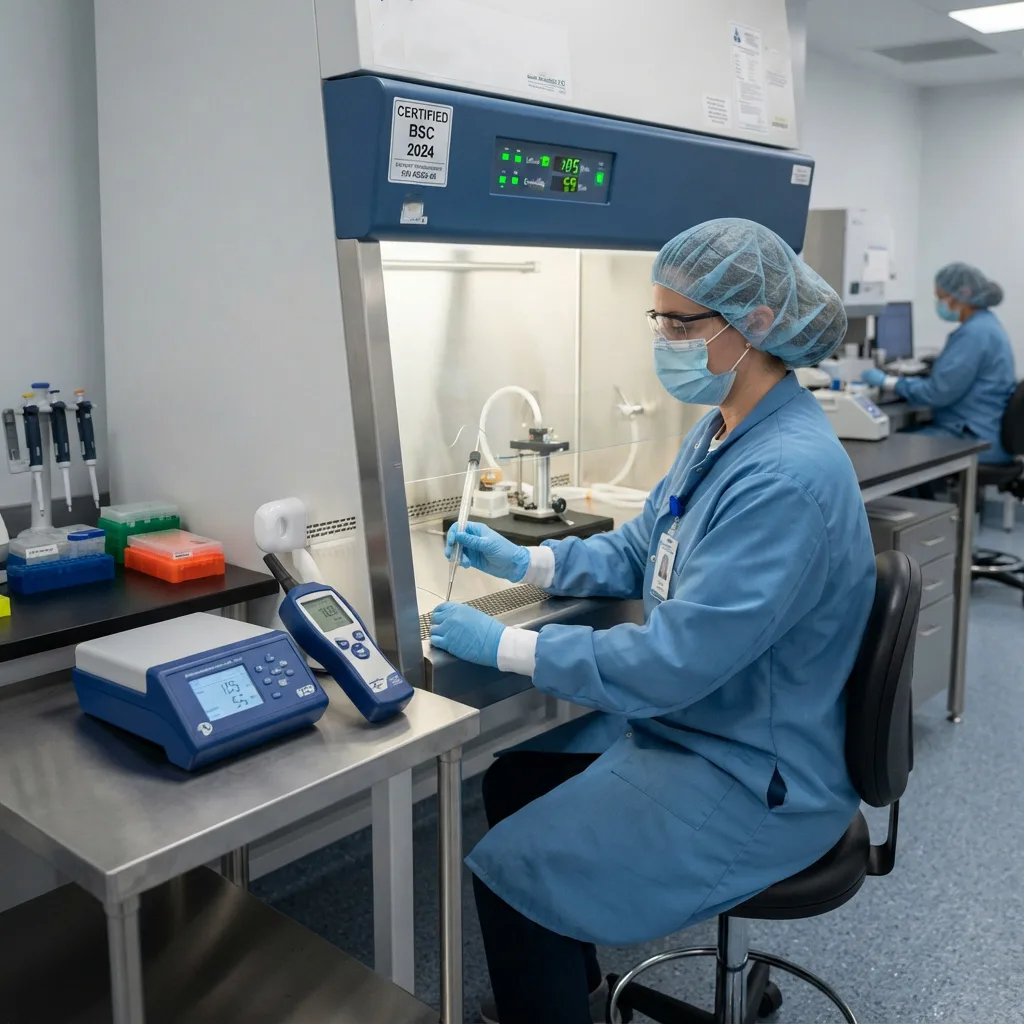
You Need a Clean Work Zone—But Do You Need a Cleanroom?
Not every laboratory or manufacturing process requires an entire cleanroom. Sometimes, the main requirement is a controlled work area that helps protect products, components or samples from airborne particles.
This is where a laminar flow clean bench can be useful.
Also known as a clean bench, laminar flow hood, laminar airflow cabinet or clean air workstation, this equipment directs filtered air across a designated work surface to reduce the risk of particle contamination.
Clean benches are used in selected laboratory procedures, electronics assembly, optical component handling, medical device manufacturing and other applications where protecting the work from airborne contamination is important.
However, choosing the right clean bench involves more than selecting a cabinet with a HEPA filter. Buyers also need to understand airflow direction, work area dimensions, filtration, installation conditions, cleaning requirements and the type of material being handled.
One distinction must be clear from the beginning: a clean bench is designed primarily to protect the work, not the operator or the surrounding environment from hazardous materials. It is not a substitute for a biosafety cabinet when biological containment is required.
What Is a Laminar Flow Clean Bench?
A laminar flow clean bench is a workstation that supplies filtered air across a working area to reduce airborne particle contamination.
The system typically includes:
-
A fan or blower
-
A HEPA filter, or another specified filtration arrangement
-
A work surface
-
An enclosure or protective panels
-
An airflow pathway
-
An electrical control system
-
Optional lighting and monitoring features
The fan draws air into the filtration system. Filtered air then moves through the work zone in a defined direction, carrying airborne particles away from the work area.
Depending on the design, the airflow can move horizontally from the rear of the bench toward the front or vertically from above the work surface downward.
These are the two main configurations available in the market.
Clean benches are sometimes described as providing a local clean zone. This means that the equipment creates a controlled area around the work, rather than controlling the cleanliness of an entire room.
For a laboratory with a limited budget or a manufacturing process that only requires localized particle control, this arrangement may be a practical alternative to expanding the cleanroom.
Common product names include:
-
Laminar flow clean bench
-
Laminar flow hood
-
Laminar airflow cabinet
-
Clean air bench
-
Clean air workstation
-
Laboratory clean bench
-
Horizontal laminar flow cabinet
-
Vertical laminar flow cabinet
-
HEPA-filtered clean bench
-
Clean zone workstation
When evaluating suppliers, buyers should confirm the actual airflow direction, filtration system and intended application instead of relying only on the product name.
How Does a Clean Bench Work?
A clean bench uses filtration and controlled airflow to reduce the presence of airborne particles around a product or workpiece.
The basic process involves three stages.
Air intake: The fan draws air from the surrounding environment or through the unit’s specified air intake arrangement.
Air filtration: The air passes through the filtration system, commonly including a HEPA filter, to remove airborne particles.
Filtered airflow: The filtered air moves through the work area in a horizontal or vertical direction, helping maintain a cleaner environment around the work.
The equipment must be correctly designed and maintained for this process to work as intended.
A HEPA filter alone does not establish the overall cleanliness of a work zone. Filter installation, leakage, airflow uniformity, the condition of the enclosure, the room environment and the way operators work can all influence performance.
A clean bench also does not automatically guarantee a sterile product. It is one part of a contamination-control process that may include clean handling procedures, suitable materials, environmental monitoring and cleaning.
What Is the Difference Between Horizontal and Vertical Laminar Flow?
Airflow direction is one of the most important decisions when choosing a clean bench.
A horizontal laminar flow clean bench and a vertical laminar flow clean bench both use filtered air, but they deliver it differently.
Horizontal Laminar Flow Clean Bench
A horizontal laminar flow clean bench usually places the main filter at the rear of the cabinet.
Filtered air moves horizontally across the work surface toward the front opening and the operator.
This creates a clean airflow pathway between the filter and the working area.
Main characteristics
-
Horizontal airflow from back to front
-
Rear-mounted filter arrangement in many designs
-
Open working access at the front
-
Suitable for selected clean assembly and product-handling tasks
-
Requires attention to the position of the product and operator’s hands
Where is horizontal airflow useful?
Horizontal laminar flow benches may be considered for:
-
Small electronic component assembly
-
Optical component inspection
-
Clean parts handling
-
Selected nonhazardous laboratory preparation
-
Dust-sensitive product assembly
-
Inspection of precision components
-
Other processes requiring a clean horizontal working zone
The final choice depends on product dimensions, work technique and contamination-control requirements.
What should buyers watch out for?
Because the airflow moves toward the user, contaminants introduced upstream can travel across the work area. The operator’s hands and movements must therefore be considered when arranging the workspace.
Horizontal airflow is also not automatically ideal for large objects. A large workpiece may obstruct the air stream and create turbulent areas behind it.
Manufacturers of clean benches identify these workpiece and airflow considerations as important differences between horizontal and vertical designs.
Vertical Laminar Flow Clean Bench
A vertical laminar flow clean bench directs filtered air downward from the upper section of the unit toward the work surface.
The filter is commonly installed above the working area.
Depending on the design, air may leave through the front opening, the base, or other intended exhaust pathways.
Main characteristics
-
Vertical airflow from top to bottom
-
Upper-mounted filtration system in many designs
-
Suitable for certain taller workpieces and equipment
-
Can provide a different approach to airflow around the product
-
Available in tabletop and freestanding configurations
Where is vertical airflow useful?
Vertical laminar flow clean benches may be considered for:
-
Precision component handling
-
Clean assembly work
-
Optical and electronic products
-
Nonhazardous laboratory preparation
-
Product inspection
-
Selected medical device assembly processes
-
Applications where the workpiece’s dimensions favor downward airflow
Vertical airflow may be preferable when a large item would significantly obstruct a horizontal air stream. However, the actual cabinet dimensions and airflow performance still need to be checked.
Some vertical clean bench models also offer different base or exhaust arrangements. Buyers should confirm whether the selected design recirculates air, exhausts air or uses another specified airflow configuration.
Horizontal vs Vertical Clean Bench: Which Is Better?
Neither configuration is universally better.
The correct choice depends on the workpiece, operator position, airflow pattern and contamination risk.
| Comparison | Horizontal Flow | Vertical Flow |
|---|---|---|
| Airflow direction | Rear to front | Top to bottom |
| Typical filter position | Rear wall | Upper section |
| Workpiece considerations | Large objects can obstruct the airflow path | Tall objects can obstruct downflow |
| Work access | Front access | Front access, depending on design |
| Common applications | Selected clean assembly and product handling | Selected clean assembly, inspection and laboratory work |
| Main selection factor | Workpiece orientation and horizontal airflow path | Workpiece height and vertical airflow path |
A practical way to decide is to describe the actual task to the manufacturer.
What is the size of the product?
Where will the operator’s hands be?
Will the workpiece block the airflow?
Does the process generate particles?
Are there any chemical or biological hazards?
These questions are more useful than choosing horizontal or vertical airflow based on appearance alone.
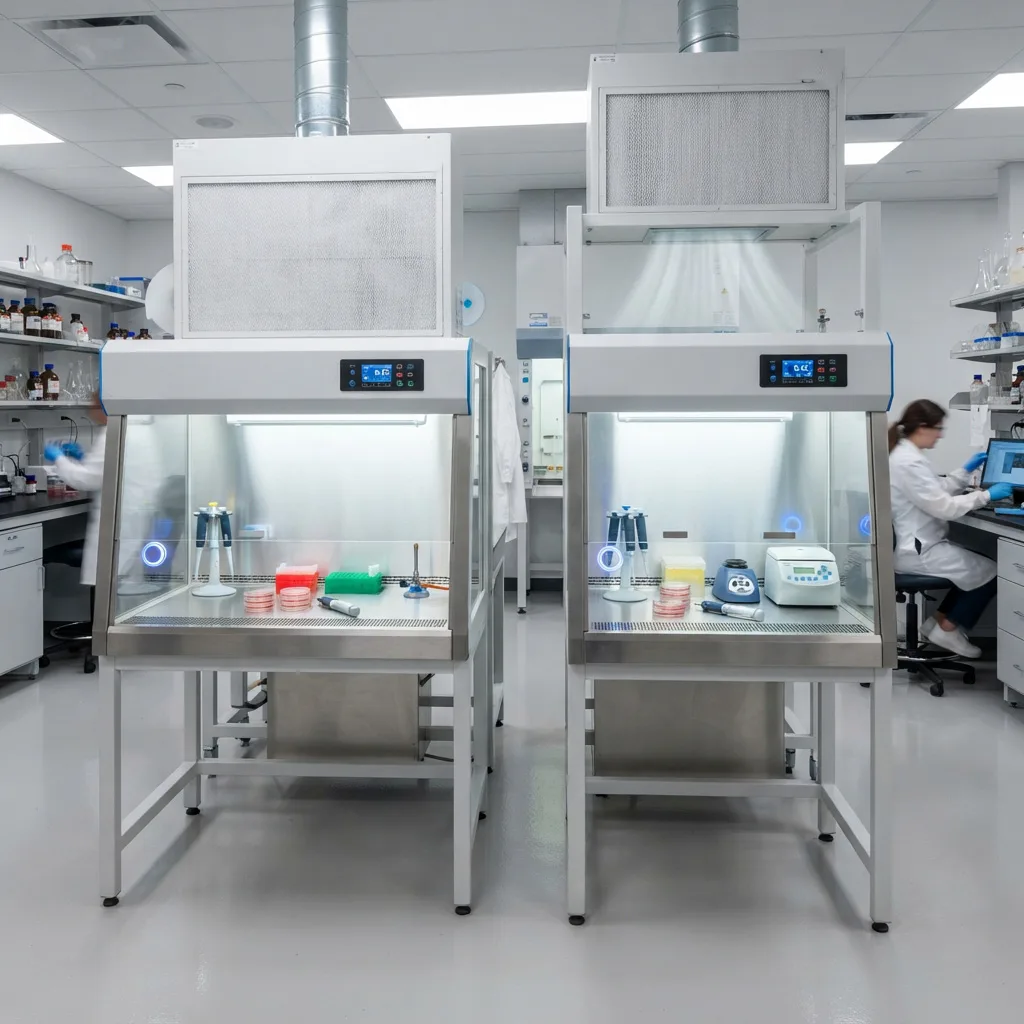
What Is a HEPA Filter in a Clean Bench?
HEPA filtration is an important feature of many laboratory clean benches.
A HEPA filter is designed to remove airborne particles from the air passing through it.
However, buyers should avoid assuming that every clean bench provides the same filtration performance simply because its product listing mentions a HEPA filter.
When comparing a HEPA clean bench, ask about:
-
Filter classification
-
Filter dimensions
-
Airflow capacity
-
Filter installation
-
Filter leakage testing
-
Replacement requirements
-
Availability of replacement filters
-
Maintenance access
-
Performance testing of the complete unit
The filter and the clean bench should be considered as one working system.
A high-specification filter cannot compensate for poor sealing, unsuitable airflow, incorrect installation or contamination introduced through poor working practices.
HEPA vs ULPA Filtration
Some suppliers also offer clean benches or clean-air equipment with ULPA filtration.
Both HEPA and ULPA refer to high-efficiency filtration categories, but their exact performance specifications differ.
The required filtration level depends on the application and project specification. A more demanding filter is not automatically necessary for every clean bench.
Before choosing ULPA filtration, buyers should consider whether the process genuinely requires it, whether the cabinet is designed for that filter type and whether the airflow system is suitable.
What Can a Laminar Flow Clean Bench Be Used For?
The main purpose of a clean bench is to help reduce product contamination from airborne particles.
This makes the equipment relevant to several industries.
Electronics and Semiconductor Components
Electronic components and precision assemblies can be affected by dust and other airborne particles.
A suitable clean bench may provide a localized clean working area for selected assembly, inspection and handling tasks.
Relevant searches include:
-
clean bench for electronics
-
electronic component clean bench
-
laminar flow workstation for electronics
-
clean air bench for precision assembly
-
HEPA clean bench for electronic components
Optical Components and Precision Instruments
Optical parts, lenses and other precision components can require careful handling to reduce dust contamination.
A suitable clean bench may help establish a cleaner workspace during selected assembly, inspection or preparation processes.
Relevant terms include:
-
optical clean bench
-
clean bench for lens assembly
-
precision instrument clean bench
-
laminar flow hood for optical components
-
clean air workstation for precision parts
Medical Device Manufacturing
Some medical device manufacturing processes require a controlled work area to reduce particulate contamination.
A clean bench may be considered for appropriate nonhazardous assembly or inspection steps, depending on the product, process and applicable quality requirements.
It should not be assumed that a clean bench alone makes a medical device sterile or satisfies all applicable regulatory and environmental requirements.
Relevant search terms include:
-
clean bench for medical device assembly
-
medical device clean workstation
-
laminar flow cabinet for medical manufacturing
-
clean air bench for medical equipment
-
clean bench for precision medical components
Pharmaceutical and Laboratory Work
A clean bench may be appropriate for some nonhazardous preparation tasks where protection of the material is the primary objective.
Its suitability must be assessed carefully. Not every pharmaceutical process is appropriate for an open-front clean bench, and a clean bench must not replace a biosafety cabinet when biological containment or personnel protection is required.
Potential search terms include:
-
laboratory laminar flow clean bench
-
clean bench for laboratory preparation
-
HEPA-filtered laboratory workstation
-
laminar flow bench for nonhazardous preparation
-
pharmaceutical clean workstation
Research and Educational Laboratories
Some laboratories use clean benches for suitable clean handling, preparation or assembly procedures.
The laboratory should identify the risks associated with the procedure before selecting the equipment.
If the work involves potentially infectious material, hazardous chemicals or another exposure risk, the required containment equipment must be selected separately.
The University of Delaware and MIT both distinguish clean benches, which provide product protection, from biosafety cabinets designed to provide biological containment.
Clean Bench vs Cleanroom: What Is the Difference?
A cleanroom is an enclosed environment designed and operated to control airborne particle levels and other environmental parameters according to its intended use.
A clean bench creates a localized clean work zone.
This is a significant difference.
A cleanroom may involve:
-
Room-level filtration
-
Controlled air supply and return
-
Environmental monitoring
-
Room pressure management
-
Specific cleaning procedures
-
Defined particle cleanliness requirements
A clean bench generally focuses on the immediate working area.
It can supplement an appropriate cleanroom or provide localized particle control for certain processes. However, a clean bench does not make the entire room compliant with a cleanroom specification.
Does a Clean Bench Have an ISO Cleanliness Class?
Some manufacturers specify a cleanliness class for the working area of their clean benches.
However, buyers should not assume that every clean bench automatically meets a particular ISO class because it uses HEPA filtration.
The actual performance should be supported by product specifications and suitable test results.
Before purchasing, ask:
What particle cleanliness level is specified?
The required cleanliness level should match the process.
Under what conditions was it tested?
The test method, sampling locations and operating conditions help explain what the result means.
Was testing carried out on the filter or the complete work zone?
These are not the same measurement.
Can the supplier provide performance records?
Documentation is important for quality assurance and project acceptance.
For equipment intended to operate inside a cleanroom, ISO 14644-14:2026 also provides a methodology for assessing the suitability of equipment for cleanroom use in relation to airborne particle cleanliness. Its scope is specific and should not be confused with a universal certification for every clean bench.
Can a Clean Bench Protect Laboratory Personnel?
No. A standard clean bench should be selected for product protection, not personnel protection.
This is one of the most important safety distinctions in laboratory equipment purchasing.
A horizontal laminar flow clean bench directs filtered air toward the operator. It does not have the biological containment function of a properly selected biosafety cabinet.
A vertical clean bench is also not automatically a biological containment device simply because its airflow moves downward.
A clean bench should not be used for work involving hazardous biological materials, infectious agents or hazardous chemicals requiring containment.
If the process requires protection of both the operator and the work, an appropriate biosafety cabinet may be necessary. If hazardous chemical vapors are the main concern, a suitable chemical fume hood may be required.
How to Choose the Right Clean Bench Size
The correct clean bench size depends on the work, not only the available floor space.
Before ordering, evaluate the following factors.
Workpiece Dimensions
Measure the products, samples, components or instruments that will be placed inside the work zone.
Usable Working Width
The external width of a clean bench is not the same as its internal working width.
Working Depth
The workpiece must fit without blocking the intended airflow path.
Working Height
Vertical clearance matters when handling taller components or equipment.
Number of Operators
A wider work area may be necessary for certain workflows, but additional width should not be assumed to improve cleanliness.
Operator Access
Make sure users can reach the work area comfortably without unnecessary obstruction.
Future Equipment
Allow for realistic future requirements rather than buying a cabinet that is too small for the expected work.
Typical buyer search terms include:
-
small clean bench
-
compact laminar flow clean bench
-
tabletop clean bench
-
benchtop laminar flow cabinet
-
large clean bench
-
wide laminar flow hood
-
custom size clean bench
-
laboratory clean bench dimensions
When requesting a quotation, provide the dimensions of the actual items to be handled whenever possible.
What Materials Are Used in Clean Benches?
Clean bench construction materials influence durability, cleaning, corrosion resistance and maintenance.
Depending on the design, materials may include:
-
Stainless steel
-
Coated steel
-
Powder-coated metal
-
Transparent acrylic or polycarbonate panels
-
Chemical-resistant components
-
Other specified work-surface materials
The correct material depends on the intended process.
Stainless Steel Clean Bench
Stainless steel is commonly considered where easy cleaning and resistance to corrosion are important.
The actual suitability depends on the grade, construction quality, surface finish and cleaning agents used.
Coated Steel Clean Bench
Coated steel can be suitable for many general clean workstation applications.
Buyers should consider the quality of the coating and whether it is compatible with the cleaning method.
Transparent Panels
Transparent side panels or protective screens can help improve visibility around the work area.
However, material selection should still consider durability, cleaning, chemical compatibility and the intended operating environment.
When comparing suppliers, specify the required material rather than relying only on descriptions such as “high-quality construction.”
Airflow Velocity and Uniformity: What Should Buyers Check?
Airflow velocity is a common term in laminar flow clean bench specifications.
However, one airflow number does not describe the complete performance of the cabinet.
Buyers should also consider:
-
Airflow uniformity
-
Flow direction
-
Work-zone particle cleanliness
-
Filter integrity
-
Workpiece obstruction
-
Airflow recovery after disturbance
-
Conditions at the front opening
A clean bench should provide an airflow pattern suitable for its intended work area.
If a product listing claims a specific cleanliness level, ask how that level is verified.
Similarly, buyers should avoid assuming that the highest airflow velocity will always deliver the best result. Excessive or poorly distributed airflow may not suit every application.
For procurement, the goal is to match the required cleanliness performance, airflow arrangement and working dimensions.
Clean Bench Installation Requirements
Clean bench installation can influence the quality of the working environment.
Even if the unit performs well under controlled factory conditions, the surrounding room can introduce additional particles or airflow disturbances.
Before installation, check:
Room cleanliness
Is the background environment suitable for the required work-zone cleanliness?
Location
Is the bench away from unnecessary traffic, open doors and disruptive air currents?
Electrical supply
Does the model match the destination country’s electrical requirements?
Working clearance
Can the operator use the bench comfortably?
Maintenance access
Can the filter and fan components be serviced?
Airflow direction
Is the bench positioned so that normal laboratory activity does not interfere with the intended airflow?
Environmental conditions
Does the location meet the manufacturer’s requirements for temperature, humidity and operating conditions?
For projects requiring a specified clean zone, the installation and test conditions should be documented.
How to Clean and Maintain a Laminar Flow Clean Bench
Routine cleaning supports the intended performance of a clean bench.
However, the cleaning method should be suitable for both the work process and the cabinet materials.
A maintenance program may include:
Cleaning the Work Surface
Remove visible contamination and clean the surface according to the laboratory procedure.
Checking the Air Intake
Make sure the intake area is not obstructed.
Inspecting the Work Zone
Look for damage, residues or objects that interfere with airflow.
Checking the Filter System
Use the manufacturer’s recommended inspection and replacement procedures.
Monitoring Airflow
Investigate changes in airflow or any warning indicators, where fitted.
Inspecting Electrical Components
Check lighting, controls and other electrical components according to the service instructions.
Maintaining Records
Record inspections, repairs, filter changes and any performance checks required by the laboratory.
The exact maintenance interval depends on the equipment, use conditions and manufacturer’s instructions.
A clean bench should not be treated as maintenance-free simply because it does not handle hazardous substances.
Do Clean Benches Need HEPA Filter Replacement?
Yes, HEPA filters are service components that may eventually require replacement.
There is no universal replacement schedule that applies to every unit.
Filter service life can depend on operating hours, environmental particle loading, filter condition, airflow performance and the manufacturer’s maintenance requirements.
Before purchase, ask the supplier:
-
What filter type is installed?
-
How can filter condition be checked?
-
Is filter replacement straightforward?
-
Are replacement filters available?
-
What testing is required after replacement?
-
What maintenance documentation is provided?
It is also useful to confirm whether filter replacement must be performed by an authorized technician or another qualified service provider.
What Is the Difference Between a Clean Bench and a Biosafety Cabinet?
This question is important enough to summarize separately.
| Feature | Clean Bench | Biosafety Cabinet |
|---|---|---|
| Main purpose | Protects the product or work from airborne contamination | Provides biological containment according to cabinet class |
| Operator protection | Not designed for this | Provided by appropriate BSC designs |
| Environmental protection | Not designed for biological containment | Provided by appropriate BSC designs |
| Filtered airflow | Commonly HEPA-filtered | HEPA-filtered according to cabinet design |
| Typical selection reason | Clean work zone for suitable nonhazardous processes | Work requiring biological containment |
| Replacement for the other? | No | Not automatically a replacement for every clean bench task |
A clean bench should never be selected solely because it is less expensive than a biosafety cabinet.
The protection requirements are different.
For a more comprehensive comparison, refer readers to the related article in this series, “Fume Hood vs Biosafety Cabinet vs Clean Bench: Key Differences, Uses, Airflow and How to Choose the Right Laboratory Equipment.”
What Is the Difference Between a Clean Bench and a Laminar Flow Hood?
In laboratory and cleanroom equipment catalogs, the terms clean bench and laminar flow hood are often used for similar equipment.
Both can describe workstations that direct filtered air across a designated work area.
However, terminology can vary between manufacturers and regions. Some products described as hoods may have different enclosures, airflow paths or intended applications.
Therefore, buyers should confirm:
-
Airflow direction
-
Filter arrangement
-
Work-zone dimensions
-
Intended product protection
-
Particle cleanliness performance
-
Permitted applications
-
Installation requirements
The product name alone is not enough to determine whether equipment is suitable for a particular process.
How Much Does a Laminar Flow Clean Bench Cost?
The price of a clean bench depends on the configuration and intended use.
Common pricing factors include:
-
Horizontal or vertical airflow
-
Work area dimensions
-
Construction materials
-
HEPA or ULPA filtration
-
Blower capacity
-
Airflow monitoring
-
Control panel
-
Lighting
-
Protective panels
-
Support stand
-
Electrical configuration
-
Optional accessories
-
Testing and documentation
-
Packaging and transportation
A compact benchtop clean bench and a customized freestanding clean air workstation may have very different costs.
When comparing quotations, confirm that the products have comparable working dimensions, filtration systems, construction materials and performance requirements.
A lower purchase price does not necessarily mean a lower total cost of ownership if replacement filters, maintenance or spare parts are difficult to obtain.
How to Compare Clean Bench Manufacturers and Suppliers
For international buyers, supplier evaluation should extend beyond product photos.
A practical comparison includes the following areas.
Product Configuration
Can the manufacturer supply horizontal or vertical airflow options appropriate for the application?
Technical Specifications
Are work-zone dimensions, airflow arrangements and filtration clearly described?
Material Options
Are the materials appropriate for the cleaning method and working environment?
Performance Documentation
Can the supplier provide relevant filter and work-zone performance information?
Customization
Can the size or configuration be adjusted if required?
Installation Guidance
Are electrical requirements and installation instructions available?
Spare Parts
Can replacement filters and important service components be obtained?
After-Sales Support
Can the supplier answer technical questions after delivery?
Export Documentation
Can the supplier provide the documents required for the destination project?
These factors are particularly relevant to laboratory equipment distributors, hospital procurement departments and companies sourcing equipment for overseas projects.
Useful commercial keywords include:
-
clean bench manufacturer
-
laminar flow clean bench supplier
-
clean bench manufacturer China
-
laminar flow cabinet manufacturer
-
clean air workstation supplier
-
laboratory clean bench supplier
-
HEPA clean bench manufacturer
-
horizontal laminar flow bench supplier
-
vertical laminar flow cabinet manufacturer
-
laboratory equipment supplier China
Common Clean Bench Purchasing Mistakes
Choosing by Price Alone
Different clean benches may have different dimensions, filter specifications and work-zone performance.
Compare equivalent configurations before choosing the cheapest quotation.
Assuming Every HEPA Clean Bench Has the Same Performance
Filter terminology alone does not establish the cleanliness of the complete work zone.
Ask for the relevant specifications and test information.
Selecting Airflow Direction Without Considering the Workpiece
Large or tall objects may obstruct airflow differently in horizontal and vertical cabinets.
Describe the actual task before choosing a model.
Assuming a Clean Bench Protects the Operator
A clean bench is primarily a product-protection device.
It should not be used instead of appropriate containment equipment for hazardous work.
Ignoring the Background Environment
Room cleanliness and airflow disturbances can affect work-zone performance.
Forgetting Filter Replacement
Filters and related components require appropriate inspection and maintenance.
Assuming a Clean Bench Creates a Sterile Product
A clean bench reduces airborne particle contamination under appropriate operating conditions. It does not independently guarantee sterility.
Overlooking Documentation
Performance data, maintenance records and installation instructions can be important for quality control and project acceptance.
Final Buying Advice: Match the Clean Bench to the Process
The right clean bench is the one that matches the work, rather than the one with the longest specification list.
Before purchasing, consider:
Application + airflow direction + workpiece size + filtration + required cleanliness + installation + maintenance + supplier support
Horizontal laminar flow may be appropriate for particular clean assembly tasks, while vertical laminar flow may suit other workpiece shapes and workstation arrangements.
Both require careful evaluation of airflow, filtration, user practices and the surrounding environment.
For buyers working on electronics, optics, medical device assembly, precision component handling and selected laboratory procedures, a clean bench can provide a localized clean work zone without requiring the entire facility to be designed as a cleanroom.
However, it is essential to distinguish product protection from biological containment. If personnel protection or environmental containment is required, choose the appropriate laboratory safety equipment based on a risk assessment.
A well-specified clean bench should therefore be evaluated not just by its price or appearance, but by its actual work-zone performance, intended application and long-term service requirements.
Frequently Asked Questions
1. What is a laminar flow clean bench?
A laminar flow clean bench is a workstation that supplies filtered air across a working area to help reduce airborne particle contamination around products or components.
2. What is a clean bench used for?
Clean benches are used for suitable clean assembly, precision component handling, product inspection and selected nonhazardous laboratory procedures where work-zone cleanliness is important.
3. What is the difference between horizontal and vertical laminar flow?
Horizontal airflow generally moves from the rear of the bench toward the front. Vertical airflow generally moves from the upper filter area downward toward the work surface.
4. Which is better, a horizontal or vertical clean bench?
Neither is universally better. The choice depends on workpiece dimensions, operator position, airflow obstruction and the application’s cleanliness requirements.
5. What is a HEPA clean bench?
A HEPA clean bench is a clean workstation that uses a HEPA filtration system to remove airborne particles from the filtered air supplied to its work zone.
6. Does a clean bench provide sterile conditions?
A clean bench can help reduce airborne particle contamination, but it does not independently guarantee sterility. Other controls may be necessary depending on the process.
7. Can a clean bench be used for microbiology?
Only for applications that are appropriate to a product-protection workstation and permitted by the laboratory’s risk assessment and procedures. A clean bench must not be used for work requiring personnel or environmental biological containment.
8. Can a clean bench replace a biosafety cabinet?
No. A clean bench protects the work from airborne contamination, while a biosafety cabinet is designed for biological containment. They have different functions.
9. Can a clean bench replace a chemical fume hood?
No. A clean bench is not designed to contain hazardous chemical vapors. Where chemical exposure control is required, an appropriate chemical fume hood or other suitable engineering control should be selected.
10. What is the difference between a clean bench and a cleanroom?
A cleanroom controls environmental cleanliness across a room or defined space. A clean bench creates a localized filtered-air work zone and does not automatically classify the surrounding room.
11. What is ISO 14644-1?
ISO 14644-1:2015 is an international standard for classifying cleanrooms and associated controlled environments according to airborne particle concentration. It does not automatically certify every clean bench.
12. How do I choose a clean bench size?
Consider the workpiece dimensions, internal width, working depth, height, operator access, equipment arrangement and future workflow requirements.
13. What materials are used in laminar flow clean benches?
Depending on the design, materials may include stainless steel, coated steel, transparent panels and other specified materials suitable for the intended work environment.
14. How often should clean bench HEPA filters be replaced?
There is no universal replacement interval. Follow the manufacturer’s maintenance recommendations and evaluate filter condition and the required work-zone performance.
15. How should a clean bench be cleaned?
Clean the work surface and accessible areas according to the manufacturer’s instructions and the laboratory’s procedures. Cleaning agents should be compatible with the equipment materials.
16. Does a clean bench need maintenance?
Yes. Maintenance may include cleaning, inspection, airflow checks, filter servicing, electrical checks and appropriate performance verification.
17. What is the difference between a clean bench and a laminar flow hood?
The terms are often used for similar types of equipment, but the exact design and intended use can vary by manufacturer. Buyers should compare the specifications rather than relying only on the name.
18. How much does a clean bench cost?
Price depends on size, airflow direction, materials, filtration, controls, accessories, testing documentation, shipping and other project requirements.
19. What should I ask a clean bench manufacturer?
Ask about work-zone dimensions, airflow, filtration, cleanliness performance, materials, testing, maintenance, filter replacement, installation and spare parts.
20. Where can I buy a laminar flow clean bench from China?
Buyers can evaluate Chinese laboratory equipment manufacturers and suppliers that offer clean benches suited to their application. Confirm the manufacturer’s specifications, relevant documentation, export support, technical assistance and long-term spare-parts availability before purchasing.