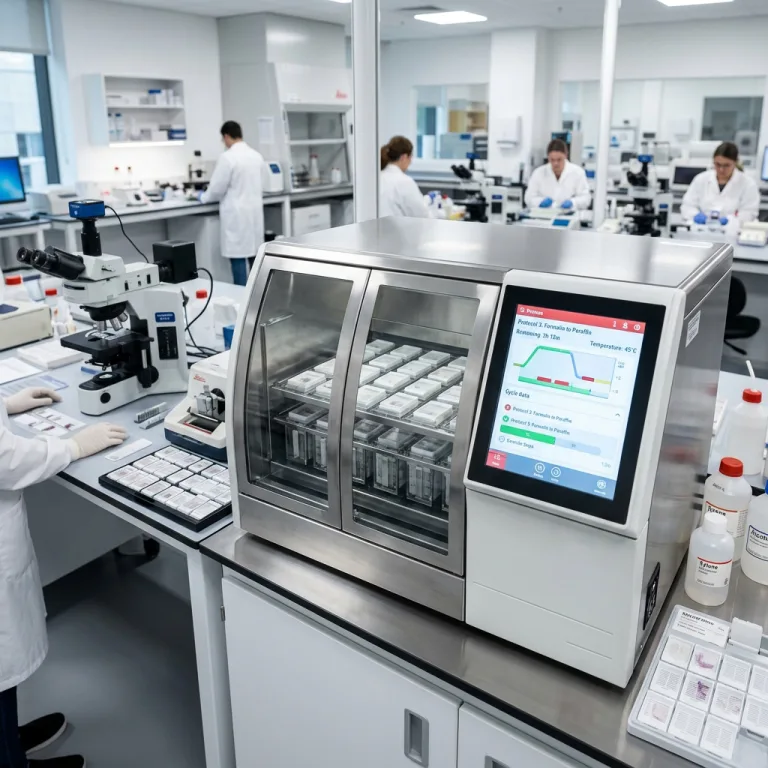
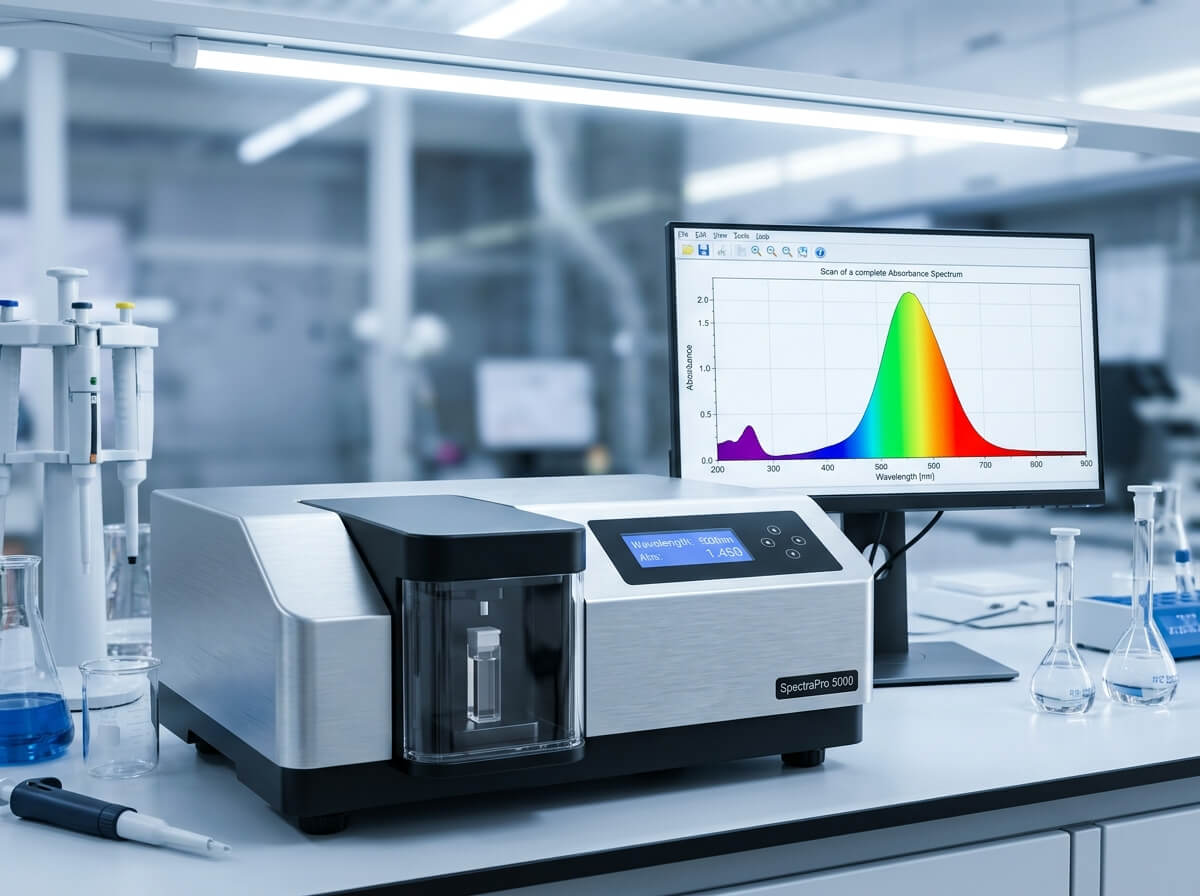
Choosing a spectrometer can be difficult when a product specification sheet contains dozens of technical terms.
A buyer may see:
- wavelength range
- spectral resolution
- wavelength accuracy
- sensitivity
- signal-to-noise ratio
- detector
- pixel size
- grating
- slit width
- dynamic range
- integration time
- optical throughput
- stray light
It is easy to focus on one number and assume that a higher value or wider range means a better instrument.
That is not always true.
A spectrometer should be selected according to the measurement task.
For example, a laboratory studying broad absorption bands may not need the same resolution as an engineer measuring closely spaced laser peaks.
A food company performing rapid material screening may care more about measurement speed and calibration than ultra-high spectral resolution.
A portable field instrument may prioritize battery life, weight, ruggedness, and ease of use.
This guide explains the most important spectrometer specifications in simple terms and shows how to use them when comparing laboratory, industrial, portable, UV-Vis, NIR, FTIR, Raman, and optical spectrometers.
1. Start With the Application
Before looking at specifications, define what you need to measure.
Ask:
What is the sample?
What information do I need?
Where will the spectrometer be used?
How fast must the measurement be?
How strong or weak is the signal?
Do I need a portable system?
These questions are more important than choosing a product based on a long specification list.
For example:
Chemical Identification
You may prioritize:
- appropriate spectroscopy technique
- spectral range
- resolution
- reference library
- software
Food Analysis
You may prioritize:
- NIR wavelength range
- calibration
- speed
- repeatability
- sample interface
LED Testing
You may prioritize:
- visible wavelength range
- wavelength accuracy
- spectral resolution
- optical input
- dynamic range
Laser Measurement
You may prioritize:
- wavelength accuracy
- spectral resolution
- wavelength range
- optical attenuation
- detector sensitivity
Field Testing
You may prioritize:
- portability
- battery
- weight
- durability
- software
The application determines the specifications that matter most.
2. Check the Spectral Wavelength Range
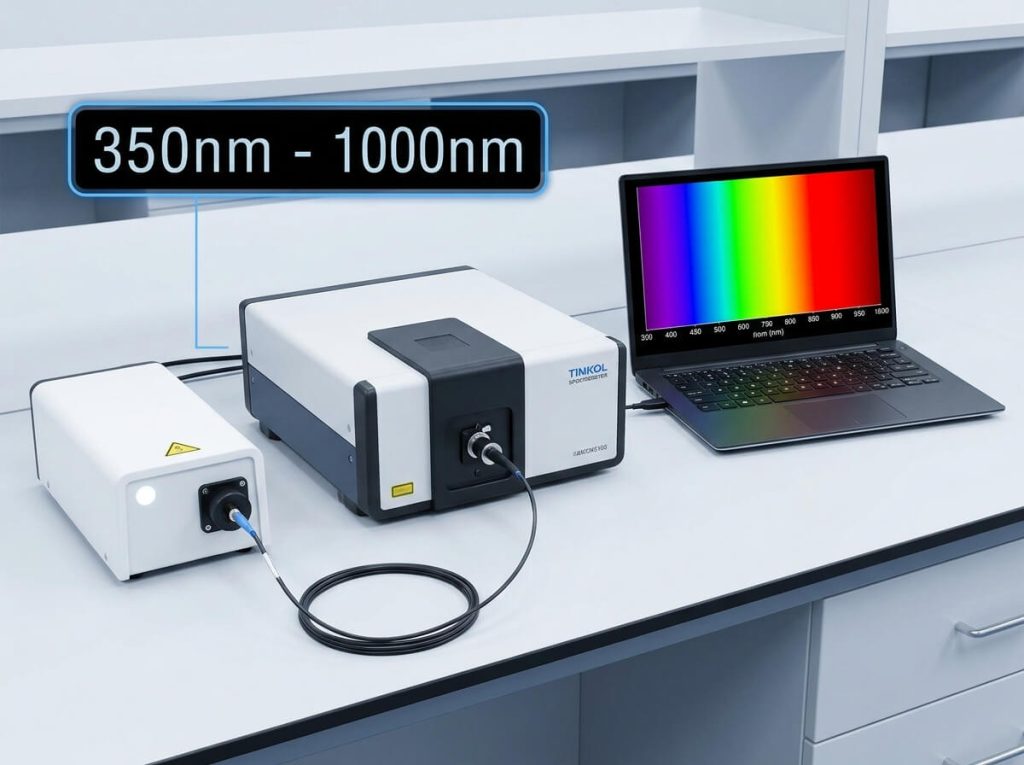
Wavelength range is usually the first specification to check.
It tells you which portion of the spectrum the instrument can measure.
Depending on the system, this could be:
- ultraviolet
- visible
- UV-Vis
- near-infrared
- infrared
- Raman-related spectral range
For example, a visible spectrometer is not automatically suitable for near-infrared measurements.
The wavelength range depends on the complete optical design, including:
- detector
- diffraction grating
- optical coatings
- filters
- light source
- spectrometer architecture
Detector response is also an important limiting factor. Ocean Optics notes that usable spectrometer range is related to the detector response and grating characteristics. (oceanoptics.com)
3. Do You Need a Wide Wavelength Range?
A wider spectral range may sound attractive.
But wider does not always mean better.
Suppose you only need to measure between 400 and 700 nm.
A spectrometer covering a much wider range may not provide a practical advantage if:
- you do not use the additional range
- the application does not need it
- the wider configuration increases cost
- the optical configuration compromises other requirements
On the other hand, a broad-range spectrometer can be useful when you need one system for several applications.
The right question is:
What is the minimum spectral range required for my measurement?
Then add reasonable margin for future applications.
4. What Is Spectral Resolution?
Spectral resolution describes how well a spectrometer can distinguish closely spaced spectral features.
Imagine two peaks:
Peak A: 500.0 nm
Peak B: 500.3 nm
A high-resolution instrument may be able to distinguish the two peaks, while a lower-resolution system may merge them into one feature.
Spectral resolution can be expressed in:
- nm
- μm
- cm⁻¹
- GHz
- other units
The appropriate unit depends on the spectroscopy technique.
5. What Spectral Resolution Do You Need?
The required resolution depends on the spectral features you need to distinguish.
Broad Absorption Bands
You may not need extremely high resolution.
LED Testing
Moderate resolution may be sufficient for many measurements.
Laser Measurement
Fine resolution may be important when examining narrow spectral features.
Emission Spectroscopy
Resolution can matter when nearby emission lines need to be separated.
Raman
The required resolution depends on the Raman shift features and analytical objective.
Therefore, do not simply ask:
What is the highest-resolution spectrometer?
Ask:
What is the smallest spectral feature I need to distinguish?
This usually leads to a more practical purchase.
6. How Is Spectral Resolution Determined?
Several factors influence spectral resolution.
Important parameters include:
- diffraction grating
- groove density
- slit width
- detector pixel size
- optical design
- wavelength range
- focal length
A narrower slit can improve spectral resolution, but it also allows less light into the instrument.
Higher groove density can increase wavelength dispersion, but the complete optical design still determines the actual resolution.
This means:
spectrometer resolution ≠ grating density alone
and:
spectrometer resolution ≠ pixel size alone
These specifications must be considered together.
7. What Is a Diffraction Grating?
A diffraction grating separates light into its wavelength components.
It contains a repeated optical structure that causes different wavelengths to diffract at different angles.
Important grating specifications include:
- groove density
- blaze wavelength
- diffraction order
- efficiency
- wavelength range
Groove density is often described as:
lines per millimeter
or:
grooves/mm
Examples include:
- 300 grooves/mm
- 600 grooves/mm
- 1200 grooves/mm
- 1800 grooves/mm
- 2400 grooves/mm
The appropriate grating depends on the target spectral range and resolution.

8. Does Higher Grating Density Mean Better?
Not automatically.
A higher groove density can provide greater angular dispersion, which can support finer spectral separation in an appropriate optical configuration.
But trade-offs exist.
A high-resolution configuration may have:
- reduced spectral coverage
- lower optical throughput
- different efficiency characteristics
A lower groove density may provide:
- broader spectral coverage
- higher throughput in some designs
- lower spectral dispersion
The best grating depends on what you need to measure.
9. What Is a Blaze Wavelength?
The blaze wavelength is associated with the wavelength where a diffraction grating is designed to have high efficiency under a specified configuration.
In simple terms, it helps indicate where the grating is optimized.
When selecting a spectrometer, the grating should be matched to the required wavelength region.
For example, a grating optimized for visible measurements may not be the ideal choice for a near-infrared application.
10. What Is an Entrance Slit?
The entrance slit controls how light enters the spectrometer.
It has an important influence on the balance between:
spectral resolution
and
optical throughput
A narrow slit can improve resolution.
A wider slit allows more light into the instrument.
This creates a practical trade-off.
Narrow Slit
Potential advantages:
- higher spectral resolution
Potential disadvantages:
- lower light throughput
- weaker signal
Wide Slit
Potential advantages:
- more optical signal
- potentially better performance for weak signals
Potential disadvantages:
- lower spectral resolution
This is why slit width is an important spectrometer specification.
11. Fixed Slit vs Adjustable Slit
Some spectrometers use a fixed slit.
Others use adjustable slit configurations.
Fixed Slit
Advantages can include:
- simple design
- repeatable configuration
- consistent optical geometry
Adjustable Slit
Advantages can include:
- user control
- ability to change resolution
- ability to optimize signal throughput
An adjustable slit can be useful when one instrument needs to support multiple measurement conditions.
However, the correct choice depends on the application.
12. What Is Spectrometer Sensitivity?
Sensitivity describes how effectively an instrument can respond to a signal.
In practical terms, it affects how well the system can detect weak optical information.
Sensitivity may be important for:
- fluorescence
- Raman
- emission
- low-light measurements
- low-concentration analysis
Sensitivity depends on many factors:
- detector
- optical throughput
- grating
- slit
- wavelength
- electronic noise
- integration time
- detector cooling
Therefore, asking only for a single “sensitivity value” may not be enough.
Ask how the manufacturer measured it.
13. What Is the Detection Limit?
A detection limit describes the lowest level of a target signal or analyte that can be reliably detected under specified conditions.
The concept is especially important for analytical applications.
Examples include:
- low-concentration chemical analysis
- trace detection
- weak fluorescence
- low-level emission
Detection limit is not a universal property of the spectrometer alone.
It can depend on:
- sample
- measurement method
- calibration
- background
- noise
- integration time
- sample preparation
So the claimed detection limit should always be associated with a defined analytical method.
14. What Is Signal-to-Noise Ratio?
Signal-to-noise ratio (SNR) compares useful signal with unwanted noise.
A higher SNR generally makes weak spectral features easier to distinguish.
SNR can be influenced by:
- detector
- electronics
- optical throughput
- integration time
- cooling
- illumination
- sample intensity
It is important to understand the test conditions.
For example:
SNR at a short integration time
and:
SNR at a long integration time
are not necessarily directly comparable.
When comparing products, use consistent test conditions.
15. What Is Dynamic Range?
Dynamic range describes the range of signal levels an instrument can handle while maintaining useful measurement performance.
A large dynamic range can be useful when a sample contains both:
- very strong spectral peaks
- weak spectral features
Without adequate dynamic range, strong signals may saturate while weak signals remain difficult to measure.
Dynamic range can be influenced by:
- detector characteristics
- electronics
- ADC
- optical design
- saturation behavior
16. What Is Stray Light?
Stray light is unwanted optical signal that reaches the detector at a wavelength or optical path where it should not contribute to the intended measurement.
Too much stray light can reduce the accuracy of measurements, particularly when measuring:
- strong absorption
- low transmission
- weak spectral features
- broad dynamic ranges
Good optical design, baffling, filters, coatings, and grating selection can help control stray light.
For a buyer working with strong absorption or high dynamic-range measurements, stray-light specifications can be important.
17. What Is Optical Throughput?
Optical throughput describes how much useful optical power the spectrometer can transmit through its optical system.
Higher throughput can be useful when:
- the available signal is weak
- measurements need to be fast
- fluorescence is being measured
- Raman signals are weak
However, high throughput and high resolution often involve design trade-offs.
A narrow slit may improve resolution but reduce throughput.
Therefore:
resolution + sensitivity + throughput
should be evaluated together.
18. What Detector Should a Spectrometer Use?
Detector selection depends mainly on wavelength range and application.
Common detector technologies include:
- silicon
- CCD
- CMOS
- InGaAs
- cooled CCD
- other specialized detectors
Silicon Detector
Commonly used in UV-visible and related optical systems, depending on detector design.
CCD
Useful for array-based spectral measurements.
CMOS
Can be useful in compact and fast digital spectrometer systems.
InGaAs
Commonly associated with near-infrared spectroscopy.
Cooled Detector
Useful when reducing detector noise is particularly important.
The detector should match both the spectral range and signal level.
19. Silicon vs InGaAs Spectrometer
This is a common purchasing question.
Silicon
Often suitable for shorter optical wavelength regions, especially visible applications.
InGaAs
Commonly selected for near-infrared applications.
For example, current compact NIR spectrometers use InGaAs detector arrays in near-infrared configurations. (oceanoptics.com)
If your application is:
visible light → silicon may be appropriate
NIR → InGaAs may be appropriate
But the exact wavelength range must be checked on the manufacturer specification sheet.
20. CCD vs CMOS Spectrometer
Both CCD and CMOS detectors can be used for spectral measurements.
When comparing them, look at:
- sensitivity
- noise
- speed
- dynamic range
- pixel size
- wavelength range
- readout architecture
The detector type alone does not determine overall spectrometer performance.
A well-designed CMOS spectrometer may be appropriate for one application, while a CCD system may be more suitable for another.
21. What Is Detector Cooling?
Some spectrometers use cooled detectors to reduce thermal noise.
Cooling can be particularly useful for:
- weak signals
- long integration times
- low-light spectroscopy
- fluorescence
- Raman
- astronomy-related measurements
- high-sensitivity applications
However, cooling may increase:
- system complexity
- power consumption
- physical size
- cost
Therefore, do not assume that a cooled detector is necessary for every application.
22. What Is Integration Time?
Integration time is the period during which the detector collects signal.
A longer integration time can increase the total collected signal.
This can help when measuring weak light.
But long integration times may reduce measurement speed and can increase sensitivity to environmental changes or detector noise.
A short integration time can support faster measurements but may provide a weaker signal.
Therefore, the correct integration time depends on:
- signal strength
- noise
- required measurement speed
- dynamic range
- detector performance
23. What Is Acquisition Speed?
Acquisition speed describes how quickly the spectrometer can collect measurements.
Some applications only require one spectrum every few seconds.
Others may need:
- real-time measurements
- process monitoring
- dynamic optical measurements
- fast LED testing
- rapid quality control
For an industrial spectrometer, acquisition speed can be as important as spectral resolution.
A high-resolution laboratory instrument may not be the best choice for a production line if the measurement is too slow.
24. What Is Wavelength Accuracy?
Wavelength accuracy indicates how closely the measured wavelength corresponds to the actual wavelength.
For example, if a known source has a wavelength of 532.0 nm, wavelength accuracy describes how closely the instrument reports that value.
Wavelength accuracy can be important for:
- laser testing
- emission-line analysis
- calibration
- scientific measurements
- quality control
Do not confuse wavelength accuracy with spectral resolution.
25. Wavelength Accuracy vs Resolution
These specifications answer different questions.
Resolution
Can the instrument distinguish two nearby spectral features?
Accuracy
Is the measured wavelength located at the correct wavelength?
A spectrometer can have high resolution but still require careful wavelength calibration.
Both specifications should therefore be reviewed separately.
26. What Is Wavelength Repeatability?
Wavelength repeatability describes how consistently the instrument reports the same wavelength under repeated measurements.
This matters when:
- comparing batches
- monitoring long-term changes
- calibrating instruments
- performing quality control
- tracking a light source
High repeatability helps produce consistent measurements.
27. What Is Spectral Accuracy?
Spectral accuracy can refer to how accurately the instrument measures spectral characteristics.
Depending on the manufacturer, this may include:
- wavelength accuracy
- wavelength repeatability
- intensity accuracy
- photometric accuracy
Buyers should ask for a clear definition because “accuracy” can mean different things.
28. What Is Pixel Size in a Spectrometer?
The detector is divided into individual pixels.
Pixel size affects how the spectrum is sampled electronically.
Pixel size and detector geometry can influence:
- spectral resolution
- wavelength range per pixel
- data size
- detector sensitivity
However, pixel size should not be considered independently.
Optical dispersion and the grating determine how much wavelength range falls across each pixel.
29. Spectral Resolution vs Pixel Size
These concepts are related but not identical.
Suppose two spectrometers use detectors with similar pixel sizes.
They can still have different spectral resolution because they may use:
- different gratings
- different focal lengths
- different slit widths
- different optical designs
Therefore:
pixel size ≠ spectral resolution
The complete spectrometer architecture matters.
30. What Is the Spectral Bandwidth?
Spectral bandwidth can describe the width of a spectral response or the measurement range of a particular optical component.
In different applications, “bandwidth” may refer to different concepts.
Therefore, buyers should ask the supplier:
What exactly does bandwidth mean in this specification?
For laser measurements, it may refer to the spectral width of the laser.
For filters, it may refer to passband width.
For spectrometers, the relevant specification may instead be spectral resolution or wavelength range.
Clear terminology prevents purchasing confusion.
31. What Sample Interface Do You Need?
A spectrometer may support different sample interfaces.
Common options include:
- free-space input
- optical fiber
- cuvette holder
- integrating sphere
- probe
- ATR accessory
- gas cell
- microscope interface
The sample interface should match the application.
For example:
liquid sample → cuvette
remote optical source → fiber optic
solid material identification → probe/accessory
total light-source measurement → integrating sphere
The optical input is therefore an important procurement specification.
32. Fiber Optic Input
A fiber optic spectrometer can receive light through an optical fiber.
Advantages may include:
- remote measurement
- flexible positioning
- easier access to difficult locations
- industrial integration
Before ordering, confirm:
- fiber type
- connector
- spectral range
- numerical aperture
- coupling
- input slit
A fiber system should be matched to the spectrometer rather than selected purely based on connector type.
33. Software Requirements
Spectrometer hardware is only one part of the system.
Software may provide:
- real-time spectrum display
- peak analysis
- wavelength calibration
- background correction
- integration
- spectral comparison
- library search
- data storage
- report generation
- export
For industrial users, software may also need:
- API
- automation
- process integration
- data logging
- remote control
Before buying, ask what software is included.
34. USB, Ethernet and Other Interfaces
Common communication interfaces include:
- USB
- Ethernet
- serial
- proprietary interfaces
- wireless options
USB
Convenient for laboratory and desktop systems.
Ethernet
Useful for network integration and some industrial systems.
Serial
Can be useful for specialized equipment integration.
Choose the interface based on the environment in which the spectrometer will operate.
35. Calibration Requirements
Calibration can influence measurement reliability.
Common calibration areas include:
- wavelength calibration
- intensity calibration
- detector response
- dark correction
Some instruments use reference lamps or standards.
For analytical applications, calibration models may also be required.
Ask the supplier:
Is calibration included?
How is wavelength calibration performed?
Is a calibration standard required?
How frequently should the instrument be recalibrated?
36. Laboratory vs Industrial Spectrometer Specifications
The priorities can be different.
Laboratory
Often prioritizes:
- resolution
- sensitivity
- wavelength accuracy
- flexibility
- sample accessories
- software
Industrial
May prioritize:
- speed
- stability
- repeatability
- ruggedness
- integration
- continuous operation
Portable
May prioritize:
- size
- weight
- battery
- durability
- simple operation
This is why one specification sheet cannot be used to judge every spectrometer.
37. Spectrometer Specifications by Application
| Application | Key Specifications |
|---|---|
| UV-Vis analysis | Wavelength range, accuracy, resolution, sensitivity |
| NIR analysis | Range, detector, calibration, speed |
| FTIR | Spectral range, resolution, signal-to-noise, accessories |
| Raman | Resolution, laser compatibility, sensitivity, fluorescence handling |
| Fluorescence | Sensitivity, detector, optical throughput |
| LED testing | Visible range, wavelength accuracy, speed |
| Laser testing | Resolution, accuracy, dynamic range |
| Food analysis | NIR range, speed, calibration, repeatability |
| Environmental testing | Sensitivity, portability, sample interface |
| Process monitoring | Speed, stability, integration, durability |
| Field analysis | Weight, battery, ruggedness, software |
38. How to Compare Two Spectrometers
Consider two hypothetical instruments.
Spectrometer A
- 350–800 nm
- 1.0 nm resolution
- silicon detector
- USB
- fixed slit
Spectrometer B
- 200–1100 nm
- 0.2 nm resolution
- cooled detector
- USB + Ethernet
- adjustable slit
At first glance, Spectrometer B may appear better.
But what if you only need:
500–700 nm
and your application is:
routine LED testing
Then Spectrometer A may already meet the actual requirement.
Spectrometer B could provide unnecessary capabilities and higher cost.
This is why:
The most advanced specification is not automatically the most suitable specification.
39. How to Compare Spectrometer Quotations
When requesting multiple quotations, create a comparison table.
| Specification | Supplier A | Supplier B | Supplier C |
|---|---|---|---|
| Spectral range | Compare | Compare | Compare |
| Resolution | Compare | Compare | Compare |
| Wavelength accuracy | Compare | Compare | Compare |
| Detector | Compare | Compare | Compare |
| Grating | Compare | Compare | Compare |
| Slit | Compare | Compare | Compare |
| SNR | Compare | Compare | Compare |
| Dynamic range | Compare | Compare | Compare |
| Integration time | Compare | Compare | Compare |
| Interface | Compare | Compare | Compare |
| Software | Compare | Compare | Compare |
| Calibration | Compare | Compare | Compare |
| Accessories | Compare | Compare | Compare |
| Warranty | Compare | Compare | Compare |
| Price | Compare | Compare | Compare |
This makes purchasing decisions much easier.
40. Questions to Ask a Spectrometer Supplier
Before ordering, ask:
Application
Is this model suitable for my sample?
Wavelength
What is the usable spectral range?
Resolution
What is the actual spectral resolution?
Detector
What detector is used?
Grating
What grating is installed?
Slit
Is the slit fixed or adjustable?
Sensitivity
How is sensitivity tested?
SNR
Under what conditions is SNR specified?
Accuracy
What is wavelength accuracy?
Calibration
How is the system calibrated?
Software
What software is included?
Integration
Is an API available?
Service
What warranty and technical support are provided?
These questions help turn a generic product inquiry into a useful technical evaluation.
41. Spectrometer Buying Checklist
Before purchasing, check:
Application
□ Chemistry
□ Pharmaceuticals
□ Food
□ Agriculture
□ Environment
□ Materials
□ Lighting
□ Laser
□ Research
□ Industrial process
Spectral Requirements
□ Wavelength range
□ Spectral resolution
□ Wavelength accuracy
□ Repeatability
Optical System
□ Grating
□ Groove density
□ Blaze wavelength
□ Slit
□ Fiber input
□ Free-space input
Detector
□ Silicon
□ CCD
□ CMOS
□ InGaAs
□ Cooling
Signal Performance
□ Sensitivity
□ SNR
□ Dynamic range
□ Stray light
□ Optical throughput
Speed
□ Integration time
□ Acquisition speed
□ Continuous measurement
Software
□ Spectrum display
□ Calibration
□ Data export
□ API
□ Automation
Practical
□ Size
□ Weight
□ Battery
□ Operating temperature
□ Environmental protection
Commercial
□ Price
□ Warranty
□ Accessories
□ Spare parts
□ Technical support
42. How to Avoid Over-Specifying a Spectrometer
Over-specification can unnecessarily increase the project cost.
For example, a buyer may purchase:
- extremely high resolution
- a very wide wavelength range
- cooled detector
- multiple interfaces
- advanced automation
when the actual application only requires routine visible-light measurement.
Instead, define the minimum practical requirement.
For example:
I need to measure LED emission from 400–800 nm with approximately 1 nm resolution.
This is a much better starting point than simply asking for:
A high-performance spectrometer.
43. How to Avoid Under-Specifying a Spectrometer
The opposite problem also occurs.
A low-cost instrument may appear suitable but fail to provide:
- sufficient wavelength range
- required sensitivity
- necessary resolution
- appropriate detector
- software compatibility
- required sample interface
Before purchasing, verify all essential specifications against the actual analytical task.
44. Spectrometer Specification Terms You Should Understand
For quick reference:
Wavelength Range
→ What wavelengths can be measured?
Spectral Resolution
→ How closely spaced can two spectral features be while still being distinguished?
Wavelength Accuracy
→ How close is the reported wavelength to the true wavelength?
Sensitivity
→ How effectively can the instrument respond to a signal?
SNR
→ How large is the useful signal compared with noise?
Dynamic Range
→ How broad a range of signal levels can be measured?
Grating
→ What separates the wavelengths?
Slit
→ Controls the optical input and affects throughput and resolution.
Detector
→ Converts the optical signal into an electronic signal.
Integration Time
→ How long the detector collects signal.
Acquisition Speed
→ How quickly spectra can be collected.
Stray Light
→ Unwanted optical signal that can affect measurements.
Optical Throughput
→ How much useful light passes through the instrument.
These terms form the foundation of most spectrometer specification sheets.
Frequently Asked Questions
What specifications should I look for in a spectrometer?
Start with wavelength range, spectral resolution, sensitivity, detector, wavelength accuracy, SNR, grating, slit, integration time, software, and sample interface.
What is the most important spectrometer specification?
There is no single specification that matters most for every application. The wavelength range and measurement objective are usually good starting points.
How do I choose a spectrometer?
Define the sample and measurement first, then select the appropriate wavelength range, resolution, sensitivity, detector, optical system, speed, software, and operating format.
What wavelength range do I need?
Choose a range that covers the target spectral features with enough additional range for calibration and practical operation.
Is a wider wavelength range better?
Not automatically. Extra range is useful only when the application requires it.
What is spectral resolution?
Spectral resolution describes how well an instrument can distinguish closely spaced spectral features.
Is lower nm resolution better?
For wavelength-based optical resolution, a smaller wavelength interval generally represents finer spectral discrimination, but the practical requirement depends on the application.
What affects spectrometer resolution?
Grating, slit width, detector pixel size, optical design, focal length, and wavelength range can all affect spectral resolution.
What is a diffraction grating?
It is an optical component that separates light into different wavelengths.
What is grating density?
Grating density describes how many grooves are present per unit length, often expressed as grooves per millimeter.
Does higher groove density always improve a spectrometer?
No. Higher groove density can support greater dispersion, but it may involve trade-offs in wavelength coverage and optical throughput.
What is slit width?
Slit width controls the optical input and influences the balance between spectral resolution and light throughput.
Should I choose a fixed or adjustable slit?
A fixed slit can provide a consistent configuration, while an adjustable slit offers flexibility. The right choice depends on your application.
What is spectrometer sensitivity?
Sensitivity describes how effectively the spectrometer detects useful signal.
What is detection limit?
Detection limit is the lowest level of a target signal or analyte that can be reliably detected under defined conditions.
What is SNR in spectroscopy?
SNR is the ratio between useful signal and noise.
Is higher SNR better?
Generally, a higher SNR makes weak spectral features easier to distinguish, but comparisons should use consistent test conditions.
What is dynamic range?
Dynamic range describes the range of signal levels that can be measured while maintaining useful performance.
What is stray light?
Stray light is unwanted optical signal that reaches the detector and can affect spectral measurements.
What is optical throughput?
Optical throughput describes how much useful optical signal passes through the spectrometer.
What detector is best for spectroscopy?
The correct detector depends on the wavelength range, sensitivity, speed, noise, and application.
Is silicon suitable for a spectrometer?
Silicon detectors are commonly used for UV-visible and related optical applications, depending on the specific detector design.
Is InGaAs good for NIR spectroscopy?
InGaAs detectors are commonly used for near-infrared spectrometers.
What is a CCD spectrometer?
A CCD spectrometer uses a CCD detector array to measure spectral information.
What is a CMOS spectrometer?
A CMOS spectrometer uses a CMOS-based detector architecture for spectral measurement.
Is CCD better than CMOS?
Neither technology is automatically better for every spectroscopy application. Compare sensitivity, noise, speed, dynamic range, wavelength range, and system design.
Why are some spectrometers cooled?
Cooling can reduce thermal noise and can be useful for weak-signal or long-integration measurements.
What is integration time?
Integration time is the period during which the detector collects signal.
Does longer integration time improve sensitivity?
It can increase collected signal for weak measurements, but longer integration may reduce measurement speed and introduce other trade-offs.
What is wavelength accuracy?
It describes how closely measured wavelengths correspond to true wavelengths.
What is wavelength repeatability?
It describes how consistently the instrument reports the same wavelength during repeated measurements.
Is wavelength accuracy the same as resolution?
No. Accuracy concerns correctness of wavelength position, while resolution concerns the ability to distinguish nearby spectral features.
What sample interface should I choose?
It depends on the sample and application. Options can include fiber optics, free-space input, cuvettes, probes, integrating spheres, ATR accessories, or other interfaces.
What is a fiber optic spectrometer?
It is a spectrometer that receives light through an optical fiber.
Does a spectrometer need software?
Most modern digital spectrometers use software for acquisition, display, processing, calibration, storage, or analysis.
What interface should I choose?
USB is common for laboratory systems, while Ethernet can be useful for network or industrial integration. The correct interface depends on the application.
How often should a spectrometer be calibrated?
Calibration frequency depends on the instrument, application, environmental conditions, and manufacturer’s recommendations.
Should I buy the highest-resolution spectrometer available?
Not necessarily. Choose the resolution required by your measurement rather than paying for performance you will not use.
Should I buy the spectrometer with the widest wavelength range?
Not necessarily. Choose the range that covers your actual application and future requirements.
How can I compare spectrometer suppliers?
Compare technical specifications, test conditions, software, accessories, warranty, service, delivery, compatibility, and total cost.
Spectrometer Buying Decision Process
A practical buying process can be summarized as follows:
Step 1: Define the Application
What are you measuring?
Step 2: Define the Sample
Liquid, solid, powder, gas, material, light source, or another sample.
Step 3: Select the Spectroscopy Technique
UV-Vis, NIR, FTIR, Raman, fluorescence, emission, or another method.
Step 4: Define the Spectral Range
Identify the wavelengths that contain the information you need.
Step 5: Define Resolution
Determine the smallest spectral feature that must be distinguished.
Step 6: Define Sensitivity
Estimate how strong or weak the expected signal will be.
Step 7: Select the Detector
Match detector technology to wavelength and signal requirements.
Step 8: Select the Optical Configuration
Consider grating, slit, fiber input, free-space input, and accessories.
Step 9: Define Speed
Determine integration time and acquisition speed requirements.
Step 10: Check Software
Confirm acquisition, analysis, calibration, export, and integration capabilities.
Step 11: Confirm Environment
Laboratory, factory, process line, or field.
Step 12: Compare Suppliers
Review technical and commercial information.
Step 13: Calculate Total Cost
Include accessories, software, installation, shipping, warranty, and service.
Final Spectrometer Specification Checklist
Before requesting a quotation, prepare the following information:
Application: __________________
Sample: __________________
Spectroscopy technique: __________________
Required wavelength range: __________________
Required resolution: __________________
Required sensitivity: __________________
Detector preference: __________________
Measurement speed: __________________
Sample interface: __________________
Software: __________________
Communication interface: __________________
Operating environment: __________________
Quantity: __________________
Budget: __________________
Certification requirement: __________________
Warranty requirement: __________________
This simple specification sheet can help a supplier provide a much more relevant quotation.
Conclusion
Choosing a spectrometer should begin with the measurement requirement, not with the longest list of technical specifications.
The most important selection factors usually include:
wavelength range
spectral resolution
sensitivity
detector
grating
slit
signal-to-noise ratio
dynamic range
wavelength accuracy
integration time
acquisition speed
sample interface
software
calibration
Each parameter answers a different question.
Wavelength range tells you what part of the spectrum you can measure.
Resolution tells you how closely spaced spectral features can be distinguished.
Sensitivity and SNR influence the ability to measure weak signals.
The detector determines how efficiently the system responds across the target spectral region.
The grating and slit influence wavelength dispersion and optical throughput.
Integration time and acquisition speed determine how quickly measurements can be collected.
Software and interfaces determine how easily the instrument can be integrated into your laboratory or industrial workflow.
The right balance depends on the application.
A food-production line may prioritize speed, calibration, and repeatability.
A research laboratory may prioritize resolution, sensitivity, and flexibility.
An LED manufacturer may focus on wavelength accuracy and visible spectral coverage.
A laser laboratory may need fine resolution and accurate wavelength measurement.
A field user may prioritize portability, battery life, and ruggedness.
For this reason, the goal should not be:
Find the spectrometer with the highest specifications.
The goal should be:
Find a spectrometer whose specifications match the measurement you actually need to perform.
A good procurement process is therefore:
Application → Sample → Technique → Wavelength → Resolution → Sensitivity → Detector → Optics → Speed → Software → Compatibility → Supplier
This approach can help laboratories, manufacturers, research institutions, universities, distributors, and industrial buyers compare spectrometers, optical spectrometers, laboratory spectrometers, NIR spectrometers, UV-Vis spectrometers, FTIR systems, Raman instruments, portable spectrometers, and customized spectroscopy solutions more effectively.
Before purchasing, always request the complete technical specification sheet and clarify the test conditions behind important performance figures. This makes supplier comparisons more meaningful and reduces the risk of paying for specifications that do not contribute to the actual application.