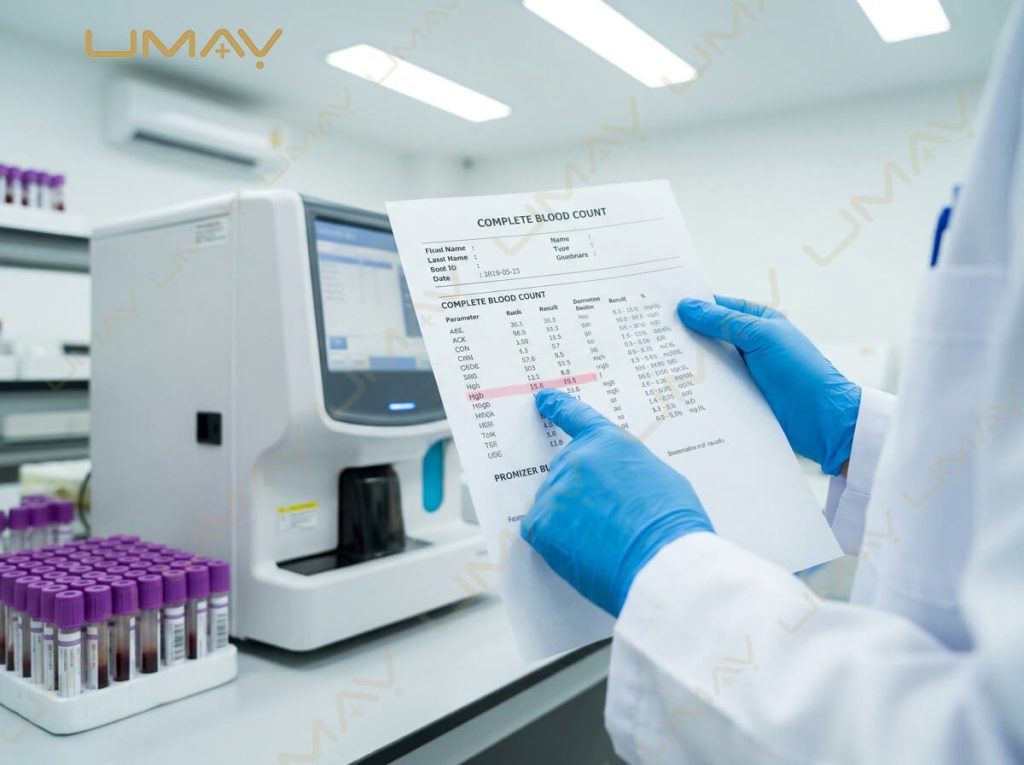
A hematology analyzer produces much more than a simple blood cell count. Modern automated hematology analyzers can report a wide range of CBC parameters, helping laboratory professionals evaluate red blood cells, white blood cells, platelets, and related measurements.
For people who are new to laboratory equipment, terms such as WBC, RBC, HGB, HCT, MCV, MCH, MCHC, RDW, PLT, and MPV can look complicated. For laboratory buyers, these abbreviations are also important because they help determine what a specific CBC analyzer can measure.
This guide explains the most common hematology analyzer parameters in plain English. It also covers CBC abbreviations, WBC differential results, histograms, analyzer flags, parameter groups, and the specifications buyers should compare when selecting an automated hematology analyzer.
The exact test menu varies by manufacturer and model, so the parameter list shown on one hematology analyzer may not be identical to another.
What Are Hematology Analyzer Parameters?
A hematology analyzer parameter is a measured or calculated value reported by an automated blood cell analyzer.
These parameters generally describe three major blood cell groups:
- White blood cells (WBC)
- Red blood cells (RBC)
- Platelets (PLT)
A standard CBC may include additional measurements related to cell size, concentration, volume, and distribution.
For example, common CBC parameters include:
- WBC
- RBC
- HGB
- HCT
- MCV
- MCH
- MCHC
- RDW
- PLT
- MPV
A 3-part hematology analyzer may provide a basic WBC differential, while a 5-part hematology analyzer generally reports a more detailed differential that separates major white blood cell populations.
What Does CBC Mean?
CBC stands for Complete Blood Count.
A CBC is one of the most common laboratory blood tests. Automated hematology analyzers are widely used to perform routine CBC testing because they can measure multiple parameters from one blood sample.
A typical CBC report can contain information about:
- White blood cells
- Red blood cells
- Hemoglobin
- Hematocrit
- Red blood cell indices
- Platelets
- White blood cell differential, depending on analyzer type
The term CBC analyzer is therefore commonly used as another name for a hematology analyzer designed to perform complete blood count testing.
WBC: White Blood Cell Count
WBC means white blood cell count.
White blood cells are part of the body’s immune system. A hematology analyzer measures the total number of WBCs in the sample and may also provide a differential count.
Common search terms include:
- WBC count
- white blood cell count
- WBC analyzer
- white blood cell analyzer
- WBC parameter
- WBC blood test
- CBC WBC
- automated WBC count
A WBC result represents the total white blood cell population measured by the analyzer.
For a more detailed analysis, laboratories may use a 5-part differential hematology analyzer to separate different WBC populations.
WBC Differential
A WBC differential provides more information than a total WBC count.
Depending on analyzer configuration, the main white blood cell populations can include:
- Neutrophils
- Lymphocytes
- Monocytes
- Eosinophils
- Basophils
A 5-part hematology analyzer typically provides these five categories separately.
Common WBC differential terms include:
- WBC differential
- differential count
- differential blood count
- 5-part differential
- white blood cell differential
- automated differential count
- WBC differential analyzer
For laboratories that require more detailed leukocyte classification, WBC differential capability can be one of the most important specifications when choosing a hematology analyzer.
NEUT: Neutrophils
NEUT is commonly used as an abbreviation for neutrophils.
A 5-part hematology analyzer may report neutrophils as:
- NEUT%
- NEUT#
- Neutrophil percentage
- Absolute neutrophil count
The exact reporting format varies between systems.
Neutrophils are a major category of white blood cells. In a 5-part differential, they are reported separately rather than being grouped together with other granulocytes.
Related keywords include:
- neutrophil count
- NEUT count
- NEUT percentage
- neutrophil analyzer
- automated neutrophil count
LYM: Lymphocytes
LYM commonly refers to lymphocytes.
The analyzer may report:
- LYM%
- LYM#
- Lymphocyte percentage
- Absolute lymphocyte count
Lymphocytes form an important white blood cell population and are reported by both 3-part and 5-part hematology analyzers, although the classification method differs.
Related search terms:
- lymphocyte count
- LYM count
- LYM percentage
- lymphocyte blood test
- lymphocyte analyzer
- automated lymphocyte count
MONO: Monocytes
MONO commonly represents monocytes.
On a 5-part hematology analyzer, monocytes are normally reported as a separate population.
Typical terms include:
- MONO%
- MONO#
- monocyte count
- monocyte percentage
- absolute monocyte count
In a 3-part analyzer, monocytes are generally not individually separated in the same way as they are on a 5-part system.
EOS: Eosinophils
EOS refers to eosinophils.
A 5-part hematology analyzer can report eosinophils separately.
Common terms include:
- EOS%
- EOS#
- eosinophil count
- eosinophil percentage
- absolute eosinophil count
This separate classification is one reason laboratories may select a 5-part hematology analyzer when detailed WBC differential information is required.
BASO: Basophils
BASO refers to basophils.
The analyzer may report:
- BASO%
- BASO#
- basophil count
- basophil percentage
- absolute basophil count
Separate basophil reporting is typically associated with 5-part differential systems.
RBC: Red Blood Cell Count
RBC means red blood cell count.
Red blood cells are responsible for carrying oxygen through the body.
Automated hematology analyzers count RBCs and also calculate or measure several related red blood cell indices.
Common RBC-related search terms include:
- RBC count
- red blood cell count
- RBC analyzer
- red blood cell analyzer
- RBC parameter
- RBC blood test
- automated RBC count
RBC is normally interpreted together with other red blood cell measurements rather than by itself.
HGB or Hb: Hemoglobin
HGB or Hb refers to hemoglobin concentration.
Hemoglobin is a protein found in red blood cells and is involved in oxygen transport.
On a hematology analyzer, hemoglobin is generally reported as one of the core CBC parameters.
Related keywords include:
- HGB test
- HGB parameter
- hemoglobin test
- hemoglobin analyzer
- Hb measurement
- automated hemoglobin test
- CBC HGB
For equipment buyers, HGB measurement is a standard feature to check when comparing CBC analyzers.
HCT: Hematocrit
HCT stands for hematocrit.
Hematocrit describes the proportion of blood volume occupied by red blood cells.
HCT is one of the most common red blood cell parameters found in a CBC report.
Related keywords include:
- HCT test
- HCT parameter
- hematocrit test
- hematocrit analyzer
- automated hematocrit
- CBC HCT
Some hematology analyzers calculate HCT using RBC and MCV measurements, while the exact implementation depends on the analyzer.
MCV: Mean Corpuscular Volume
MCV means Mean Corpuscular Volume.
It describes the average volume of an individual red blood cell.
MCV is an important red blood cell index and is typically included in automated CBC testing.
Related terms include:
- MCV test
- MCV parameter
- MCV blood test
- mean corpuscular volume
- MCV analyzer
- automated MCV
For buyers, MCV is generally part of the standard red blood cell parameter group.
MCH: Mean Corpuscular Hemoglobin
MCH means Mean Corpuscular Hemoglobin.
It represents the average amount of hemoglobin associated with an individual red blood cell.
Common search phrases include:
- MCH test
- MCH parameter
- MCH blood test
- mean corpuscular hemoglobin
- MCH analyzer
- automated MCH
MCH is normally presented together with RBC, HGB, MCV, and MCHC.
MCHC: Mean Corpuscular Hemoglobin Concentration
MCHC means Mean Corpuscular Hemoglobin Concentration.
It describes the average concentration of hemoglobin within red blood cells.
Common keywords include:
- MCHC test
- MCHC parameter
- MCHC blood test
- mean corpuscular hemoglobin concentration
- MCHC analyzer
- automated MCHC
MCHC is one of the standard red blood cell indices found on many CBC reports.
RDW: Red Cell Distribution Width
RDW stands for Red Cell Distribution Width.
It describes variation in red blood cell size.
Depending on the analyzer, the report may include different forms such as:
- RDW-CV
- RDW-SD
Related search terms include:
- RDW test
- RDW parameter
- RDW-CV
- RDW-SD
- red cell distribution width
- RDW analyzer
- automated RDW
The exact calculation and presentation can vary between hematology analyzer systems.
PLT: Platelet Count
PLT means platelet count.
Platelets are small blood components involved in normal clotting processes.
A hematology analyzer generally measures platelets as one of the key CBC parameters.
Related searches include:
- PLT count
- platelet count
- platelet analyzer
- platelet parameter
- platelet blood test
- automated platelet counter
- CBC platelet count
For equipment buyers, platelet performance can be an important area to review when comparing different analyzers.
MPV: Mean Platelet Volume
MPV means Mean Platelet Volume.
MPV describes the average volume of platelets.
Depending on the model, a hematology analyzer may report:
- MPV
- platelet distribution information
- platelet histogram
- additional platelet parameters
Related keywords include:
- MPV test
- MPV parameter
- mean platelet volume
- MPV blood test
- platelet volume analyzer
PCT and Other Platelet Parameters
Some hematology analyzers provide additional platelet-related parameters.
Depending on the analyzer, the menu may include parameters such as:
- PCT
- PDW
- P-LCR
- P-LCC
These abbreviations refer to different platelet measurements or calculated platelet indices.
Not all hematology analyzers provide the same platelet parameter menu, so the manufacturer’s specification should always be checked.
For purchasing teams, this is a good example of why comparing the complete parameter list is more useful than comparing only the analyzer’s product name.
What Are Absolute Count and Percentage Results?
A white blood cell differential may be reported in two main forms:
Percentage
This shows the relative proportion of a particular WBC population.
For example:
- NEUT%
- LYM%
- MONO%
- EOS%
- BASO%
Absolute Count
This reports the measured number of cells in a defined volume.
Common abbreviations include:
- NEUT#
- LYM#
- MONO#
- EOS#
- BASO#
Both formats can be useful depending on the laboratory’s reporting requirements.
What Are Hematology Analyzer Histograms?
A histogram is a graphical representation of cell size or volume distribution.
A hematology analyzer may provide histograms for:
- WBC
- RBC
- PLT
Instead of showing only a numerical result, the histogram provides a visual distribution of measured cell populations.
Histograms are often helpful for reviewing the overall distribution pattern and identifying analyzer-generated flags that may require further review.
The exact histogram format depends on the analyzer.
What Are Scattergrams?
A scattergram is a graphical plot used in some advanced hematology analyzers to display cell populations according to measured characteristics.
Scattergrams are particularly associated with more advanced WBC differential systems.
In a 5-part hematology analyzer, a scattergram may visually separate:
- Neutrophils
- Lymphocytes
- Monocytes
- Eosinophils
- Basophils
Scattergram technology can therefore be an important feature for laboratories looking at detailed differential analysis.
What Are Hematology Analyzer Flags?
A flag is an alert generated by the analyzer when the measured data meets a condition defined by the instrument’s software.
Depending on the analyzer, flags may relate to:
- Abnormal cell distributions
- Measurement limitations
- Possible interference
- Unusual histograms
- Unclassified populations
- Suspect results
- Instrument conditions
A flag does not automatically mean that a specific medical condition is present.
Instead, it signals that the result may require additional review according to laboratory procedures.
This distinction is especially important when discussing automated hematology analyzer results.
Why Do Different Hematology Analyzers Have Different Parameters?
Not all hematology analyzers are designed for the same purpose.
Parameter differences can result from:
- Analyzer technology
- Measurement channels
- Product configuration
- Software capabilities
- Intended use
- Reagent system
- Differential method
- Optional modules
For example, a compact 3-part CBC analyzer may focus on routine parameters, while a larger 5-part hematology analyzer may provide more detailed WBC differential data.
Advanced systems may also offer specialized modules or parameters beyond routine CBC testing.
3-Part vs 5-Part Parameters
A common question is:
Which parameters are different between 3-part and 5-part hematology analyzers?
The core CBC parameters are often similar.
These may include:
- WBC
- RBC
- HGB
- HCT
- MCV
- MCH
- MCHC
- RDW
- PLT
- MPV
The largest difference is usually in the WBC differential.
3-Part Analyzer
Typically groups WBCs into three populations such as:
- Lymphocytes
- MID or mixed population
- Granulocytes
5-Part Analyzer
Typically separates:
- Neutrophils
- Lymphocytes
- Monocytes
- Eosinophils
- Basophils
Therefore, laboratories should select the analyzer based on the required differential information rather than assuming that every 5-part analyzer provides identical additional parameters.
How Many Parameters Does a Hematology Analyzer Have?
There is no universal number.
A basic hematology analyzer may report a relatively compact CBC menu, while an advanced analyzer may provide:
- CBC parameters
- 5-part differential
- Platelet indices
- Additional WBC parameters
- Reticulocyte parameters
- Specialized measurements
- Research-use parameters, depending on product design
For this reason, product specifications often use phrases such as:
“20 parameters,” “21 parameters,” “25 parameters,” or “more than 30 parameters.”
However, the number alone does not tell you whether a machine is suitable for your laboratory.
The actual parameter names matter more than the headline number.
Which Hematology Analyzer Parameters Should Buyers Check?
When purchasing a hematology analyzer, start with the laboratory’s required report.
Create a simple parameter checklist.
Core CBC Parameters
Check whether the system provides:
- WBC
- RBC
- HGB
- HCT
- MCV
- MCH
- MCHC
- RDW
- PLT
- MPV
Differential Parameters
If a 5-part system is required, check:
- NEUT
- LYM
- MONO
- EOS
- BASO
Additional Parameters
Depending on laboratory requirements, also check:
- PDW
- PCT
- P-LCR
- Reticulocytes
- Advanced flags
- Additional WBC indices
This helps procurement teams compare products on actual laboratory needs rather than marketing descriptions.
What Does “Parameter” Mean on a Product Datasheet?
When manufacturers list hematology analyzer parameters, they are usually referring to values the instrument can measure, calculate, or report.
A datasheet might list:
WBC, LYM%, LYM#, MID%, MID#, GRA%, GRA#, RBC, HGB, HCT, MCV, MCH, MCHC, RDW-CV, RDW-SD, PLT, MPV, PDW, PCT
A 5-part analyzer datasheet may instead include:
WBC, NEUT%, NEUT#, LYM%, LYM#, MONO%, MONO#, EOS%, EOS#, BASO%, BASO#…
When comparing products, buyers should check whether each parameter is:
- Measured
- Calculated
- Optional
- Included in the standard configuration
- Available only with additional reagents or modules
This can prevent confusion during procurement.
Why Sample and Reagent Specifications Matter
The parameter list is only one part of hematology analyzer selection.
Two machines may report similar CBC parameters but have very different operating characteristics.
Important specifications include:
Sample Volume
How much blood is required for one analysis?
Throughput
How many samples can the machine process per hour?
Reagent Consumption
How much reagent is used per test?
Differential Technology
How are WBC populations separated?
Automation
How much manual sample handling is required?
QC Functions
What quality-control tools are built into the system?
Connectivity
Can the analyzer connect with a laboratory information system?
These factors can have as much practical importance as the parameter count.
Hematology Analyzer Results and Laboratory Workflow
A hematology analyzer result normally moves through several stages:
Sample → Analysis → Calculation → Result → Review → Reporting
The analyzer generates numerical results, histograms, scattergrams, and flags according to its configuration.
Laboratory staff then review the results according to established procedures.
Some results may be accepted automatically, while flagged or unusual results may require additional review or follow-up testing.
The analyzer is therefore an important part of the laboratory workflow, but it is not the only component.
Common Hematology Analyzer Terminology
For buyers searching online, understanding common terminology can make product research easier.
| Term | Meaning |
|---|---|
| CBC | Complete Blood Count |
| WBC | White Blood Cell Count |
| RBC | Red Blood Cell Count |
| HGB/Hb | Hemoglobin |
| HCT | Hematocrit |
| MCV | Mean Corpuscular Volume |
| MCH | Mean Corpuscular Hemoglobin |
| MCHC | Mean Corpuscular Hemoglobin Concentration |
| RDW | Red Cell Distribution Width |
| PLT | Platelet Count |
| MPV | Mean Platelet Volume |
| NEUT | Neutrophils |
| LYM | Lymphocytes |
| MONO | Monocytes |
| EOS | Eosinophils |
| BASO | Basophils |
| QC | Quality Control |
| LIS | Laboratory Information System |
This terminology also forms a useful keyword base for searching hematology analyzer specifications and laboratory equipment suppliers.
Common Questions About CBC Parameters
What are the main parameters of a CBC?
Common CBC parameters include WBC, RBC, HGB, HCT, MCV, MCH, MCHC, RDW, and PLT. Depending on the analyzer, additional platelet and WBC differential parameters may also be included.
What does WBC mean on a hematology report?
WBC means white blood cell count.
What does RBC mean on a CBC report?
RBC means red blood cell count.
What does HGB mean?
HGB refers to hemoglobin concentration.
What does HCT mean?
HCT refers to hematocrit.
What does MCV mean?
MCV means mean corpuscular volume.
What does MCH mean?
MCH means mean corpuscular hemoglobin.
What does MCHC mean?
MCHC means mean corpuscular hemoglobin concentration.
What does RDW mean?
RDW means red cell distribution width.
What does PLT mean?
PLT refers to platelet count.
What does MPV mean?
MPV refers to mean platelet volume.
What is a 5-part differential?
A 5-part differential typically separates neutrophils, lymphocytes, monocytes, eosinophils, and basophils.
What is a 3-part differential?
A 3-part differential generally groups WBCs into lymphocytes, a mid or mixed population, and granulocytes.