The Evolving Landscape of Hospital Ultrasound Procurement
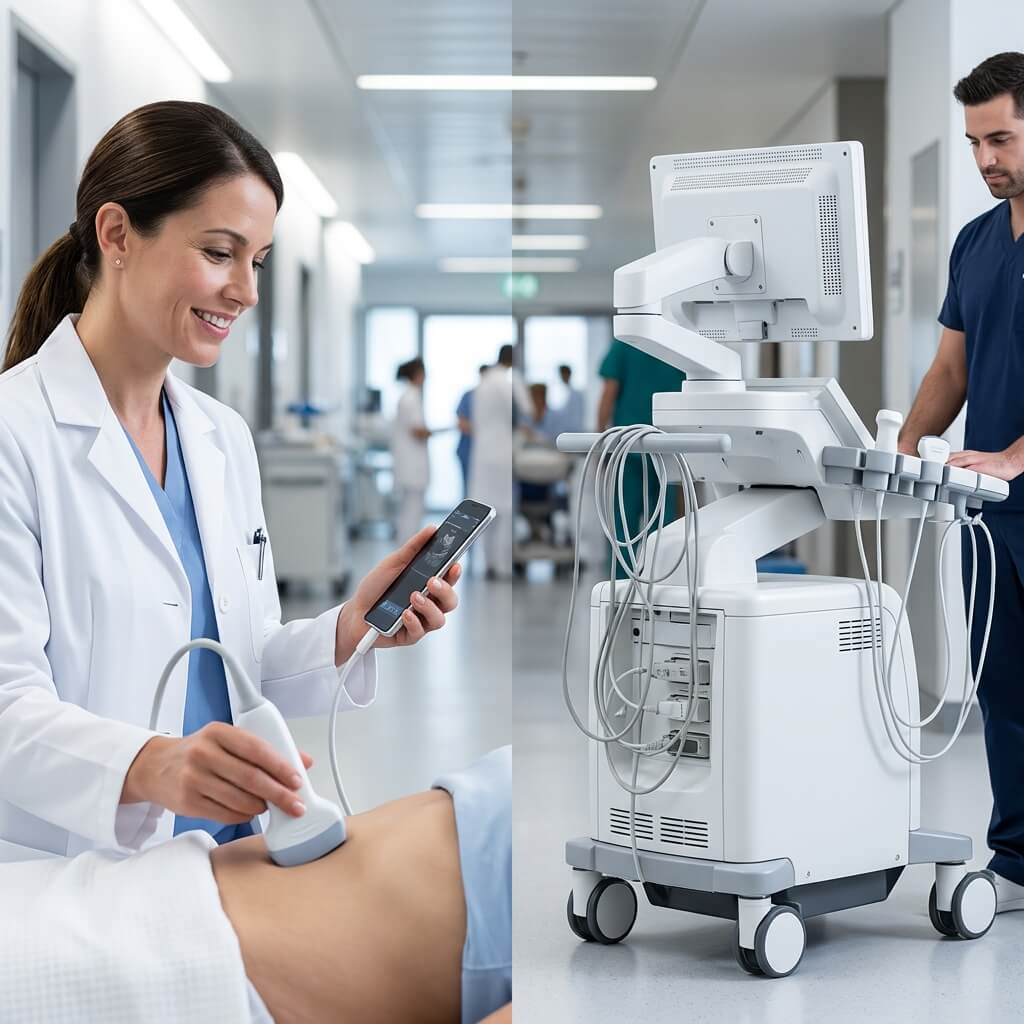
For decades, hospital radiology departments and outpatient clinics relied exclusively on heavy, cart-based ultrasound consoles. While these multi-thousand-dollar cart systems deliver premium image resolution and specialized imaging modes, their physical footprint, high capital cost, and slow boot times make them impractical for rapid bedside point-of-care ultrasound (POCUS).
                     ULTRASOUND FORM FACTOR SPECTRUM
  +--------------------+    +--------------------+    +--------------------+
  |  CART CONSOLE      |    |  LAPTOP PORTABLE   |    |  HANDHELD POCKET   |
  |  $25K - $100K+     |    |  $8K - $25K        |    |  $2.5K - $8K       |
  |  High Resolution   |    |  Shared Service    |    |  Instant Bedside   |
  |  Stationary/Heavy  |    |  Medium Mobility   |    |  Pocket Size / App |
  +--------------------+    +--------------------+    +--------------------+
Hospital CFOs, clinical directors, and procurement managers are increasingly adopting a hybrid imaging strategy: deploying high-end cart systems for complex sub-specialty diagnostics while equipping emergency departments, ICUs, surgical suites, and mobile clinics with pocket-sized handheld scanners.
Understanding the balance between Capital Expenditure (CAPEX), Operational Expenditure (OPEX), and clinical throughput is essential for optimizing healthcare facility investments.
2. Head-to-Head Comparison: Handheld vs. Laptop vs. Cart Systems
The table below provides a comprehensive comparison of technical, operational, and financial factors across the three major ultrasound form factors:
| Feature & Evaluation Metric | Handheld Ultrasound Probe | Portable Laptop System | Traditional Cart Console |
| Average System Price | $2,500 – $8,000 USD | $8,000 – $25,000 USD | $25,000 – $100,000+ USD |
| System Weight & Size | 200g – 300g (Coat Pocket) | 4 kg – 7 kg (Briefcase size) | 60 kg – 120 kg (Floor unit) |
| Startup / Boot Time | Instant (< 10 seconds) | 30 – 60 seconds | 1 – 3 minutes |
| Display Screen | Connected Smartphone / Tablet | Integrated 15″–17″ LCD | 21″–24″ High-Res Monitor |
| Probe Connections | Integrated or 3-in-1 Probe | 2 to 3 Active Ports | 4 to 5 Active Ports |
| Diagnostic Scope | Bedside POCUS, Triage, Guidance | Shared Service, General Rehab | Advanced Cardiology & Radiology |
| Annual Service Contract | $200 – $500 / year | $1,000 – $2,500 / year | $3,000 – $8,000+ / year |
| Estimated 5-Year TCO | $3,500 – $10,500 USD | $13,500 – $40,000 USD | $40,000 – $120,000+ USD |
3. Financial Deep Dive: Total Cost of Ownership (TCO) & ROI Analysis
When evaluating medical equipment, acquisition cost is only one piece of the puzzle. Procurement officers must analyze the Total Cost of Ownership (TCO) over a 5-year operating lifecycle.
                     5-YEAR TOTAL COST OF OWNERSHIP (TCO)
+-------------------------------------------------------------------------+
| HANDHELD:  [ CAPEX: $4,000 ] + [ OPEX/Service: $1,500 ]  = $5,500 Total |
| CART UNIT: [ CAPEX: $50,000] + [ OPEX/Service: $25,000 ] = $75,000 Total|
+-------------------------------------------------------------------------+
Capital Expenditure (CAPEX) Savings
Equipping an emergency department with 10 handheld ultrasound probes costs approximately $30,000 to $50,000 total, compared to spending $150,000 to $300,000 for 2 or 3 shared cart consoles. This allows health systems to expand point-of-care scanning coverage to every physician and bedside at a fraction of the capital budget.
Operational Expenditure (OPEX) & Service Contracts
Traditional cart consoles involve substantial recurring costs:
-
Annual Maintenance Agreements: Cart systems require costly annual service contracts covering complex mechanical articulated arms, power supply units, and multi-channel beamformers. Handheld units have no moving mechanical parts, resulting in minimal maintenance expenses.
-
Probe Replacement Costs: Replacing a broken multi-head cart transducer can cost $5,000 to $12,000. Replacing a handheld probe head typically costs a fraction of that amount.
-
Avoid Subscription Paywalls: Many brand-name handheld manufacturers charge compulsory annual software subscription fees ($500–$1,200/year per probe). Choosing a supplier with subscription-free software ensures long-term operational cost predictability.
Generating Return on Investment (ROI)
Handheld ultrasound systems generate rapid financial returns through operational efficiency and billable procedure coding:
-
Faster Bed Turnover: Conducting bedside eFAST, lung, or gallbladder scans reduces waiting times for formal radiology appointments, shortening emergency department length-of-stay by an average of 30 to 45 minutes per patient.
-
Reimbursable Bedside Procedures: Ultrasound-guided central line placements, nerve blocks, joint aspirations, and paracentesis are billable clinical procedures. Performing just 2 to 3 guided procedures per week pays off a $4,000 handheld scanner investment within 3 to 6 months.
-
Preventing Downstream Costs: Bedside detection of deep vein thrombosis (DVT) or abdominal aortic aneurysms prevents costly emergency room readmissions and acute clinical complications.
4. Performance Scope: Where Handhelds Excel vs. Where Cart Systems Rule
While handheld ultrasound technology has advanced rapidly, understanding the clinical boundaries of each platform prevents misallocation of resources.
                     CLINICAL CAPABILITY MATRIX
+-------------------------------------------------------------------------+
| HANDHELD ULTRASOUND STRENGTHS:                                          |
| - Rapid bedside triage (eFAST, pneumothorax, AAA)                       |
| - Real-time needle guidance (vascular access, nerve blocks, MSK)        |
| - Outpatient screening & rural / mobile healthcare                      |
|                                                                         |
| CART-BASED CONSOLE STRENGTHS:                                           |
| - Comprehensive structural cardiology (Strain, Transesophageal TEE)     |
| - High-frame-rate deep abdominal diagnostics in obese patients          |
| - Multi-specialty radiology departments with high daily scan volume     |
+-------------------------------------------------------------------------+
When Handheld Ultrasound is the Best Choice
-
Emergency & Trauma Rooms: Provides instant diagnostic answers during acute resuscitation without wheeling heavy equipment into crowded trauma bays.
-
Outpatient & Primary Care Clinics: Replaces physical palpation with instant visual verification during routine patient visits.
-
Bedside Procedure Guidance: Enhances patient safety during vascular cannulation, thoracentesis, and regional nerve blocks.
-
Mobile Health Units & Disaster Relief: Compact, battery-powered operation enables high-quality imaging in remote locations with limited electrical grid access.
When Cart-Based Consoles are Still Required
-
Advanced Echocardiography: Complex cardiac evaluations requiring continuous wave (CW) Doppler, tissue Doppler imaging (TDI), or transesophageal echocardiography (TEE) still rely on dedicated cart consoles.
-
Deep Abdominal Imaging in High-BMI Patients: High-voltage processing channels in cart systems deliver deeper acoustic penetration in technically difficult patients.
-
Full Radiology Suite Exams: Comprehensive multi-organ radiological evaluations where high frame rates and 4D OB/GYN rendering are standard requirements.
5. Strategic Procurement Framework: Implementing a Hybrid Model
Rather than viewing handheld and cart systems as direct competitors, progressive health systems adopt a Strategic Hybrid Procurement Model:
                   STRATEGIC HYBRID PROCUREMENT MODEL
                                    |
     +------------------------------+------------------------------+
     |                                                             |
     v                                                             v
[ CENTRAL RADIOLOGY & CARDIOLOGY ]               [ EMERGENCY, ICU & WARDS ]
- High-End Cart Consoles ($50K - $100K+)         - Handheld Pocket Scanners ($3K - $6K)
- Comprehensive Diagnostic Exams                 - Point-of-Care Triage & Procedure Guidance
- Specialized Sub-specialty Probes               - Instant Physician Access at Bedside
By shifting routine bedside screening and procedure guidance to handheld scanners, hospitals preserve expensive cart systems for high-complexity diagnostic appointments, maximizing the revenue efficiency of every asset.
6. Why UMY Medical Equipment Co Ltd Delivers Maximum ROI for Buyers
When procuring handheld ultrasound devices for health networks, government tenders, or equipment distribution, sourcing from a direct manufacturer offers unmatched financial and operational advantages.
                  UMY MEDICAL DIRECT PROCUREMENT VALUE
                                     |
     +-------------------------------+-------------------------------+
     |                               |                               |
     v                               v                               v
[ Direct Factory Pricing ]      [ Subscription-Free Policy ]    [ Certified B2B Quality ]
 No Middleman Distributor Fees  Zero Monthly App Fees or Paywalls ISO 13485 & CE Directives
Direct Factory Advantages with UMY Medical:
-
Factory-Direct Pricing Structure: UMY Medical Equipment Co Ltd eliminates distributor markups, allowing health systems to acquire diagnostic-grade handheld scanners at direct manufacturing costs.
-
Zero Software Subscriptions: UMY Medical provides full access to imaging modes, specialized presets, and DICOM 3.0 export features without annual license renewals.
-
ISO 13485 & CE Quality Assurance: Built under certified medical device quality management systems, UMY Medical handheld units undergo rigorous drop-testing, waterproof verification, and acoustic accuracy calibration.
-
Flexible OEM / ODM Integration: UMY Medical collaborates with global medical equipment distributors to provide customized housing colors, brand labeling, custom software UI localization, and localized warranty support.
Frequently Asked Questions (FAQ)
Q1: What is the typical payback period for a handheld ultrasound scanner?
In private practices and outpatient clinics, a handheld ultrasound machine costing $3,000 to $5,000 typically pays for itself within 3 to 6 months through reimbursable procedure billing (e.g., vascular access guidance, joint injections, and diagnostic POCUS exams).
Q2: Can a hospital completely replace its cart ultrasound machines with handheld probes?
No. Handheld ultrasound scanners are designed to supplement cart systems, not replace them entirely. Cart systems remain necessary for advanced echocardiography, deep radiological studies, and specialized multi-frequency procedures, while handhelds manage 80% of routine bedside POCUS exams.
Q3: How do 5-year maintenance costs compare between cart systems and handheld probes?
Over 5 years, servicing a cart system typically costs $15,000 to $30,000 in service contracts and replacement probes. Servicing a handheld probe costs around $1,000 to $2,500 total, resulting in significant long-term operational savings.
Q4: What hidden fees should buyers watch for when choosing a handheld ultrasound brand?
Buyers should check for mandatory annual software subscriptions, locked DICOM export features, expensive replacement cable fees, and locked clinical presets. Sourcing from manufacturers like UMY Medical eliminates these hidden fees.
Q5: How can procurement officers request a customized bulk quote from UMY Medical?
Procurement directors, hospital purchasing managers, and B2B distributors can contact UMY Medical Equipment Co Ltd via their B2B web portal to request factory-direct quotations, technical datasheets, and sample evaluation units.