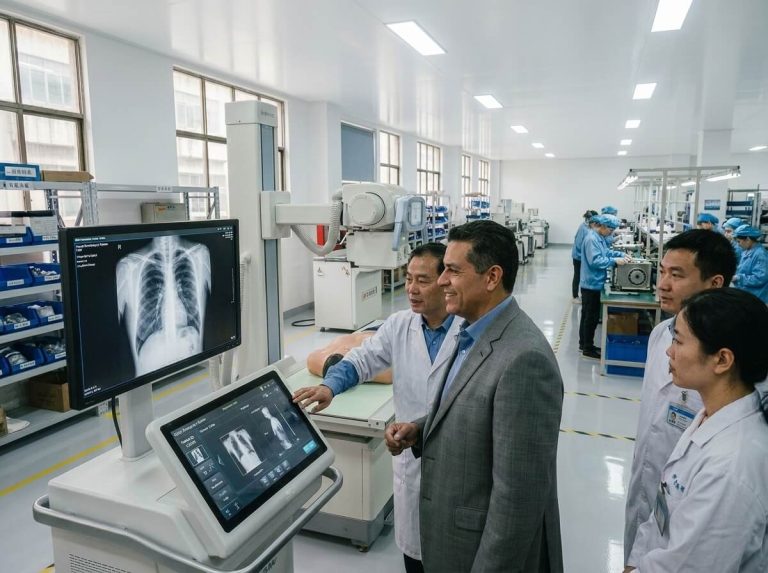
Setting up a computed tomography (CT) facility requires meticulous engineering, architectural planning, and strict adherence to radiation safety regulations. Installing a CT scanner is not simply a matter of moving a piece of equipment into a room; it requires dedicated structural reinforcement, specialized electrical transformers, precision climate control, and lead-lined radiation barriers.
Whether you are building a new diagnostic imaging suite or retrofitting an existing clinical space, this comprehensive guide covers the essential technical specifications for room dimensions, electrical supply, radiation shielding, and environmental controls.
1. Architectural Layout & Minimum Space Requirements
A standard CT scanner facility consists of three distinct, interconnected zones: the Scan Room, the Operator Control Room, and the Equipment/Technical Room.
┌──────────────────────────────────────────────────────────┐
│                     CT SCAN ROOM                         │
│  (Min 20–25 sq meters / Lead-lined walls & doors)        │
│  ┌──────────────┐         ┌─────────────────────────┐    │
│  │  CT Gantry   │         │  Patient Table (Couch)  │    │
│  └──────────────┘         └─────────────────────────┘    │
└───────────────────────────┬──────────────────────────────┘
                          │ Lead-Glass Window (2.0mm Pb)
┌───────────────────────────┴──────────────────────────────┐
│                    CONTROL ROOM                          │
│(Min 8–12 sq meters / Operator Console & PACS Workstation)│
└──────────────────────────────────────────────────────────┘
Scan Room Dimensions
-
Minimum Floor Space: 20 to 25 square meters (approx. 215 to 270 square feet).
-
Ceiling Height: Minimum clear ceiling height of 2.6 to 2.8 meters (8.5 to 9.2 feet) to accommodate overhead gantry maintenance clearance, cable carriers, and ceiling-mounted contrast injectors.
-
Service Access Path: Transport routes, elevators, and doorways from the unloading bay to the scan room must feature a minimum opening width of 1.5 to 1.8 meters and a height clearance of 2.1 meters to allow passage of the CT gantry.
Floor Loading Weight Capacity
CT gantries are heavy industrial components. A typical multi-detector CT gantry weighs between 1,800 kg and 3,500 kg (4,000 to 7,700 lbs), concentrating immense load over a small floor footprint.
-
The floor must be constructed of reinforced concrete with a minimum load-bearing capacity of 500 to 1,000 kg/m².
-
Architectural engineers must verify structural integrity, particularly when installing equipment on upper floors of a medical building.
2. Radiation Shielding & Safety Compliance
Radiation protection is governed by international standards (e.g., NCRP Report 147, IAEA guidelines) to protect clinical staff, patients in adjacent rooms, and the public.
Lead Shielding Specifications
-
Wall Shielding: Scan room walls require continuous sheet lead lining, typically 2.0 mm to 3.0 mm lead equivalence (Pb), extending from the finished floor up to a height of at least 2.1 meters (7 feet).
-
Control Room Viewing Window: The glass window separating the operator console from the scan room must be certified lead glass with at least 2.0 mm Pb equivalence.
-
Radiation Doors: Access doors must be heavy-duty, lead-lined doors fitted with interlocking safety switches that immediately abort exposure if a door is opened during a scan.
-
Floors and Ceilings: If the scan room is situated directly above or below occupied spaces, additional lead lining or high-density concrete floors (minimum 150 mm thick) are required.
┌──────────────────────────────────────────────────────────────┐
│                Radiation Shielding Baseline                  │
├───────────────────────────┬──────────────────────────────────┤
│ Scan Room Walls           │ 2.0 mm – 3.0 mm Lead Equivalent  │
│ Control Room Window       │ 2.0 mm Lead Glass                │
│ Access Doors              │ 2.0 mm Lead-Lined Core           │
│ Ceiling / Floor (Multi)   │ Certified Radiation Barrier Audit│
└───────────────────────────┴──────────────────────────────────┘
3. Electrical Infrastructure & Power Supply Layout
CT scanners draw immense electrical energy in short bursts during high-kV X-ray tube exposures. Unstable power lines cause image artifacts, component damage, and system shutdowns.
Electrical Specifications
-
Voltage Rating: Dedicated 3-phase, 5-wire electrical supply at 380V, 400V, 440V, or 480V AC (50/60 Hz).
-
Apparent Power Capacity: The main power line transformer must be rated for 75 kVA to 120 kVA depending on whether you are running a 16-slice or 320-slice system.
-
Voltage Regulation: Main power stability must stay within ±5% under full peak exposure load.
Uninterruptible Power Supply (UPS) & Clean Grounding
-
UPS Systems: A dedicated online double-conversion UPS (typically 15 kVA to 40 kVA) is required to supply emergency backup power to the detector electronics, computer console, and gantry cooling fans during a power outage.
-
Independent Grounding: The system requires an isolated, low-impedance ground line (ground resistance < 2 Ohms) to eliminate electrical noise that causes signal degradation in sensitive digital detectors.
4. HVAC & Environmental Climate Control
CT gantries, high-voltage X-ray generators, and image computing servers produce substantial thermal output. Maintaining constant ambient temperature and humidity is essential to prevent detector drift and tube overheating.
Temperature and Humidity Standards
-
Scan Room Temperature: Maintained strictly between 18°C and 22°C (64°F to 72°F).
-
Relative Humidity: Kept between 30% and 60% (non-condensing). Rapid humidity fluctuations cause moisture condensation on high-voltage connectors, triggering short circuits.
-
Heat Dissipation (HVAC Load): A typical CT suite generates 15,000 to 45,000 BTU/hr (4.5 to 13 kW) of heat during operation. Dedicated precision air conditioning units must operate 24/7.
-
Chiller Infrastructure: High-end CT scanners utilize liquid-to-air or liquid-to-water closed-loop heat exchangers (chillers) to cool the X-ray tube anode assembly continuously.
5. Network Infrastructure & IT Integration
A modern CT scanner generates gigabytes of DICOM data daily. Data bottlenecks slow down clinical workflows and delay diagnostic reporting.
-
Dedicated Data Drops: Minimum dual Cat6A or dedicated optical fiber lines connecting the CT operator console directly to the hospital network switch.
-
Network Speed: Minimum 1 Gbps bandwidth (10 Gbps recommended for multi-slice angiography and 3D volume rendering).
-
PACS / RIS Compatibility: System software must fully comply with DICOM 3.0 standards for Modality Worklist (MWL), Storage Commitment, and Modality Performed Procedure Step (MPPS).
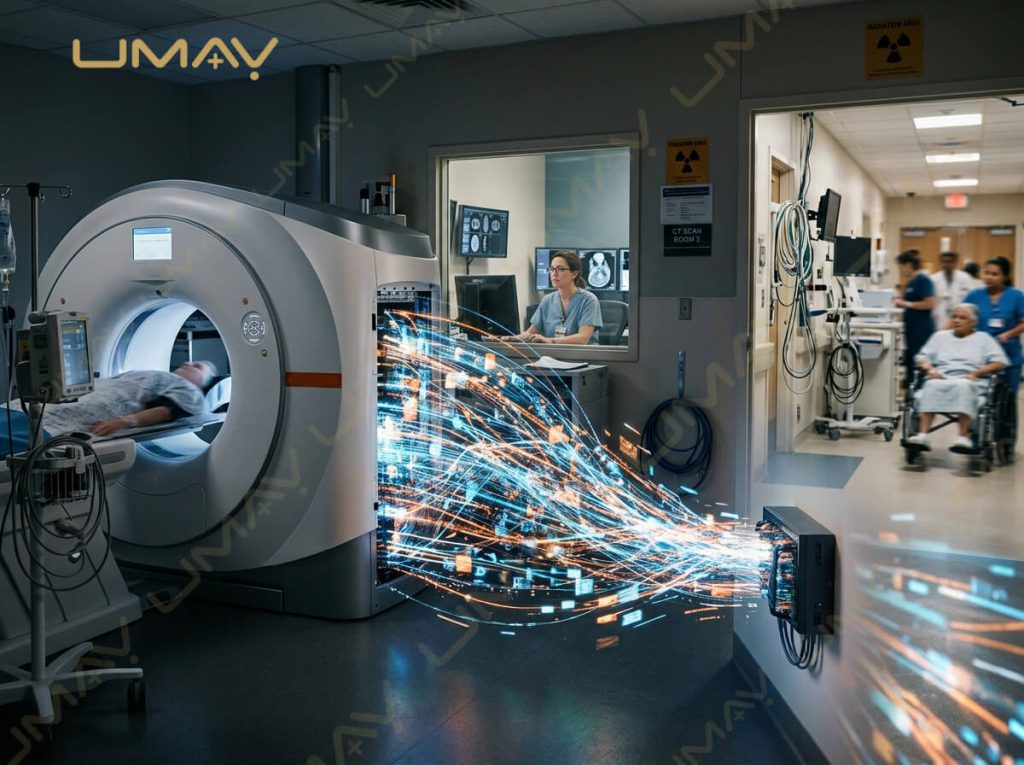
A CT scanner operating in a hospital radiology room with light trails illustrating high-speed data transfer to control workstation and PACS network.
6. Pre-Installation Site Preparation Checklist
Before the equipment delivery truck arrives, complete the following validation steps:
-
[x] Radiation Physics Survey: Obtain certified approval for room shielding plans from a licensed Medical Radiation Physicist.
-
[x] Path-of-Travel Clearance Audit: Verify doorway width, hallway turns, and elevator load capacities along the rigging route.
-
[x] Power Quality Testing: Test incoming 3-phase lines for voltage spikes, harmonic distortion, and grounding resistance.
-
[x] HVAC & Chiller Stress Test: Ensure air conditioning can maintain temperature stability under full heat-load simulation.
-
[x] Flooring Anchor Points: Mark gantry mounting locations and verify concrete floor thickness (minimum 100 mm to 150 mm solid slab).
7. Frequently Asked Questions (FAQ)
Q1: What is the minimum room size required for a CT scanner?
The minimum space required for a standard CT scan room is approximately 20 to 25 square meters (215 to 270 sq ft). An additional 8 to 12 square meters is needed for the operator control room, plus room for the electrical distribution cabinet.
Q2: How thick does lead shielding need to be for a CT room?
Most regulatory standards require wall lead shielding thickness between 2.0 mm and 3.0 mm lead equivalence (Pb). The exact requirement must be calculated by a certified medical physicist based on patient workload, beam orientation, and occupancy rates of adjacent rooms.
Q3: What kind of electrical power supply does a CT scanner need?
CT scanners require a dedicated 3-phase high-voltage power supply (380V to 480V) connected to a line transformer rated for 75 kVA to 120 kVA. A stable, grounded line with less than ±5% voltage fluctuation is required.
Q4: What happens if the CT room temperature gets too high?
Excess heat causes the X-ray tube to thermal-lock (shut down automatically to prevent damage) and introduces signal noise in detector crystals, leading to poor image quality or electronic board failure. Reliable 24/7 HVAC cooling is essential.