Why C-Arm X-Ray Machine Prices Are Different
Searching for C-arm X-ray machine price can produce a wide range of quotations.
This is normal because a C-arm is not a single standardized product.
Price can change according to:
- C-arm type
- Mobile or portable design
- Mini or full-size configuration
- Generator power
- X-ray tube
- Flat panel detector
- Image intensifier detector
- Detector size
- Image-processing software
- Fluoroscopy functions
- Dose-management functions
- Monitor configuration
- Workstation
- DICOM/PACS functions
- Accessories
- Warranty
- Installation
- Training
- Certification requirements
- Shipping destination
- Order quantity
- Customization
As a result, two suppliers may quote very different prices for products described using almost identical words.
The buyer needs to compare the configuration behind the price.
2. Main C-Arm Price Categories
From a purchasing perspective, C-arms can be broadly divided into several commercial categories.
| C-Arm Category | Typical Buyer | Main Pricing Factors |
|---|---|---|
| Mini C-arm | Orthopedic and extremity-focused facilities | Detector, compact design, software |
| Compact C-arm | Clinics and smaller ORs | Generator, detector, mobility |
| Mobile C-arm | General hospitals and surgical departments | Generator, detector, movement, software |
| Digital FPD C-arm | Hospitals requiring modern digital imaging | FPD, image processing, workflow |
| High-frequency C-arm | Hospitals and surgical centers | Generator, tube, imaging system |
| Portable C-arm | Facilities prioritizing mobility | Size, weight, power, imaging configuration |
| Customized C-arm | Distributors and project buyers | Configuration, OEM, certification |
These categories overlap, so the actual quotation still needs to be evaluated according to the technical configuration.
3. What Determines C-Arm X-Ray Machine Price?
3.1 Generator Power
Generator capacity is one of the specifications that can influence price.
A C-arm with a different generator configuration may be designed for a different workload and imaging requirement.
However, generator power should not be used as a standalone measurement of system value.
Compare:
- kW
- kV range
- mA range
- fluoroscopy modes
- pulse rate
- tube configuration
- operating limitations
A supplier should provide the complete generator specification rather than only stating “high-frequency generator.”
4. Detector Technology Has a Major Impact on Cost
Detector configuration is often one of the most important differences between C-arm systems.
Common configurations include:
Flat Panel Detector (FPD)
and
Image Intensifier (II).
An FPD C-arm can have a different cost structure depending on:
- Detector size
- Pixel pitch
- Active area
- Resolution
- Detector technology
- Acquisition rate
- Image processing
- Software package
The phrase digital C-arm alone does not provide enough information to compare prices.
A buyer should request the detector specifications in the quotation.
5. C-Arm X-Ray Tube and Generator Configuration
The X-ray tube also influences the overall equipment configuration.
Ask suppliers for:
- Tube manufacturer
- Tube model
- Focal spot
- Tube capacity
- Anode configuration
- Cooling characteristics
- Maximum voltage
- Current range
- Warranty
- Replacement cost
The X-ray tube is a long-term consideration because replacement can represent a significant maintenance expense.
A low initial purchase price does not necessarily mean a lower long-term equipment cost.
6. Software Can Change the Price
Two machines with similar hardware can have different prices because their software packages differ.
Depending on model and market, software options may include:
- Image enhancement
- Noise reduction
- Edge enhancement
- Image averaging
- Last-image-hold
- Digital image storage
- Cine-loop
- Measurement tools
- Annotation
- Image rotation
- Zoom
- Multi-image display
- Patient management
- DICOM
- PACS connectivity
When comparing C-arm suppliers, ask:
Which software functions are included in the standard quotation?
This prevents an apparently low quotation from becoming more expensive when necessary functions are added later.
7. Mobile C-Arm Price vs Mini C-Arm Price
A mini C-arm is generally more compact and is commonly associated with extremity-focused imaging.
A full-size mobile C-arm can offer a different combination of detector coverage, mechanical movement, generator configuration and workflow capabilities.
The purchasing decision should therefore consider:
- Intended procedures
- Anatomy
- Patient volume
- OR space
- Mobility requirements
- Imaging requirements
- Future expansion
Do not choose the smallest or cheapest machine simply because it has a lower purchase price.
8. New C-Arm vs Refurbished C-Arm
Buyers may encounter both new and refurbished C-arm X-ray machines.
A refurbished C-arm can sometimes have a lower initial acquisition cost, but the buyer should evaluate:
- Original manufacturing date
- X-ray tube condition
- Detector condition
- Generator condition
- Software version
- Service history
- Previous usage
- Replacement components
- Calibration
- Warranty
- Availability of spare parts
For refurbished equipment, documentation and service history become particularly important.
For a hospital establishing a new imaging service, a new system may offer more predictable warranty and support conditions.
9. China C-Arm X-Ray Machine Manufacturers
China is an important sourcing market for medical equipment, including C-arm X-ray systems.
When searching online, buyers may use terms such as:
- China C-arm X-ray machine manufacturer
- China mobile C-arm manufacturer
- C-arm X-ray machine supplier China
- C-arm factory China
- Digital C-arm manufacturer China
- FPD C-arm supplier China
- Portable C-arm manufacturer
- C-arm X-ray machine factory
- Chinese C-arm medical equipment supplier
- C-arm OEM manufacturer China
- C-arm ODM supplier
- Wholesale C-arm X-ray machine China
However, the term manufacturer should be verified.
Some companies are manufacturers, some operate production facilities through manufacturing partners, and some are trading companies.
Ask for evidence such as:
- Factory information
- Manufacturing capability
- Quality-management documentation
- Product documentation
- Technical support structure
- Production or assembly information
- Certifications applicable to the target market
10. How to Verify a C-Arm Manufacturer
A professional supplier should be able to answer specific questions.
Question 1: Where is the factory?
Request the manufacturing or production-site information.
Question 2: Who manufactures the X-ray system?
Determine whether the supplier manufactures the system directly or sources it from another factory.
Question 3: Which components are original?
Ask about:
- Detector
- X-ray tube
- Generator
- Monitor
- Software
- Mechanical components
Question 4: Can you provide technical documentation?
Request:
- User manual
- Technical specification
- Product catalog
- Test documentation
- DICOM information
- Certification documents
Question 5: Who provides after-sales service?
Determine whether support comes from:
- Manufacturer engineers
- Local distributor
- Authorized service partner
- Remote technical team
These questions can help distinguish a long-term manufacturer relationship from a simple trading transaction.
11. Why Manufacturer and Supplier Are Not Always the Same
The word supplier covers a much broader range of companies than “manufacturer.”
A medical equipment supplier may provide:
- One product
- Multiple product brands
- Factory-direct equipment
- Integrated hospital solutions
- OEM products
- ODM services
- Distribution services
For a single C-arm purchase, a specialized supplier can still be appropriate.
For a hospital project involving multiple departments, however, the buyer may prefer a supplier capable of coordinating several categories of medical equipment.
This is particularly relevant for international hospital procurement projects.
12. OEM and ODM C-Arm X-Ray Machines
Some distributors prefer to sell equipment under their own brand.
In this situation, ask whether the manufacturer supports:
OEM — Original Equipment Manufacturing
or
ODM — Original Design Manufacturing.
Possible customization may include:
- Brand name
- Logo
- Product label
- Packaging
- User manual
- Interface language
- Color or exterior elements
- Accessories
- Documentation
- Market-specific configuration
However, not every change is appropriate or allowed in every market.
For medical devices, regulatory and registration implications should be confirmed before requesting major product modifications.
13. C-Arm Certification and Regulatory Requirements
Certification is an important part of an international C-arm purchase.
The exact requirements depend on the destination country.
A buyer may need documentation related to:
- Medical device registration
- Electrical safety
- Electromagnetic compatibility
- Radiation safety
- Quality management
- Conformity assessment
- Import requirements
For example, the FDA regulates fluoroscopic X-ray systems in the United States under its radiation-emitting product and medical-device framework.
This does not mean that FDA documentation is automatically required for every country.
The key point is:
Check the destination market before selecting the supplier.
A product that can be legally marketed in one country may require additional registration or documentation in another.
14. C-Arm Shipping Cost
International buyers should not compare only the EXW or FOB equipment price.
The final landed cost may include:
- Product price
- Export packaging
- Inland transportation
- Port charges
- Ocean freight
- Air freight
- Insurance
- Customs clearance
- Import duties
- Local taxes
- Local transportation
- Installation
- Commissioning
For urgent projects, air freight may be considered, while larger equipment projects often use sea transportation.
Request quotations using clearly defined Incoterms such as:
- EXW
- FOB
- CIF
- DAP
- Other agreed terms
This makes supplier quotations easier to compare.
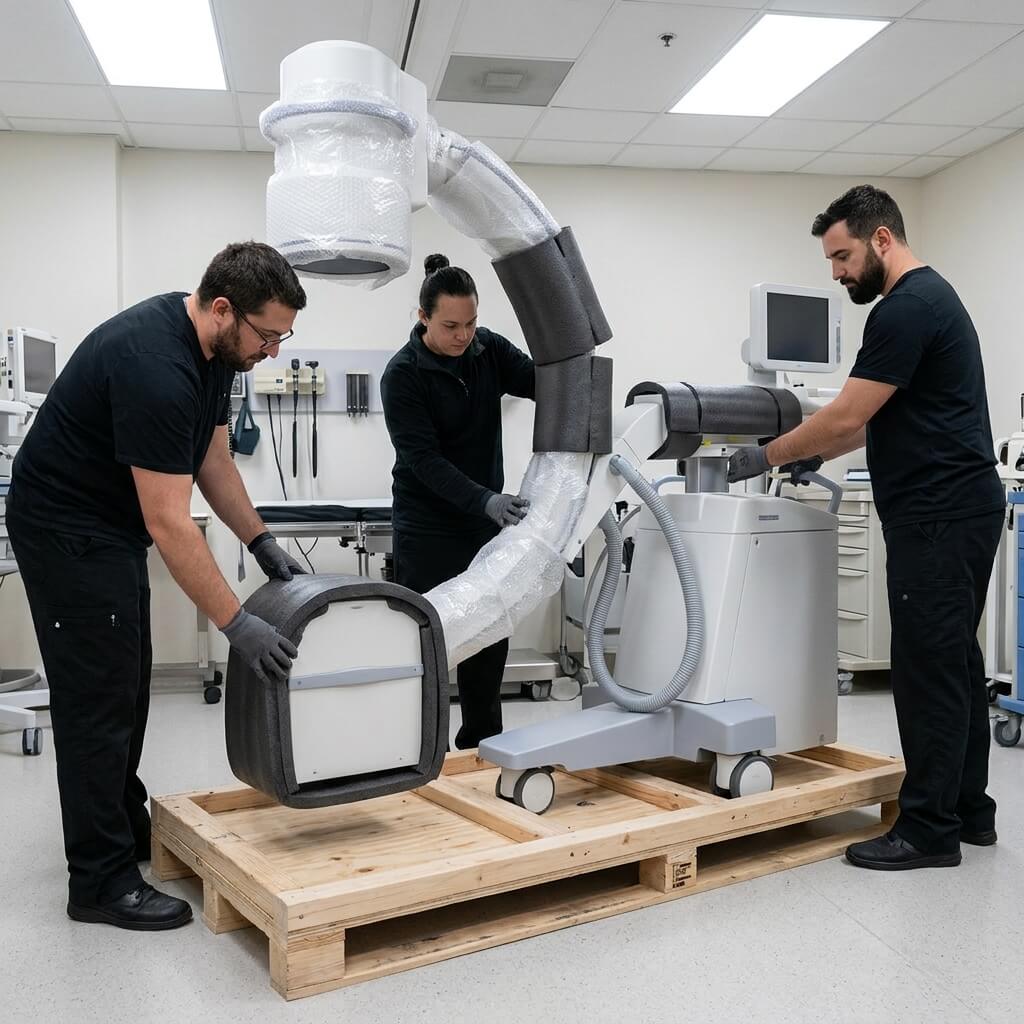
15. C-Arm Packaging and Transportation
A C-arm contains sensitive imaging and mechanical components.
Before shipment, confirm:
- Export packaging
- Shock protection
- Moisture protection
- Equipment fixation
- Wooden crate requirements
- Shipping dimensions
- Gross weight
- Net weight
- Number of packages
- Loading requirements
The buyer should also confirm whether the packaging is appropriate for long-distance international transportation.
16. Installation Cost
Some suppliers include installation in the equipment quotation.
Others charge separately.
Ask:
Is installation included in the C-arm price?
Also ask:
- Who performs installation?
- Is remote installation support available?
- Is on-site installation available?
- Who performs calibration?
- Who tests image quality?
- Who connects the PACS?
- Who trains operators?
These details can significantly affect the actual project cost.
17. Warranty: What Does the C-Arm Warranty Cover?
A “warranty” statement is not enough.
Ask for the exact warranty coverage.
Important components include:
- X-ray generator
- X-ray tube
- Detector
- Monitor
- Mechanical system
- Computer/workstation
- Software
- Accessories
Also clarify:
- Warranty duration
- Replacement policy
- Labor coverage
- Shipping responsibility
- Remote support
- On-site service
- Exclusions
For an international customer, ask:
Who pays the freight if a covered component needs to be returned?
This small question can prevent unexpected costs.
18. Spare Parts and Long-Term Maintenance
Before buying from an overseas supplier, check spare-part availability.
Common service-related considerations include:
- X-ray tube
- Detector components
- Cables
- Wheels
- Footswitch
- Monitor
- Computer
- Control board
- Mechanical components
- Power components
The supplier should provide information about parts availability and expected support.
A reliable supply chain is particularly important for hospitals that cannot afford prolonged equipment downtime.
19. C-Arm After-Sales Service for International Buyers
For international procurement, technical support can be just as important as initial pricing.
Look for:
- Remote troubleshooting
- Video training
- User manuals
- Installation guidance
- Software support
- Spare parts supply
- Engineer assistance
- Distributor training
- Service response process
A supplier should clearly explain what happens when an equipment problem occurs after installation.
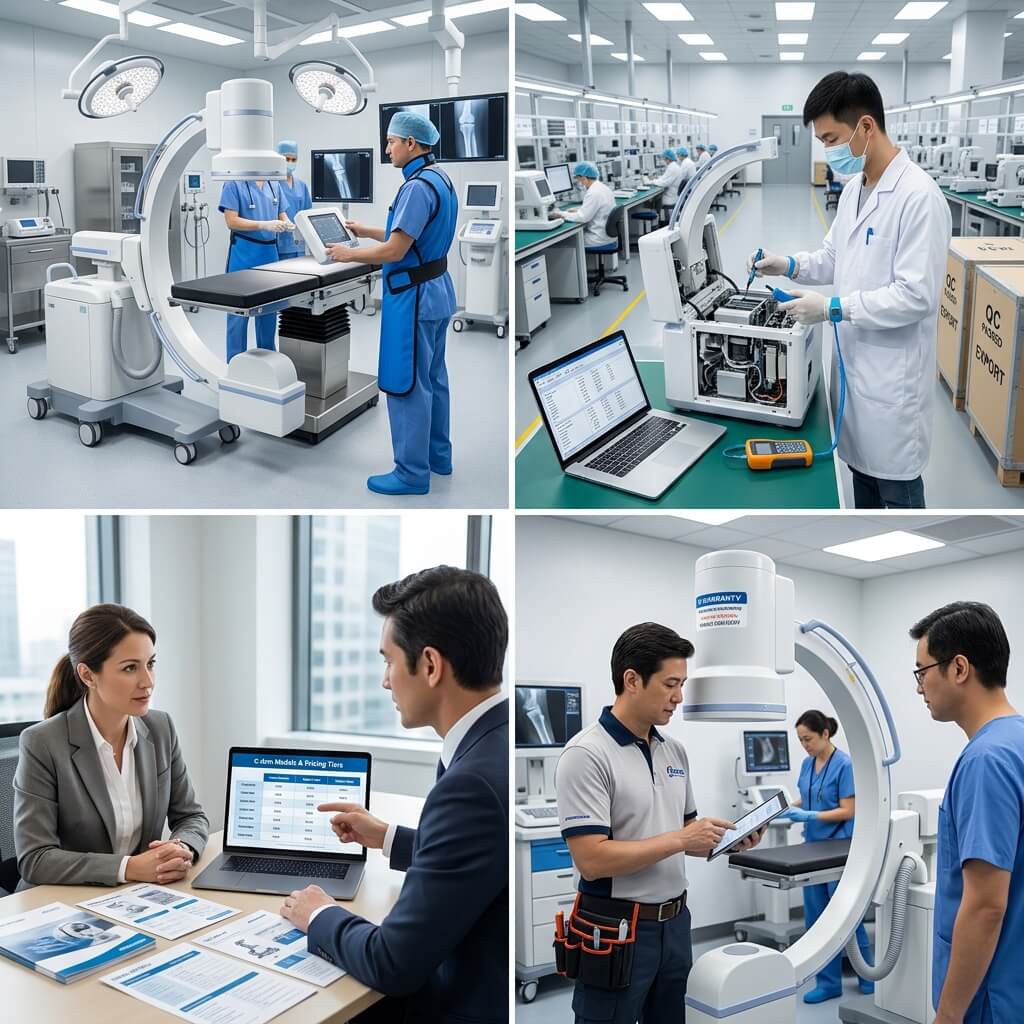
UMY Medical currently presents export support and a 7×24 online service team on its official contact page.
For an international purchase, this type of support structure can be relevant when evaluating the supplier’s service capability.
20. How to Reduce the Total Purchase Cost
Reducing equipment cost does not always mean negotiating the machine price aggressively.
Instead, optimize the complete purchase.
Purchase the required configuration
Avoid paying for functions that your department will not use.
Purchase accessories together
Some accessories may be less expensive when included in the initial order.
Compare multiple quantities
Distributors and hospital groups may receive better commercial terms for multiple units.
Negotiate spare parts
Consider requesting commonly needed spare parts as part of the purchase package.
Compare shipping terms
FOB, CIF and DAP can create different final landed costs.
Clarify warranty
A longer or more comprehensive warranty can reduce future risk.
Evaluate service
A low equipment price may not be economical if technical support is difficult to obtain.
21. UMY Medical as a C-Arm Supplier
UMY Medical’s current C-arm product range includes several mobile and digital configurations, including 5 kW mobile C-arm systems, FPD-based mobile C-arms, portable high-frequency C-arms and other digital C-arm configurations.
The company also states that it provides OEM services and one-stop medical equipment solutions.
For overseas buyers, the practical approach is to submit the intended application, required specifications, destination market and quantity so that the supplier can prepare a model-specific quotation.
For distributors, the discussion can additionally cover:
- OEM requirements
- Quantity
- Packaging
- Spare parts
- Warranty
- Certification
- Branding
- Delivery
- Technical support
This provides a more useful basis for supplier evaluation than comparing a single advertised price.
22. Questions to Ask a C-Arm X-Ray Machine Manufacturer
Before placing an order, ask these questions:
Product Questions
What C-arm model is suitable for our requirements?
What detector technology is included?
What are the generator and X-ray tube specifications?
What fluoroscopy modes are available?
What image-management functions are included?
Commercial Questions
What is the unit price?
What is the MOQ?
What is the lead time?
What payment terms are available?
What Incoterms are available?
Service Questions
How long is the warranty?
Are spare parts available?
Is remote technical support included?
Is installation available?
Is operator training included?
Compliance Questions
What certifications are available?
Can you provide product registration documents?
Can you provide a DICOM conformance statement?
Can you support our local registration process?
These questions allow a buyer to compare the complete supplier package.
23. C-Arm X-Ray Machine Buying Checklist for International Buyers
Before making the final purchase decision, confirm:
Product
□ Correct C-arm type
□ Appropriate generator
□ Appropriate detector
□ Required software
□ Suitable mechanical movement
Commercial
□ Final equipment price
□ Quantity discount
□ Shipping cost
□ Import cost
□ Payment terms
□ Lead time
Compliance
□ Destination-market requirements
□ Certification
□ Registration documentation
□ User documentation
Service
□ Warranty
□ Spare parts
□ Installation
□ Training
□ Remote support
□ After-sales process
Integration
□ DICOM
□ PACS
□ Electrical configuration
□ Hospital network compatibility
C-Arm X-Ray Machine FAQ
What is the price of a C-arm X-ray machine?
There is no single universal price. C-arm prices vary according to detector technology, generator, tube, software, mechanical configuration, accessories, certification and service requirements.
Why do C-arm suppliers offer different prices for similar machines?
Suppliers may use different detectors, X-ray tubes, generators, software packages, warranties, accessories and service conditions. The complete technical configuration should be compared before evaluating price.
Is a China C-arm X-ray machine cheaper?
Chinese suppliers can offer different price points depending on product configuration, production model, components, order quantity and export requirements. Buyers should compare complete specifications and total landed cost rather than assuming country of origin alone determines price.
How do I find a C-arm manufacturer in China?
Search terms such as “China C-arm X-ray machine manufacturer,” “mobile C-arm supplier China,” and “C-arm factory China” can help identify suppliers. Verify manufacturing capability, documentation, quality systems and after-sales support before purchasing.
Can I buy a C-arm directly from a factory?
Some manufacturers sell directly to hospitals, distributors and international buyers. Direct factory purchasing can simplify communication, but the supplier’s actual manufacturing and service capabilities should still be verified.
Can I buy a C-arm wholesale?
Yes. Medical equipment distributors can request wholesale pricing based on quantity. Ask for tiered pricing, spare parts, warranty, OEM options and delivery terms.
Can C-arm X-ray machines be customized?
Some suppliers offer OEM or ODM services, including branding, packaging, documentation and selected configurations. Medical-device regulatory requirements should be checked before making modifications.
Does the C-arm price include installation?
Not always. Installation may be included or quoted separately. Confirm installation, calibration, commissioning and training before signing the order.
Does the C-arm price include shipping?
Not necessarily. Always ask whether the quotation is EXW, FOB, CIF, DAP or another Incoterm.
What should I know about C-arm warranty?
Check the warranty period and determine whether it covers the detector, X-ray tube, generator, monitor, workstation and other major components.
What is the most important factor when buying a C-arm?
The most important factor is matching the complete system configuration to the intended workload. Technical performance, radiation-management features, workflow, service and total cost should all be considered.
Is the cheapest C-arm the best choice?
Not necessarily. The lowest purchase price may not represent the lowest total cost if the machine requires expensive maintenance, has limited documentation or lacks accessible technical support.