The Great Lighting Myth: Is a Brighter Surgical Headlight Always Better?
If you hand a surgical headlight brochure to a procurement officer, the first specification they typically check is the brightness output. In a market flooded with aggressive marketing, manufacturers often boast about producing the “brightest surgical headlamp on the market,” pushing outputs that exceed 100,000 Lux.
This creates a dangerous clinical misconception: Is brighter always better?
The clinical answer is unequivocally no.
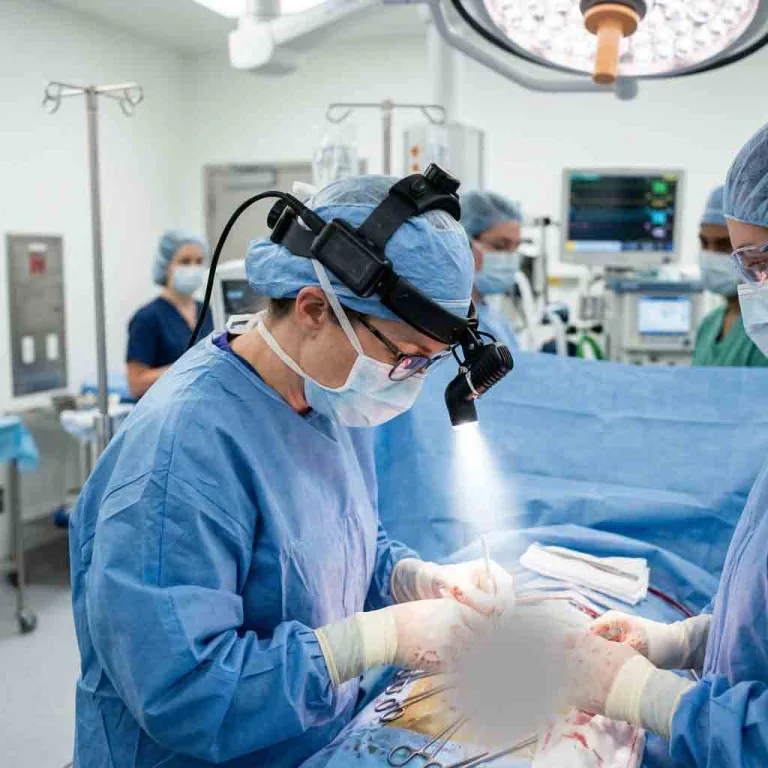
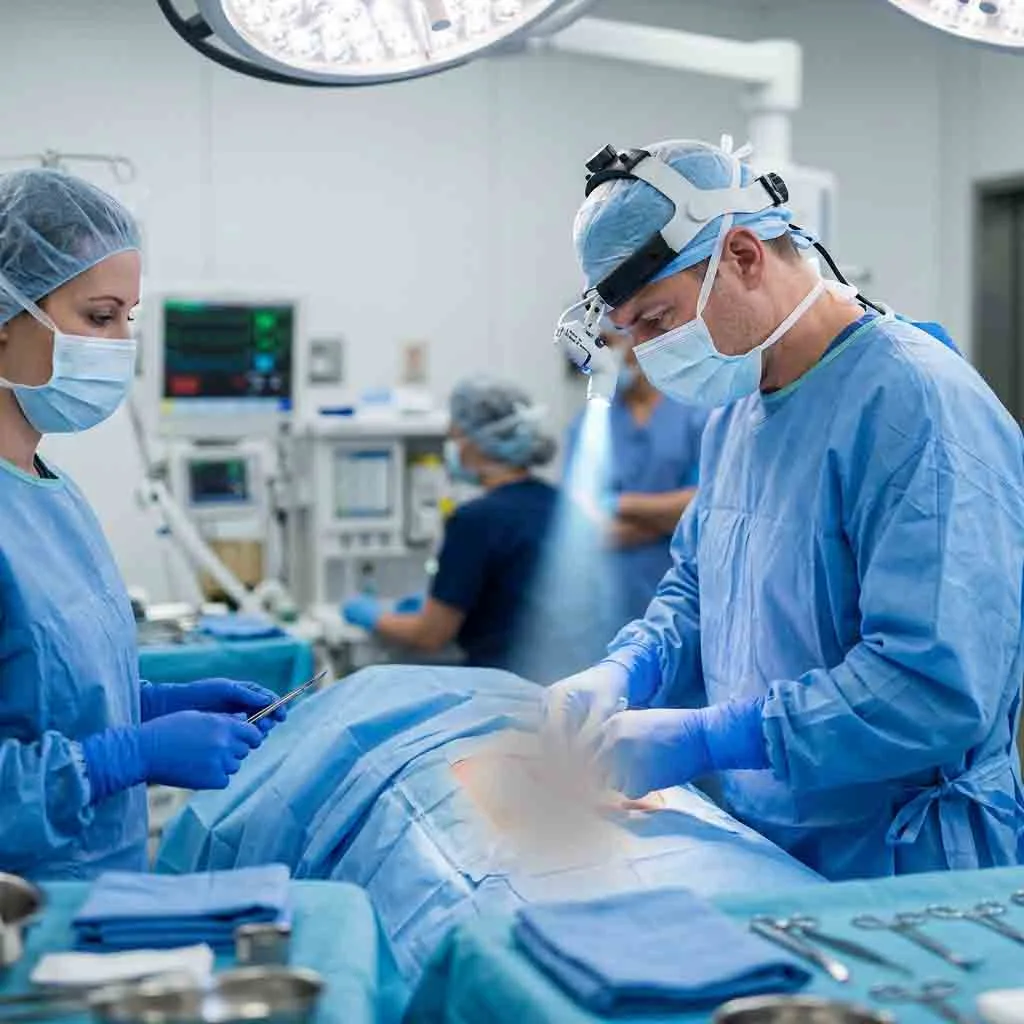
While a surgeon needs enough light to see down a narrow anatomical corridor, extreme brightness is highly counterproductive. When an overly bright LED beam hits wet, highly reflective surgical tissue (such as the mucosal lining, wet fascia, or pooled blood), it creates blinding glare. This glare rapidly exhausts the surgeon’s retinas, washes out subtle tissue details, and causes debilitating eye strain over a multi-hour procedure.
Instead of chasing maximum brightness, modern surgical procurement must focus on beam quality, color accuracy, spot uniformity, and sustained ergonomic power.
This comprehensive buyer’s guide breaks down the exact technical hardware specifications that hospitals, clinics, and equipment distributors must evaluate when sourcing professional medical headlights.
1. Demystifying Brightness: Medical Headlight Lux vs. Lumens
The lighting industry uses various metrics to measure light, but confusing them leads to poor procurement decisions. The two most misunderstood terms are Lumens and Lux.
What are Lumens?
Lumens measure the total amount of visible light emitted by a source in all directions. A standard household lightbulb may emit 800 lumens, scattering light across an entire room.
-
The Problem: In surgery, you do not want light scattered everywhere; you want it focused into a tiny, intense spot inside a surgical cavity. Therefore, a high-lumen rating on a medical headlight is largely meaningless if the optical lens fails to focus that light properly.
What is Lux?
Lux measures illuminance—the actual intensity of light that lands on a specific surface area at a specific distance (1 Lux = 1 Lumen per square meter).
-
The Clinical Metric: For surgical headlights, Lux is the only brightness metric that matters. It tells the surgeon exactly how intense the light will be when it hits the tissue at their working distance (typically measured at 35 cm to 40 cm away from the face).
The Ideal Lux Range for Surgery
Different clinical specialties require different illumination intensities:
-
Dental and General Exams (20,000 – 40,000 Lux): Perfect for general oral examinations and superficial dermatological procedures without causing glare off white tooth enamel.
-
General Surgery and ENT (40,000 – 70,000 Lux): The optimal “sweet spot” for most surgical disciplines, providing deep cavity illumination without washing out tissue margins.
-
High-Magnification Neurosurgery / Spine (70,000 – 90,000+ Lux): Deep cranial or spinal cavities require intense light, especially when the surgeon is wearing high-magnification loupes (4.0x to 6.0x), which naturally darken the visual field.
Procurement Tip: Always ask vendors at what distance their Lux is measured. A headlight claiming 100,000 Lux at a highly unrealistic 15 cm distance will be dangerously dim at a true surgical working distance of 40 cm.
2. The Science of Seeing: CRI and Color Temperature
If a surgeon cannot distinguish between a healthy nerve and an inflamed blood vessel, the surgery is fundamentally unsafe. The ability to see accurate tissue color is dictated by two highly specific LED metrics: the Color Rendering Index and Color Temperature.
Plaintext
                  THE SPECTRUM OF CLINICAL LIGHT
+-------------------------------------------------------------------------+
| COLOR RENDERING INDEX (CRI) | Accuracy of tissue color reproduction     |
| COLOR TEMPERATURE (Kelvin)  | The warmth or coolness of the white light |
+-------------------------------------------------------------------------+
Color Rendering Index (CRI 90+)
Natural sunlight has a perfect CRI of 100. It contains every wavelength of the color spectrum, allowing human eyes to see every hue perfectly.
Cheap commercial LEDs often have a CRI of 70 to 80. They are missing vital red and deep-red wavelengths. If a surgeon operates under a low-CRI headlight, red tissues (like oxygenated arterial blood, inflamed mucosa, and muscle fascia) will appear dull, gray, or washed out.
-
The Clinical Standard: A professional medical headlight must feature an LED with a CRI of 90 or higher (some premium units now reach CRI 95+). High-CRI LEDs ensure that the surgeon can instantly differentiate between a dark blue vein, a bright red artery, and pale nerve tissue.
Color Temperature (5500K)
Color temperature is measured in Kelvin (K). It describes whether the white light leans toward yellow (warm) or blue (cool).
-
3000K (Warm/Yellow): Typical of older halogen bulbs. The yellow tint masks subtle tissue inflammation and reduces overall contrast.
-
7000K+ (Cool/Blue): Many cheap LED headlights push the color temperature very high because it makes the light seem artificially “brighter.” However, heavy blue light distorts tissue colors and causes severe retinal fatigue.
-
5000K to 5500K (Daylight Balanced): The absolute gold standard for surgical headlamps. A color temperature of 5500K perfectly replicates crisp, midday sunlight. It provides maximum contrast with minimal eye strain.
3. Beam Quality: Adjustable Spot Size and Edge-to-Edge Clarity
The quality of the optical lens sitting in front of the LED chip is just as important as the LED itself. A poor lens creates a messy, blurry spot of light that distracts the surgeon.
Edge-to-Edge Uniformity
A premium surgical headlamp utilizes multi-element optical lenses to create a perfectly uniform spot.
-
The Flawed Spot: Cheap headlamps create a “hot spot” (a blindingly bright center) surrounded by a dim, yellow “halo” ring. The surgeon’s eyes are forced to constantly readjust between the bright center and the dark edges, causing rapid fatigue.
-
The Perfect Spot: A high-quality headlamp projects a crisp, perfectly round circle of light. The brightness is identical in the exact center of the circle as it is on the outer edge, with a sharp drop-off into darkness.
Adjustable Spot Size Headlamp
Anatomical targets change constantly. An ENT doctor checking an ear canal needs a tiny, tightly focused 3 cm spot of light. A general surgeon performing an open abdominal procedure needs a wide 12 cm spot.
-
When procuring headlights for multi-specialty hospitals, look for an adjustable spot size headlamp. By simply rotating the bezel on the LED housing, the surgeon can mechanically open or close an internal iris, changing the diameter of the light spot without moving their head.
4. Power Management: The Lithium-Ion Surgical Battery
An untethered surgeon is an efficient surgeon. Modern operating rooms have moved away from heavy fiber-optic cables plugged into wall consoles in favor of battery-powered mobility. However, battery failure mid-surgery is a critical safety hazard.
Lithium-Ion (Li-ion) and Lithium-Polymer (Li-Po) Technology
Modern surgical headlights rely exclusively on advanced lithium-based chemistries.
-
Benefits: They are exceptionally lightweight, do not suffer from “memory effect” (they can be recharged at any percentage without damaging the battery), and maintain a flat discharge curve.
-
Flat Discharge Curve: This is crucial. A cheap alkaline battery slowly dims as it dies. A medical-grade lithium-ion surgical battery utilizes an internal microprocessor to deliver a perfectly flat, consistent voltage to the LED. The light remains at 100% brightness for the entire surgery and simply shuts off only when the battery is completely empty.
Continuous Runtime vs. Surgical Duration
Procurement teams must match the battery runtime to the clinic’s workflow:
-
Short Procedures (Dentistry, Outpatient Exams): A small, lightweight battery providing 4 to 6 hours of continuous runtime is usually sufficient.
-
Long Procedures (Neuro, Cardio, Transplants): For grueling 8-to-12 hour cases, surgeons require high-capacity battery packs.
Hot-Swappable Battery Systems
For continuous hospital use, the best systems feature hot-swappable batteries. The surgeon wears a primary battery pack. When the low-battery warning indicator flashes (often a subtle beep or a momentary dimming of the light), a circulating nurse can pop out the dying battery and snap a fully charged replacement into the holster in seconds, without the surgeon ever breaking the sterile field or removing the headlight.
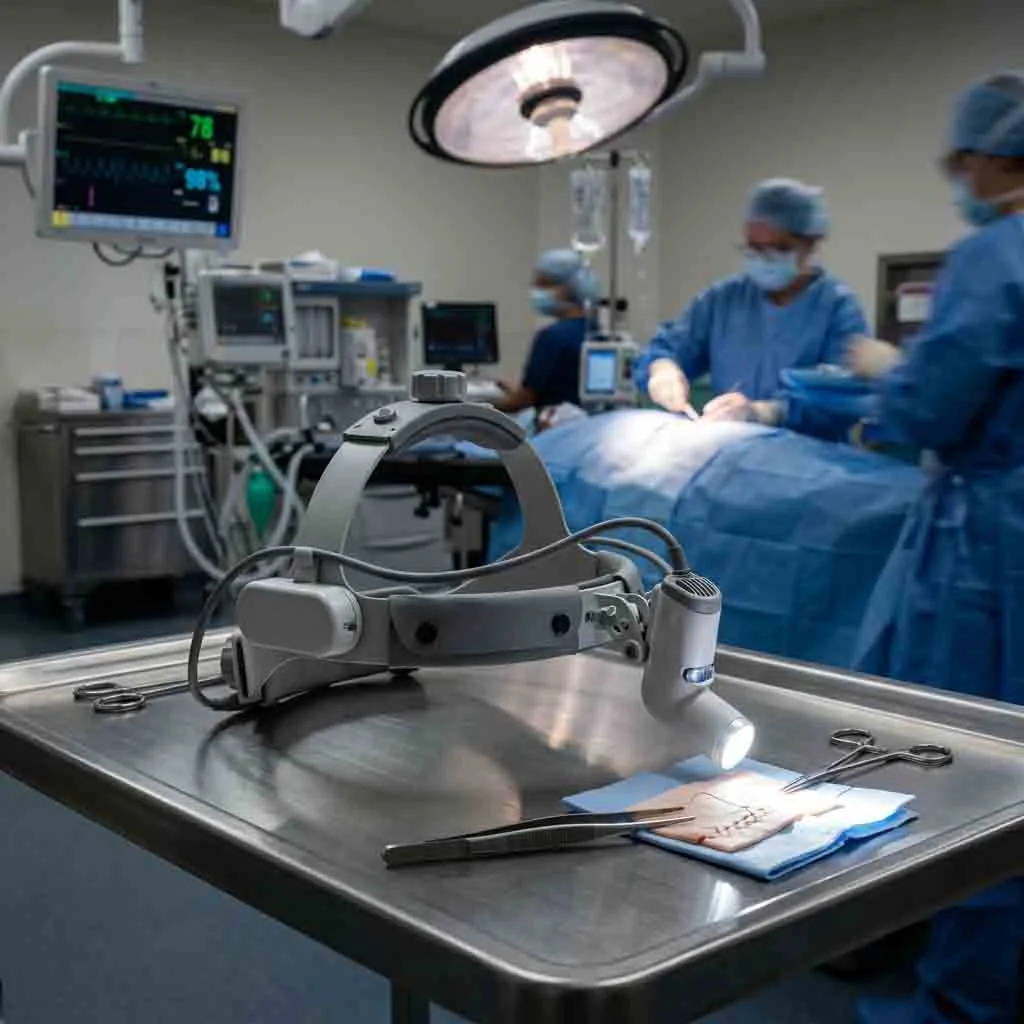
5. Ergonomics: Headlight Weight Distribution & Mounting Options
A surgical headlight must be worn for hours at a time. If the device is improperly balanced, the surgeon will experience localized pressure headaches on the forehead and severe strain on the cervical spine.
The Weight Factor
The total weight of the headlamp system should be heavily scrutinized.
-
The front LED optical module should weigh under 20 grams (many modern premium units weigh less than 10 grams).
-
Heavy aluminum housings pull the surgeon’s head forward, forcing the neck muscles to constantly fire to keep the head upright.
Mounting Options: Loupes vs. Headbands
Medical headlights are typically mounted in two distinct ways, depending on the specialty:
Plaintext
                     HEADLIGHT MOUNTING COMPARISON
+-------------------------------------------------------------------------+
| LOUPE-MOUNTED HEADLIGHTS                | FULL HEADBAND MOUNT           |
+-----------------------------------------+-------------------------------+
| - Clips directly to surgical glasses    | - Wraps around the entire skull|
| - Ultra-lightweight requirement (<15g)  | - Distributes weight evenly   |
| - Highly coaxial (aligned with eyes)    | - Ideal for larger, heavier LEDs|
| - Standard for Dental, Plastic, Spine   | - Standard for ENT, General OR|
+-------------------------------------------------------------------------+
-
Loupe Integrations (Clip-on Systems): For dentists, neurosurgeons, and vascular surgeons who already wear custom-fit magnification loupes (TTL – Through the Lens), the headlamp must clip directly onto the bridge of the glasses. Because the bridge of the nose bears the weight, these LED modules must be extraordinarily light.
-
Cranial Headbands: For surgeons who do not wear loupes, or require maximum brightness, a rigid or semi-rigid plastic headband is utilized. A high-quality headband features a dual-ratchet system (one dial tightens the circumference, the other adjusts the overhead cross-strap). This isolates the weight on the top of the skull, completely removing pressure from the forehead and the bridge of the nose.
6. Cable Management and Durability
A frequently overlooked specification in headlight procurement is the durability of the wiring. In a cordless headlight system, a thin wire connects the front LED module to the battery pack (which is usually clipped to the surgeon’s scrub belt or placed in a breast pocket).
-
The Failure Point: The most common reason a surgical headlight breaks is not a dead LED; it is a fractured copper wire caused by daily bending and pulling.
-
The Solution: Procurement officers should demand heavy-duty, reinforced cabling. Look for cables wrapped in Kevlar braiding or thick medical-grade silicone that resists fraying. Additionally, standardizing on systems that use durable, locking connectors (rather than fragile USB micro ports) prevents the cable from accidentally ripping out mid-surgery.
7. The B2B Procurement Evaluation Matrix
When hospital purchasing committees, clinical directors, or equipment distributors solicit bids for medical headlights, they must evaluate vendors against a standardized matrix. Use the following checklist to score competitive tenders:
| Specification Requirement | Minimum Acceptable Standard | Premium Clinical Standard |
| Target Illuminance (Lux) | 30,000 Lux @ 40 cm | 50,000 – 70,000+ Lux @ 40 cm |
| Color Rendering Index (CRI) | CRI > 85 | CRI $\ge$ 90 to 95 |
| Color Temperature | 4500K or 6500K | 5000K to 5500K (Daylight) |
| Optical Spot Quality | Fixed spot | Adjustable spot with uniform edge-to-edge clarity |
| Battery Chemistry | Standard Lithium-Ion | Medical-grade Li-Po with flat discharge curve |
| Continuous Runtime | 4 Hours | 8 to 12 Hours (Hot-swappable) |
| LED Module Weight | < 30 grams | < 15 grams (Ultra-lightweight) |
| Cable Durability | Standard PVC wire | Kevlar-reinforced with locking connectors |
Summary
Procuring the right medical headlight is an exercise in balancing optical physics with human ergonomics.
Purchasing decisions driven solely by claims of “maximum brightness” lead to blinding glare, tissue washout, and physician fatigue. By refocusing procurement tenders on the metrics that actually impact surgical success—a targeted Lux range of 30,000 to 70,000, a high CRI of 90+, daylight-balanced 5500K color temperatures, and lithium-ion surgical batteries supporting continuous runtime—hospitals can equip their surgical staff with tools that actively enhance clinical precision and career longevity.
While headlights solve the problem of deep cavity shadows, they represent only half of the operating room’s lighting equation. To understand the massive engineering behind ambient OR illumination, continue to our next guide.