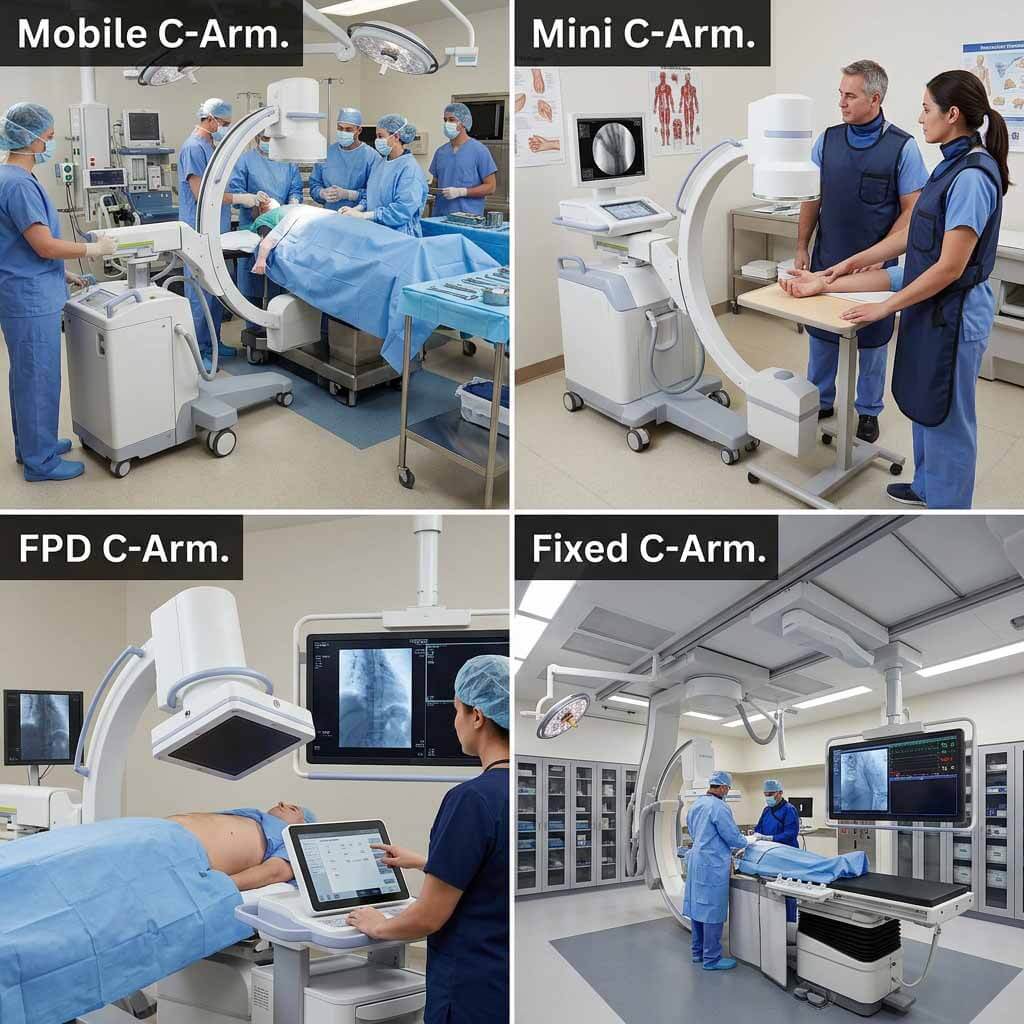
C-arm X-ray systems can be grouped according to size, detector technology, mobility, imaging capability, and clinical application.
Common types include:
- mobile C-arm
- mini C-arm
- full-size C-arm
- portable C-arm
- digital C-arm
- FPD C-arm
- image intensifier C-arm
- fixed C-arm
- high-frequency C-arm
- compact C-arm
- surgical C-arm
The right type depends mainly on the procedure, anatomical area, operating-room space, required imaging performance, and budget.
For example, a mini C-arm is generally associated with extremity procedures, while a full-size mobile C-arm can support a broader range of surgical applications.
An FPD C-arm uses a flat panel detector, while an image intensifier C-arm uses an image intensifier.
UMY Medical currently offers several mobile C-arm configurations, including FPD and high-frequency systems, for applications such as orthopedics, urology, gynecology, angiography, and medical imaging. (umymedical.com)
1. Mobile C-Arm
A mobile C-arm is designed to move between operating rooms or procedure areas.
It usually includes:
- mobile base
- C-shaped gantry
- X-ray tube
- image receptor
- generator
- monitor
- control system
The main advantage is flexibility.
Instead of permanently installing a fluoroscopy system in one room, the hospital can move the equipment to the location where imaging is needed.
Common Uses
Mobile C-arms are commonly considered for:
- orthopedic surgery
- trauma surgery
- spine procedures
- urology
- pain management
- general surgery
- operating-room imaging
Who Usually Needs a Mobile C-Arm?
Typical buyers include:
- hospitals
- surgical centers
- orthopedic departments
- trauma centers
- specialty clinics
The specific configuration should be selected according to the procedures.
2. Mini C-Arm
A mini C-arm is a compact C-arm primarily designed for extremity imaging.
It is particularly associated with:
- hand surgery
- wrist surgery
- foot surgery
- ankle surgery
- small-bone procedures
- outpatient orthopedic procedures
The smaller footprint can make positioning easier around the surgical site.
Why Choose a Mini C-Arm?
A mini C-arm may be appropriate when:
- most procedures involve extremities
- operating-room space is limited
- high system mobility is useful
- the hospital does not need full-body coverage
A facility focused mainly on hand and foot surgery may not need a full-size mobile C-arm.
3. Full-Size Mobile C-Arm
A full-size C-arm is designed for a wider range of procedures and anatomical regions.
It can potentially be used for:
- orthopedic surgery
- trauma
- spine surgery
- urology
- general surgery
- other image-guided procedures
Compared with a mini C-arm, a full-size system generally provides a larger working envelope and broader application range.
Full-Size C-Arm Advantages
Depending on the model, buyers may benefit from:
- broader field of view
- greater positioning flexibility
- larger detector options
- wider procedure coverage
The trade-off can be:
- larger footprint
- greater weight
- higher investment
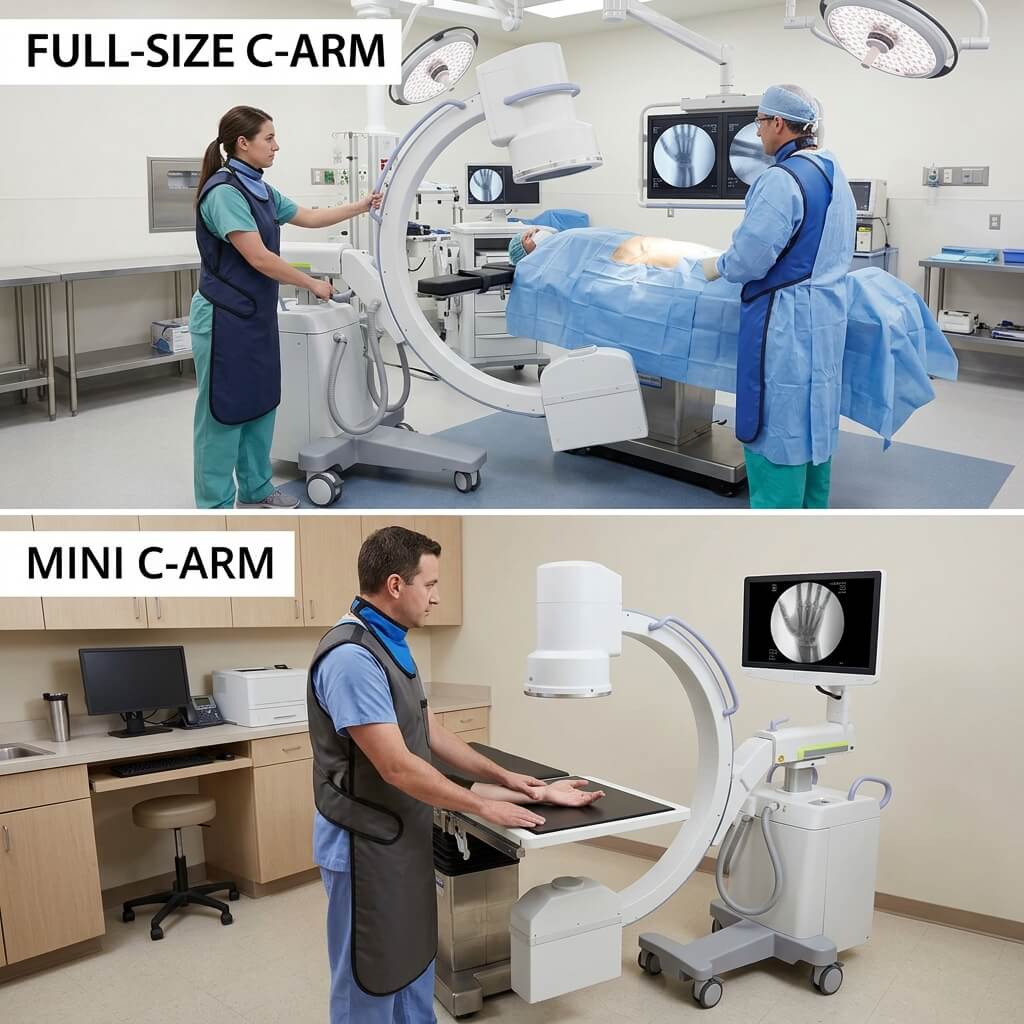
4. Mini C-Arm vs Full-Size C-Arm
This is one of the most useful comparisons for buyers.
| Feature | Mini C-Arm | Full-Size C-Arm |
|---|---|---|
| Main use | Extremities | Broader surgical use |
| Size | Compact | Larger |
| Mobility | High | High |
| Operating-room footprint | Smaller | Larger |
| Typical applications | Hand, wrist, foot, ankle | Orthopedics, trauma, spine, urology |
| Field of view | More limited | Broader |
| Portability | High | Moderate to high |
| Best for | Specialty orthopedic use | Multi-purpose surgical imaging |
Which One Should You Choose?
Choose a mini C-arm when the majority of procedures involve extremities.
Choose a full-size mobile C-arm when the hospital needs broader procedural coverage.
5. Portable C-Arm
The term portable C-arm is often used to emphasize ease of movement and transport.
However, “portable” does not have one universal technical definition.
When comparing portable systems, look at:
- overall weight
- dimensions
- wheelbase
- steering
- cable management
- monitor design
- setup time
- C-arm movement
A portable C-arm should be evaluated based on how easily it can actually be used within the target environment.
6. Digital C-Arm
A digital C-arm uses digital image acquisition and computer-based processing.
Compared with older analog workflows, digital systems can offer features such as:
- digital image display
- image storage
- image processing
- image review
- digital export
- DICOM functionality on supported models
Potential applications include:
- orthopedic surgery
- trauma
- urology
- general surgery
- pain management
The word “digital” alone does not define image quality.
Buyers should also compare:
- detector technology
- resolution
- image processing
- frame rate
- noise
- workflow
7. FPD C-Arm
An FPD C-arm uses a flat panel detector.
FPD stands for Flat Panel Detector.
Instead of an image intensifier, the detector uses a flat digital imaging panel.
Potential Characteristics
FPD systems can provide:
- flat detector geometry
- digital image acquisition
- compact detector design
- digital image processing
Important specifications can include:
- detector size
- pixel pitch
- active area
- spatial resolution
- DQE
- dynamic range
Not every FPD C-arm has the same image performance, so comparisons should always use the actual manufacturer specifications.
8. Image Intensifier C-Arm
An image intensifier C-arm uses an image intensifier for X-ray image conversion.
Image intensifiers have been widely used in fluoroscopy systems.
When considering an image intensifier C-arm, buyers may review:
- field of view
- image quality
- distortion
- detector design
- maintenance
- system age
- replacement availability
For existing hospitals, an image-intensifier system may still be appropriate depending on application, budget, and service requirements.
9. FPD C-Arm vs Image Intensifier C-Arm
This is a major technology comparison.
| Feature | FPD C-Arm | Image Intensifier C-Arm |
|---|---|---|
| Detector | Flat panel detector | Image intensifier |
| Physical shape | Flat panel | Intensifier housing |
| Digital architecture | Native digital detector | Different image conversion architecture |
| Image distortion characteristics | Different from II systems | May exhibit image-intensifier distortion |
| Common modern configuration | Yes | Established technology |
| Procurement focus | Detector performance, software, workflow | Intensifier condition, image quality, maintenance |
A buyer should compare the complete system rather than assuming one technology is automatically better.
10. FPD C-Arm vs Conventional C-Arm
“Conventional C-arm” can refer to older image-intensifier-based systems.
A newer FPD C-arm may offer a more modern detector architecture.
However, the comparison should include:
- detector
- image quality
- field of view
- dose management
- software
- storage
- DICOM
- service
- price
For a hospital replacement project, the complete lifecycle cost can be more important than the detector technology alone.
11. High-Frequency C-Arm
A high-frequency C-arm uses a high-frequency generator design for X-ray production.
High-frequency generators are widely used in modern diagnostic and fluoroscopic X-ray equipment.
Depending on the system, advantages can include:
- stable high-frequency power conversion
- compact generator design
- controlled X-ray output
When comparing high-frequency C-arms, the generator should be evaluated together with:
- X-ray tube
- detector
- fluoroscopy mode
- exposure control
- image processing
A high-frequency generator is one part of the imaging system, not a standalone measure of overall performance.
12. Compact C-Arm
A compact C-arm is designed around a smaller physical footprint.
This can be useful when:
- the operating room is small
- the procedure area is crowded
- mobility is important
- only a limited imaging field is required
A compact system may be particularly useful for:
- orthopedic procedures
- extremity surgery
- pain procedures
- smaller procedure rooms
However, buyers should check whether the smaller design still provides the required movement range and field of view.
13. Surgical C-Arm
The term surgical C-arm generally refers to a C-arm used for intraoperative imaging.
Common surgical applications include:
- orthopedic surgery
- trauma
- spine
- urology
- general surgery
A surgical C-arm should be evaluated around the procedure.
Important areas include:
- imaging quality
- detector size
- movement
- operating-room footprint
- fluoroscopy modes
- monitor
- workflow
14. C-Arm for Orthopedic Surgery
Orthopedic departments may choose either:
mini C-arm
or:
full-size mobile C-arm
depending on their procedures.
Mini C-Arm
Often suitable for:
- hands
- wrists
- feet
- ankles
- extremity procedures
Full-Size C-Arm
Often more appropriate when the department also performs:
- trauma surgery
- larger orthopedic procedures
- spine procedures
- implant fixation
The clinical workload should determine the system type.
15. C-Arm for Trauma
Trauma departments often need flexible imaging.
A full-size mobile C-arm can support procedures involving:
- fracture reduction
- fixation
- implant positioning
- intraoperative imaging
Important selection factors include:
- mobility
- detector coverage
- image quality
- movement
- setup speed
- operating-room compatibility
16. C-Arm for Spine Procedures
Spine procedures can require different imaging projections.
A full-size mobile C-arm may therefore be preferred over a mini C-arm.
Buyers should consider:
- C-arm travel
- orbital movement
- detector field of view
- image quality
- operating-table compatibility
The exact requirements depend on the procedure.
17. C-Arm for Urology
For urology, a C-arm can provide image guidance during selected procedures.
Relevant features may include:
- fluoroscopy
- positioning flexibility
- image display
- detector coverage
- workflow
A full-size mobile C-arm is generally more suitable for broader urological applications than an extremity-focused mini C-arm.
18. C-Arm for Pain Management
Pain-management procedures can involve image-guided injections and other interventions.
A compact mobile C-arm can be useful where:
- room size is limited
- mobility is important
- the procedure mainly targets specific anatomical regions
Selection should focus on the actual clinical workflow.
19. Fixed C-Arm
A fixed C-arm or fixed fluoroscopy system is installed in a dedicated procedure room rather than moved between rooms.
It can be suitable for facilities with:
- high procedure volume
- dedicated interventional rooms
- specialized imaging requirements
The main difference from a mobile C-arm is the installation concept.
Mobile
Flexible location
Fixed
Dedicated location
The correct option depends on workload and facility design.
20. Mobile vs Fixed C-Arm
| Feature | Mobile C-Arm | Fixed C-Arm |
|---|---|---|
| Installation | Mobile | Permanent |
| Room flexibility | High | Low |
| Shared use | Possible | Usually dedicated |
| Setup | Mobile positioning | Dedicated room |
| Space requirement | Storage + procedure space | Dedicated installation |
| Typical use | Surgery and multiple rooms | High-volume dedicated imaging |
For hospitals with multiple operating rooms, mobile systems can provide greater flexibility.
For high-volume specialized procedures, a dedicated system may be more appropriate.
21. Portable vs Mobile C-Arm
The terms are sometimes used interchangeably, but procurement teams should focus on actual specifications.
Ask:
- How much does the system weigh?
- Can it pass through standard doors?
- What is the wheelbase?
- How easy is steering?
- How quickly can it be positioned?
- How much storage space is required?
The actual dimensions matter more than the label.
22. Digital C-Arm vs Traditional C-Arm
A modern digital C-arm can provide digital acquisition and image-processing capabilities.
Potential differences include:
- image storage
- processing
- connectivity
- detector technology
- workstation
However, the word “digital” does not automatically describe every aspect of image quality.
Compare the actual technical specifications.
23. Single-Monitor vs Dual-Monitor C-Arm
Some C-arms use one monitor, while others provide dual-monitor configurations.
Single Monitor
Can provide:
- simpler design
- smaller footprint
- basic image viewing
Dual Monitor
Can allow the operator to display different information simultaneously, depending on system design.
For example:
- live image
- reference image
or:
- current image
- previous image
The appropriate configuration depends on the procedure and workflow.
24. C-Arm with FPD vs Image Intensifier: What Should Hospitals Consider?
When comparing detector technologies, consider:
Image
- resolution
- noise
- contrast
- field of view
Physical Design
- detector size
- system geometry
- operating-room clearance
Workflow
- image processing
- storage
- monitor
- connectivity
Maintenance
- detector replacement
- service
- spare parts
Budget
- purchase price
- installation
- maintenance
- lifecycle cost
The correct choice should be based on the hospital’s requirements.
25. Which C-Arm Type Is Best for Orthopedics?
For extremity-focused orthopedic procedures:
Mini C-arm
can be a practical option.
For broader orthopedic and trauma work:
Full-size mobile C-arm
may provide more flexibility.
For hospitals performing both types of procedures, the choice may depend on workload and whether a single system needs to serve multiple departments.
26. Which C-Arm Type Is Best for a Small Operating Room?
A compact or mini C-arm may be easier to position in a limited space.
However, room size should not be the only consideration.
Check:
- C-arm dimensions
- movement range
- detector size
- table compatibility
- monitor location
- clearance around staff
A small C-arm that does not provide sufficient imaging coverage may create limitations later.
27. Which C-Arm Type Is Best for a Hospital?
A hospital should first identify its procedures.
Primarily Extremity Orthopedics
Consider:
Mini C-arm
General Orthopedics and Trauma
Consider:
Full-size mobile C-arm
Multiple Departments
Consider:
Versatile mobile C-arm
Dedicated High-Volume Procedure Room
Consider:
Fixed or advanced specialized fluoroscopy system
The best configuration is based on clinical use, not simply equipment category.
28. Which C-Arm Type Is Best for a Clinic?
A clinic may prioritize:
- compact size
- simple operation
- manageable price
- mobility
- easy service
For an orthopedic clinic focused on extremities, a mini C-arm can be useful.
For a broader surgical clinic, a mobile full-size C-arm may be more appropriate.
29. Which C-Arm Type Is Best for Veterinary Use?
Veterinary imaging can require flexible positioning.
Depending on animal size and procedures, buyers may consider:
- compact C-arm
- mini C-arm
- mobile C-arm
Important considerations include:
- detector size
- portability
- durability
- cleaning
- battery
- image quality
The correct choice depends on the type and size of animals being examined.
30. C-Arm Type Selection by Application
| Application | Common Choice |
|---|---|
| Hand surgery | Mini C-arm |
| Wrist surgery | Mini C-arm |
| Foot surgery | Mini C-arm |
| Ankle surgery | Mini C-arm |
| General orthopedics | Full-size mobile C-arm |
| Trauma surgery | Full-size mobile C-arm |
| Spine surgery | Full-size mobile C-arm |
| Urology | Full-size mobile C-arm |
| Pain management | Compact/mobile C-arm |
| Multi-room hospital use | Mobile C-arm |
| High-volume dedicated room | Fixed/advanced system |
| Veterinary extremity imaging | Mini/compact C-arm |
These are general selection guidelines. Clinical and regulatory requirements should determine the final configuration.
31. How to Compare C-Arm Types Before Buying
A simple five-step approach can help.
Step 1: Identify the Procedures
List the procedures the machine must support.
Step 2: Define the Anatomical Area
Determine whether you need:
- extremity imaging
- full-body imaging
- spine imaging
- pelvic imaging
- other applications
Step 3: Determine the Required Mobility
Ask whether the C-arm needs to:
- move between rooms
- stay in one room
- move around different operating tables
Step 4: Select Detector Technology
Compare:
- FPD
- image intensifier
Step 5: Check Physical Requirements
Confirm:
- C-arm dimensions
- movement
- operating-room clearance
- monitor
- storage
This provides a much better basis for equipment selection.
32. How UMY Medical Fits Different C-Arm Requirements
UMY Medical Equipment Co., Ltd. currently provides several C-arm configurations rather than focusing on only one C-arm format.
Its current product category includes:
- 5 kW mobile C-arm
- FPD C-arm
- high-frequency mobile C-arm
- portable high-frequency C-arm
- digital C-arm systems
The listed applications include orthopedics, urology, gynecology, angiography, and medical imaging, depending on the model. (umymedical.com)
This range allows a buyer to start from the procedure and operating environment and then select an appropriate system configuration.
UMY Medical also states that it serves more than 1,100 healthcare entities in 168+ countries and regions, supported by more than 30 medical subsidiaries and 18 production bases. The company describes its wider portfolio as covering medical imaging, laboratory, surgical, dental, and other healthcare equipment. (umymedical.com)
For an international hospital or distributor, this broader product coverage may be useful when a C-arm is part of a larger medical-equipment project.
33. C-Arm Type Comparison for Procurement
Before choosing a system, create a comparison like this:
| Factor | Mini C-Arm | Mobile C-Arm | FPD C-Arm | Fixed C-Arm |
|---|---|---|---|---|
| Extremity use | Excellent fit | Suitable | Suitable | Possible |
| General surgery | Limited | Suitable | Suitable | Suitable |
| Mobility | High | High | High | Low |
| Detector | Digital/specialized | FPD/II | FPD | FPD/other |
| Room flexibility | High | High | High | Low |
| Multi-room use | Possible | Suitable | Suitable | Limited |
| Initial investment | Varies | Varies | Varies | Usually higher project scope |
| Main factor | Extremity procedures | Mobility | Detector/image workflow | Dedicated room |
Actual capabilities vary by model.
34. A Simple C-Arm Selection Decision Tree
Use this process:
Do you mainly perform extremity procedures?
Yes → Consider a mini C-arm.
No → Continue.
Do you need to move the system between rooms?
Yes → Consider a mobile C-arm.
No → Consider a fixed system where appropriate.
Do you prefer a flat panel detector?
Yes → Consider an FPD C-arm.
Do you need a broader surgical application range?
Yes → Consider a full-size mobile C-arm.
Is the operating room small?
Yes → Prioritize compact dimensions and maneuverability.
This is a starting point, not a substitute for a full technical evaluation.
Frequently Asked Questions
What are the main types of C-arms?
The main categories include mobile C-arms, mini C-arms, full-size C-arms, portable C-arms, digital C-arms, FPD C-arms, image-intensifier C-arms, fixed systems, compact C-arms, and high-frequency C-arms.
What is a mobile C-arm?
A mobile C-arm is an X-ray fluoroscopy system designed to be moved between procedure rooms or clinical locations.
What is a mini C-arm?
A mini C-arm is a compact system mainly designed for extremity and orthopedic procedures.
What is a full-size C-arm?
A full-size C-arm is designed for a broader range of surgical applications, including orthopedics, trauma, spine, urology, and other procedures.
What is an FPD C-arm?
An FPD C-arm uses a flat panel detector as its X-ray image receptor.
What is an image intensifier C-arm?
It is a C-arm that uses an image intensifier as its image receptor.
What is a digital C-arm?
A digital C-arm uses digital image acquisition and processing.
What is a portable C-arm?
A portable C-arm is designed to be moved relatively easily between locations. Actual portability depends on system weight and dimensions.
What is a high-frequency C-arm?
A high-frequency C-arm uses a high-frequency generator design for X-ray production.
What is a compact C-arm?
A compact C-arm is designed with a smaller physical footprint for applications where space and maneuverability are important.
What is the difference between a mini C-arm and a mobile C-arm?
A mini C-arm is generally optimized for extremity imaging, while a full-size mobile C-arm supports a wider range of surgical procedures.
What is the difference between FPD and image intensifier C-arms?
They use different image-receptor technologies. FPD systems use flat panel detectors, while image-intensifier systems use image intensifiers.
Is an FPD C-arm better than an image intensifier C-arm?
Neither should automatically be considered better. Compare image performance, workflow, maintenance, application, and total cost.
Which C-arm is best for orthopedic surgery?
A mini C-arm is often considered for extremity procedures, while a full-size mobile C-arm is more appropriate when the orthopedic department handles broader procedures.
Which C-arm is best for hand surgery?
A mini C-arm can be suitable for many hand and extremity procedures, subject to clinical and system requirements.
Which C-arm is best for spine surgery?
A full-size mobile C-arm is generally more suitable for procedures requiring broader imaging coverage and positioning.
Which C-arm is best for urology?
A full-size mobile C-arm is commonly considered for urological procedures requiring fluoroscopic guidance.
Which C-arm is best for a small operating room?
A compact or mini C-arm may be easier to maneuver, but the detector coverage and movement range must still meet the procedure requirements.
Which C-arm is best for a hospital?
The answer depends on the hospital’s procedure mix, workload, operating-room layout, and imaging requirements.
Which C-arm is best for a clinic?
The choice depends on whether the clinic mainly performs extremity procedures or needs broader surgical imaging.
Can a C-arm be used in multiple operating rooms?
A mobile C-arm can potentially be shared between compatible operating rooms, depending on hospital workflow.
Can a mini C-arm replace a full-size C-arm?
Usually not for every application. Mini C-arms are generally focused on extremities and may not provide the coverage required for broader procedures.
Can a full-size C-arm be used for hand surgery?
Yes, depending on the system, although a mini C-arm may offer a more compact solution for extremity-focused workflows.
What should I compare when buying a C-arm?
Compare application, detector type, detector size, generator, movement, imaging modes, image quality, software, operating-room footprint, connectivity, service, and total cost.
How do I choose between mobile and fixed C-arm?
Choose based on whether the equipment needs to be shared between rooms, the procedure volume, available space, and facility design.
How do I choose between FPD and image intensifier?
Compare image performance, field of view, physical design, workflow, maintenance, service, and budget.
Does a larger C-arm always provide better imaging?
No. Larger systems may provide broader coverage, but the appropriate system depends on the procedure and required imaging field.
Does higher generator power mean a better C-arm?
Not automatically. Generator power is only one part of overall system performance.
Is a portable C-arm the same as a mobile C-arm?
The terms can overlap, but buyers should compare actual dimensions, weight, mobility, and setup requirements.
What information should I give a C-arm supplier?
Provide the intended procedures, anatomical areas, preferred C-arm type, detector preference, operating-room conditions, required imaging modes, quantity, and target market requirements.
C-Arm Type Selection Checklist
Before purchasing, confirm:
Application
□ Orthopedic
□ Trauma
□ Spine
□ Urology
□ Pain management
□ General surgery
□ Veterinary
System Type
□ Mini C-arm
□ Mobile C-arm
□ Full-size C-arm
□ Compact C-arm
□ Fixed C-arm
Detector
□ FPD
□ Image intensifier
□ Detector size
□ Required field of view
Imaging
□ Fluoroscopy
□ Pulsed fluoroscopy
□ Radiography
□ Image processing
Physical
□ Operating-room footprint
□ C-arm movement
□ Wheelbase
□ Monitor
□ Storage
Digital
□ DICOM
□ PACS
□ Image storage
□ Data export
Commercial
□ Budget
□ Warranty
□ Spare parts
□ Installation
□ Training
□ Technical support
Conclusion
C-arms are available in several configurations, and each type is designed around different clinical and operational needs.
Mini C-arms are commonly associated with extremity procedures.
Full-size mobile C-arms provide broader surgical coverage.
FPD C-arms use flat panel detectors for digital image acquisition.
Image-intensifier C-arms use established image-intensifier technology.
Compact and portable C-arms focus on mobility and space efficiency.
Fixed systems are designed for dedicated procedure rooms.
The right choice depends on the combination of:
procedure → anatomy → detector → mobility → operating-room space → imaging requirements → workflow
For orthopedic clinics focused on hands and feet, a mini C-arm may be appropriate.
For hospitals handling trauma, spine, urology, and general surgical procedures, a full-size mobile C-arm may provide greater flexibility.
For facilities looking for a modern digital detector configuration, an FPD C-arm may be worth evaluating against an image-intensifier system.
UMY Medical Equipment Co., Ltd. currently provides multiple mobile C-arm configurations, including FPD and high-frequency systems, serving different surgical and medical imaging applications. (umymedical.com)
For buyers and distributors, the most effective approach is to define the required clinical applications first and then compare C-arm types according to detector technology, imaging capability, mobility, space, workflow, service, and total cost.
Choose the C-arm type around the procedure—not simply around the product name.