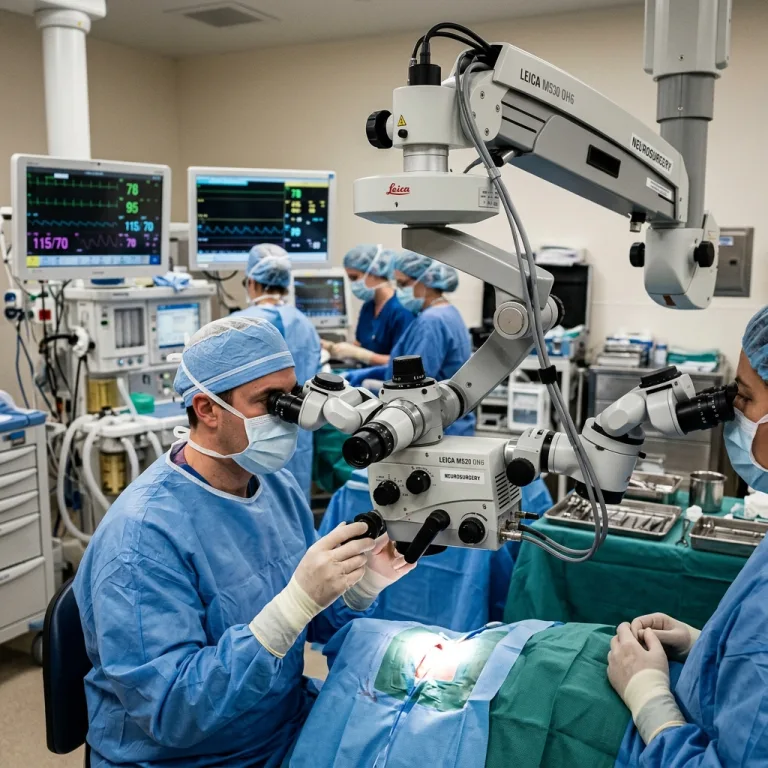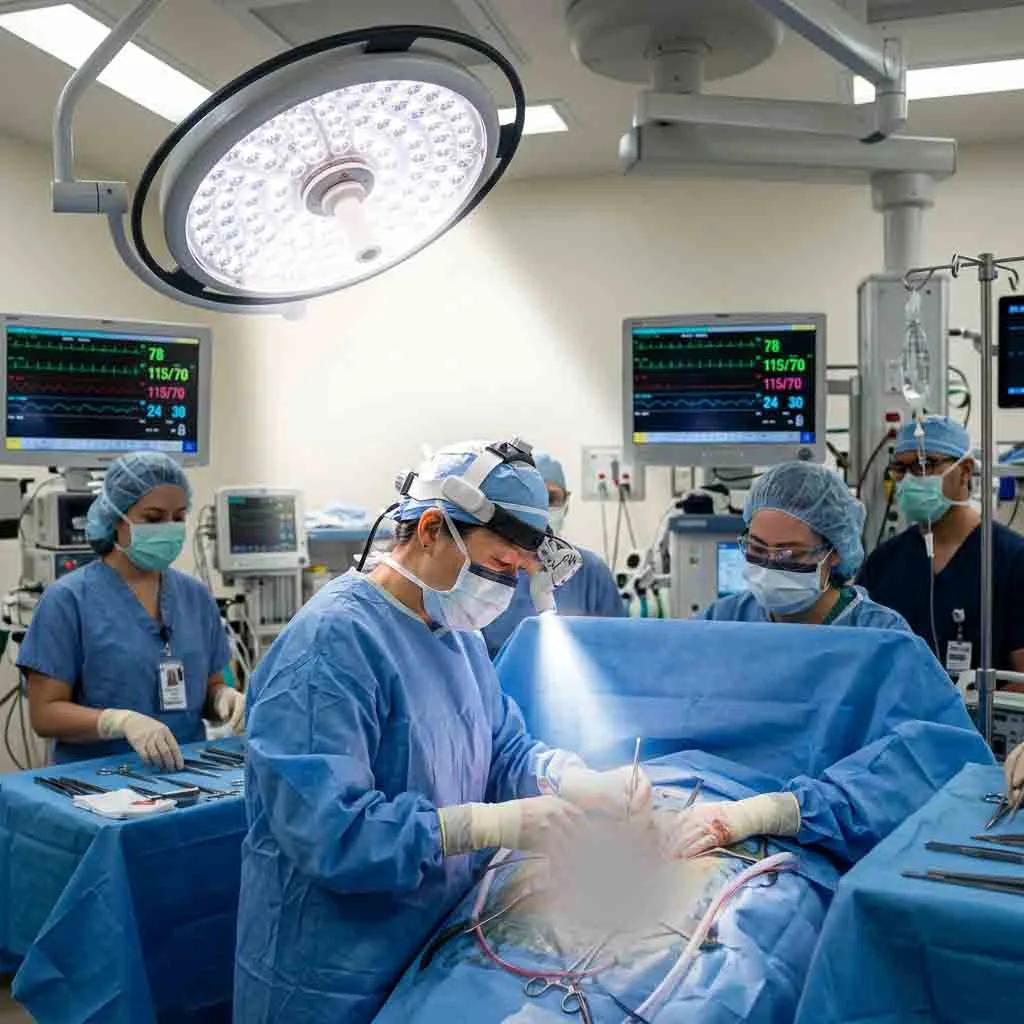
The Operating Room as a Dynamic Visual Ecosystem
In clinical facility design, there is a dangerous tendency to view equipment in isolation. A hospital procurement committee might spend weeks evaluating the specifications of a ceiling-mounted surgical dome, only to treat the surgeon’s wearable headlamp as an afterthought.
However, visual performance in the operating room does not rely on a single fixture. The surgical field is a highly dynamic environment. The patient’s anatomy shifts, retractors are adjusted, and the surgeon constantly moves their head and hands. In this fluid setting, a single light source—no matter how powerful or technologically advanced—will inevitably fail to illuminate every angle.
The future of surgical facility design relies on a systems-thinking approach. Building a surgical lighting ecosystem means understanding how ambient overhead illumination and targeted wearable optics interact to support human vision.
When a hospital masters its OR illumination strategy, the result is a safer, faster, and more ergonomically sustainable environment for the entire surgical team.
The Limitations of Isolated Lighting Solutions
To understand why a combined ecosystem is necessary, we must first examine what happens when clinical teams rely exclusively on one form of lighting.
The Flaw of “Overhead-Only” Lighting
As explored in previous guides, overhead surgical domes are marvels of shadow dilution. They use dozens of overlapping LED beams to wrap light around obstacles. However, they are fundamentally limited by geometry.
-
When a surgeon performs a deep pelvic dissection, a spinal laminectomy, or a neurosurgical craniotomy, they are looking down into a narrow tissue cylinder.
-
Because the overhead light sits at a fixed angle in the ceiling, the light hits the outer edges of the incision but cannot penetrate the bottom of the deep cavity.
-
The surgeon’s own head becomes an impenetrable physical barrier, creating a dangerous surgical blind spot right where the scalpel is working.
The Flaw of “Headlight-Only” Lighting
If overhead lights fail to penetrate deep cavities, why not turn them off entirely and just use a powerful medical headlight? This mistake is commonly made in outpatient clinics and dental offices, and it leads directly to severe physiological eye strain.
-
The Tunnel Vision Effect: A headlight produces a brilliant, highly concentrated spot of light. If the rest of the operating room is dark, the surgeon’s eyes are subjected to extreme visual contrast.
-
Pupillary Fatigue: When the surgeon looks down into the brightly lit cavity, their pupils constrict. When they briefly look up to ask the scrub nurse for an instrument in the dark room, their pupils dilate. Forcing the human eye to rapidly constrict and dilate hundreds of times an hour causes massive ciliary muscle fatigue, leading to blurred vision, tension headaches, and degraded clinical performance by the end of a long shift.
Combining Overhead Lights and Headlights: The Perfect Balance
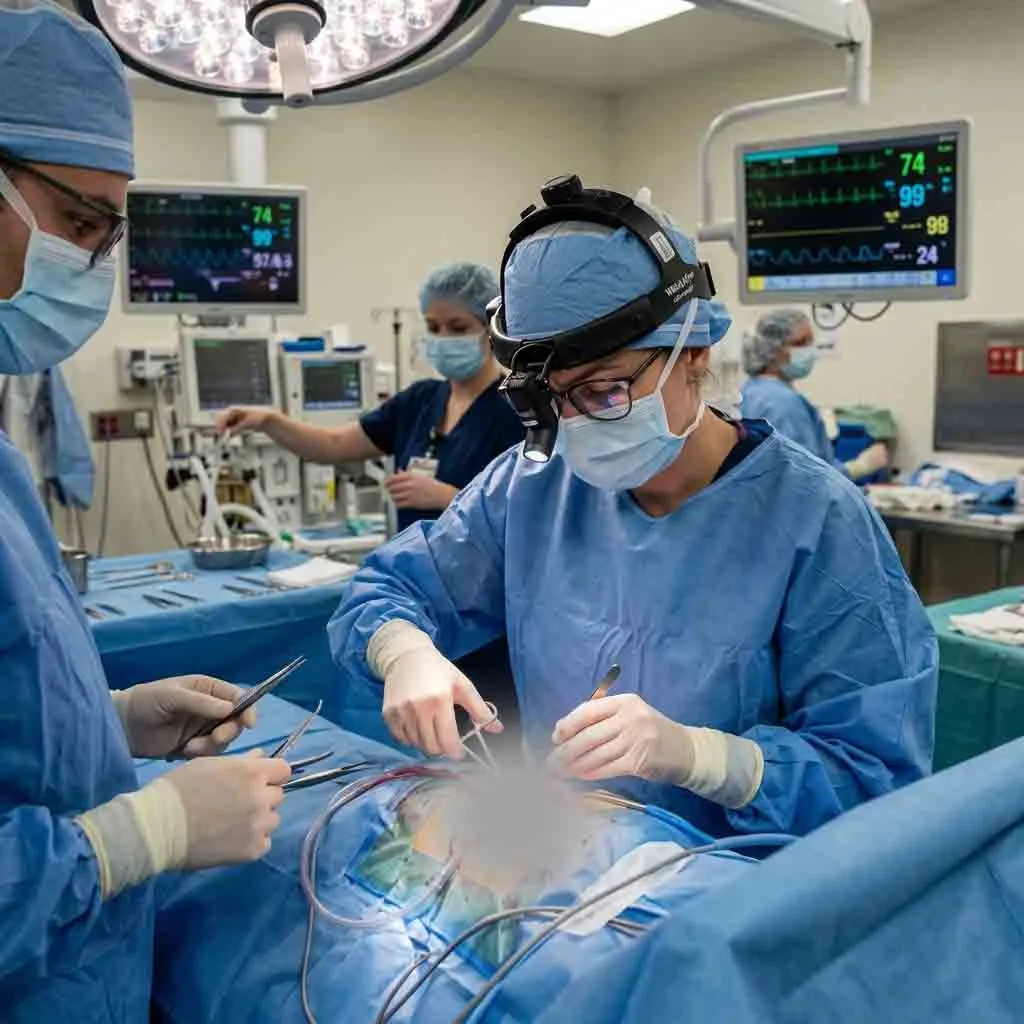
The ultimate solution for eliminating surgical blind spots is layering light. By combining overhead lights and headlights, clinical engineers create a balanced visual field that protects the surgeon’s eyes while delivering pinpoint accuracy.
Plaintext
               THE SURGICAL LIGHTING ECOSYSTEM MODEL
+-------------------------------------------------------------------------+
| LAYER 1: AMBIENT ROOM LIGHTING (Standard Ceiling Troffers)              |
| Purpose: Basic room navigation for anesthesiologists and circulating RNs|
|                                                                         |
| LAYER 2: OVERHEAD SURGICAL DOMES (Wide-Field Illumination)              |
| Purpose: Illuminates the entire sterile table, instrument trays, and    |
| surface-level anatomy. Prevents high-contrast pupillary fatigue.        |
|                                                                         |
| LAYER 3: MEDICAL HEADLIGHT (Coaxial Deep-Cavity Illumination)           |
| Purpose: Penetrates narrow incisions parallel to the surgeon's vision.  |
| Eradicates micro-shadows at the exact tip of the surgical instrument.   |
+-------------------------------------------------------------------------+
1. Contrast Normalization
In a properly integrated lighting ecosystem, the overhead surgical lights act as a high-intensity baseline. They bathe the entire surgical table in 100,000 to 160,000 Lux of light.
When the surgeon switches on their medical headlight (adding a focused 50,000 to 70,000 Lux spot into the cavity), the brightness transition from the edge of the incision to the center is smooth and gradual. The surgeon can look up at the scrub nurse or the vital sign monitors without their pupils having to violently adjust to the dark, eliminating visual exhaustion.
2. Team-Wide Visibility
Surgery is a team endeavor. A medical headlight only illuminates what the primary surgeon is looking at. If the surgeon turns their head to inspect a monitor, the surgical cavity suddenly goes dark for the surgical assistant and the scrub nurse.
Overhead surgical lights ensure that the baseline sterile field remains constantly illuminated, allowing the assistant to continue suctioning or preparing sutures safely, regardless of where the primary surgeon is looking.
3. Color Temperature Synchronization
A critical aspect of an integrated medical lighting strategy is ensuring that all light sources emit the exact same color temperature.
-
If a hospital pairs a warm, yellowish halogen overhead light (3000K) with a crisp, daylight-white LED surgical headlight (5500K), the conflicting color spectrums will distort tissue colors.
-
A synchronized ecosystem ensures that both the overhead domes and the wearable headlights operate at a matched daylight 5500K. This unified spectrum allows the surgeon to accurately judge vascular health and tissue perfusion without optical confusion.
Specialty Use Cases: Where the Ecosystem Shines
While general surface surgeries (like simple abdominal skin closures or superficial excisions) can often be performed with overhead lights alone, complex procedures absolutely demand the combined lighting ecosystem.
| Surgical Specialty | The Overhead Light’s Role | The Medical Headlight’s Role |
| Cardiothoracic (Open Heart) | Illuminates the massive open chest cavity, retractors, and sternal edges. | Spots fine coronary arteries for bypass grafting without casting shadows from the surgeon’s hands. |
| Spine & Orthopedics | Lights the wide sterile field and heavy orthopedic instrument trays. | Penetrates the narrow tubular retractors used in minimally invasive microdiscectomies. |
| Head & Neck / ENT | Provides ambient light for the scrub nurse handling dozens of micro-instruments. | Pushes coaxial light directly into the throat, nasal passages, or ear canal. |
| Plastic / Reconstructive | Provides uniform, shadow-diluted light to assess skin flap symmetry across the body. | Highlights microscopic blood vessels (under 1.0mm) during free-flap microvascular anastomosis. |
B2B Procurement: The Value of a Single-Source Supplier
For hospital procurement boards, regional healthcare networks, and medical device distributors, purchasing overhead lights and medical headlights from disparate vendors creates logistical and clinical headaches. Batteries degrade, color temperatures clash, and warranty claims become a tangled web of third-party dealers.
Building a true shadowless operating theater is vastly easier and more cost-effective when the entire lighting ecosystem is sourced from a single, vertically integrated manufacturer.
UMY Medical Equipment Co Ltd is uniquely positioned as a comprehensive factory-direct supplier capable of outfitting modern operating rooms from the ceiling grid down to the surgeon’s loupes.
The Synergies of Sourcing Through UMY Medical:
-
Perfect Optical Matching: Because UMY Medical engineers both their dual-dome overhead surgical lights and their wearable cordless headlights, the LED chipsets are perfectly synchronized. Both systems deliver identical 5500K daylight color temperatures and exceptional CRI > 90 ratings, preventing color distortion in the surgical cavity.
-
Streamlined Hospital Logistics: Facility managers deal with a single point of contact for installation diagrams, biomedical maintenance manuals, and replacement parts. Whether replacing a sterile handle on an overhead dome or ordering a backup lithium-ion battery for a headlamp, the supply chain is unified.
-
Wholesale Capital Efficiency: By bundling ceiling-mounted surgical lights and portable medical headlights into a single procurement tender, B2B distributors and hospital CFOs can leverage UMY Medical’s direct-factory pricing to drastically lower the Total Cost of Ownership (TCO) across their entire surgical department.
-
Uncompromising Quality: Operating under strict ISO 13485 quality management systems and CE directives, UMY Medical ensures that every component of your surgical lighting ecosystem—whether bolted to structural steel or worn on a surgeon’s head—meets rigorous international patient safety and electrical standards.
Conclusion: Lighting the Future of Surgery
This concludes our comprehensive 5-part masterclass on clinical illumination. Throughout this series, we have tracked the incredible technological evolution of surgical lighting—from the physical necessity of coaxial headlamps to the cold, shadow-diluted precision of modern LED ceiling domes.
We have learned that procuring surgical lights is not simply a matter of finding the brightest bulb. It requires a deep understanding of optical physics, physiological ergonomics, architectural constraints, and long-term financial modeling.
Most importantly, we have seen that the most effective operating rooms do not rely on isolated devices. By treating illumination as a comprehensive, integrated ecosystem—where overhead surgical lights and medical headlights work in perfect harmony—hospitals can permanently eliminate surgical blind spots.
When you empower a highly skilled surgeon with a flawless, shadow-free visual field, you directly elevate the standard of patient care. By partnering with a dedicated, certified manufacturer like UMY Medical Equipment Co Ltd, healthcare facilities worldwide can achieve this optical perfection efficiently, reliably, and cost-effectively.