How Do You Choose the Right Ultrasound Probe?
Choosing the correct ultrasound probe or ultrasound transducer is an important decision for hospitals, clinics and medical equipment distributors.
The right probe depends on:
- Clinical application
- Examination type
- Imaging depth
- Frequency requirements
- Ultrasound machine compatibility
- Image quality requirements
- Budget
- Supplier support
A common mistake is choosing a probe only based on price.
A more effective approach is:
Application → Probe Type → Frequency → Compatibility → Supplier Evaluation
For example:
- A cardiology department usually needs a phased array ultrasound probe.
- A vascular department often requires a high-frequency linear probe.
- An obstetrics department commonly uses a convex ultrasound probe.
- A gynecology department may require an endocavity ultrasound probe.
Understanding these factors helps buyers avoid purchasing unsuitable ultrasound transducers.
1. Why Choosing the Right Ultrasound Probe Matters
An ultrasound machine can only provide accurate imaging when the transducer matches the examination requirements.
The ultrasound probe directly affects:
- Image resolution
- Scanning depth
- Examination efficiency
- Diagnostic workflow
- User experience
Common search keywords:
- how to choose ultrasound probe
- ultrasound probe buying guide
- ultrasound transducer selection
- best ultrasound probe for different applications
- medical ultrasound probe guide
- ultrasound probe recommendation
2. What Factors Should Be Considered When Buying an Ultrasound Probe?
Before purchasing an ultrasound transducer, hospitals and distributors should evaluate several key factors.
Factor 1: Clinical Application
The first question should be:
“What will this ultrasound probe be used for?”
Different medical applications require different probe designs.
Abdominal Imaging
Recommended probe:
Convex ultrasound probe
Applications:
- Liver examination
- Kidney imaging
- Gallbladder examination
- Abdominal organs
Keywords:
- abdominal ultrasound probe
- abdomen ultrasound transducer
- curved array ultrasound probe
Why choose convex probes?
Because abdominal organs are located deeper inside the body and require stronger penetration.
Obstetrics and Pregnancy Ultrasound
Recommended probes:
- Convex probe
- 3D/4D ultrasound probe
Applications:
- Pregnancy monitoring
- Fetal examination
- Obstetric imaging
Keywords:
- pregnancy ultrasound probe
- obstetric ultrasound transducer
- fetal ultrasound probe
- 4D ultrasound probe
Cardiology
Recommended probe:
Phased array ultrasound probe
Applications:
- Echocardiography
- Heart examination
- Cardiac imaging
Keywords:
- cardiac ultrasound probe
- echo ultrasound probe
- echocardiography transducer
Why?
The heart is located behind ribs, and phased array probes have a small footprint suitable for cardiac scanning.
Vascular Examination
Recommended probe:
Linear ultrasound probe
Applications:
- Arteries
- Veins
- Blood vessels
- Vascular access
Keywords:
- vascular ultrasound probe
- Doppler ultrasound probe
- linear vascular transducer
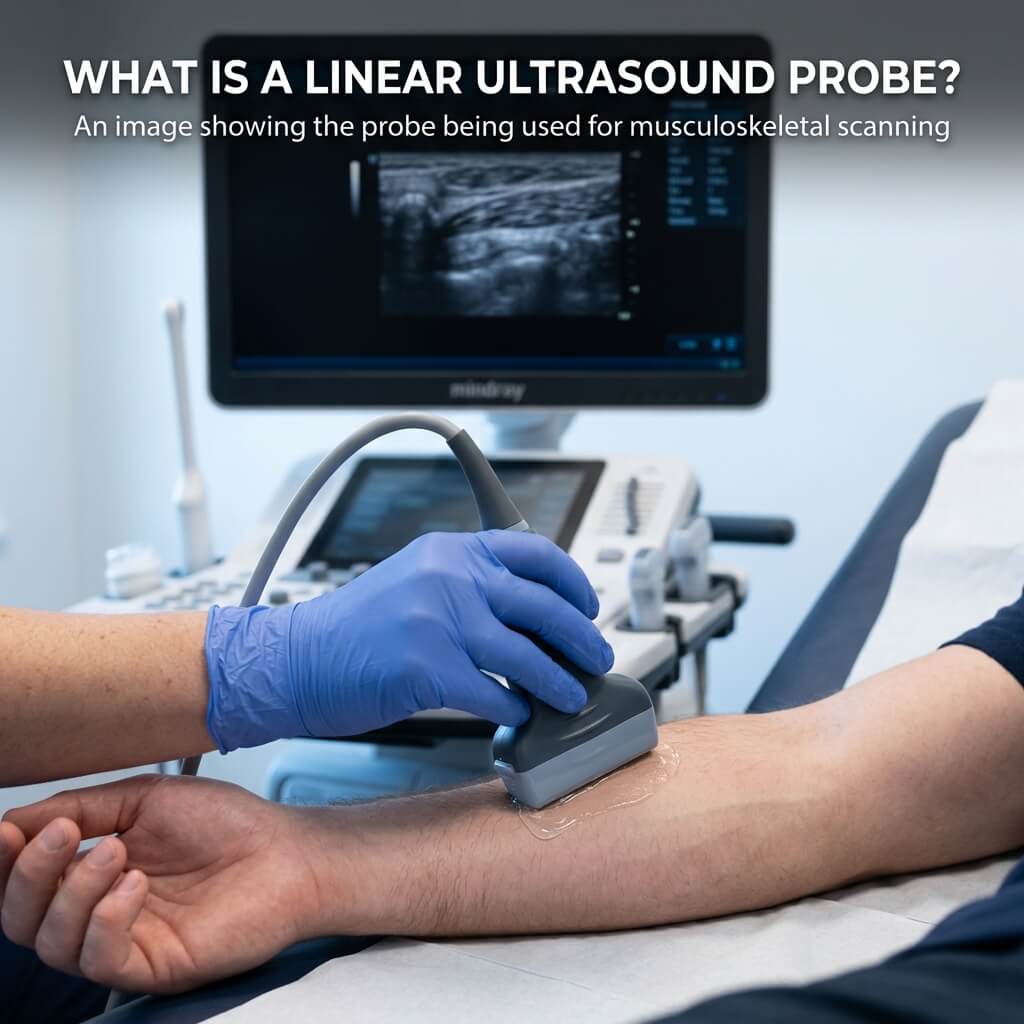
Musculoskeletal Ultrasound
Recommended probe:
High-frequency linear probe
Applications:
- Tendons
- Ligaments
- Muscles
- Joints
Keywords:
- MSK ultrasound probe
- musculoskeletal ultrasound transducer
- orthopedic ultrasound probe
Gynecology
Recommended probe:
Endocavity ultrasound probe
Applications:
- Pelvic examination
- Transvaginal imaging
- Reproductive health examination
Keywords:
- transvaginal ultrasound probe
- gynecological ultrasound probe
- endocavity transducer
3. Choose Ultrasound Probe Based on Frequency
One of the most important technical factors is ultrasound frequency.
Many buyers ask:
“What frequency ultrasound probe should I choose?”
The answer depends on the target anatomy.
High Frequency Ultrasound Probe
Usually:
- Higher resolution
- Lower penetration depth
Suitable for:
- Vascular imaging
- Thyroid examination
- Breast imaging
- Musculoskeletal imaging
Keywords:
- high frequency ultrasound probe
- high resolution ultrasound transducer
Low Frequency Ultrasound Probe
Usually:
- Greater penetration
- Lower image detail compared with high frequency probes
Suitable for:
- Abdomen
- Pregnancy
- Deep organs
Keywords:
- low frequency ultrasound probe
- deep imaging ultrasound transducer
Frequency Selection Rule
A simple guide:
Superficial Structure → Higher Frequency
Deep Structure → Lower Frequency
4. Ultrasound Probe Compatibility: A Critical Purchasing Factor
A common question from buyers:
“Can any ultrasound probe work with any ultrasound machine?”
The answer is:
No.
Ultrasound probes must match the ultrasound system.
Compatibility depends on:
- Connector type
- Electrical design
- Software support
- Manufacturer specifications
Common Ultrasound Probe Compatibility Searches
Many customers search:
- GE ultrasound probe
- Philips ultrasound probe
- Mindray ultrasound probe
- Siemens ultrasound probe
- Canon ultrasound probe
- Samsung ultrasound probe
Original vs Compatible Ultrasound Probe
Hospitals usually consider:
Original Manufacturer Probe
Advantages:
- Official compatibility
- Manufacturer support
Considerations:
- Usually higher cost
Compatible Replacement Probe
Advantages:
- More cost-effective
- Suitable for replacement needs
Considerations:
- Need reliable supplier confirmation
Questions Buyers Should Ask Suppliers
Before purchasing:
- Is this probe compatible with my ultrasound system?
- What connector type is used?
- Does it support my software version?
- Is testing available before shipment?
5. How Image Quality Affects Ultrasound Probe Selection
Image quality is one of the most important evaluation factors.
Important technical factors include:
Resolution
Resolution determines how clearly small structures can be displayed.
Important for:
- Thyroid imaging
- Breast examination
- Vascular imaging
Penetration Depth
Depth determines how deep the ultrasound beam can reach.
Important for:
- Abdominal imaging
- Pregnancy examination
Bandwidth
Bandwidth affects the range of frequencies the probe can operate.
A wider bandwidth may support more flexible imaging.
Sensitivity
Sensitivity affects the ability to detect weak returning ultrasound signals.
6. Ultrasound Probe Types and Their Buying Considerations
Linear Probe Buying Guide
Choose when you need:
- High resolution
- Superficial imaging
Suitable for:
- Vascular
- MSK
- Thyroid
- Breast
Key search terms:
- linear ultrasound probe price
- linear array transducer supplier
Convex Probe Buying Guide
Choose when you need:
- Deep penetration
- Large scanning area
Suitable for:
- Abdomen
- Pregnancy
Keywords:
- convex ultrasound probe supplier
- abdominal ultrasound transducer
Phased Array Probe Buying Guide
Choose when you need:
- Cardiac imaging
- Small footprint scanning
Keywords:
- cardiac ultrasound probe supplier
- phased array transducer
Endocavity Probe Buying Guide
Choose when you need:
- Internal examination
Keywords:
- endocavity ultrasound probe supplier
- transvaginal ultrasound probe
3D/4D Probe Buying Guide
Choose when you need:
- Volume imaging
- Advanced fetal imaging
Keywords:
- 4D ultrasound transducer supplier
- 3D ultrasound probe manufacturer
7. How Much Does an Ultrasound Probe Cost?
Many buyers search:
- ultrasound probe price
- ultrasound transducer cost
- ultrasound probe replacement price
The cost depends on:
Probe Type
Different technologies have different manufacturing complexity.
Examples:
- Linear probe
- Convex probe
- Phased array probe
- 3D probe
Frequency Range
Advanced frequency technologies may influence pricing.
Compatibility
Compatible probes require matching:
- Connector
- Electronics
- Software requirements
Manufacturing Quality
Important factors:
- Crystal quality
- Housing durability
- Cable quality
- Quality inspection
Supplier Service
Cost may include:
- Technical support
- Compatibility confirmation
- Warranty
- After-sales service
8. How Can Hospitals Reduce Ultrasound Probe Purchasing Costs?
Hospitals can reduce long-term expenses by:
1. Choosing the Correct Probe First
Avoid purchasing unsuitable probes.
2. Buying According to Actual Applications
Do not purchase unnecessary probe types.
3. Working With Reliable Suppliers
A professional supplier can help:
- Confirm compatibility
- Recommend suitable models
- Reduce replacement mistakes
4. Considering OEM Solutions
For distributors, OEM ultrasound probes may provide:
- Customized solutions
- Branding options
- Stable supply
9. OEM Ultrasound Probe Supplier Selection Guide
For distributors and medical equipment companies, OEM capability is important.
Common search keywords:
- OEM ultrasound probe supplier
- ultrasound transducer manufacturer
- private label ultrasound probe
- ultrasound probe factory
What Should OEM Buyers Evaluate?
Manufacturing Capability
Check:
- Production experience
- Quality management
- Testing process
Product Range
A capable supplier should provide different probe categories:
- Linear probes
- Convex probes
- Cardiac probes
- Endocavity probes
- Wireless probes
Customization Ability
Possible requirements:
- Branding
- Packaging
- Product configuration
- Market-specific solutions
10. How to Choose a Reliable Ultrasound Probe Supplier?
For international procurement, supplier selection is as important as product selection.
Consider:
Medical Industry Experience
A supplier should understand:
- Clinical applications
- Hospital requirements
- Technical specifications
Quality Control
Important areas:
- Product testing
- Inspection procedures
- Performance verification
Export Experience
International buyers should consider:
- Documentation support
- Shipping experience
- Communication efficiency
After-Sales Support
Important services:
- Technical assistance
- Product guidance
- Replacement support
11. Why Consider UMY Medical Equipment Co., Ltd.?
For global healthcare buyers, selecting a reliable medical equipment partner can simplify procurement.
UMY Medical Equipment Co., Ltd. is a China-based medical equipment supplier providing healthcare solutions for hospitals, clinics and distributors worldwide.
With more than 20 years of experience in medical equipment supply, UMY Medical provides solutions covering:
- Medical imaging equipment
- Ultrasound systems
- Laboratory equipment
- Operating room equipment
- Other healthcare products
The company supports international customers through:
- OEM/ODM services
- Customized requirements
- Project communication
- Export support
For ultrasound-related projects, UMY Medical focuses on understanding customer requirements, including:
- Application scenarios
- Ultrasound system compatibility
- Market needs
- Equipment configuration
12. Ultrasound Probe Buying Checklist
Before ordering, buyers can review this checklist:
Application
☐ Examination type identified
☐ Department requirements confirmed
Technical
☐ Correct probe type selected
☐ Frequency suitable
☐ Image quality requirements confirmed
Compatibility
☐ Ultrasound machine model confirmed
☐ Connector confirmed
☐ Software compatibility checked
Supplier
☐ Manufacturing capability
☐ Quality control
☐ Technical support
☐ Warranty service
13. Frequently Asked Questions About Choosing Ultrasound Probes
Which ultrasound probe is best?
The best probe depends on the application. Different examinations require different transducers.
Which probe is used for pregnancy?
A convex ultrasound probe is commonly used for pregnancy examinations.
Which probe is used for heart ultrasound?
A phased array ultrasound probe is commonly used for cardiac imaging.
Which probe is used for blood vessels?
A high-frequency linear ultrasound probe is commonly used for vascular imaging.
Can I use one probe for all examinations?
Usually not. Different applications require different probe designs.
How do I know if a probe is compatible?
Check ultrasound system model, connector type and supplier compatibility information.
Should hospitals buy original or compatible probes?
The choice depends on budget, compatibility requirements and supplier reliability.
Conclusion
Choosing the right ultrasound probe requires understanding:
- Clinical application
- Probe type
- Frequency
- Compatibility
- Image quality
- Supplier capability
A suitable ultrasound transducer improves workflow efficiency and helps healthcare professionals obtain better diagnostic information.
For hospitals, clinics and distributors, the correct purchasing strategy is not simply choosing the cheapest probe.
The goal is selecting a reliable ultrasound probe solution that matches:
Medical Application + Ultrasound System + Long-Term Service Requirements
A professional supplier with technical knowledge and international experience can help buyers make better decisions.