Three Questions Every BSC Buyer Should Answer
Before comparing prices or asking a microbiological safety cabinet supplier for a quotation, answer three questions:
What are you handling?
Who needs protection?
What level of containment does the work require?
These questions are more useful than starting with cabinet dimensions or a product model.
A microbiological safety cabinet, also called a biological safety cabinet, biosafety cabinet, or BSC, is a primary containment device used for certain laboratory procedures involving biological materials that may create aerosols or other exposure risks.
The correct cabinet depends on the work, the risk assessment, the protection required, the airflow design and the installation environment.
The current CDC-NIH Biosafety in Microbiological and Biomedical Laboratories, 6th edition, continues to emphasize protocol-driven risk assessment rather than assuming that one cabinet type is appropriate for every laboratory activity. BMBL 6th Edition was updated by CDC in March 2026.
This guide explains the main microbiological safety cabinet types, what each class is designed to do, how airflow works, where different configurations are used, and what international buyers should check before placing an order.
What Is a Microbiological Safety Cabinet?
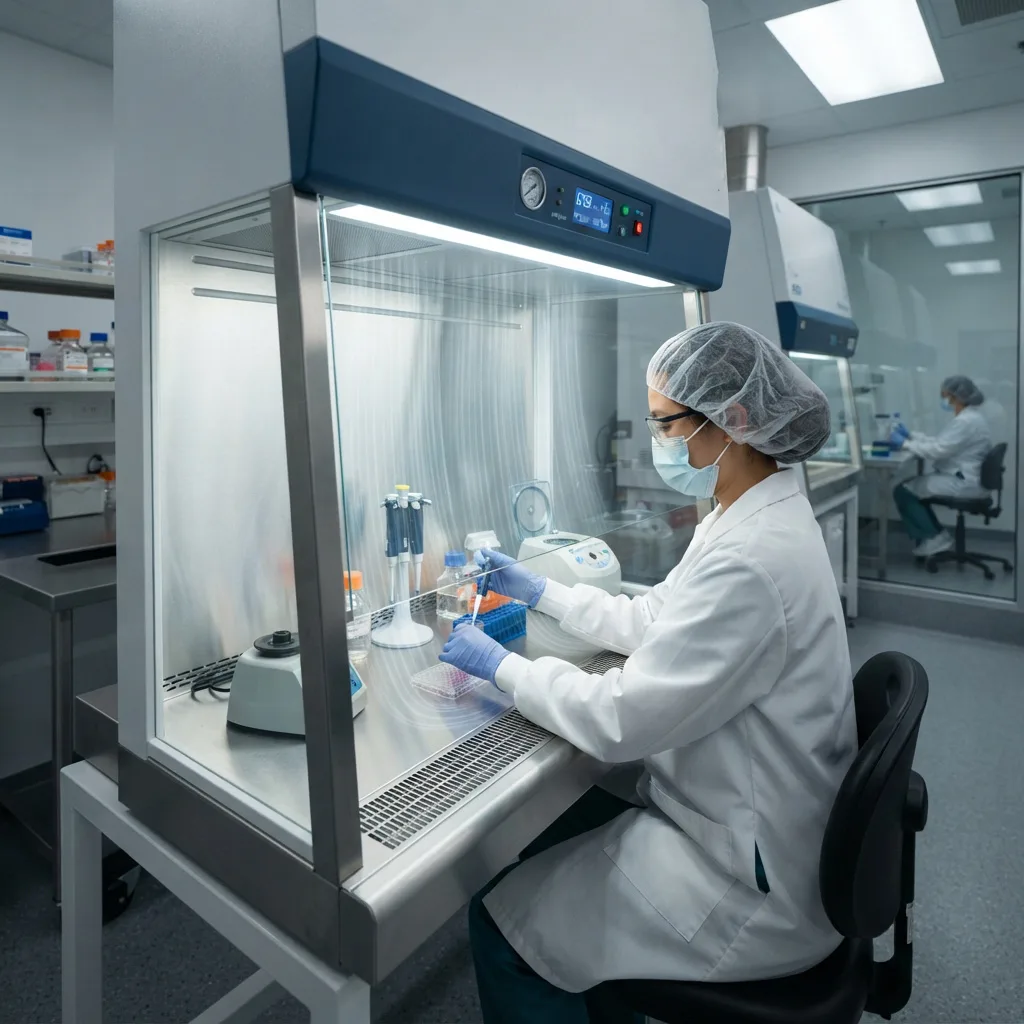
A microbiological safety cabinet is an enclosed or semi-enclosed laboratory workstation that uses controlled airflow and filtration to provide primary containment during certain biological procedures.
Depending on the cabinet class, a BSC can be designed to provide some combination of:
- Personnel protection
- Product or sample protection
- Environmental protection
This distinction is important.
A cabinet that protects laboratory personnel from biological aerosols is not necessarily designed to protect the work from contamination in the same way as another airflow device.
Likewise, a clean bench is not a replacement for a BSC when personnel or environmental protection is required.
WHO describes biological safety cabinets as primary containment devices and emphasizes that their effectiveness depends on correct selection, installation, use, maintenance and certification.
Common search terms include:
microbiological safety cabinet
microbiology safety cabinet
biological safety cabinet
biosafety cabinet
BSC cabinet
laboratory biosafety cabinet
biological safety cabinet for laboratory
microbiological cabinet
laboratory containment cabinet
biological containment cabinet
What Does a Biosafety Cabinet Protect?
The easiest way to understand BSCs is to separate the three protection goals.
Personnel Protection
Personnel protection means reducing the chance that biological aerosols or droplets escape from the cabinet and expose the operator.
Product Protection
Product protection means protecting the material being handled from contamination introduced from the surrounding laboratory.
This matters for some cell culture, microbiological and research procedures.
Environmental Protection
Environmental protection means reducing the release of biological contaminants from the cabinet into the surrounding laboratory or outside environment.
Not every BSC class provides these three protections in exactly the same way.
That is why simply searching for a “HEPA cabinet” is not enough.
Class I, Class II and Class III: The Basic Difference
The three main BSC categories are:
Class I
Primarily personnel and environmental protection.
Class II
Personnel, product and environmental protection, depending on the specific design and correct operation.
Class III
A fully enclosed cabinet providing a high level of containment, with work performed through glove ports.
CDC’s BMBL 6th Edition presents Class I as providing personnel and environmental protection, Class II as providing personnel, product and environmental protection, and Class III as providing all three for higher-containment applications.
This basic distinction is one of the most important things a buyer should understand before comparing models.
Class I Biosafety Cabinet
A Class I biosafety cabinet has an open front.
Room air is drawn into the cabinet through the front opening and contaminated air is directed toward an exhaust HEPA filter and exhaust system.
Its main purpose is to provide:
Personnel protection + environmental protection
It does not provide product protection in the same way as a Class II cabinet.
CDC’s BMBL describes Class I BSCs as similar in some ways to chemical fume hoods in that they use inward airflow for personnel protection, while the exhaust is HEPA-filtered.
A Class I BSC may therefore be considered for processes where product sterility is not the primary concern.
Typical search queries
class 1 biosafety cabinet
class I biological safety cabinet
class I BSC
class 1 microbiological safety cabinet
class I biosafety cabinet applications
class I biological safety cabinet manufacturer
class I BSC supplier
Class II Biosafety Cabinet
Class II is the most important BSC category for many clinical, microbiological and research laboratories.
Unlike Class I, a Class II cabinet combines:
inward airflow through the front opening
with
HEPA-filtered downward airflow over the work area
This arrangement can provide protection for:
- Operator
- Work product
- Laboratory environment
WHO identifies Class II BSCs as providing personnel, environment and product protection, while noting that different Class II airflow arrangements can have different installation and application requirements.
Class II cabinets are widely used in:
- Clinical laboratories
- Microbiology laboratories
- Cell culture laboratories
- Biotechnology laboratories
- Research laboratories
- Diagnostic laboratories
- Public health laboratories
- Pharmaceutical research
- Molecular biology laboratories
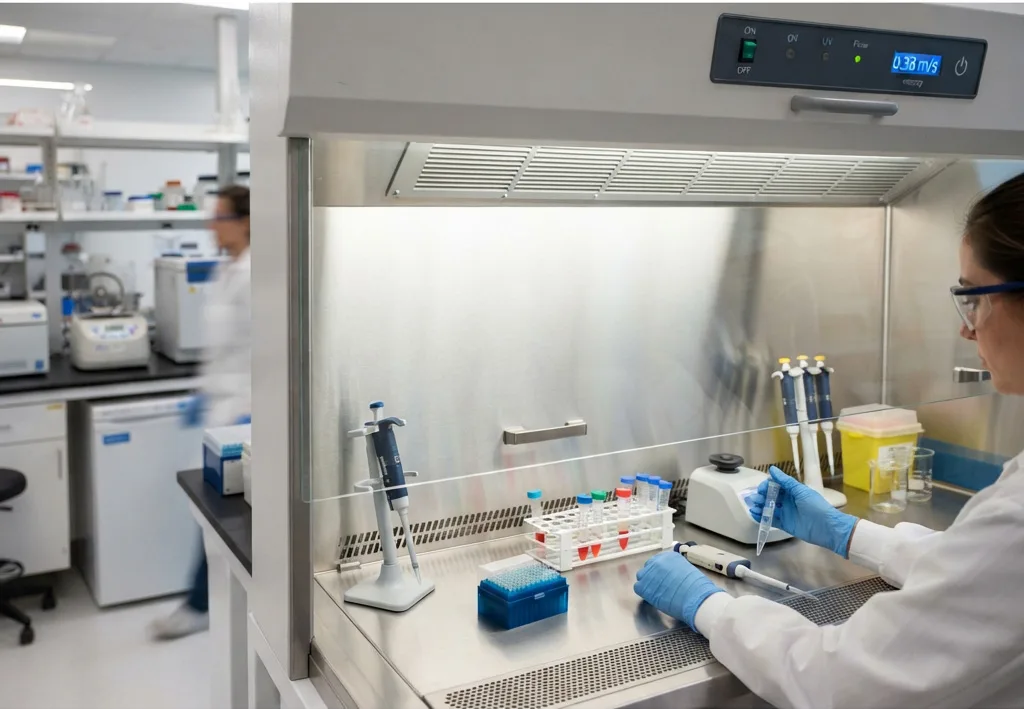
CDC has also identified Class II Type A1 and A2 cabinets as commonly suited to many diagnostic laboratory applications where volatile toxic chemicals are not being manipulated inside the cabinet.
Class II Type A1 vs A2
Among the many search terms around biosafety cabinets, Class II A2 biosafety cabinet is particularly important.
Class II Type A cabinets recirculate a portion of the cabinet air through the supply HEPA filter and exhaust another portion through the exhaust HEPA filter.
CDC’s BMBL notes that the difference between A1 and A2 is relatively small in modern designs compared with earlier configurations, with the primary distinction involving inflow velocity. The BMBL also describes Type A2 as having a minimum calculated or measured inflow velocity of 100 feet per minute.
For a buyer, the more useful question is not simply:
“Is this an A1 or A2?”
Instead ask:
“Does this cabinet’s airflow and exhaust configuration match the biological work and installation requirements?”
Class II Type A2 Biosafety Cabinet
The Class II Type A2 BSC is an especially common search term in clinical and research laboratory procurement.
It is frequently considered for:
- Microbiological sample processing
- Cell culture
- Clinical specimen handling
- Molecular biology
- Research procedures
- Diagnostic laboratory workflows
CDC’s BMBL notes that small quantities of volatile toxic chemicals or radionuclides may be used in an A2 cabinet only under specific conditions, including appropriate exhaust to the outside through a properly functioning canopy arrangement. Buyers should not interpret an A2 cabinet as a general chemical fume hood.
This distinction is critical when a laboratory handles both chemical and biological hazards.
Class II Type B1 Biosafety Cabinet
A Class II Type B1 BSC is designed around a different airflow and exhaust concept from a Type A cabinet.
It may be considered when a biological procedure also involves certain small quantities of volatile toxic chemicals or carcinogens.
CDC describes Type B1 cabinets as being developed for biological work where chemical containment requirements can be present, with cabinet exhaust routed to the outside through a dedicated exhaust system.
Because the building exhaust system becomes an important part of the installation, this is not a cabinet that should be selected from a basic product catalog without reviewing the laboratory’s ventilation design.
Relevant searches include:
Class B1 biosafety cabinet
Class II B1 BSC
B1 biological safety cabinet
B1 biosafety cabinet manufacturer
B1 BSC supplier
Class II Type B2 Biosafety Cabinet
A Class II Type B2 BSC is a more specialized configuration.
Unlike a recirculating Type A arrangement, Type B2 uses a total exhaust design in which cabinet air is exhausted to the outside through the building exhaust system.
CDC describes Type B2 cabinets as non-recirculating systems that require hard-ducted exhaust to the outside.
This can make B2 appropriate for specific applications where biological and chemical hazards coexist, but the installation requirements are more demanding.
Before selecting a B2 cabinet, a project should review:
- Building exhaust capacity
- Dedicated exhaust requirements
- Ductwork
- Cabinet exhaust characteristics
- Air balance
- Failure conditions
- Backup planning
- Commissioning
- Certification
A Type B2 cabinet should therefore be treated as a coordinated laboratory engineering project rather than a standalone item of furniture.
Class II Type C1 Biosafety Cabinet
The Class II Type C1 BSC is a newer configuration that is increasingly relevant to technical searches around flexible laboratory biosafety equipment.
CDC’s BMBL 6th Edition includes both non-connected and connected Type C1 configurations and describes components including supply and exhaust blowers, HEPA filters and optional building exhaust connections.
For procurement teams, C1 can be interesting where laboratory workflows require more flexibility than a traditional Type B installation provides.
However, the exact configuration and intended use should always be evaluated against the manufacturer’s documentation, the applicable certification standard and the laboratory risk assessment.
Useful search terms include:
Class II C1 biosafety cabinet
C1 BSC
Type C1 biological safety cabinet
C1 biosafety cabinet manufacturer
C1 BSC supplier
Class III Biosafety Cabinet
A Class III biosafety cabinet is fundamentally different from an open-front Class I or Class II cabinet.
It is a fully enclosed system.
Operators do not put their hands directly into the work chamber. Instead, manipulation is carried out through attached glove ports.
This configuration provides a high level of containment and can be used for work involving particularly hazardous biological materials.
WHO describes Class III cabinets as completely sealed systems accessed through glove ports, with dedicated HEPA-filtered supply and exhaust airflow.
Class III systems can be considered for specialized high-containment environments where maximum containment is required by the risk assessment and laboratory program.
Search terms include:
Class III biosafety cabinet
Class 3 biological safety cabinet
Class III BSC
fully enclosed biosafety cabinet
glove box biosafety cabinet
high containment biosafety cabinet
Class III laboratory cabinet
Which Biosafety Cabinet Is Right for You?
The answer should come from risk assessment rather than cabinet popularity.
A simple decision framework is:
Need personnel and environmental protection, but product protection is not the primary requirement?
A Class I BSC may be considered.
Need personnel, product and environmental protection for common microbiology or cell culture work?
A Class II BSC may be appropriate, with the exact Type selected according to the work and installation.
Need integrated chemical and biological containment?
A Class II Type B or another application-specific arrangement may be considered, depending on the risk assessment and chemical conditions.
Need a fully enclosed high-containment system?
A Class III BSC may be appropriate.
This is a guide, not a substitute for a laboratory-specific biosafety risk assessment.
The current BMBL explicitly emphasizes risk assessment as the basis for choosing controls.
What Is the Most Common Type of Biosafety Cabinet?
There is no single answer for every country, laboratory or application.
However, Class II cabinets, particularly A2 configurations, are very common in clinical, diagnostic and research laboratory environments.
WHO notes that Type A2 is widely used in clinical and public health laboratories.
That makes the following terms commercially important for an international laboratory equipment website:
Class II biosafety cabinet
Class II A2 biosafety cabinet
Class 2 biological safety cabinet
Class II BSC
A2 biosafety cabinet
Class II microbiological safety cabinet
Class II laboratory biosafety cabinet
How Does Biosafety Cabinet Airflow Work?
Airflow is one of the most important parts of BSC performance.
A typical open-front Class II BSC uses two airflow patterns at the same time.
Inward Airflow
Room air moves inward through the front opening.
This helps reduce the release of aerosols from the cabinet into the laboratory.
Downflow Air
HEPA-filtered air moves downward through the work area.
This supports product protection and helps maintain controlled airflow within the cabinet.
The two airflow patterns work together.
WHO explains that open-front BSCs use inward airflow to protect the operator and surrounding environment, while directional HEPA-filtered airflow supports work-area protection in Class II systems.
Why HEPA Filtration Matters
HEPA filtration is a central part of many BSC designs.
Filters are used to remove very small airborne particles from the air stream.
But buyers should understand an important point:
A HEPA filter does not automatically make a cabinet a biosafety cabinet.
The cabinet’s:
- Airflow pattern
- Enclosure
- Filter arrangement
- Pressure relationships
- Exhaust design
- Construction
- Monitoring
- Certification
all contribute to its intended protective function.
That is why purchasing teams should evaluate the complete cabinet rather than asking only:
“Does it have a HEPA filter?”
How Does a BSC Protect the Product?
Product protection is primarily associated with Class II BSC airflow.
Filtered downward airflow moves across the work zone and helps reduce the introduction of unwanted airborne contamination into the work area.
This can be important for procedures involving:
- Cell culture
- Microbiological preparation
- Clinical specimen processing
- Aseptic laboratory procedures
- Molecular biology
- Research samples
However, the cabinet must be used correctly.
Incorrect placement of materials, blocked intake grilles, excessive movement and overloading can disturb airflow.
WHO specifically warns that the front intake grille of a Class II BSC must not be blocked and recommends organizing work from clean areas toward contaminated areas.
BSC Work Area: Clean-to-Dirty Organization
A useful operational concept for Class II cabinets is:
clean → work → contaminated
The exact arrangement depends on the process, but the principle is to avoid repeatedly moving contaminated materials through clean areas.
WHO guidance provides a typical Class II work-area layout in which clean supplies, active sample processing and contaminated waste are separated across the work surface.
This is a simple point, but it is important for both laboratory users and buyers.
A spacious BSC is not necessarily a better BSC if the work area is poorly organized.
How Big Should a Biosafety Cabinet Be?
BSCs are available in different working widths and configurations.
Common commercial search terms include:
- 2 ft biosafety cabinet
- 3 ft biosafety cabinet
- 4 ft biosafety cabinet
- 5 ft biosafety cabinet
- 6 ft biosafety cabinet
- compact biosafety cabinet
- large biosafety cabinet
- wide biological safety cabinet
- double workstation biosafety cabinet
The right size depends on:
Number of users
Will one operator use it or does the workflow require a larger work area?
Equipment
Will centrifuge accessories, pipettes, containers, racks or other instruments be used inside?
Sample workflow
Does the process require clean and contaminated zones within the same cabinet?
Laboratory space
Does the room have adequate access and service clearance?
Future use
Will the laboratory add equipment or change the workflow?
Larger does not always mean better.
An oversized cabinet takes up more laboratory space and may not improve the actual workflow.
What Should Be Considered When Buying a Biosafety Cabinet?
A professional procurement specification should include more than:
“Class II BSC, please quote.”
A better RFQ should cover the following.
Cabinet Class and Type
Class I, Class II A1, A2, B1, B2, C1 or Class III.
Intended Application
Clinical specimens, microbiology, cell culture, research, pharmaceutical work or another defined process.
Working Width
Specify the required work zone rather than just external dimensions.
Airflow
Ask about inflow and downflow performance.
Filtration
Review supply and exhaust HEPA filter configuration.
Exhaust Arrangement
Is the cabinet recirculating, canopy connected or hard-ducted?
Sash
Check the opening height and operating configuration.
Alarm System
Ask about airflow alarms and other monitoring functions.
Utilities
Consider electrical outlets, service taps and optional connections.
Stand
Confirm whether a support stand is included.
Certification
Clarify what factory documentation and field certification are available.
Installation
Determine whether the room requires special ventilation or exhaust provisions.
What Is the Difference Between BSC Airflow and Fume Hood Airflow?
Both devices use controlled airflow, but they are designed for different purposes.
A chemical fume hood is primarily a chemical exposure control device.
A biosafety cabinet is a biological primary containment device.
A Class II BSC uses HEPA-filtered air across the work area to support product protection while also maintaining inward airflow through the front opening.
The distinction is important because equipment that looks similar externally may provide very different protection functions.
This is also why a microbiological safety cabinet should not simply be substituted for a chemical fume hood when hazardous chemical vapors are the primary concern.
The CDC BMBL specifically addresses chemical compatibility and the special configurations needed when volatile toxic chemicals are used within certain BSC types.
The full fume hood vs BSC vs clean bench comparison will be developed in Post 6 of this series.
Biosafety Cabinet Standards: NSF/ANSI 49
One of the most important international procurement terms is:
NSF/ANSI 49
NSF states that NSF/ANSI 49 establishes requirements for the design, construction and performance of Class II biosafety cabinetry and includes test procedures, as well as information related to installation, field certification and decontamination.
For buyers in markets that reference NSF/ANSI 49, ask the supplier:
- Is the cabinet designed to the applicable requirements?
- What certification is available?
- Who performs field certification?
- Which tests are included?
- What documentation accompanies the equipment?
Do not treat the standard name as a substitute for actual certification documentation.
What Is EN 12469?
European buyers may encounter:
EN 12469
The European standard framework for microbiological safety cabinets is also important.
As of the current 2026 standards landscape, BSI lists BS EN 12469-2:2025 as the current standard for BSC Class II, covering specific requirements for design, construction, safety and hygiene.
BSI also lists BS EN 12469-5:2025, covering installation, commissioning and routine testing of biological safety cabinets.
This is particularly useful for SEO because many older laboratory equipment articles simply mention “EN 12469” without explaining the newer structure.
For an international procurement page, it is better to ask the supplier to identify the exact applicable standard and edition rather than using a generic compliance statement.
Why Installation Location Matters
Even a properly designed BSC can be affected by its surrounding laboratory environment.
WHO warns that airflow generated by people walking near the cabinet, open windows, supply registers and doors can disrupt the inward airflow of a BSC.
This creates practical installation considerations.
Avoid placing a BSC:
- Directly beside a busy doorway
- Where strong air currents cross the front
- Near disruptive supply-air outlets
- In a high-traffic location
- Where maintenance access is restricted
WHO recommends following the manufacturer’s placement guidance and maintaining appropriate clearance for maintenance and testing.
For international projects, installation drawings should be reviewed before the cabinet is shipped.
Why BSC Certification Is Important
Buying a cabinet and certifying a cabinet are not the same thing.
The cabinet may be tested during manufacturing, but once it reaches the laboratory:
- Room airflow changes
- Exhaust conditions change
- The cabinet may be relocated
- Filters may eventually be replaced
- Internal components may be serviced
These factors can affect performance.
WHO recommends certification at installation, after relocation and regularly thereafter, at least annually, by qualified technicians according to the applicable performance standards and manufacturer’s specifications.
CDC’s BMBL 6th Edition similarly states that BSCs should be certified at installation and at least annually thereafter, with recertification following certain repairs, HEPA or ULPA filter replacement and relocation.
For procurement, therefore, ask:
Who will certify the BSC after installation in the destination country?
That question can be more important than a small difference in purchase price.
What Tests May Be Included in BSC Certification?
Depending on the applicable standard and certification program, testing may address areas such as:
- Cabinet integrity
- HEPA filter leakage
- Inflow velocity
- Downflow velocity
- Airflow smoke patterns
- Negative pressure or pressure relationships
- Alarm functions
- Interlocks
- Exhaust conditions
WHO identifies cabinet integrity, HEPA filter leak testing, downflow, face velocity, negative pressure, smoke patterns and alarms among potential certification checks. TB Knowledge Sharing
The exact test package should be confirmed with the certification professional and based on the applicable standard.
Common Biosafety Cabinet Applications
A BSC can be relevant to many laboratory environments.
Clinical Laboratories
For controlled processing of clinical specimens where aerosol-generating procedures may present a biological risk.
Microbiology Laboratories
For microbiological procedures requiring primary containment.
Cell Culture Laboratories
For selected cell culture and related aseptic biological work.
Biotechnology Laboratories
For research and development involving biological materials.
Pharmaceutical Research
For biological research workflows where the appropriate containment controls are required.
Public Health Laboratories
For diagnostic and microbiology workflows.
University Laboratories
For teaching and research where cabinet selection follows the actual procedure and risk assessment.
Diagnostic Laboratories
For specimen processing and other defined microbiological activities.
The cabinet should always be selected according to the process rather than the name of the laboratory.
Does Every Microbiology Laboratory Need the Same BSC?
No.
Two laboratories can both be called “microbiology laboratories” and still require different equipment.
One might focus on routine diagnostic specimens.
Another might conduct research involving aerosol-generating procedures.
Another could combine biological work with volatile chemical applications.
Another might require a higher level of containment.
Therefore, the buyer should communicate:
what is handled + what procedure is performed + what protection is required + how the cabinet will be installed
This is much more useful than simply writing:
“We need a Class II biosafety cabinet.”
UMY Medical Equipment Co., Ltd. and International BSC Procurement
For an international buyer, evaluating the supplier is almost as important as evaluating the cabinet.
UMY Medical Equipment Co., Ltd. is a Guangzhou-based medical equipment supplier with a broader portfolio covering medical laboratory and life-science equipment, including biological safety cabinets. Its current product information describes BSC configurations across Class I, Class II and Class III, with options involving airflow design, HEPA filtration, exhaust arrangements, working widths and monitoring functions.
For procurement teams, this type of supplier profile can be useful when a project requires coordination across multiple categories of medical and laboratory equipment rather than a single standalone product.
The key evaluation questions should still be practical:
Can the supplier provide the required BSC class?
Can the configuration match the destination country’s electrical and installation conditions?
Can the supplier provide technical documentation?
Is OEM or ODM coordination available where required?
Can spare parts and technical communication be supported after delivery?
These questions help turn a product inquiry into a complete procurement evaluation.
BSC Price: What Determines the Cost?
There is no single standard price for a microbiological safety cabinet.
The final quotation can depend on:
- Cabinet class
- Cabinet type
- Working width
- HEPA filter configuration
- Airflow control
- Exhaust arrangement
- Control panel
- Alarm system
- Stand
- Electrical configuration
- Additional accessories
- Certification
- Packaging
- Shipping
- Installation
- Destination-country requirements
A compact Class II A2 BSC and a specialized Class II B2 or Class III system should not be compared only by their purchase price.
The equipment configuration and project requirements are fundamentally different.
Common BSC Purchasing Mistakes
Choosing the Most Expensive Class
A higher class is not automatically the correct class.
The cabinet should match the biological risk and application.
Choosing by Size Alone
A larger work area does not compensate for an unsuitable airflow configuration.
Focusing Only on HEPA Filters
Filter specification is important, but airflow design and cabinet construction are equally important.
Ignoring the Room
Door movement, air supply and traffic can affect cabinet airflow.
Forgetting Certification
Installation and field certification should be included in project planning.
Using a BSC for the Wrong Hazard
A BSC is not a universal laboratory exhaust cabinet.
Buying Without Installation Information
A supplier needs enough project information to understand the intended installation.
Treating Every Class II Cabinet as Equivalent
A2, B1, B2 and C1 configurations have different airflow and exhaust arrangements.
BSC vs Clean Bench: The Basic Principle
Although this article focuses on BSCs, one distinction is worth remembering.
A clean bench is generally designed to provide clean airflow for the work or product.
A biosafety cabinet is designed as a containment device for biological work.
That means a clean bench should not automatically replace a BSC when personnel or environmental biological protection is required.
This distinction will become one of the major subjects of Post 6: Fume Hood vs Biosafety Cabinet vs Clean Bench.
Final Takeaway
Choosing a microbiological safety cabinet should begin with the work being performed, not the product catalog.
The key decision path is:
Risk assessment → protection requirement → cabinet class → airflow configuration → exhaust arrangement → installation → certification → lifecycle support
For many routine microbiology and clinical applications, Class II cabinets are highly relevant, while specialized work may require Type B configurations or Class III containment.
For international procurement, buyers should also examine the exact applicable standard, certification process, room installation requirements, documentation and supplier support.
The current CDC-NIH BMBL 6th Edition reinforces the central idea: biosafety controls should be selected through a protocol-driven risk assessment rather than by assuming one cabinet fits every situation.
A good BSC purchase is therefore not simply a choice between two cabinets with different prices. It is a decision about containment, airflow, laboratory workflow, installation and long-term performance.
Frequently Asked Questions
What is a microbiological safety cabinet?
A microbiological safety cabinet is a primary containment device used for certain laboratory procedures involving biological materials. Depending on its class, it can provide personnel, product and environmental protection.
What is another name for a microbiological safety cabinet?
Common names include biological safety cabinet, biosafety cabinet, biological cabinet, BSC and microbiology safety cabinet.
What is a BSC in a laboratory?
BSC stands for biosafety cabinet. It is a controlled-airflow containment device used for defined biological laboratory procedures.
What is a Class I biosafety cabinet?
Class I primarily provides personnel and environmental protection and does not provide the same product protection as a Class II cabinet.
What is a Class II biosafety cabinet?
Class II BSCs use inward airflow and HEPA-filtered airflow through the work area to provide personnel, product and environmental protection when properly selected and operated.
What is a Class II A2 biosafety cabinet?
A Class II Type A2 BSC is a common configuration for many clinical, microbiological and research applications. CDC describes Type A2 airflow and exhaust characteristics in BMBL 6th Edition.
What is a Class II B2 biosafety cabinet?
A Class II B2 cabinet uses a total-exhaust configuration and requires a suitable connection to the building exhaust system. It is used for specialized applications involving both biological and certain chemical hazards.
What is a Class III biosafety cabinet?
A Class III BSC is a fully enclosed glove-port cabinet designed for high-containment work.
What is the difference between Class I and Class II BSC?
Class I primarily provides personnel and environmental protection, while Class II additionally provides product protection through HEPA-filtered airflow across the work area.
What is the difference between Class II A2 and B2?
A2 commonly uses a recirculating airflow arrangement with a portion of air exhausted, while B2 uses total exhaust to the outside and requires dedicated exhaust infrastructure.
What is a Class C1 biosafety cabinet?
Class C1 is a Class II configuration included in the current BMBL and uses separate supply and exhaust blowers, with configurations that can operate without or with a building exhaust connection.
Which biosafety cabinet is best for microbiology?
There is no universal answer. The correct cabinet depends on the biological material, procedure, aerosol risk, protection requirements and laboratory risk assessment.
Which BSC is commonly used in clinical laboratories?
Class II Type A2 is commonly used in many clinical and public health laboratory applications, particularly when volatile toxic chemicals are not being manipulated inside the cabinet.
Is a biosafety cabinet suitable for cell culture?
A properly selected Class II BSC can be used for many cell culture and related biological workflows where personnel, product and environmental protection are required.
Can I use a BSC for chemical work?
It depends on the cabinet class and the chemicals. Certain Class II configurations can accommodate limited chemical applications under defined conditions, but a BSC is not a general replacement for a chemical fume hood.
What is the purpose of HEPA filtration in a biosafety cabinet?
HEPA filters remove airborne particles from the cabinet airflow and are an important component of biological containment and clean airflow, depending on the cabinet design.
How does a Class II BSC airflow system work?
Room air enters through the front opening while HEPA-filtered air moves through the work area. The two airflow patterns work together to support containment and product protection.
Can a BSC be placed next to a door?
It is generally preferable to avoid locations where door movement, pedestrian traffic or strong room airflow can disrupt the cabinet’s inward airflow.
How far should a BSC be from surrounding airflow disturbances?
The exact installation position should follow the manufacturer’s requirements and site design. Room airflow, doors, traffic and ventilation outlets should be evaluated because they can disrupt containment.
How often should a biosafety cabinet be certified?
WHO recommends certification at installation, after relocation and regularly thereafter, at least annually, by qualified technicians. CDC’s BMBL 6th Edition also recommends certification at installation and at least annually, with recertification after specified maintenance, filter replacement or relocation events.
What is NSF/ANSI 49?
NSF/ANSI 49 is a standard covering the design, construction and performance of Class II biosafety cabinetry and includes testing and certification-related provisions.
What is EN 12469?
EN 12469 refers to the European standard framework for microbiological safety cabinets. Current BSI listings include BS EN 12469-2:2025 for Class II BSCs and BS EN 12469-5:2025 for installation, commissioning and routine testing.
What information should I send a biosafety cabinet supplier?
Provide the intended application, biological material, required cabinet class, working width, voltage, destination country, installation conditions, exhaust arrangement and required accessories or certification documentation.
How much does a microbiological safety cabinet cost?
The price depends on cabinet class, working width, airflow configuration, filters, exhaust system, controls, accessories, certification, shipping and installation requirements.
What should I look for in a biosafety cabinet manufacturer?
Evaluate the manufacturer’s product range, technical documentation, certification support, customization options, manufacturing capability, spare parts, installation guidance and after-sales technical service.