Choosing a biochemical analyzer is an important decision for hospitals, diagnostic laboratories, clinics, medical centers, and laboratory equipment distributors. The right analyzer should match the laboratory’s workload, required tests, available space, staffing, budget, and long-term operating needs.
Many buyers start with a simple question:
How much does a biochemical analyzer cost?
However, price should not be the only consideration. A low-cost analyzer may not provide the required test menu or throughput, while a high-capacity system may be unnecessary for a small laboratory.
A more practical approach is to evaluate the complete laboratory workflow.
Important factors include:
- Test menu
- Throughput
- Automation level
- Sample volume
- Reagent system
- Reaction system
- Optical system
- Calibration
- Quality control
- STAT testing
- LIS connectivity
- Maintenance
- Technical support
- Reagent cost
- Consumable cost
- Total cost of ownership
This guide explains these factors in simple terms and provides a practical framework for selecting a clinical chemistry analyzer.
What Is a Biochemical Analyzer?
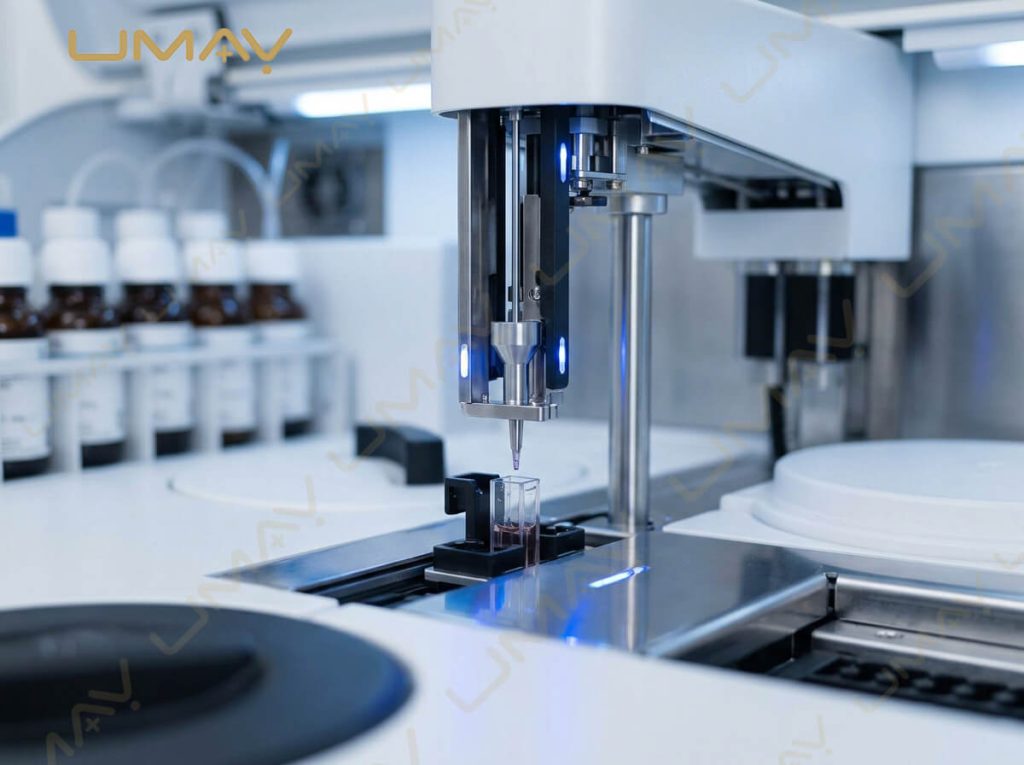
A biochemical analyzer, also called a biochemistry analyzer, clinical chemistry analyzer, or chemistry analyzer, is laboratory equipment used to measure chemical substances in biological samples.
Depending on the model and reagent applications, common tests include:
- Glucose
- Urea
- Creatinine
- Uric acid
- Cholesterol
- Triglycerides
- HDL
- LDL
- ALT
- AST
- ALP
- Bilirubin
- Albumin
- Total protein
- Calcium
- Phosphorus
- Amylase
Biochemical analyzers are used in:
- Hospitals
- Diagnostic laboratories
- Clinics
- Medical centers
- Private laboratories
- Research laboratories
- Laboratory networks
Different laboratories require different analyzer configurations.
Why Is Choosing the Right Biochemical Analyzer Important?
A laboratory analyzer is not simply a piece of equipment. It becomes part of the laboratory’s daily workflow.
The wrong configuration can result in:
- Unnecessary equipment costs
- Insufficient throughput
- Limited test options
- Higher reagent expenses
- Difficult maintenance
- Workflow delays
- Poor integration with existing laboratory systems
The right analyzer can help a laboratory organize routine biochemical testing according to its workload and operational requirements.
Therefore, purchasing decisions should begin with the laboratory’s needs rather than the equipment’s marketing description.
Step 1: Determine Your Daily Sample Volume
One of the first questions to answer is:
How many samples does your laboratory process every day?
For example:
- Small clinic: relatively low sample volume
- Small laboratory: low to moderate volume
- Medium laboratory: moderate volume
- Central laboratory: high volume
The actual workload should be calculated using both samples and tests.
For example:
200 samples/day × 5 tests/sample = approximately 1,000 tests/day
This is more useful than looking only at the number of samples.
What Is Biochemical Analyzer Throughput?
Throughput describes how much testing an analyzer can process during a specific period.
Manufacturers may express throughput as:
- Tests per hour
- Samples per hour
- Tests per day
For example, an analyzer may be described as having a throughput of a certain number of tests per hour.
However, buyers should ask exactly how the manufacturer defines the stated throughput.
Actual laboratory performance can depend on:
- Test mix
- Sample preparation
- Reagent loading
- Calibration
- Quality control
- Reruns
- Dilutions
- STAT samples
- Operator workflow
Therefore, advertised throughput should be compared with the laboratory’s real workflow.
How Much Throughput Do You Need?
There is no universal throughput requirement.
A simple planning approach is:
Daily testing volume ÷ Available operating hours = Approximate hourly workload
For example, if a laboratory needs to process 1,000 tests during an 8-hour working period:
1,000 ÷ 8 = 125 tests/hour
The laboratory should then consider peak workloads, urgent samples, reruns, calibration, QC, and downtime.
This means the required analyzer capacity may be higher than the basic average.
High-Throughput vs Low-Throughput Biochemical Analyzer
Low-Throughput Analyzer
A lower-throughput analyzer may be suitable for:
- Small clinics
- Small laboratories
- Medical centers
- Low-volume diagnostic facilities
Important features may include:
- Compact size
- Simple operation
- Flexible test selection
- Lower sample requirements
- Easy maintenance
High-Throughput Analyzer
A high-throughput chemistry analyzer may be considered for:
- Large hospitals
- Central laboratories
- High-volume diagnostic laboratories
- Laboratory networks
Important features may include:
- Automated sample handling
- Large reagent capacity
- High testing speed
- Continuous operation
- STAT testing
- LIS connectivity
The key is to match throughput to actual workload.
Step 2: Define Your Required Test Menu
The test menu is one of the most important factors when selecting a biochemical analyzer.
Start by listing all tests currently performed by your laboratory.
For example:
Basic Chemistry
- Glucose
- Urea
- Creatinine
- Uric acid
Liver-Related Tests
- ALT
- AST
- ALP
- Bilirubin
- Albumin
- Total protein
Lipid Tests
- Cholesterol
- Triglycerides
- HDL
- LDL
Other Tests
- Calcium
- Phosphorus
- Magnesium
- Amylase
Then identify any tests you may add in the future.
Why Is the Test Menu Important?
An analyzer may have impressive technical specifications but still be unsuitable if it does not support your required assays.
For example:
Laboratory A needs:
- Glucose
- Urea
- Creatinine
- ALT
- AST
- Cholesterol
Laboratory B needs all of these plus:
- HDL
- LDL
- Calcium
- Phosphorus
- Magnesium
- Amylase
These laboratories may require different analyzer configurations.
Therefore, do not choose a biochemical analyzer only because it supports a large number of parameters.
Choose one that supports the parameters you actually need.
Step 3: Choose the Right Automation Level
Another major decision is:
Should you buy a semi-automatic or fully automatic biochemical analyzer?
Semi-Automatic Biochemistry Analyzer
A semi-automatic analyzer requires the operator to perform some testing steps manually.
It may be suitable for:
- Small laboratories
- Clinics
- Low-volume facilities
- Laboratories with limited automation requirements
Potential advantages include:
- Compact design
- Simple workflow
- Lower initial investment
- Flexible operation
Fully Automatic Biochemistry Analyzer
A fully automatic analyzer automates more testing procedures.
Depending on the model, it may automate:
- Sample pipetting
- Reagent dispensing
- Mixing
- Incubation
- Measurement
- Result calculation
- Washing
- Calibration
- Quality control functions
It may be suitable for:
- Hospitals
- Central laboratories
- High-volume diagnostic laboratories
- Facilities requiring greater automation
Semi-Automatic vs Fully Automatic
| Factor | Semi-Automatic | Fully Automatic |
|---|---|---|
| Automation | Partial | High |
| Manual operation | More | Less |
| Throughput | Usually lower | Usually higher |
| Initial equipment cost | Often lower | Often higher |
| Sample handling | More manual | More automated |
| Laboratory size | Small to medium | Medium to large |
| Workflow | Operator-assisted | Automated |
| Maintenance | Generally simpler | More structured |
| LIS | Depends on model | Common on many systems |
Neither type is automatically the correct choice.
The decision should be based on laboratory workload and workflow.
Step 4: Check Sample Volume
Sample volume is an important specification for a biochemical analyzer.
Different systems require different amounts of sample.
Ask the supplier about:
- Minimum sample volume
- Reaction volume
- Dead volume
- Sample probe volume
- Dilution requirements
A low sample volume can be useful in situations where sample availability is limited.
Relevant search terms include:
- low sample volume biochemical analyzer
- low volume chemistry analyzer
- minimum sample volume analyzer
- micro sample biochemical analyzer
- biochemical analyzer sample volume
However, sample volume should be considered together with analytical requirements and workflow.
What Sample Types Does the Analyzer Support?
Common biological samples used in clinical chemistry include:
- Serum
- Plasma
- Urine
The exact sample types depend on the analyzer and validated applications.
Before purchasing, ask:
Which sample types are supported?
Also check:
- Sample tube compatibility
- Sample cup compatibility
- Sample volume requirements
- Sample stability requirements
- Barcode support
Never assume that every biochemical analyzer supports the same sample types.
Step 5: Evaluate the Reagent System
The reagent system is one of the most important long-term considerations.
A laboratory may use an analyzer for many years, so reagent availability and cost can have a major effect on operating expenses.
Ask:
- What reagents are required?
- Is the system open or closed?
- Which reagent suppliers are supported?
- How much reagent is consumed per test?
- How should reagents be stored?
- What is the reagent stability?
- How often must reagents be replaced?
Open Reagent Biochemical Analyzer
An open reagent biochemical analyzer may provide greater flexibility in selecting compatible reagents, depending on the manufacturer’s specifications and validated applications.
Potential benefits may include:
- More reagent choices
- Purchasing flexibility
- Potentially easier local sourcing
However, compatibility must be confirmed.
A reagent should not be used simply because its chemical name appears compatible.
The analyzer, reagent, calibration, and testing method should be validated according to the applicable instructions.
Closed Reagent Biochemical Analyzer
A closed reagent system is designed around specified reagent configurations.
Potential benefits may include:
- Standardized workflow
- Defined reagent configuration
- Simplified operation
However, the buyer should understand the long-term reagent supply and operating cost before purchasing.
For international buyers, reagent availability in the destination market is especially important.
Step 6: Check Reagent Cost
The purchase price of the analyzer is only one part of the total cost.
For a laboratory performing thousands of tests, reagent consumption can become a major operating expense.
A useful comparison is:
Cost per test = Reagent cost + Consumables + Other variable testing costs
Buyers should ask suppliers for estimated reagent consumption for commonly used tests.
For example, compare:
- Glucose reagent consumption
- Creatinine reagent consumption
- ALT reagent consumption
- AST reagent consumption
- Cholesterol reagent consumption
This provides a more realistic view of operating costs.
Step 7: Consider Calibration
Calibration establishes the relationship between the analyzer’s measurement response and the expected analytical result for a specific test system.
Calibration requirements depend on:
- Analyzer
- Reagent
- Test method
- Calibrator
- Manufacturer instructions
Ask the supplier:
- How is calibration performed?
- How often is calibration required?
- Is calibration automatic?
- How many calibrators are needed?
- Can calibration information be stored?
- How is a new reagent lot calibrated?
These questions are useful when comparing clinical chemistry analyzers.
Step 8: Review Quality Control Functions
Laboratory quality control (QC) is another important consideration.
A biochemical analyzer may provide QC functions such as:
- QC result storage
- QC charts
- Control level management
- QC trend review
- Result flagging
The exact software features vary by model.
When comparing analyzers, ask:
How does the analyzer manage quality control data?
This is particularly important for laboratories with formal quality management systems.
Step 9: Check STAT Testing
Hospitals may need urgent laboratory testing.
STAT testing allows urgent samples to be prioritized.
If your laboratory handles emergency testing, ask:
- Is STAT testing supported?
- Is there a dedicated STAT position?
- Can STAT samples be loaded during routine operation?
- Does STAT testing interrupt routine testing?
- How are urgent results displayed?
STAT capability can be an important feature for hospital chemistry laboratories.
Step 10: Evaluate LIS Connectivity
Modern laboratories often need analyzers to communicate with laboratory information systems.
LIS stands for Laboratory Information System.
LIS connectivity can help with:
- Sample information
- Test requests
- Result transmission
- Data storage
- Laboratory workflow
Relevant search terms include:
- biochemical analyzer LIS
- chemistry analyzer LIS
- clinical chemistry analyzer connectivity
- laboratory analyzer integration
- LIS compatible chemistry analyzer
Before purchasing, ask the supplier:
- Does the analyzer support LIS?
- What communication interface is used?
- Is middleware required?
- Can results be transmitted automatically?
- Is barcode identification supported?
Barcode and Sample Identification
Barcode identification can help laboratories manage sample information.
A barcode system may allow the analyzer to associate:
Sample ID → Patient information → Test request → Result
The exact workflow depends on the analyzer and LIS.
For laboratories processing many samples, barcode support can be an important purchasing consideration.
Step 11: Check the Optical System
Many biochemical analyzers use photometric or spectrophotometric measurement.
Important specifications can include:
- Wavelength range
- Number of wavelengths
- Light source
- Optical measurement system
- Photometric range
However, a longer wavelength list does not automatically mean a better analyzer.
The key question is:
Does the optical system support the tests required by your laboratory?
Step 12: Evaluate Reaction System
The reaction system affects how samples and reagents are processed.
Important specifications may include:
- Reaction positions
- Reaction volume
- Incubation temperature
- Reaction time
- Mixing system
- Cuvette system
For automatic analyzers, also consider:
- Cuvette washing
- Cuvette replacement
- Carryover control
- Reaction monitoring
Step 13: Consider Carryover
Carryover refers to the possibility that material from one sample or reagent affects another measurement.
Modern analyzer designs may include procedures or system features intended to minimize carryover.
When evaluating a biochemical analyzer, buyers should ask the manufacturer about:
- Carryover specifications
- Probe washing
- Cuvette washing
- Reagent separation
- Sample handling procedures
This can be especially important for laboratories with high testing volumes.
Step 14: Check Analyzer Dimensions and Laboratory Space
Laboratory space is easy to overlook.
Before purchasing, measure:
- Bench length
- Bench depth
- Available height
- Service access
- Reagent storage area
- Waste area
- Operator working space
For a benchtop biochemical analyzer, the physical footprint may be relatively compact.
For a larger fully automatic chemistry analyzer, installation requirements can be more demanding.
Do not forget space for:
- Computer
- Printer
- Reagents
- Consumables
- Waste containers
- UPS or power protection equipment, if required
Step 15: Check Power Requirements
International buyers should confirm:
- Voltage
- Frequency
- Power consumption
- Plug type
- Electrical protection requirements
For example, a laboratory may need to determine whether the analyzer is compatible with its local electrical supply.
Ask the supplier for the official installation requirements before shipment.
Step 16: Evaluate Maintenance Requirements
Every laboratory analyzer requires maintenance.
Common tasks may include:
- Daily cleaning
- Probe cleaning
- Cuvette cleaning
- Waste disposal
- Reagent system maintenance
- Optical inspection
- Calibration
- Consumable replacement
Fully automatic systems may require more structured preventive maintenance because of their larger number of automated components.
Ask for the manufacturer’s:
- Daily maintenance procedure
- Weekly maintenance procedure
- Monthly maintenance procedure
- Preventive maintenance schedule
- Troubleshooting guide
What Is Preventive Maintenance?
Preventive maintenance means performing routine maintenance before a problem occurs.
For a biochemical analyzer, this can include:
- Cleaning
- Inspection
- Replacing consumables
- Checking probes
- Checking optical components
- Reviewing system warnings
- Performing recommended calibration procedures
Following the manufacturer’s maintenance schedule can help laboratories manage equipment operation more systematically.
Step 17: Consider Technical Support
When buying laboratory equipment internationally, technical support can be as important as the equipment itself.
Ask suppliers about:
- Installation
- Operator training
- Remote support
- On-site service
- Warranty
- Spare parts
- Preventive maintenance
- Troubleshooting
- Software support
For distributors, hospitals, and laboratories in regions far from the manufacturer, spare parts availability and response time can be especially important.
Step 18: Evaluate Training
A biochemical analyzer may have sophisticated software and automated functions.
Training can help operators understand:
- Sample loading
- Reagent loading
- Test selection
- Calibration
- Quality control
- Maintenance
- Error handling
- Result management
When requesting a quotation, ask whether operator training is included.
Step 19: Review Warranty Terms
Warranty terms can vary significantly between suppliers.
Ask:
- How long is the warranty?
- Which components are covered?
- Are spare parts included?
- Is labor included?
- Is remote support included?
- What situations are excluded?
- How are warranty claims handled internationally?
A clear warranty policy can make procurement easier.
Step 20: Check Spare Parts Availability
A laboratory may operate an analyzer for many years.
Therefore, buyers should ask about the availability of:
- Sample probes
- Reagent probes
- Pumps
- Valves
- Lamps
- Cuvettes
- Tubing
- Electrodes
- Other consumables and replacement parts
Long-term spare parts support can be important when selecting a biochemical analyzer manufacturer.
What Is the Cost Per Test?
Cost per test is an important commercial consideration for many laboratories.
A simplified calculation is:
Cost per test = Reagent cost + Consumable cost + Other variable costs
The actual calculation may be more complex because laboratories may also need to account for:
- Calibration
- Quality control
- Repeat tests
- Dilution
- Waste
- Maintenance
- Labor
- Equipment depreciation
When requesting a quotation, ask suppliers for estimated reagent consumption for your main test menu.
How to Choose a Biochemical Analyzer for a Small Laboratory
A small laboratory may prioritize:
- Compact design
- Easy operation
- Moderate throughput
- Low sample volume
- Flexible test selection
- Reasonable reagent cost
- Simple maintenance
- Local technical support
A semi-automatic biochemical analyzer or compact benchtop system may be considered.
Before purchasing, calculate the laboratory’s actual daily workload.
How to Choose a Biochemical Analyzer for a Hospital
A hospital laboratory may have:
- Higher sample volumes
- More test requests
- Emergency samples
- Multiple shifts
- Greater data management requirements
Important features may include:
- High throughput
- Fully automatic operation
- STAT testing
- Barcode identification
- Large reagent capacity
- Automatic dilution
- Automatic rerun
- LIS connectivity
- Quality control software
- Technical support
However, hospital laboratories can have very different requirements, so the analyzer should be selected according to the specific department and workload.
How to Choose a Biochemical Analyzer for a Diagnostic Laboratory
A diagnostic laboratory may focus heavily on:
- Testing volume
- Cost per test
- Reagent availability
- Test menu
- Automation
- Throughput
- Result turnaround
- LIS connectivity
- Maintenance
For a high-volume laboratory, even a small difference in reagent consumption per test can become significant over time.
How to Choose a Biochemical Analyzer for a Clinic
A clinic may have lower testing volumes and limited laboratory space.
Important considerations may include:
- Compact size
- Simple operation
- Low sample volume
- Basic chemistry test menu
- Easy maintenance
- Low operating cost
A compact or semi-automatic chemistry analyzer may be appropriate depending on the clinic’s testing needs.
Biochemical Analyzer for International Buyers
International buyers should consider several additional factors.
Local Power Supply
Check voltage and frequency requirements.
Reagent Availability
Confirm that reagents can be supplied to the destination market.
Language
Check whether software, manuals, and training materials are available in the required language.
Shipping
Consider:
- Packaging
- Instrument dimensions
- Shipping weight
- Installation requirements
Technical Support
Ask whether remote or local technical support is available.
Spare Parts
Confirm long-term spare parts availability.
Regulatory Documentation
Depending on the destination market, buyers may require specific product and regulatory documents.
The exact regulatory requirements vary by country, so buyers should confirm applicable requirements with the relevant authorities and their local regulatory professionals.
How to Evaluate a Biochemical Analyzer Supplier
The supplier is an important part of the purchasing decision.
When comparing biochemical analyzer manufacturers, consider:
Manufacturing Capability
Does the company have established manufacturing and quality management processes?
Product Portfolio
Does the supplier offer the analyzer configuration you need?
Technical Documentation
Can the supplier provide clear specifications, manuals, reagent information, and other required documents?
Service Capability
Can the supplier provide installation, training, maintenance, and technical support?
Export Experience
For international buyers, experience with export procedures and destination-market requirements can simplify procurement.
OEM and ODM
For distributors and brands, ask whether OEM or ODM services are available.
What Should Be Included in a Biochemical Analyzer RFQ?
An RFQ, or Request for Quotation, should include enough information for suppliers to provide comparable offers.
A basic RFQ can include:
Product Requirements
- Analyzer type
- Semi-automatic or fully automatic
- Required throughput
- Required test menu
- Sample types
- Sample volume
Technical Requirements
- Wavelengths
- Reaction system
- Reagent positions
- Sample positions
- Calibration
- Quality control
- STAT
- LIS
- Barcode
Commercial Requirements
- Unit price
- Delivery time
- Warranty
- Installation
- Training
- Spare parts
- Reagent price
- Shipping terms
This helps reduce misunderstandings between buyers and suppliers.
Common Mistakes When Buying a Biochemical Analyzer
Mistake 1: Choosing Based Only on Price
The lowest equipment price may not result in the lowest long-term operating cost.
Mistake 2: Choosing the Highest Throughput
A small laboratory may not need a high-throughput system.
Mistake 3: Ignoring Reagent Cost
Reagent expenses can become a significant long-term cost.
Mistake 4: Ignoring the Test Menu
An analyzer is only useful if it supports the laboratory’s required assays.
Mistake 5: Ignoring Service Support
Technical support and spare parts can affect long-term operation.
Mistake 6: Forgetting Laboratory Space
Always check the complete installation footprint.
Mistake 7: Not Checking LIS Compatibility
Data connectivity may become important as laboratory operations expand.
Mistake 8: Not Asking About Training
Operators should understand how to use and maintain the analyzer correctly.
Frequently Asked Questions
What should I consider when buying a biochemical analyzer?
Consider test menu, throughput, automation, sample volume, reagent system, calibration, QC, LIS connectivity, maintenance, technical support, and total cost of ownership.
How do I choose a biochemical analyzer for a small laboratory?
Start with daily sample volume and required tests. A compact or semi-automatic analyzer may be suitable if the workload is relatively low.
Which biochemical analyzer is suitable for a hospital?
A hospital may require a fully automatic, higher-throughput clinical chemistry analyzer, particularly when the laboratory processes many samples. The exact choice depends on workload and testing requirements.
How important is biochemical analyzer throughput?
Throughput is important when sample volumes are high. However, buyers should also consider test mix, STAT testing, reruns, calibration, QC, and actual workflow.
Is a fully automatic analyzer better than a semi-automatic analyzer?
Not in every situation. A fully automatic analyzer can reduce manual work and support higher throughput, while a semi-automatic analyzer may be more practical for smaller laboratories.
What is the most important biochemical analyzer specification?
There is no single most important specification. The most important specifications are those that directly match the laboratory’s workload and testing requirements.
How much does a biochemical analyzer cost?
The price depends on analyzer type, automation, throughput, configuration, test menu, reagent system, software, connectivity, and supplier. Buyers should also evaluate ongoing operating costs.
What is the total cost of ownership of a biochemical analyzer?
It includes the equipment purchase price plus installation, training, reagents, consumables, maintenance, spare parts, technical service, and other operating costs over the equipment’s useful life.
Should I choose an open reagent analyzer?
An open reagent system may provide greater reagent flexibility, but buyers should confirm validated compatibility, local reagent availability, calibration requirements, and long-term operating costs.
Do I need LIS connectivity?
If the laboratory already uses an LIS or plans to integrate multiple instruments, LIS connectivity can be very useful. Smaller laboratories with simple workflows may have different requirements.
What should I ask a biochemical analyzer supplier?
Ask about throughput, test menu, sample volume, reagent system, calibration, QC, maintenance, warranty, training, technical support, spare parts, LIS connectivity, and total operating costs.