Understanding MRI Machine Types Before Purchasing
MRI technology has become one of the most important diagnostic imaging solutions in modern healthcare.
However, when hospitals, imaging centers, and medical distributors search for an MRI machine, they often face many choices:
Each type of MRI scanner has different advantages, costs, applications, and installation requirements.
Choosing the right MRI system is not about buying the most powerful machine.
The best MRI equipment depends on:
- Clinical requirements
- Patient volume
- Available budget
- Hospital size
- Future development plans
This guide explains different MRI machine types and helps hospitals understand which MRI system is most suitable for their needs.
1. How Are MRI Machines Classified?
MRI scanners can mainly be classified according to:
- Magnetic field strength
- Magnet design
- Clinical application
- Equipment structure
The most common classification is based on magnetic field strength.
2. MRI Classification by Magnetic Field Strength
The strength of an MRI magnet is measured in Tesla (T).
The higher the Tesla value, generally the stronger the magnetic field.
Common MRI field strengths include:
- Low field MRI (below 1.0T)
- Medium field MRI (around 1.0T-1.5T)
- High field MRI (1.5T and above)
- Ultra-high field MRI (3T and above)
3. Low Field MRI Machine
What Is Low Field MRI?
Low field MRI usually refers to MRI scanners with magnetic strength below 1 Tesla.
Common models include:
- 0.35T MRI
- 0.5T MRI
These systems are designed to provide reliable diagnostic imaging with lower investment requirements.
Advantages of Low Field MRI
1. Lower Equipment Cost
One of the biggest advantages is affordability.
Compared with high-field MRI systems, low-field MRI machines usually require:
- Lower purchase investment
- Lower installation cost
- Lower maintenance cost
2. Easier Installation
Low-field MRI generally requires:
- Less complicated site preparation
- Lower infrastructure requirements
- Smaller investment in facility modification
3. Lower Operating Cost
Benefits include:
- Lower energy consumption
- Reduced maintenance requirements
- More affordable operation
Common Applications of Low Field MRI
Low-field MRI can be used for:
Orthopedic Imaging
Including:
- Knee MRI
- Shoulder MRI
- Joint examination
- Sports injuries
Spine Imaging
Including:
- Cervical spine MRI
- Lumbar spine MRI
- Disc evaluation
Brain Imaging
For:
- Basic neurological examination
- Brain structure evaluation
Who Should Choose Low Field MRI?
Low-field MRI is suitable for:
✔ Small hospitals
✔ Private clinics
✔ Developing medical markets
✔ Diagnostic centers with limited budgets
It is especially attractive in regions where healthcare infrastructure is developing.
4. 1.5T MRI Machine: The Most Popular Hospital Choice
What Is a 1.5T MRI Scanner?
A 1.5 Tesla MRI system is currently one of the most widely used MRI machines worldwide.
It provides a balance between:
- Image quality
- Clinical capability
- Equipment cost
- Operating requirements
Advantages of 1.5T MRI
1. Excellent Clinical Performance
A 1.5T MRI can support many examinations:
- Brain MRI
- Spine MRI
- Abdominal MRI
- Pelvic MRI
- Cardiac MRI
- Musculoskeletal MRI
2. Balanced Investment
Compared with 3T MRI:
- Lower purchase cost
- Easier installation
- Lower maintenance expenses
3. Mature Technology
Because 1.5T MRI has been widely used for many years:
Hospitals benefit from:
- Stable performance
- Experienced technicians
- Available service support
Applications of 1.5T MRI
Common departments include:
- Radiology department
- Neurology department
- Orthopedic department
- Oncology department
- Emergency department
Who Should Choose 1.5T MRI?
A 1.5T MRI scanner is suitable for:
✔ General hospitals
✔ Large clinics
✔ Medical imaging centers
✔ Regional healthcare facilities
For many hospitals, 1.5T MRI is the most practical investment choice.
5. 3T MRI Machine: Advanced High-Performance Imaging
What Is a 3T MRI Scanner?
A 3 Tesla MRI machine uses a stronger magnetic field compared with 1.5T MRI.
It provides higher signal strength and advanced imaging capabilities.
Advantages of 3T MRI
1. Higher Image Detail
3T MRI provides:
- Higher resolution images
- Better visualization of small structures
- Improved diagnostic confidence
2. Advanced Clinical Applications
3T MRI is commonly used for:
- Brain research
- Functional MRI
- Neurosurgery planning
- Advanced oncology imaging
3. Better Signal Quality
A stronger magnetic field improves:
- Signal-to-noise ratio
- Image detail
- Small lesion detection
Limitations of 3T MRI
Despite its advantages, 3T MRI also has challenges:
Higher Investment Cost
3T MRI requires:
- More expensive equipment
- More complex installation
- Higher maintenance budget
More Technical Requirements
Hospitals may need:
- Experienced MRI technicians
- Advanced clinical workflow
Who Should Choose 3T MRI?
3T MRI is suitable for:
✔ Large hospitals
✔ Research centers
✔ University hospitals
✔ Specialized imaging centers
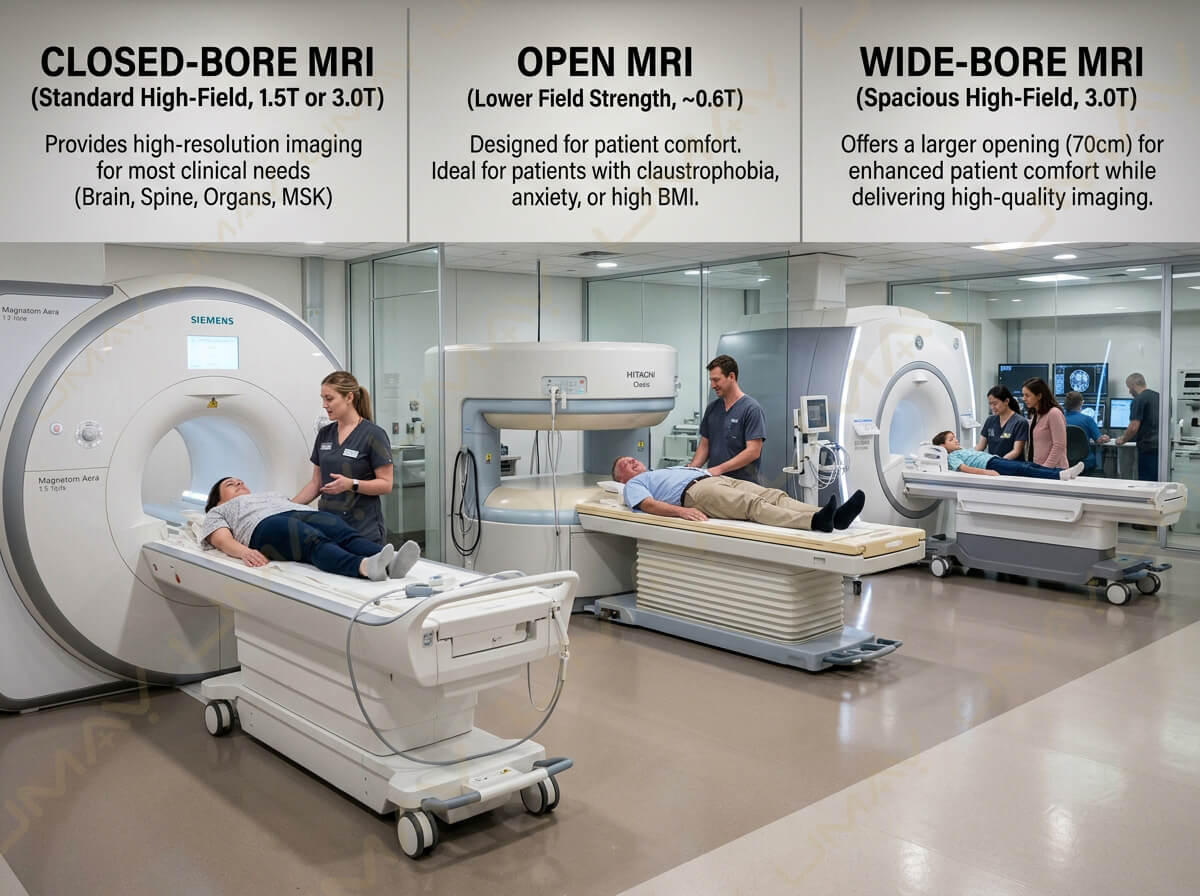
6. Open MRI vs Closed MRI
Besides Tesla strength, MRI systems can also be classified by structure.
Closed MRI Machine
Closed MRI is the traditional design.
The patient lies inside a cylindrical magnet.
Advantages:
✔ Higher image quality
✔ More widely available
✔ Suitable for most applications
Applications:
- Brain MRI
- Spine MRI
- Whole body MRI
- Advanced imaging
Open MRI Machine
Open MRI uses a more open magnet design.
Advantages:
✔ Better patient comfort
✔ Suitable for claustrophobic patients
✔ Easier access for some patients
Suitable for:
- Elderly patients
- Children
- Patients with anxiety
- Larger body types
7. Permanent Magnet MRI vs Superconducting MRI
MRI magnets can also be divided into:
- Permanent magnet MRI
- Superconducting MRI
Permanent Magnet MRI
Advantages:
✔ Lower operating cost
✔ No helium requirement
✔ Stable magnet performance
Commonly used in:
- Low-field MRI systems
Superconducting MRI
Advantages:
✔ Strong magnetic field
✔ Higher image quality
✔ Used in 1.5T and 3T systems
Requires:
- Cryogenic cooling
- Professional maintenance
8. 1.5T MRI vs 3T MRI Comparison
| Feature | 1.5T MRI | 3T MRI |
|---|---|---|
| Image Quality | Excellent | Higher |
| Cost | Medium | High |
| Installation | Easier | More complex |
| Clinical Use | Wide | Advanced |
| Maintenance Cost | Lower | Higher |
| Hospital Type | General hospitals | Research & advanced centers |
9. How to Choose the Right MRI Machine?
Hospitals should consider the following factors:
1. Clinical Applications
Ask:
What examinations will be performed?
For example:
- Orthopedic imaging
- Brain imaging
- Oncology
- Cardiology
2. Patient Volume
High patient volume hospitals need:
- Faster workflow
- Reliable operation
- Advanced software
3. Budget Planning
Consider:
- Equipment cost
- Installation
- Maintenance
- Training
4. Future Expansion
A hospital should consider:
- Expected patient growth
- New departments
- Advanced imaging requirements
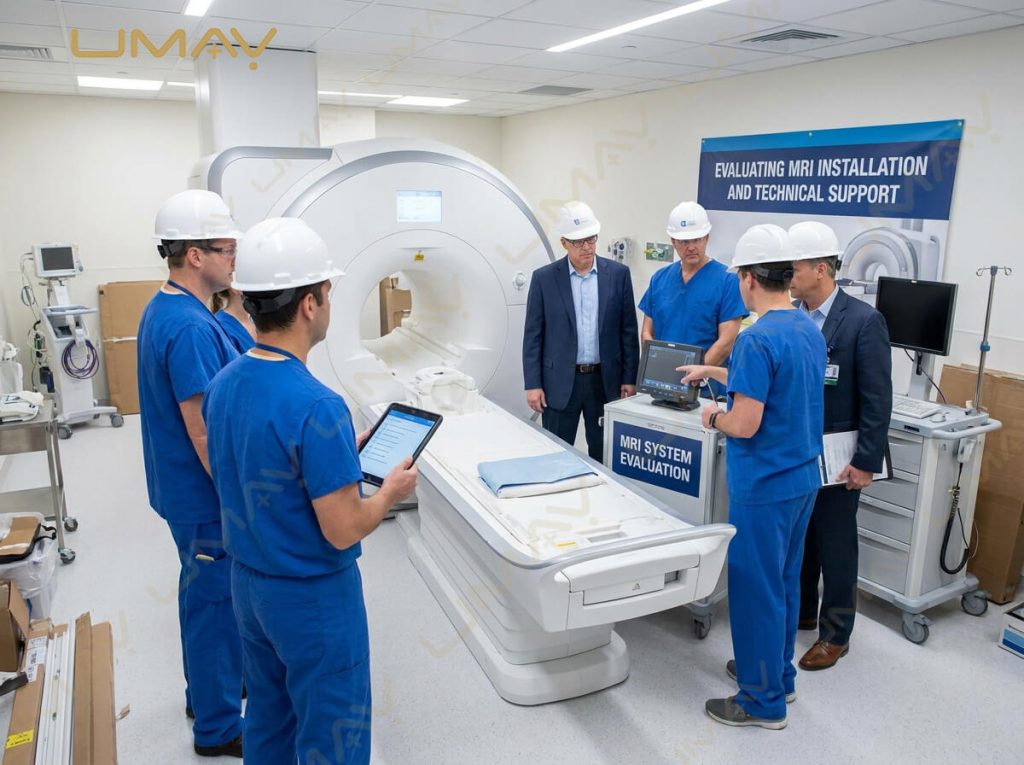
Medical specialists and installation engineers conducting an MRI system evaluation and technical inspection inside a newly set up radiology suite.
10. MRI Machine Selection for Different Healthcare Facilities
Small Clinic
Recommended:
Low field MRI
Reasons:
- Lower cost
- Easier operation
- Basic diagnostic capability
General Hospital
Recommended:
1.5T MRI
Reasons:
- Wide applications
- Good performance
- Strong clinical value
Large Medical Center
Recommended:
1.5T or 3T MRI
Reasons:
- Advanced diagnosis
- High patient demand
- Specialized departments
11. Why More Hospitals Choose Chinese MRI Manufacturers
Medical imaging equipment suppliers from China have become increasingly important in the global market.
Advantages include:
Competitive Pricing
Chinese manufacturers often provide:
- Cost-effective solutions
- Flexible configurations
- Better price-performance ratio
Manufacturing Experience
Professional suppliers provide:
- Factory production
- Quality control
- International export service
Customized Solutions
Hospitals and distributors may request:
- OEM service
- Customized configurations
- Regional solutions
FAQ: MRI Machine Types
Q1: What type of MRI machine is best?
For most hospitals, a 1.5T MRI scanner offers the best balance between performance and investment.
Q2: Is 3T MRI better than 1.5T MRI?
3T MRI provides higher image detail, but 1.5T MRI is sufficient for most routine clinical applications.
Q3: What is the cheapest MRI machine?
Low-field MRI systems such as 0.35T and 0.5T MRI are usually more affordable.
Q4: What MRI machine is suitable for a small clinic?
A low-field MRI system is often suitable because of lower cost and easier installation.
Q5: Should I buy 1.5T or 3T MRI?
The choice depends on clinical requirements, budget, and hospital development goals.
Conclusion
Understanding different MRI machine types is essential before purchasing medical imaging equipment.
Low-field MRI provides an affordable solution for basic diagnostic needs.
1.5T MRI offers the best balance between cost and clinical performance and remains the most popular choice worldwide.
3T MRI provides advanced imaging capability for hospitals requiring high-level diagnosis and research.
The right MRI scanner should match the hospital’s actual needs, patient volume, and long-term development strategy.
Choosing an experienced MRI manufacturer with strong technical support can help healthcare providers build reliable imaging centers and improve patient care.