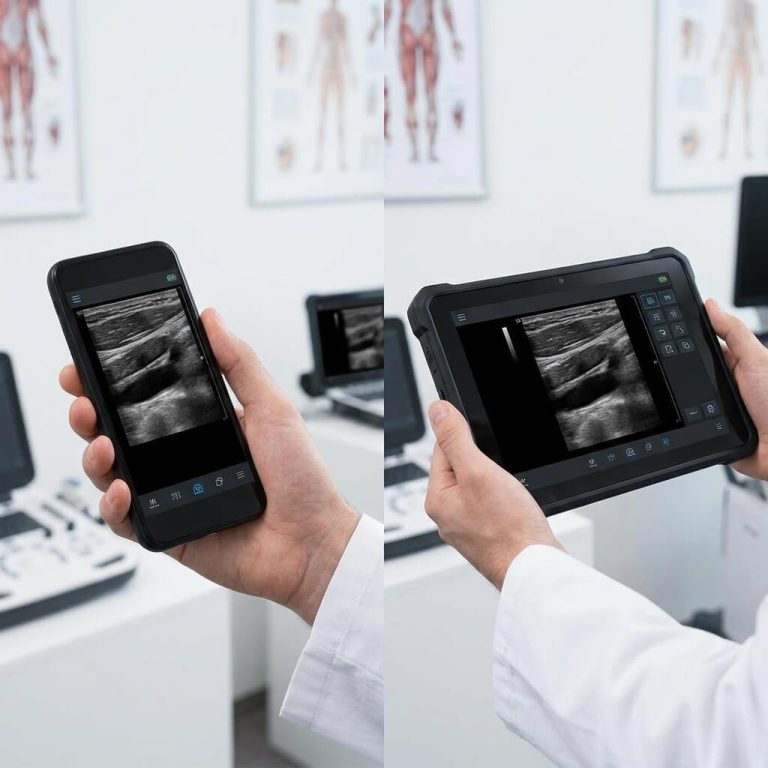
Adding a 3D Cone Beam Computed Tomography (CBCT) scanner to your dental practice is more than a clinical upgrade—it is a major business transformation. For clinic owners, practice managers, and procurement officers, the decision to invest $30,000 to $100,000+ in a 3D dental X-ray system comes down to two critical factors: financial return on investment (ROI) and operational feasibility.
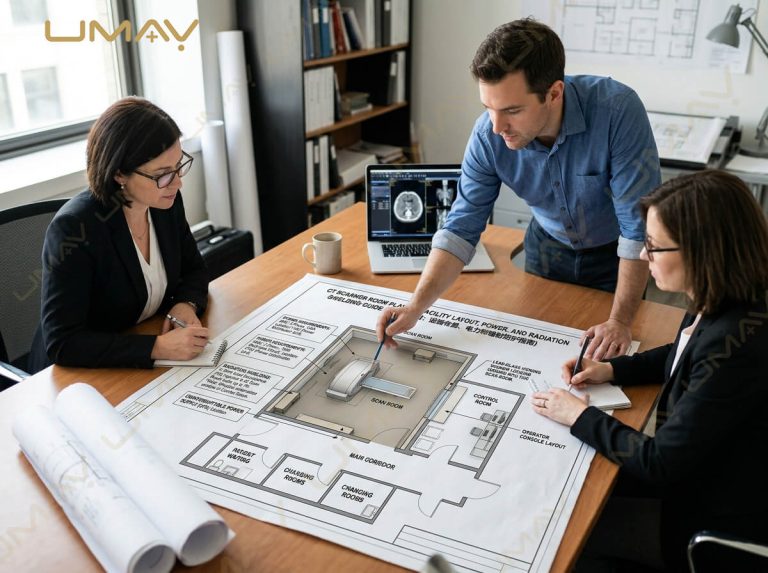
How quickly will the machine pay for itself? What room dimensions and lead shielding are required? How do you ensure seamless DICOM software integration with your existing practice management software?
This operational playbook breaks down the financial modeling, facility requirements, software configuration, and routine maintenance protocols necessary to maximize the profitability and lifespan of your dental CBCT investment.
1. Calculating the Financial ROI of a Dental CBCT Machine
A dental CBCT scanner generates revenue through two distinct channels: Direct Imaging Revenue (charging for diagnostic scans) and Indirect Treatment Revenue (retaining high-value surgical procedures in-house and increasing case acceptance).
-----------------------------------------------------------------------
|                    CBCT Revenue Generation Model                      |
------------------------------------+----------------------------------
| Direct Revenue Streams             | Indirect Revenue Streams         |
------------------------------------+----------------------------------
| - Diagnostic Scan Fees ($150-$350) | - In-House Dental Implant Cases  |
| - Surgical Guide Fabrication Fees  | - Complex Endodontic Retreatments|
| - Outsources Scan Referrals        | - Sleep Apnea & Airway Therapies |
| - Radiologist Report Billing       | - Increased Patient Case Conversion|
----------------------------------------------------------------------
Direct Revenue: Scan Billing
In private practices, a diagnostic 3D CBCT scan carries an average out-of-pocket or insurance billing rate of $150 to $350 USD per scan, depending on the Field of View (FOV) and location.
-
1 Scan per Day (20/month): $3,000 to $7,000 monthly revenue
-
3 Scans per Day (60/month): $9,000 to $21,000 monthly revenue
-
5 Scans per Day (100/month): $15,000 to $35,000 monthly revenue
Indirect Revenue: Surgical Retention & Case Acceptance
The primary financial driver of 3D CBCT technology is case retention.
-
Retaining Dental Implants: Referring out 3 implant cases a month means losing $6,000 to $12,000 in production. A CBCT machine enables precise, flapless guided implant placement in-house.
-
Higher Patient Conversion: Patients understand 3D visual models far better than flat 2D X-rays. Demonstrating bone loss, nerve proximity, or airway constriction in 3D dramatically increases patient treatment plan acceptance rates by 25% to 40%.
CBCT Payback & Financial Breakdown Table
Assuming a mid-range 3D CBCT purchase price of $50,000 USD financed over 5 years (60 months) at an estimated monthly payment of $1,050 USD:
| Monthly Scan Volume | Average Fee Per Scan | Gross Monthly Scan Income | Estimated Monthly Equipment Loan | Net Monthly Profit (Direct Only) | Payback Timeline |
| 10 Scans / Month | $200 USD | $2,000 USD | $1,050 USD | + $950 USD | ~ 14 Months |
| 25 Scans / Month | $200 USD | $5,000 USD | $1,050 USD | + $3,950 USD | ~ 8 Months |
| 50 Scans / Month | $200 USD | $10,000 USD | $1,050 USD | + $8,950 USD | ~ 4 Months |
Key Financial Takeaway: Performing as few as 6 to 8 scans per month completely covers the equipment financing cost. Every scan beyond that point delivers direct profit to the practice.
2. Maintenance, Calibration & Operating Cost Management
To avoid unexpected downtime and preserve image quality, practice managers must establish a routine maintenance schedule.
------------------------------------------------------------------------
|                     CBCT Maintenance Schedule                          |
-----------------------------------------------------------------------
| Frequency                | Operational Maintenance Task                |
-----------------------------------------------------------------------
| Daily                    | Sensor initialization & chin rest sanitization|
| Monthly                  | Quality Assurance (QA) phantom calibration   |
| Bi-Annually              | Laser marker alignment & mechanical check   |
| Annually                 | Certified Radiation Physics Inspection      |
-----------------------------------------------------------------------
Quality Assurance (QA) Phantom Calibration
Every CBCT unit comes with a specialized calibration phantom (a cylinder containing materials of known density).
-
Running a monthly 10-minute phantom scan tests noise ratios, contrast resolution, spatial resolution, and artifact levels.
-
Automatic calibration software adjusts the sensor baseline to compensate for natural component aging over time
Lifespan Expectations of Core Components
-
X-Ray Tube: Typically lasts 7 to 10 years under normal clinic usage (20 to 50 exposures per day). Operating tube voltage (kVp) and current (mA) should be verified during annual service checks.
-
Flat Panel Detector (CMOS FPD): Built for high longevity with proper handling. Avoid physical impacts or exposure to excessive heat and moisture.
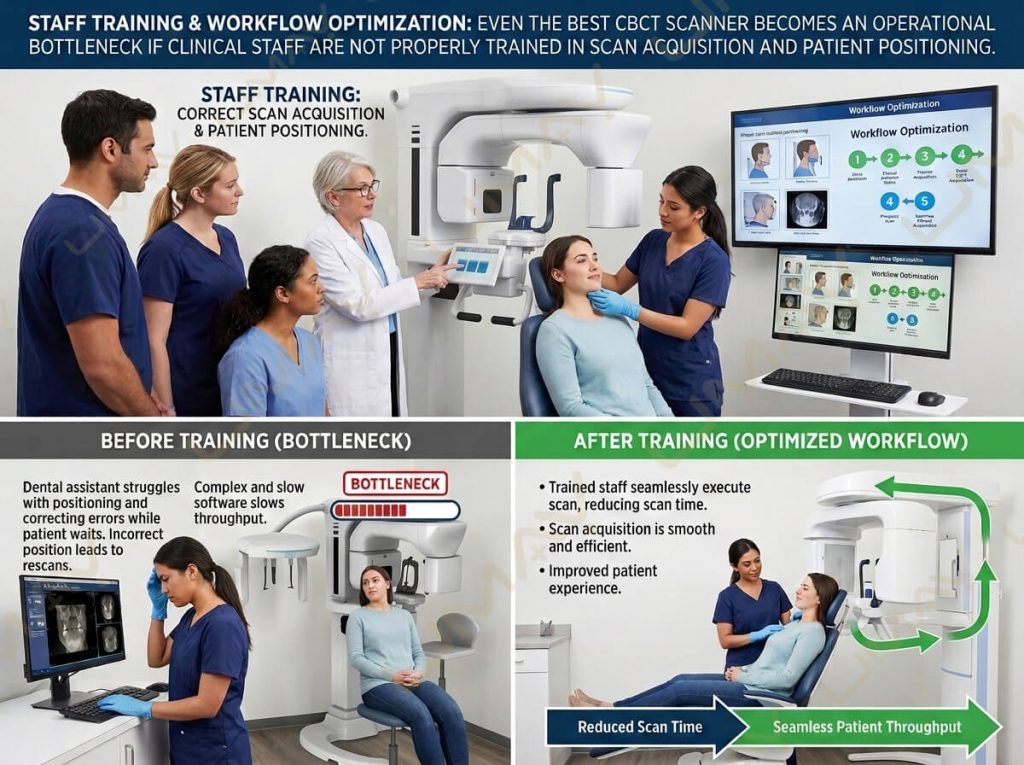
Educational graphic showing CBCT scan acquisition training, patient positioning, and clinic workflow efficiency.
3.Standardized Patient Positioning Protocol
Patient motion is the primary cause of blurred 3D scans and lost time due to re-takes.
-
Remove Metallic Objects: Ensure patients remove earrings, necklaces, glasses, hairpins, and removable partial dentures prior to entering the scan room.
-
Utilize Positioning Lasers: Align the machine’s horizontal (Midsagittal, Frankfort plane) laser lines precisely to stabilize the target head posture.
-
Firm Chin & Bite Support: Instruct the patient to bite firmly on the positioning block and rest their forehead against the head stabilizer.
-
Swallow and Rest Tongue: Instruct the patient to swallow, place their tongue against the roof of their mouth, close their eyes, and remain completely still during the exposure.
4. Frequently Asked Questions (FAQ)
How long does it take to physically install a dental CBCT machine?
A standard CBCT installation takes 1 to 2 days. Day 1 involves uncrating, mechanical assembly, wall anchoring, electrical wiring, and network integration. Day 2 focuses on software calibration, radiation physics testing, and clinical staff training.
What electrical setup is required for a 3D dental X-ray machine?
Most standard CBCT units operate on a single-phase 110V to 240V AC power supply with a dedicated 15A or 20A circuit breaker. It is highly recommended to install a Uninterruptible Power Supply (UPS) with surge protection to prevent power spikes from damaging sensitive FPD sensors during scans.
How much does annual maintenance cost after the warranty expires?
Post-warranty annual service contracts typically range from $3,000 to $6,000 USD per year, depending on whether detector coverage is included. Alternatively, clinics can opt for pay-per-service arrangements for routine calibrations.
Can we charge medical insurance for dental 3D CBCT scans?
Yes. Depending on the clinical indication (e.g., impacted teeth, TMJ disorders, airway analysis, facial trauma), 3D CBCT scans can often be billed to medical insurance policies using standard medical diagnostic CPT codes alongside dental insurance CDT codes.
Conclusion: Operational Readiness Drives Clinical Success
Integrating a 3D dental CBCT machine into your practice is a highly profitable investment when executed with a clear operational plan. By choosing a system with open DICOM export, preparing your facility for proper radiation shielding and network speed, and training your clinical team on efficient positioning protocols, you build a high-margin diagnostic hub that pays for itself in months while delivering superior patient care.