1. Understanding the Financial Dynamics of CT Acquisition
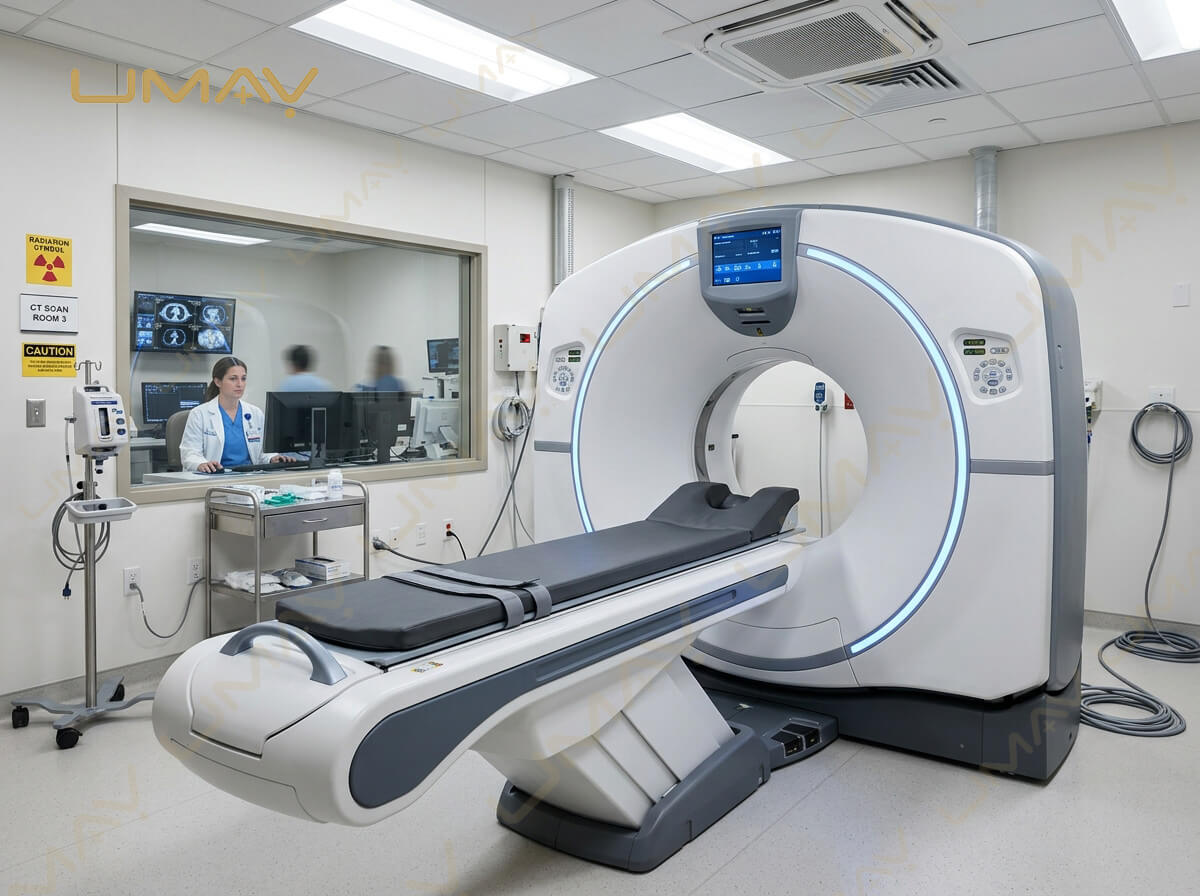
Acquiring a Computed Tomography (CT) system is one of the most significant capital expenditure (CapEx) decisions a hospital, diagnostic imaging center, or private clinic will make. Beyond the sticker price of the equipment, healthcare administrators and procurement managers must evaluate the operational expenditure (OpEx) across a typical 7-to-10-year system lifecycle.
Failing to account for installation costs, room shielding, annual service agreements, and X-ray tube replacements can lead to severe budget overruns. This comprehensive financial guide provides realistic price benchmarks, compares new versus refurbished systems, breaks down hidden lifecycle costs, and offers a practical Return on Investment (ROI) framework.
2. Average CT Scanner Price Benchmarks by Slice Architecture
CT scanner pricing varies significantly based on detector slice count, software packages, generator power, and tube heat capacity (MHU).
Price Escalation Curve:
16-Slice (Outpatient / Basic)  ──►  $120,000 – $220,000 (New)
64-Slice (Hospital Workhorse)  ──►  $280,000 – $480,000 (New)
128/256-Slice (Advanced)       ──►  $500,000 – $850,000 (New)
320-Slice (Ultra-Premium)      ──►  $950,000 – $1,800,000+ (New)
The table below provides current global market estimates for new and certified refurbished CT scanners across major OEMs (e.g., GE HealthCare, Siemens Healthineers, Philips Healthcare, Canon Medical Systems).
| System Architecture | Primary Clinical Applications | Estimated Price (New) | Estimated Price (Refurbished) |
| 16-Slice CT | Outpatient, urgent care, routine head/chest scans | $120,000 – $220,000 | $55,000 – $95,000 |
| 64-Slice CT | General hospital, acute trauma, basic cardiac | $280,000 – $480,000 | $110,000 – $180,000 |
| 128/256-Slice CT | Advanced cardiac angiography, oncology, pediatrics | $500,000 – $850,000 | $220,000 – $380,000 |
| 320-Slice CT | Single-beat whole-heart, dynamic stroke perfusion | $950,000 – $1,800,000+ | $450,000 – $700,000 |
Note: Prices represent equipment purchase cost and generally exclude tax, shipping, site preparation, and extended warranties.
3. New vs. Refurbished CT Scanners: Strategic Decision Matrix
Choosing between a factory-new CT scanner and a certified refurbished system depends on clinical throughput requirements, capital availability, and financial risk tolerance.
                    ┌──────────────────────────────────────────────┐
                    │            EQUIPMENT SELECTION               │
                    └──────────────────────┬───────────────────────┘
                                           │
                    ┌──────────────────────┴──────────────────────┐
                    ▼                                             ▼
     ┌──────────────────────────────┐              ┌──────────────────────────────┐
     │          NEW SYSTEM          │              │      REFURBISHED SYSTEM      │
     ├──────────────────────────────┤              ├──────────────────────────────┤
     │ • Premium CapEx              │              │ • 40%–60% Capital Savings    │
     │ • Full Factory Warranty      │              │ • Faster ROI / Lower Risk    │
     │ • Latest Software & AI       │              │ • Proven Reliability         │
     │ • High-Volume Hospitals      │              │ • Outpatient & Small Clinics │
     └──────────────────────────────┘              └──────────────────────────────┘
Advantages of New CT Scanners
-
Cutting-Edge Technology: Access to the latest AI-driven image reconstruction algorithms, lower radiation dose software, and advanced spectral imaging options.
-
Maximum Reliability & Uptime: Brand-new internal components reduce early breakdown risks during high-patient volume operations.
-
Full OEM Warranty Coverage: Typically includes 12 to 24 months of comprehensive parts, labor, and X-ray tube coverage directly from the manufacturer.
Advantages of Refurbished CT Scanners
-
Capital Conservation: Saves 40% to 60% compared to new list prices, allowing facilities to preserve capital for facility expansion or other clinical tools.
-
Faster ROI & Payback: Lower upfront debt service enables smaller practices to achieve profitability at lower daily patient volumes.
-
Established Parts Ecosystem: Independent Service Organizations (ISOs) and secondary markets offer abundant, affordable replacement parts and replacement tubes.
4. Uncovering Hidden Expenses: The 5 Pillars of Total Cost of Ownership (TCO)
The initial purchase price accounts for only 50% to 60% of a CT scanner’s overall expenditure over a 7-year operating lifecycle. Procurement teams must budget for five primary hidden cost centers:
Pillar 1: Site Preparation & Radiation Shielding ($30,000 – $80,000)
-
Architectural lead lining (2.0mm – 3.0mm Pb) on walls, doors, and control room lead glass.
-
Floor reinforcement for high floor-loading weights (up to 3,500 kg).
-
Dedicated 3-phase electrical transformers, sub-panels, and ground wiring.
Pillar 2: Delivery, Rigging, and Installation ($10,000 – $30,000)
-
Specialized heavy-equipment rigging, crane rental (for upper-floor placements), and transport insurance.
-
On-site OEM assembly, mechanical alignment, and physics calibration testing.
Pillar 3: Annual Service Contracts & Maintenance ($25,000 – $95,000/year)
-
Post-warranty service coverage averages 8% to 12% of the initial system purchase price annually.
-
Premium service plans covering X-ray tube replacements cost significantly more than basic PM-only contracts.
Pillar 4: X-Ray Tube Replacements ($35,000 – $130,000 per tube)
-
Depending on patient volume and tube MHU capacity, tubes require replacement every 1.5 to 4 years.
-
Unplanned tube burnouts without contract coverage represent the largest sudden expense in radiology.
Pillar 5: HVAC, Energy & Utilities ($8,000 – $18,000/year)
-
High-power generators (60 kW to 120 kW) and 24/7 HVAC climate chillers consume substantial electricity.

Hospital financial director reviewing CT scanner acquisition feasibility graphs, cost per scan, and ROI projections on a tablet.
5. Financial ROI & Payback Calculation Framework
To justify a CT scanner acquisition, financial directors evaluate the Payback Period and Net Present Value (NPV) based on estimated scan volume and reimbursement rates.
Practical ROI Scenario: 64-Slice CT Scanner
-
Total Initial Capital Outlay: $350,000 (Refurbished 64-slice system + site prep + installation)
-
Average Scan Volume: 12 scans per day (240 scans per month)
-
Average Net Reimbursement: $250 per scan
-
Gross Monthly Revenue: $60,000
-
Monthly Operational Expense (Staff, Contract, Power): $22,000
-
Net Monthly Profit: $38,000
-
Estimated Payback Period: ~9.2 Months
Once the initial investment is paid off, the system generates high profit margins, making CT imaging one of the highest revenue-generating services in diagnostic healthcare.
6. Procurement Checklist for Hospital Buyers
Before signing a CT scanner procurement agreement or issuing a commercial purchase order, ensure the supplier contract addresses the following key terms:
-
[x] Software License Inclusions: Confirm whether permanent diagnostic software licenses (and DICOM features) transfer to your facility without recurring annual fees.
-
[x] Tube Condition Audit (Refurbished Units): Verify remaining X-ray tube life (exposure count and accumulated slice count) certified by an independent technician.
-
[x] De-Installation & Rigging Responsibilities: Clarify whether the vendor handles door clearance, transport insurance, and final positioning in the scan room.
-
[x] Inservice Clinical Training: Secure at least 3 to 5 days of on-site application training for radiologic technologists included in the purchase price.
-
[x] Uptime Guarantee Clause: Ensure service agreements contain a minimum 95% to 98% uptime guarantee with financial credit remedies.
7. Frequently Asked Questions (FAQ)
Q1: What is the average lifespan of a modern CT scanner?
A well-maintained CT scanner has an operational lifespan of 7 to 10 years in high-volume settings. With regular preventive maintenance and timely tube replacements, refurbished systems can remain clinically reliable for up to 12 years in lower-volume facilities.
Q2: How much should a clinic budget for CT room site preparation?
Site preparation costs typically range between $30,000 and $80,000, depending on whether the building already possesses adequate 3-phase electrical supply, reinforced floors, and existing lead shielding.
Q3: Are refurbished CT scanners safe and regulatory-compliant?
Yes. Certified refurbished CT scanners undergo rigorous restoration processes, where worn mechanical parts are replaced, software is updated, and the entire system is calibrated to meet original manufacturer performance and radiation safety standards.
Q4: What is the single biggest operational expense of running a CT scanner?
Outside of staff salaries, the annual service agreement (including X-ray tube coverage) is the largest continuous operational expense, costing between $25,000 and $95,000 per year depending on slice count and coverage level.