The Role of Centrifugation in Modern Laboratories
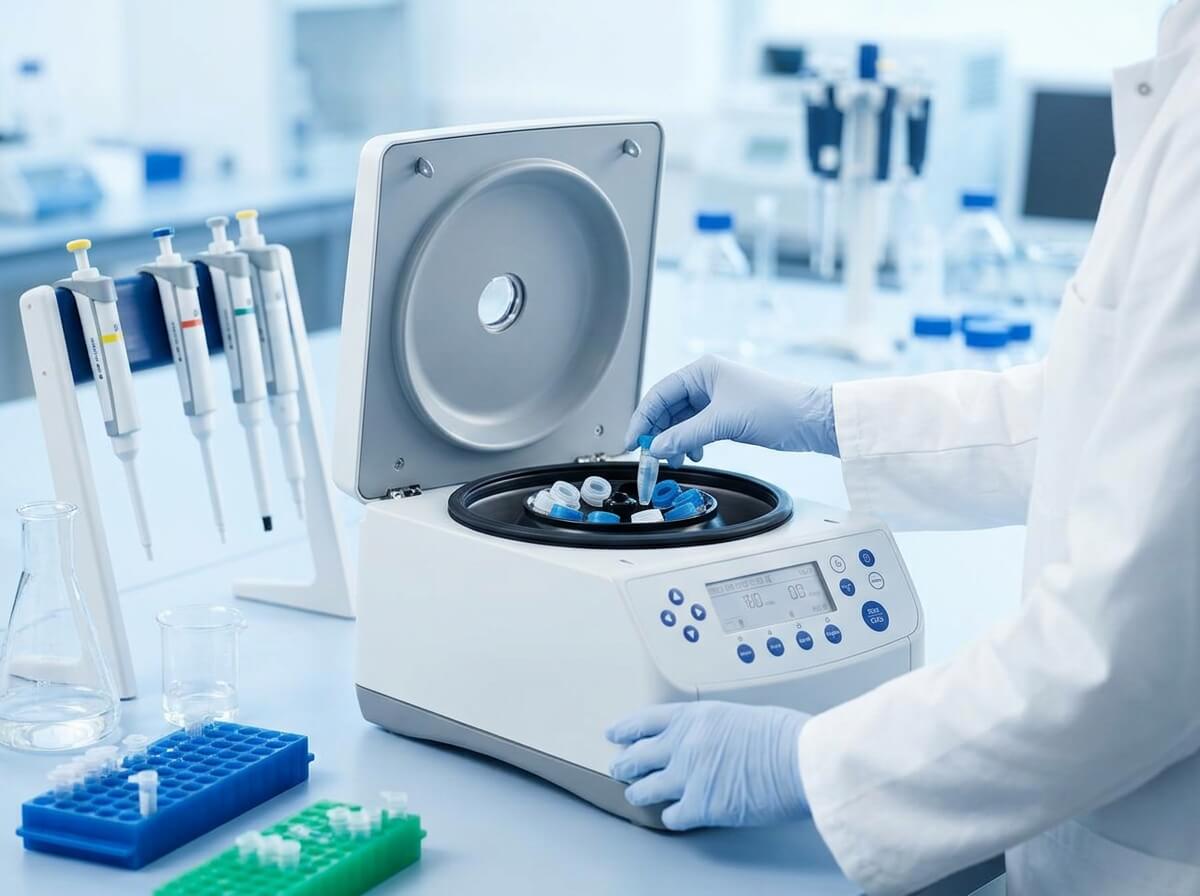
Laboratory centrifuges are foundational instruments across clinical diagnostics, life science research, pharmaceutical development, and industrial quality control. By applying centrifugal force, these units accelerate the natural sedimentation process, separating particles in a liquid medium based on density, size, shape, and viscosity.
Selecting the correct centrifuge requires balancing operational parameters such as rotational speed, relative centrifugal force (RCF), sample volume capacity, temperature sensitivity, and rotor geometry.
+------------------------------------------------------------------------------+-----+
|                     LABORATORY CENTRIFUGATION WORKFLOW                             |
+------------------------------------------------------------------------------+-----+
|  1. Sample Preparation     | Load equal liquid volumes into compatible tubes       |
|  2. Rotor Balancing        | Load samples symmetrically across the rotor axis      |
|  3. Parameter Configuration| Set RCF/RPM, run time, acceleration, and temperature  |
|  4. Separation & Recovery  | Retrieve separated supernatant, buffy coat, or pellet |
+---------------------------------------------------------------------------------+--+
2. Classification by Form Factor & Footprint
Centrifuges are built in various physical sizes to accommodate different laboratory bench spaces and sample throughput requirements.
                      CENTRIFUGE FORM FACTOR CATEGORIES
                                       |
       +-------------------------------+-------------------------------+
       |                                                               |
Benchtop & Compact Units                        Floor-Standing High-Capacity Units
- Small footprint for standard lab benches      - Dedicated floor space required
- Handles microtubes up to 50 mL tubes         - Handles bulk bottles (up to 2–6 Liters)
- Ideal for clinical labs & research benches    - Optimized for blood banks & pilot plants
Mini & Personal Microcentrifuges
-
Footprint: Extremely compact desktop units requiring minimal surface area.
-
Capacity & Tubes: Designed for rapid spin-downs of microtubes and PCR strip tubes.
-
Primary Applications: Quick vessel wall clearing, droplet collection, and quick cell pelleting at individual research stations.
Benchtop Centrifuges
-
Footprint: Mid-sized instruments designed to sit on standard laboratory workbenches. Available in non-refrigerated and refrigerated variants.
-
Capacity & Tubes: Accommodates interchangeable rotors supporting standard clinical blood tubes (3mL to 10mL), 15mL and 50mL conical tubes, or microplates.
-
Primary Applications: General clinical diagnostics, cell culture processing, and routine chemical sample preparation.
Floor-Standing Centrifuges
-
Footprint: Heavy-duty, standalone floor units equipped with industrial casters and heavy sound insulation.
-
Capacity & Tubes: Accepts large-volume processing bottles (250mL to 1,000mL) or multi-liter blood bag systems.
-
Primary Applications: Centralized blood collection centers, bioprocess development, industrial clarification, and high-throughput biomanufacturing.
3. Classification by Functional Capabilities & Temperature Control
Beyond physical size, centrifuges are classified by operational speed ranges, separation forces, and thermal regulation capabilities.
Clinical Centrifuges
-
Performance Range: Low to moderate speeds (typically 3,000 to 5,000 RPM / up to 3,000 times).
-
Key Features: Simple fixed-speed or programmable protocols optimized for standard blood collection tubes and urine tubes.
-
Primary Purpose: Separation of whole blood into serum or plasma, buffy coat isolation, and sediment analysis for routine medical diagnostics.
High-Speed Microcentrifuges
-
Performance Range: High rotational speeds (13,000 to 15,000 RPM / up to 21,000 times g).
-
Key Features: Precision brushless induction motors, aerosol-tight containment lids, and rapid acceleration/deceleration profiles.
-
Primary Purpose: Nucleic acid (DNA/RNA) extraction, protein precipitation, and spin-column purifications in molecular biology labs.
Refrigerated Centrifuges
-
Temperature Range: Integrated compressor systems maintaining precise chamber temperatures between 20°C and +40°C (typically set to 4°C for biologicals).
-
Key Features: Active temperature monitoring that counteracts frictional heat generated during high-speed spinning.
-
Primary Purpose: Preserving heat-sensitive biological samples, including live cells, proteins, enzymes, RNA, and viral particles.
Ultracentrifuges
-
Performance Range: Extremely high speeds (up to 100,000+ RPM / exceeding 800,000 times).
-
Key Features: High-vacuum chambers, structural armor plating, and advanced drive shafts to minimize air friction and thermal buildup.
-
Primary Purpose: Isolating subcellular organelles, viruses, exosomes, lipoproteins, and performing macromolecular density gradient separations.
4. Key Technical Metrics: Speed, Force, and Rotor Design
Understanding operational parameters ensures buyers match the centrifuge to their required experimental protocols.
                      ROTOR GEOMETRY & PELLET PATTERN
                                       |
       +-------------------------------+-------------------------------+
       |                                                               |
Fixed-Angle Rotors                              Swinging-Bucket Rotors
- Tubes held at fixed angle (25°–45°)          - Buckets swing 90° to horizontal during spin
- Shorter pathlength = faster pelleting        - Creates flat, uniform pellet at tube bottom
- Pellets form along outer tube wall           - Superior supernatant phase separation
Speed vs. Relative Centrifugal Force (RCF)
-
RPM (Rotations Per Minute): Measures how fast the rotor spins around its central axis.
-
RCF (Relative Centrifugal Force ): Measures the actual gravitational force exerted on the sample. RCF depends on both RPM and the rotational radius ($r$) of the rotor:
-
Buyer Note: Protocols should always be set and reported in RCF rather than RPM, as different rotor radii yield different forces at the same RPM.
Fixed-Angle vs. Swinging-Bucket Rotors
-
Fixed-Angle Rotors: Hold tubes at a permanent angle (20° to 45°) relative to the rotation axis. Ideal for rapid pelleting of small molecules and cells, as the boundary path length is short.
-
Swinging-Bucket Rotors: Buckets swing out to a horizontal 90° angle during rotation. Produces a flat, even pellet at the exact bottom of the tube, facilitating clean aspiration of the supernatant without disturbing the sediment.
5. Technical Comparison Matrix of Centrifuge Types
| Centrifuge Category | Max Speed Range (RPM) | Max RCF Range (×g) | Typical Tube Volumes | Primary Laboratory Setting |
| Mini / Microcentrifuge | 6,000 – 15,000 | 2,000 – 21,000 | 0.2 mL – 2.0 mL | Molecular Biology, PCR Labs |
| Clinical Benchtop | 3,000 – 6,000 | 1,000 – 4,500 | 3 mL – 15 mL Blood Tubes | Medical & Hospital Diagnostics |
| General Purpose Benchtop | 4,000 – 15,000 | 3,000 – 25,000 | 1.5 mL – 750 mL | Academic, Pharma, Biotech |
| Refrigerated High-Speed | 15,000 – 30,000 | 20,000 – 65,000 | 10 mL – 250 mL | Biochemistry, Cell Biology |
| Floor-Standing Ultra | 40,000 – 100,000+ | 100,000 – 800,000+ | 2 mL – 100 mL | Proteomics, Virology, Structural Bio |
6. Strategic Buyer Checklist: Sourcing the Right Centrifuge
When selecting a laboratory centrifuge for new clinic installations or research lab upgrades, evaluate these parameters:
-
Protocol Force Requirements: Identify the maximum RCF specified by your laboratory protocols rather than relying solely on RPM ratings.
-
Sample Volume & Throughput: Determine your maximum daily tube count and select a rotor that accommodates total volume without requiring excessive run cycles.
-
Temperature Sensitivity: Choose a refrigerated unit if working with proteins, live cells, RNA, or active enzymes to counteract rotational heat buildup.
-
Rotor Versatility & Adapters: Confirm whether the system accepts modular tube adapters (allowing microplates to run in the same rotor).
-
Safety Interlocks: Ensure the unit features automatic rotor recognition, imbalance detection shutoff, motorized lid locking, and aerosol-tight biocontainment covers.

Researcher using a tablet computer to check technical specifications and sourcing criteria next to lab equipment.
7. Frequently Asked Questions (FAQ)
Q1: Why is Relative Centrifugal Force (RCF) preferred over Rotations Per Minute (RPM) when configuring a centrifuge?
RPM measures only the speed of rotation, while RCF measures the actual force applied to the sample. Because RCF accounts for the rotor radius, specifying RCF ensures that experimental protocols can be accurately reproduced on different centrifuges with varying rotor dimensions.
Q2: Do I need a refrigerated centrifuge if my laboratory is air-conditioned?
Yes, if you process temperature-sensitive samples. The rapid friction generated between the spinning rotor and air inside the chamber can increase sample temperatures by 10°C to 15°C above ambient room temperature, potentially degrading enzymes, proteins, or nucleic acids.
Q3: What is the main operational difference between fixed-angle and swinging-bucket rotors?
Fixed-angle rotors hold tubes at a set angle, allowing faster separation and shorter run times, but pellets deposit along the side wall of the tube. Swinging-bucket rotors allow tubes to rotate horizontally, creating a flat pellet at the very bottom of the tube for easy supernatant separation.