Electing the Right Mobile Radiology Architecture
Deploying a mobile radiology room requires selecting a structural vehicle platform that balances mobility, interior spatial capacity, weight distribution, and radiation shielding.
A high-slice Computed Tomography (CT) gantry or a Magnetic Resonance Imaging (MRI) magnet demands heavy structural floor reinforcement, high-capacity climate control, and extensive lead or radiofrequency (RF) shielding. Conversely, a routine Digital Radiography (DR) X-ray or Mammography program prioritizes urban maneuverability and rapid deployment.
This guide compares the three dominant mobile radiology vehicle architectures—Semi-Trailers, Expandable ISO Containers, and Rigid Truck Vans—to help healthcare procurement teams and clinical directors choose the optimal platform for their operational demands.
1. Mobile Radiology Semi-Trailers (Heavy-Duty Imaging Trailers)
Mobile semi-trailers represent the gold standard for high-volume hospital expansion, temporary department replacement during renovations, and mobile CT or MRI diagnostic services.
+-----------------------------------------------------------------------------------+
|                         MOBILE SEMI-TRAILER FLOOR PLAN                            |
|                                                                                   |
|  [ Patient Ramp / Lift ] --> [ Control Room ] --> [ Lead-Shielded CT/MRI Bay ]    |
|                              (Operator Booth)     (Expandable Slide-Out Wing)     |
+-----------------------------------------------------------------------------------+
Architectural Features & Layout
Triple-Room Zoning:
-
-
Reception / Patient Waiting Bay: Equipped with wheel-chair lifts, climate control, and changing cubicles.
-
Operator Control Room: Includes lead-glass viewing windows, primary workstation consoles, and PACS server racks.
-
Scanning Bay: Reinforced sub-frame designed to hold 3,000 to 6,000 kg equipment loads, lined with lead or RF shielding.
-
-
Mobility Mechanism: Pulled by standard commercial tractor trucks; parked via heavy-duty 4-point hydraulic leveling jacks.
Primary Use Cases
-
High-throughput mobile CT and MRI screening programs.
-
Interim hospital radiology backup during facility upgrades.
-
Multi-site regional hospital diagnostic networks.
2. Expandable ISO Containerized Medical Units
Expandable ISO medical containers offer unparalleled global transport versatility. Built around standard intermodal shipping container dimensions, these units can be transported worldwide via cargo ship, flatbed truck, or military transport aircraft.
               EXPANDABLE ISO CONTAINER OPERATION

        [ Unfolded Mode ]                  [ Expanded Mode ]
        +---------------+               +---------------------+
        |  Main Center  |    ====>      | Wing | Center | Wing|
        |   Container   |               | Left | Module |Right|
        +---------------+               +---------------------+
       (Transport Width: 2.4m)         (Expanded Width: ~6.0m)
Architectural Features & Layout
-
Dual Hydraulic Expansion Wings: Side walls expand outward mechanically or hydraulically upon arrival, tripling the interior floor space to approximately in under 20 minutes.
-
Self-Lifting Hydraulic Leg System: Integrated corner jacks lift the entire container off a trailer chassis without requiring heavy cranes, enabling true “drop-and-go” field deployment.
-
Severe Environment Engineering: Lined with high-density polyurethane thermal insulation, stainless steel hardware, and heavy-duty HVAC systems rated for desert or arctic conditions.
Primary Use Cases
-
Military field hospitals and combat casualty care.
-
Disaster emergency response and epidemic containment.
-
Off-grid rural health centers and NGO humanitarian medical missions.
3. Rigid Truck Chassis & Van Conversions
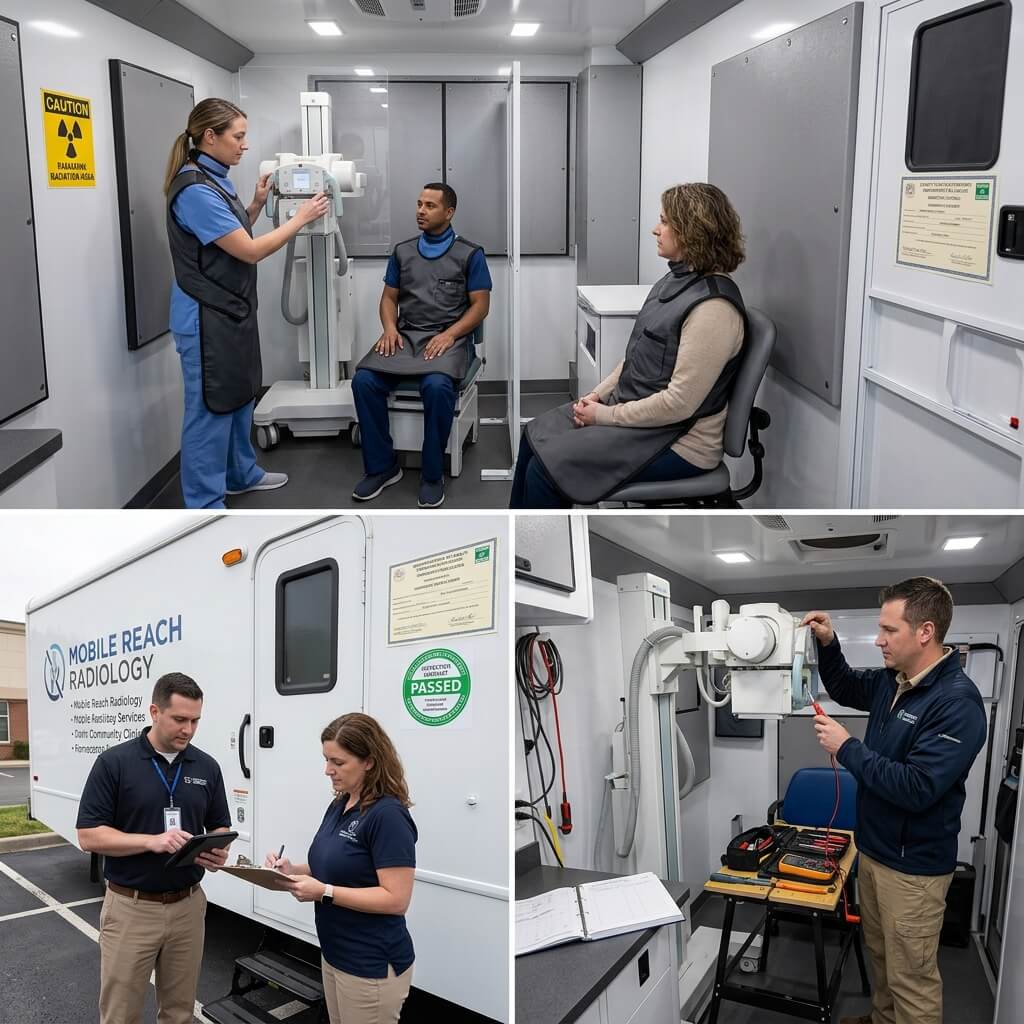
For daily urban health drives, school screening programs, and narrow roadway navigation, rigid truck conversions offer unmatched speed and ease of operation.
+-----------------------------------------------------------------------------------+
|                        RIGID TRUCK RADIOLOGY CONVERSION                           |
|                                                                                   |
|  [ Driver Cab ] === [ Compact Control Desk ] === [ Lead-Lined DR X-Ray / Mammo ]  |
+-----------------------------------------------------------------------------------+
Architectural Features & Layout
-
Platform: Built on 8 to 16 gross vehicle weight rating (GVWR) truck chassis (e.g., Isuzu, MAN, Mercedes-Benz, or Dongfeng).
-
Compact All-in-One Design: The driver cabin is integrated directly with the rear medical box, eliminating the need for a separate tractor head.
-
Streamlined Workflow: Designed primarily for single-modality operations such as Digital Radiography (DR) X-ray, Digital Mammography, or 3D/4D Ultrasound.
-
Ultra-Fast Setup: Arrives on site, deploys stabilizer jacks, engages the onboard generator, and begins patient scanning in under 15 minutes.
Primary Use Cases
-
Mobile breast cancer screening programs (Mobile Mammography).
-
Occupational health chest X-ray screening drives.
-
Community tuberculosis (TB) and respiratory health monitoring.
4. Technical Comparison Matrix: Semi-Trailer vs. Container vs. Truck Van
This engineering matrix breaks down key selection criteria for hospital procurement officers:
| Engineering Parameter | Semi-Trailer Mobile Unit | Expandable ISO Container | Rigid Truck Chassis |
| Max Floor Space | Up to 45 m^2 (with slide-outs) | Up to 36 m^2 (expanded) | 15 to 22 m^2 |
| Gantry Weight Capacity | Up to 7,000 kg | Up to 4,500 kg | Up to 2,500 kg |
| Lead Shielding Thickness | 2.0 to 3.0 mm Pb | 2.0 to 3.0 mm Pb | 1.5 to 2.0 mm Pb |
| MRI RF Shielding | Full copper Faraday cage | Modular aluminum/copper cage | Limited (Specialized chassis) |
| Transport Method | Tractor truck tow | Sea freight, air cargo, truck | Self-propelled driving |
| Offloading Requirement | Stays on trailer wheels | Integrated self-lifting legs | N/A (Integrated vehicle) |
| Deployment Time | 30 to 45 minutes | 15 to 30 minutes | Under 15 minutes |
| HVAC Cooling Capacity | Dual 12,000–24,000 BTU units | Heavy-duty military HVAC | Single 12,000–18,000 BTU unit |
| Onboard Generator | 60 to 150 kVA Diesel | 30 to 80 kVA Diesel | 20 to 40 kVA Diesel |
5. Critical Structural & Shielding Considerations
Regardless of vehicle type, housing high-voltage radiation equipment inside a mobile enclosure requires specialized engineering:
                      SPECIALIZED SHIELDING TYPES
                                   |
     +-----------------------------+-----------------------------+
     |                                                           |
     v                                                           v
[ Lead Radiation Shielding ]                   [ Radiofrequency (RF) Shielding ]
- Seamless overlapping lead sheet             - Copper / Aluminum Faraday cage
- Prevents X-Ray & CT leakage                 - Blocks electromagnetic interference
- Applied to walls, doors, & glass            - Mandatory for Mobile MRI units
A. Lead Shielding Integrity & Joint Overlaps
Vibration during transport can cause micro-gaps in standard lead walls. Premier manufacturers like UMY Medical use continuous, high-purity lead sheets with a minimum 15 mm lead-to-lead seam overlap. All wiring pass-throughs, door frames, and AC ducts feature angled lead baffles to prevent direct radiation leakage.
B. Radiofrequency (RF) Shielding for Mobile MRI
Mobile MRI units require a fully enclosed Faraday cage built into the walls, ceiling, and floor. This prevents external environmental radio frequencies (from cell towers, radios, and power lines) from interfering with image acquisition.
C. Structural Subframe Reinforcement
A CT gantry concentrated in a small footprint can cause floor sag over time. Mobile imaging boxes feature heavy-gauge steel I-beam sub-structures that distribute gantry weight evenly across the axle and stabilization jacks.
6. Why UMY Medical Equipment Co Ltd is the Premier Industry Partner
As an established manufacturer of specialized medical vehicles and mobile clinical shelters, UMY Medical Equipment Co Ltd delivers customized diagnostic solutions tailored to client specifications.
                    UMY MEDICAL ADVANTAGE
                               |
     +-------------------------+-------------------------+
     |                         |                         |
     v                         v                         v
[ Complete Customization ]  [ ISO 13485 & CE Quality ] [ Global Logistics Support ]
 Vehicle, Container, Layout  Full Radiation Certification Shipping to 80+ Countries
Why Procurement Teams Rely on UMY Medical:
-
Custom Vehicle Engineering: UMY Medical designs and manufactures semi-trailers, expandable container shelters, and truck bodies under one roof, matching chassis specifications to local road regulations in Asia, Africa, Europe, the Middle East, and the Americas.
-
Certified Radiation Safety: Every shelter undergo stringent radiation leak testing before leaving the factory. Certified to meet ISO 13485 quality standards and CE safety directives.
-
Turnkey Equipment Integration: UMY Medical handles the physical mounting, electrical cabling, shock dampening, and PACS network setup for fixed DR X-rays, mobile CTs, and mammography systems.
-
Factory-Direct Pricing: Eliminating trading middlemen allows UMY Medical to provide hospital-grade mobile radiology infrastructure at significant cost savings.
Frequently Asked Questions (FAQ)
Q1: Can an expandable ISO container house a full-size 64-slice CT scanner?
Yes. UMY Medical designs 40 ft expandable ISO containers with reinforced floor sub-frames and 3.0 mm Pb lead shielding capable of housing multi-slice CT gantries, control consoles, and patient preparation areas.
Q2: What is the lifespan of a mobile radiology semi-trailer or container?
With routine vehicle maintenance and proper climate control, a heavy-duty mobile radiology trailer or container manufactured by UMY Medical has an operational lifespan of 15 to 20 years.
Q3: How are expandable side wings sealed against water and dust intrusion?
UMY Medical expandable shelters utilize multi-stage inflatable rubber gaskets and mechanical compression seals that automatically lock when side wings are fully extended, providing complete weatherproofing against heavy rain, dust storms, and extreme temperatures.
Q4: Is special licensing required to drive a mobile radiology truck van?
Driver requirements depend on local transport regulations and Gross Vehicle Weight Rating (GVWR). Compact X-ray vans can often be driven with a standard driver’s license, while heavy trucks ($>8 \text{ tons}$) and semi-trailers require a commercial driver’s license (CDL).
Q5: How do I select between a semi-trailer and an expandable container for a rural health program?
If your program requires frequent highway driving between regional hospitals, choose a Semi-Trailer. If your program involves shipping equipment overseas via container ships, dropping units off in off-grid terrain, or military field deployment, choose an Expandable ISO Container.
Conclusion & Next Steps
Selecting the right mobile radiology architecture depends on your imaging modality, geographic terrain, and mobility frequency. Whether you require a high-throughput semi-trailer, a rugged expandable container, or a agile urban truck van, UMY Medical Equipment Co Ltd delivers factory-direct engineering built to international standards.