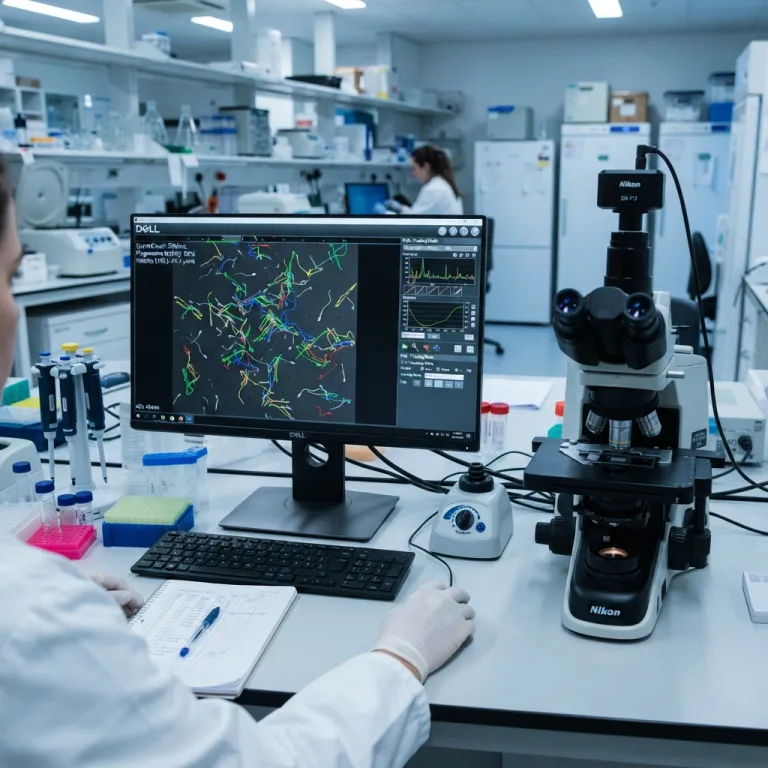
The 3-Degree Trap: Why Software Is Only as Good as Hardware
When fertility clinic directors, urology department heads, and medical equipment procurement managers begin evaluating Computer-Assisted Semen Analysis (CASA) systems, the evaluation process too often focuses on the computer software—inspecting user interface layouts, report printing templates, and database export screens.
This is a critical procurement mistake. In automated semen analysis, the software can only calculate what the optical and mechanical hardware captures.
If the microscope stage lacks precise thermal regulation, if the digital camera captures video at an inadequate frame rate, or if the counting chamber varies in depth by a few micrometers, the underlying biological reality of the specimen is distorted before the computer vision algorithm ever sees a single frame.
Procuring a professional-grade sperm analyzer requires an engineering audit of the physical hardware. This hardware buyer’s guide breaks down the core mechanical and optical subsystems that dictate analytical reliability and calculates the financial return on investment (ROI) for modern fertility clinics.
1. The 37°CFahrenheit Factor: PID Thermal Stage Regulation
Spermatozoa are ectothermic cells; their metabolic rate, flagellar beat frequency, and swimming speed are tightly coupled to thermal energy. In the human body, spermatogenesis and seminal storage occur at core internal temperatures maintained strictly around 37°C.
The Physics of Ambient Cooling
When a fresh, liquefied semen sample is collected in a clinical specimen cup, it is naturally at body temperature. However, if the specimen is placed onto a standard room-temperature microscope glass slide (typically 20°C to 24°C in an air-conditioned laboratory), heat transfers rapidly out of the tiny liquid drop.
-
The Clinical Result: A drop in temperature of just 2°C to 3°C causes a severe, immediate depression in progressive velocity and total motility. Healthy, rapidly swimming Grade A spermatozoa will artificially slow down, grouping together or appearing immotile.
-
The Diagnostic Failure: This ambient cooling triggers false-positive asthenozoospermia, leading clinicians to misdiagnose a fertile patient as having severe motility impairment simply because the microscope stage was cold.
The Engineering Solution: PID-Controlled Thermal Stages
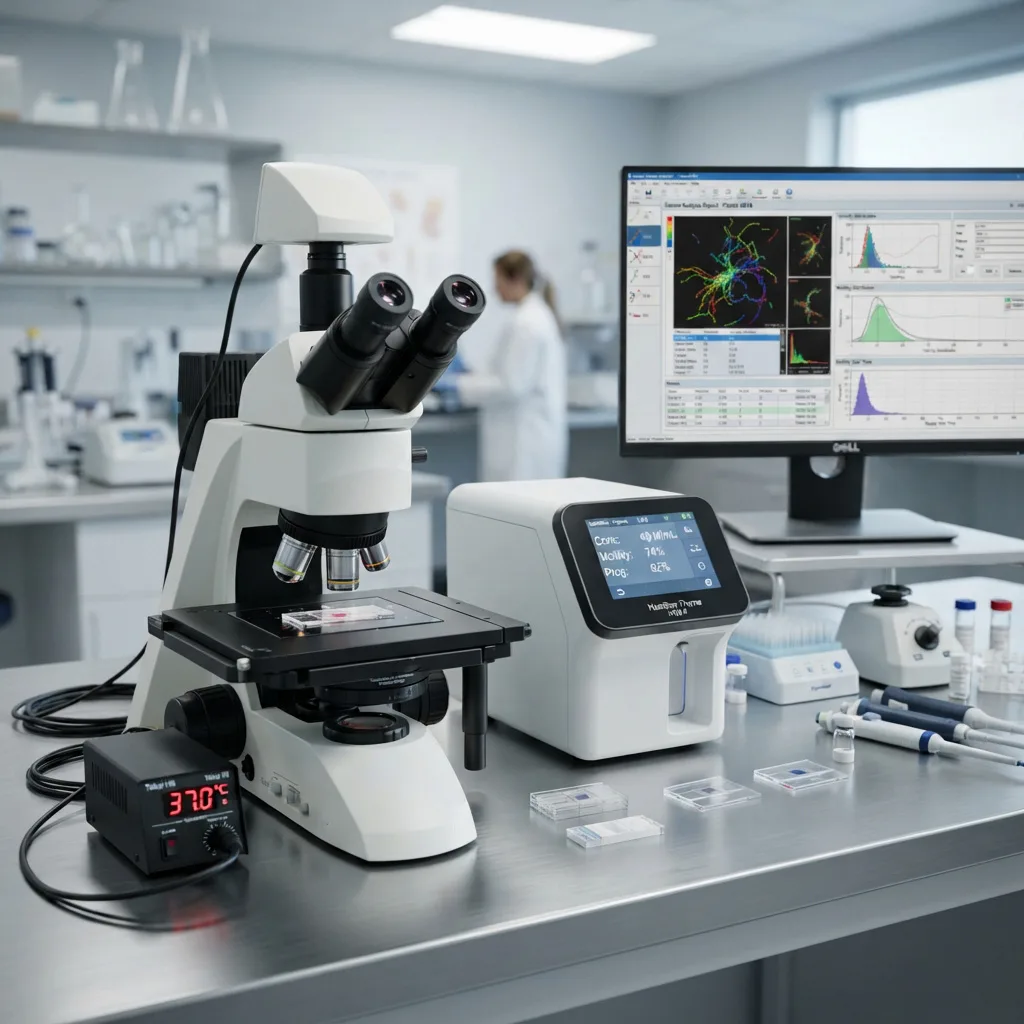
A professional clinical CASA workstation must feature a dedicated PID (Proportional-Integral-Derivative) Thermal Heating Stage:
-
Active Surface Heating: The microscope stage plate is machined from high-thermal-conductivity aluminum or embedded with transparent Indium Tin Oxide (ITO) conductive glass heating elements.
-
Closed-Loop Feedback: A precision thermistor probe measures the temperature of the slide platform in real time, feeding data back to a microprocessor that maintains the specimen surface at 37.0°C ± 0.5°C continuously.
-
Integrated Warm-Up Blocks: Premium systems include auxiliary warming blocks on the workstation housing to pre-warm glass slides, pipette tips, and collection vials prior to sample loading, ensuring zero thermal shock from the moment ejaculation occurs to final computer tracking.
2. Optical Capture Speed: Why Frame Rate (FPS) Matters
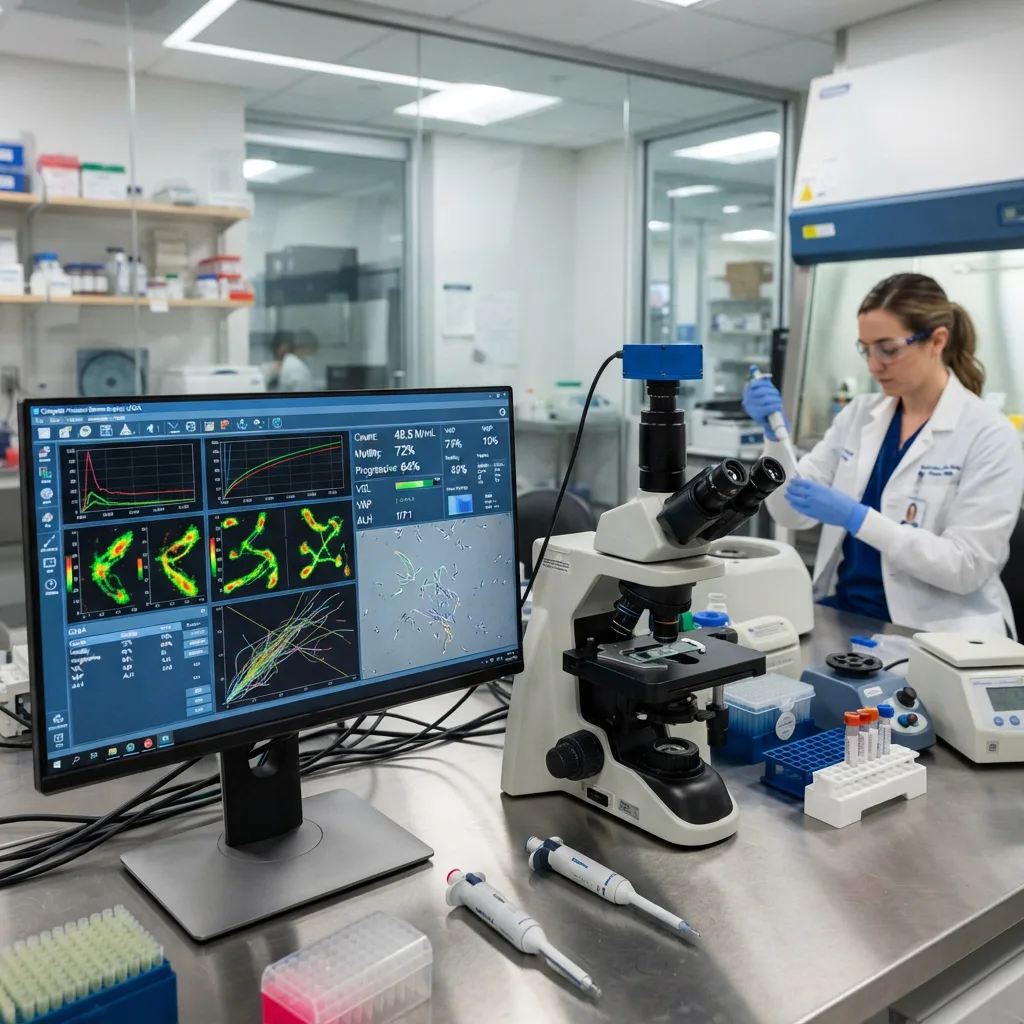
Spermatozoa are among the fastest-moving cells in the human body. A vigorous Grade A spermatozoon travels at curvilinear velocities exceeding 60 to 90 micrometers per second—covering a distance equal to three times its own head length every single second.
The Blurring of Slow Frame Rates
If a laboratory attempts to capture sperm motility using a standard inexpensive office camera or basic webcam running at 15 to 25 frames per second (fps):
-
Between Frame 1 and Frame 2, a fast-swimming sperm head has moved too far across the sensor.
-
The resulting video displays motion blur, elongating the sperm head into a smeared streak or causing the trajectory algorithm to lose track of the cell entirely.
-
When the software cannot reliably establish head centroids across sequential frames, kinematic calculations (VCL, VSL, ALH) become mathematically distorted.
The Global Shutter Standard (60 to 100+ FPS)
Professional CASA hardware utilizes specialized industrial machine-vision cameras equipped with global shutters operating at a minimum of 60 to 100+ frames per second:
-
Global Shuttering: Unlike rolling shutters (which expose sensor lines sequentially from top to bottom, warping fast-moving objects), a global shutter exposes all pixels on the CMOS sensor simultaneously for every microsecond flash.
-
Freezing Motion: At 60+ fps, even the most hyperactivated, frantic spermatozoa are captured as razor-sharp, isolated points in time, allowing the computer vision algorithm to trace clean, uninterrupted trajectory lines across 30 to 60 consecutive frames.
3. Counting Chambers: Capillary Micro-Slides vs. Makler/Neubauer Grids
Calculating sperm concentration requires introducing a precise, known volume of semen into an optical counting chamber of exact, standardized depth. Using incorrect or inconsistent chambers destroys concentration accuracy.
Ⅰ. Reusable Optical Chambers (Makler & Neubauer Chambers)
-
Makler Chamber: Consists of a heavy optical glass slide with a 10-micrometer deep central well surrounded by a fine 1-mm grid divided into 100 squares (each 0.1 x 0.1 mm).
-
Neubauer Hemocytometer: Traditionally used in hematology, adapted with specialized dilution pipettes for high-concentration sperm counting.
-
Advantages & Caveats: While reusable glass chambers eliminate recurring plastic consumable costs, they require meticulous manual cleaning in warm enzymatic detergent between every test. A single microscopic scratch on the glass floor permanently distorts depth calibration, necessitating regular optical recertification.
4. Optical Phase-Contrast Configuration vs. Stained Brightfield
When evaluating a CASA workstation’s microscope optical head, procurement officers must verify how the system illuminates the specimen:
-
Phase-Contrast Illumination (Unstained Motility & Concentration): Utilizes specialized phase rings in the objective lens and annular diaphragms in the condenser. This optical setup converts phase shifts into high-contrast brightness, allowing technicians to evaluate live, moving sperm without adding chemical stains that alter motility behavior.
-
Brightfield Staining Module (Morphology & Vitality): For Kruger morphology and Eosin-Nigrosin vitality testing, the system switches to standard brightfield illumination paired with high-numerical-aperture achromat or apochromat objectives, ensuring crisp color reproduction of Diff-Quik or Papanicolaou stained smears.
5. Clinic Financial Modeling: Calculating CASA Return on Investment (ROI)
Investing in capital laboratory equipment requires a clear financial justification. For fertility clinics, urology practices, and diagnostic centers, a CASA sperm analyzer is a high-yield asset that rapidly repays its initial capital expenditure.
               CASA CLINICAL PAYBACK & PROFITABILITY MODEL
+-------------------------------------------------------------------------+
| TYPICAL CLINICAL VOLUME: 12 Semen Profiles per Week (~600 tests/year)   |
|                                                                         |
| FINANCIAL REVENUE DRIVERS:                                              |
| - Comprehensive CASA Semen Analysis + Kruger Morphology + DFI Screening |
| - Average Outpatient Tariff / Billing Fee: $100 to $250 USD per profile |
| - Annual Gross Procedural Revenue: ~$60,000 to $150,000 USD             |
|                                                                         |
| OPERATING EXPENDITURES (OPEX):                                          |
| - Consumables (Disposable capillary slides, stains, tips): ~$3–$5/test  |
| - Technician Labor: Reduced by 70% (From 45 mins down to 10 mins/test)  |
|                                                                         |
| PAYBACK TIMELINE: Initial CAPEX fully recovered within 60 to 90 days!   |
+-------------------------------------------------------------------------+
The Labor Efficiency Dividend
Under manual andrology protocols, a skilled embryologist or medical technologist spends 30 to 45 minutes per patient: manually pipetting dilutions, squinting through a hemocytometer grid to count hundreds of cells across multiple squares, hand-tallying motile vs. immotile fractions, and subjectively guessing head shapes.
-
Automating the workflow with a CASA system reduces hands-on technical time to under 10 minutes per patient, enabling a single technician to process a high volume of samples during morning intake windows without workflow bottlenecks.
6. Direct Factory Sourcing: The UMY Medical Advantage
When hospital procurement committees, IVF center directors, and international medical distributors look to acquire professional andrology diagnostic equipment without the inflated markups of legacy specialty brands, sourcing directly from a certified original equipment manufacturer is the most strategic path.
UMY Medical Equipment Co., Ltd. is a globally recognized manufacturer of in-vitro diagnostic (IVD) and clinical laboratory systems, supplying fertility centers, hospitals, and distribution networks across more than 80 countries.
                  UMY MEDICAL CASA HARDWARE ADVANTAGE
                                    |
     +------------------------------+------------------------------+
     |                              |                              |
     v                              v                              v
[ Precision Thermal Control ]   [ High-Speed Global Vision ]   [ Complete B2B Support ]
 PID 37.0°C Slide Stage          60 fps Global Shutter Camera   ISO 13485 & CE Certified
 Zero Motility Drop-Off          Zero Motion Blur Tracking      Factory Direct Wholesale TCO
Why Global Fertility Clinics and Distributors Choose UMY Medical:
-
Uncompromising Thermal & Optical Engineering: UMY Medical CASA workstations integrate precision PID 37°C thermal stage platforms with high-contrast phase-contrast optics and 60+ fps global shutter cameras, eliminating ambient cooling drop-off and motion blur.
-
Comprehensive Andrology Diagnostic Suite: Beyond standard WHO 5th and 6th edition motility and concentration, UMY Medical software natively supports Strict Kruger Morphology, Sperm DNA Fragmentation (SCD Halo), Eosin-Nigrosin Vitality, and Leukocyte Peroxidase assays on a single workstation.
-
Certified Quality & Open Hospital IT Integration: Manufactured under strict ISO 13485 quality management systems and carrying CE IVD compliance, UMY Medical systems feature subscription-free software with native bidirectional HL7/ASTM LIS connectivity.
-
Direct Factory Wholesale TCO: By manufacturing precision optical and mechanical hardware in-house, UMY Medical eliminates multi-tier trading markups, providing fertility clinics and B2B distributors with superior margins and long-term spare parts security. (For direct inquiries and factory-direct specifications, visit the official website at https://www.umymedical.com/).
Frequently Asked Questions (FAQ)
Q1: Can a CASA sperm analyzer be operated in a standard room without a dedicated climate-controlled incubator?
While a laboratory should ideally maintain a stable ambient temperature (20°C to 24°C), the critical requirement is the microscope slide temperature, not the room air. Because UMY Medical CASA workstations feature an integrated PID-controlled 37°C thermal stage platform, the specimen remains at exact physiological temperature regardless of normal room air conditioning fluctuations, preventing false-positive motility drops.
Q2: How long does a complete CASA semen analysis take from sample loading to printed report?
Once the liquefied semen sample is loaded into a calibrated capillary counting slide and placed on the heated microscope stage, the CASA software completes automated field capture, multi-frame trajectory tracking, concentration calculation, and morphology classification in approximately 60 to 90 seconds per field. A complete multi-field clinical report is finalized and ready for physician sign-off in under 5 minutes.
Q3: Do disposable capillary counting slides require daily calibration?
No. High-precision disposable capillary micro-slides are manufactured using laser-micrometer optical tolerances that guarantee a uniform 20-micrometer depth batch after batch. This eliminates the need for manual grid calibration or micrometer slide verifications required by traditional reusable hemocytometers.
Q4: How does a CASA analyzer manage clumped or viscous semen samples?
Fresh human semen undergoes liquefaction within 15 to 30 minutes at 37°C. However, hyper-viscous or incompletely liquefied specimens can contain sperm clusters that interfere with individual tracking. UMY Medical CASA workstations feature automated agglomeration-resolution and multi-object separation algorithms that mathematically uncouple touching sperm heads, ensuring accurate concentration counts even in challenging clinical samples.