What Is the Price of a Medical Fiberscope?
There is no single fixed price for a medical fiberscope.
The term covers products ranging from relatively simple optical scopes to specialized flexible endoscopy systems.
Public China B2B listings currently show examples such as:
- Basic flexible fiberscopes: around US$100–2,000
- Fiberoptic camera probes: around US$100–890
- Flexible ureteroscope-type products: around US$1,500–1,990
- More complete or specialized flexible endoscopy systems: roughly US$2,000–7,000 or more
These figures are examples of published marketplace asking prices, not a universal price list. Product configuration, certification, accessories, quantity and destination market can change the final quotation considerably.
This creates several useful SEO search clusters:
- Medical fiberscope price
- Fiberscope price
- Medical fiber optic scope price
- Flexible fiberscope price
- Fiberoptic endoscope price
- Flexible endoscope cost
- Medical endoscope price
- Fiberoptic bronchoscope price
- Flexible cystoscope price
- Fiberscope cost
2. Why Do Medical Fiberscope Prices Vary So Much?
Two products can both be called a “medical fiberscope” while having very different configurations.
The main price factors include:
Scope Type
A basic ENT fiberscope and a specialized urology scope may have completely different specifications.
Diameter
Smaller-diameter designs can require specialized optical and mechanical construction.
Working Channel
A scope with an instrument channel has different functional requirements from a visualization-only scope.
Tip Deflection
More complex articulation mechanisms can influence manufacturing cost.
Optical System
The fiber bundle, optics and illumination system affect the final product configuration.
Accessories
A scope supplied as part of a complete system costs more than the scope alone.
Certification
Different destination markets can require different documentation and regulatory compliance.
Quantity
A one-piece sample order and a hospital project are normally quoted differently.
3. Medical Fiberscope Price by Product Type
A useful way to compare prices is by product category rather than by the word “fiberscope.”
| Product Type | Typical Procurement Considerations |
|---|---|
| ENT fiberscope | Diameter, length, articulation, optical quality |
| Nasopharyngoscope | Small diameter, viewing angle, portability |
| Bronchoscope | Diameter, working channel, articulation, accessories |
| Cystoscope | Diameter, viewing angle, working length |
| Ureteroscope | Deflection, diameter, working channel |
| Choledochoscope | Small diameter, access, imaging |
| Hysteroscope | Diameter, viewing direction, accessories |
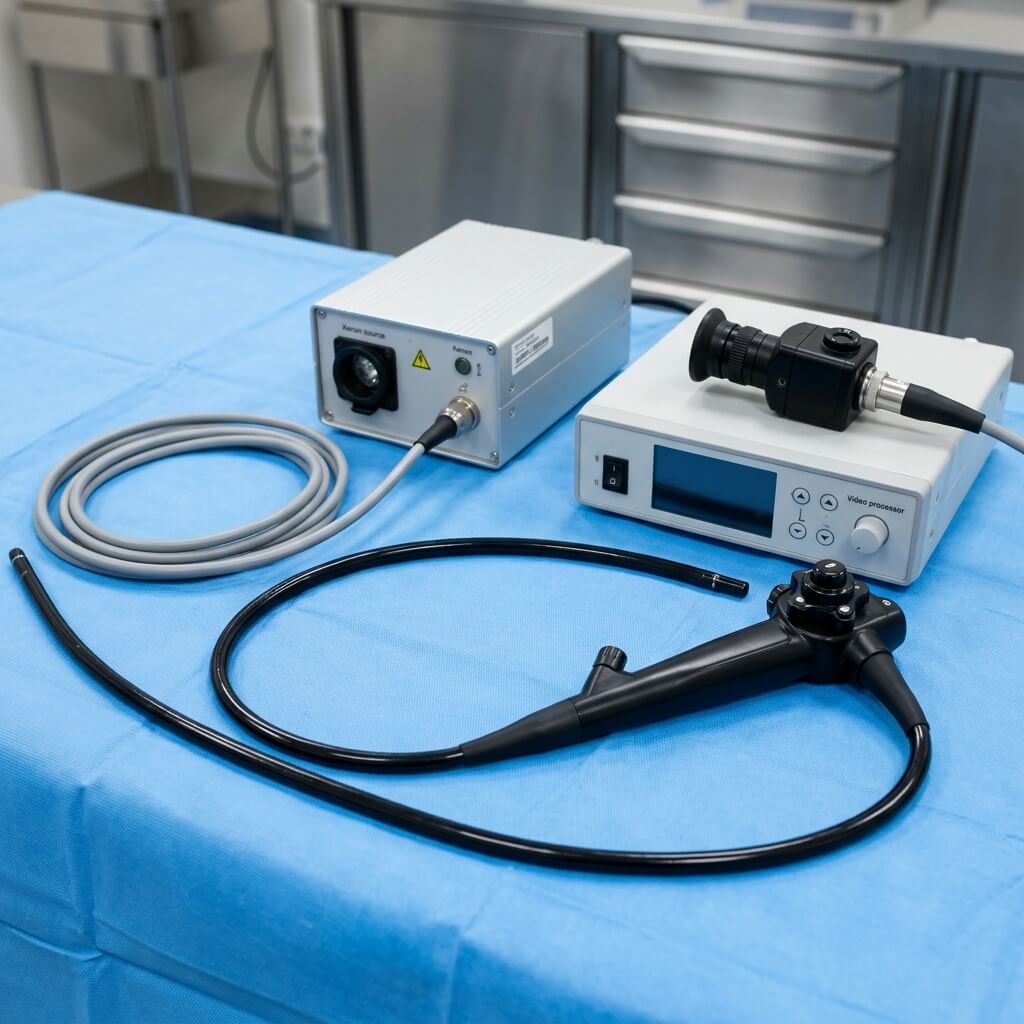
| Complete endoscopy system | Scope + camera + light source + monitor |
The final price should therefore be compared against the same configuration.
4. Basic Fiberscope vs Complete Endoscopy System
This is one of the biggest reasons online prices can appear confusing.
A listing may represent:
Scope Only
while another quotation represents:
Scope + Light Source + Camera + Monitor + Accessories
These are not directly comparable.
For example, a public marketplace listing may show a low price for a flexible optical fiberscope, while another supplier may quote several thousand dollars for a complete endoscopy setup.
Before comparing prices, ask:
“What exactly is included?”
5. What Is Included in a Medical Fiberscope System?
Depending on the product, a quotation may include:
- Medical fiberscope
- Fiberoptic cable
- Light source
- Camera adapter
- Camera
- Image processor
- Monitor
- Recording system
- Biopsy accessories
- Cleaning accessories
- Storage case
- User manual
Not every project needs all of these.
A clinic may already own a compatible light source and monitor.
A new endoscopy department may need an almost complete system.
Therefore, equipment configuration should be defined before price comparison.
6. Medical Fiberscope Price for Hospitals
Hospital procurement usually involves more than the unit purchase price.
A hospital may need to consider:
- Number of scopes
- Number of departments
- Existing imaging equipment
- Accessories
- Spare parts
- Staff training
- Warranty
- Technical support
- Reprocessing requirements
- Import requirements
A hospital purchasing ten scopes, for example, may have completely different commercial requirements from a clinic purchasing one sample unit.
7. Medical Fiberscope Price for Distributors
Distributors often search for:
- Medical fiberscope wholesale
- Fiberscope wholesale supplier
- Medical endoscope wholesale
- Fiberoptic endoscope distributor
- Medical fiberscope bulk price
- China fiberscope supplier
- Endoscope manufacturer China
- Medical equipment OEM China
For distributors, the commercial model may include:
Factory Price → Distributor Margin → Local Logistics → Import Costs → Local Service
This means the lowest factory quotation does not automatically produce the lowest total distribution cost.
8. Medical Fiberscope Wholesale Price
Wholesale pricing usually depends on:
- Quantity
- Model
- Configuration
- Packaging
- Certification
- Destination
- Payment terms
- Delivery terms
A buyer should therefore provide a realistic purchasing quantity when requesting a quotation.
For example:
Quantity: 20 units
Application: ENT
Destination: Kenya
Required certification: CE
Scope type: Flexible nasopharyngoscope
This is much more useful than simply asking:
“Please send your best fiberscope price.”
9. Medical Fiberscope MOQ
MOQ means Minimum Order Quantity.
Different suppliers may have different MOQs.
Some current B2B listings show MOQs of one unit, while other products specify several sets or higher quantities.
For hospitals, a low MOQ can be useful for:
- Product evaluation
- Sample purchase
- Pilot projects
- Initial clinical testing
For distributors, the more important question may be whether the supplier offers volume-based pricing.
10. Medical Fiberscope Sample Order
A sample order is often useful before a larger purchase.
The buyer can evaluate:
- Physical construction
- Image quality
- Tip movement
- Handle operation
- Scope flexibility
- Connector compatibility
- Packaging
- Documentation
A sample order can also help the distributor determine whether the product is suitable for the local market.
However, the sample price may not equal the final bulk price.
11. How to Get a Medical Fiberscope Factory Price
A good RFQ should include at least:
Product
- Fiberscope type
- Intended application
- Quantity
Technical
- Diameter
- Working length
- Working channel
- Field of view
- Tip deflection
System
- Camera
- Light source
- Monitor
- Accessories
Commercial
- Destination country
- Required certification
- Incoterm
- Delivery quantity
- Target delivery date
This allows manufacturers to prepare a more meaningful quotation.
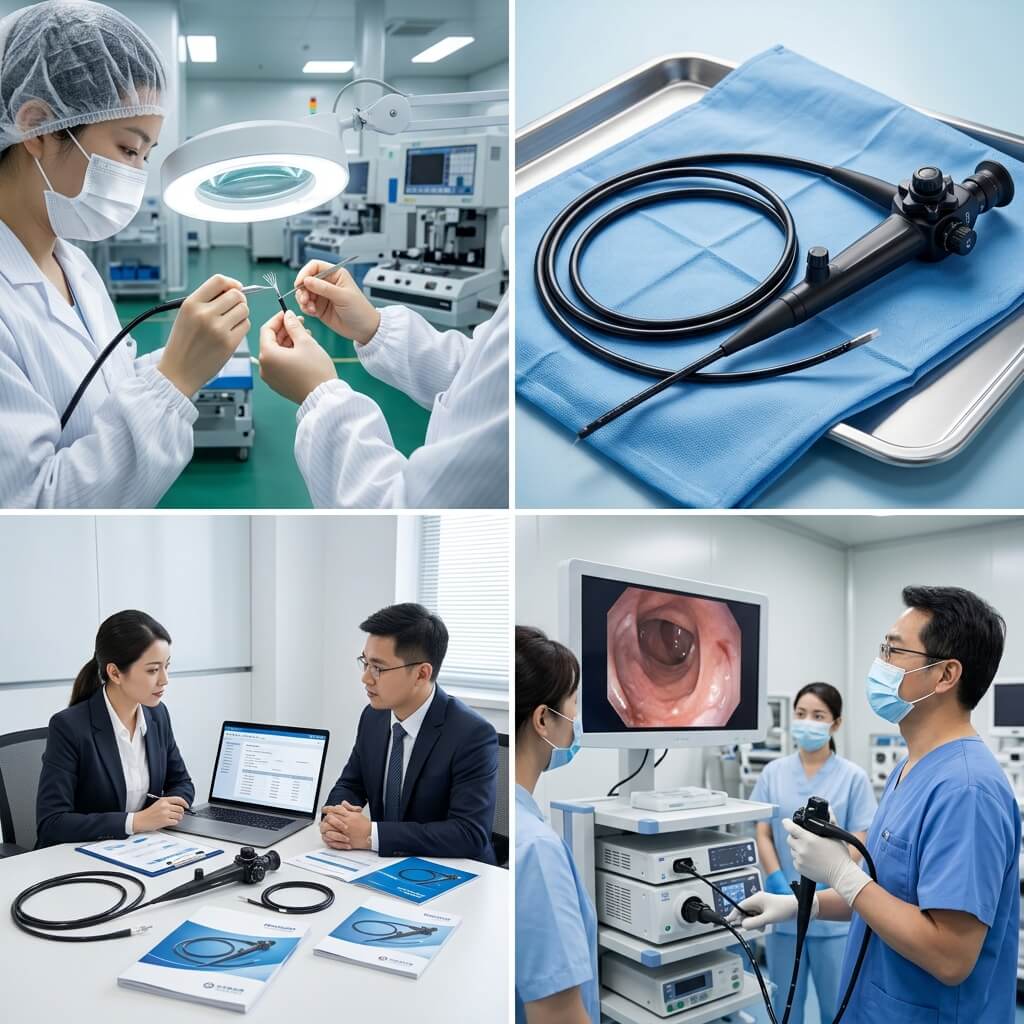
12. China Medical Fiberscope Manufacturers
China has a large medical-device manufacturing and export ecosystem.
B2B marketplaces currently show numerous China-based suppliers offering medical fiberscopes, flexible endoscopes, fiberoptic scopes and related equipment. The published products range from basic optical scopes to specialized endoscopy systems.
Common buyer searches include:
- China medical fiberscope manufacturer
- Medical fiberscope manufacturer China
- China flexible fiberscope supplier
- China fiberoptic endoscope manufacturer
- Medical endoscope factory China
- China bronchoscope manufacturer
- China cystoscope supplier
- China nasopharyngoscope manufacturer
However, a supplier appearing on a marketplace should not automatically be considered the actual manufacturer.
13. Manufacturer vs Trading Company
This is an important distinction for procurement teams.
Manufacturer
A manufacturer may control:
- Product design
- Production
- Quality control
- Technical documentation
- Engineering changes
- Spare parts
Trading Company
A trading company may source products from different factories and provide:
- Product sourcing
- Export services
- Multi-brand purchasing
- Consolidated orders
Neither business model alone tells you whether a product is suitable.
The buyer should verify:
- Who makes the product?
- Who owns the product documentation?
- Who provides warranty service?
- Who handles technical issues?
- Who provides replacement parts?
14. How to Verify a Medical Fiberscope Manufacturer
Ask the supplier for:
- Company profile
- Factory information
- Product catalog
- Technical datasheet
- Quality certificates
- Regulatory documents
- Product registration information where applicable
- User manual
- Warranty terms
- After-sales policy
For larger orders, buyers may also request:
- Factory audit
- Video factory inspection
- Third-party inspection
- Sample evaluation
- Reference projects
The objective is to verify the supply chain, not simply the marketing page.
15. Medical Device Quality Management
For medical-device procurement, quality management deserves specific attention.
ISO 13485:2016 is the internationally recognized quality-management standard specifically designed for medical devices. ISO states that the standard addresses regulatory and customer requirements for medical-device organizations and was reviewed and confirmed as current in 2025.
A buyer should therefore ask:
- Does the manufacturer operate under an appropriate medical-device QMS?
- What certification is available?
- Which products are covered?
- Is the certificate current?
- Does the certification apply to the manufacturing organization?
Certification should be verified against the actual supplier and product scope.
16. Medical Fiberscope Certification
Certification requirements depend on the destination market.
Common procurement terms include:
- CE medical fiberscope
- FDA medical fiberscope
- ISO 13485 fiberscope
- Medical device certification
- Endoscope CE certification
- Flexible endoscope regulatory approval
A CE marking requirement in one market does not automatically mean that the product satisfies the requirements of another market.
The buyer should tell the supplier the destination country before requesting the final quotation.
17. Why Destination Country Matters
A supplier may need to provide different documentation depending on the market.
For example:
- European market
- Middle East
- Africa
- Southeast Asia
- Latin America
- North America
The required regulatory pathway, registration and documentation can vary.
Therefore, a proper RFQ should always contain:
Destination Country + Intended Product + Intended Use
This helps the supplier determine which documentation needs to be discussed.
18. FDA Requirements and Reusable Endoscopes
For buyers targeting the United States, regulatory requirements deserve special attention.
FDA product classifications include flexible and rigid endoscopes, and certain reusable flexible endoscopes require validated reprocessing instructions and validation data within the applicable regulatory pathway.
FDA also specifically identifies flexible bronchoscopes among devices for which reprocessing validation data may be required in applicable 510(k) submissions.
This means a buyer should not simply ask:
“Does this fiberscope have FDA?”
A better question is:
“What is the regulatory status of this exact model for the intended U.S. market?”
19. Reprocessing and Total Cost
A reusable fiberscope has a cost beyond the initial purchase.
Potential costs include:
- Cleaning equipment
- Disinfection
- Sterilization where applicable
- Cleaning accessories
- Staff training
- Maintenance
- Repairs
- Replacement parts
FDA describes reprocessing as a multistep process involving cleaning followed by disinfection or sterilization as appropriate, and emphasizes that reusable devices require device-specific reprocessing procedures.
The FDA-recognized AAMI ST91:2021 standard covers processing of flexible GI, bronchoscopic, ENT, urology and other reusable flexible endoscopes.
Therefore, reprocessing should be included in the procurement discussion from the beginning.
20. Medical Fiberscope Warranty
Warranty is another important part of supplier comparison.
Common warranty questions include:
- How long is the warranty?
- What components are covered?
- Is accidental damage covered?
- Are optical fibers covered?
- Are bending mechanisms covered?
- Who pays shipping for repairs?
- How long does repair normally take?
- Are replacement parts available?
A one-year warranty, for example, should not be evaluated without knowing what the warranty actually covers.
21. Spare Parts and Repairs
For international buyers, spare parts can become particularly important.
Potential spare parts include:
- Light cables
- Connectors
- Seals
- Valves
- Adapters
- Camera accessories
- Handle components
For larger hospital projects, ask whether the supplier can provide a recommended spare-parts list.
This can reduce downtime if a component needs replacement.
22. Medical Fiberscope After-Sales Service
A medical equipment supplier should ideally provide clear information about:
- Technical support
- Troubleshooting
- Warranty
- Repairs
- Spare parts
- User training
- Documentation updates
For overseas buyers, online technical support can be particularly useful.
Before ordering, ask:
“What happens if the scope develops a technical problem after delivery?”
The answer can reveal more about the supplier’s service capability than a promotional product description.
23. OEM Medical Fiberscope
OEM is a common search term among distributors.
Potential searches include:
- OEM medical fiberscope
- OEM flexible endoscope
- OEM fiberoptic endoscope
- Private label fiberscope
- Custom medical fiberscope
- Medical endoscope OEM China
- Fiberscope ODM manufacturer
OEM requirements may include:
- Logo
- Packaging
- User manual
- Product label
- Color
- Accessories
- Product configuration
However, OEM customization of a medical device may have regulatory implications in the destination market.
The buyer should confirm this with the supplier before changing product labeling or intended-use information.
24. OEM vs ODM Medical Fiberscope
The terms are sometimes used interchangeably, but they can describe different commercial relationships.
OEM
Usually focuses on manufacturing according to the buyer’s requirements or branding arrangement.
ODM
Generally involves a supplier providing an existing design or platform that can be adapted for the buyer.
Possible customization areas include:
- Branding
- Packaging
- Accessories
- Configuration
- Documentation
The actual scope of customization depends on the manufacturer.
25. Medical Fiberscope Private Label
Private-label buyers may search for:
- Private label medical fiberscope
- Private label endoscope
- Custom branded fiberscope
- Medical endoscope private label
- OEM endoscopy equipment
Before starting private-label production, confirm:
- Product ownership
- Brand ownership
- Regulatory responsibilities
- Label requirements
- User manual requirements
- Warranty responsibilities
- Product registration
These issues become especially important when the distributor becomes responsible for placing the device on a regulated market.
26. Medical Fiberscope Wholesale from China
A China sourcing project usually involves several steps:
Supplier Search
↓
Product Screening
↓
Specification Confirmation
↓
Sample Order
↓
Documentation Review
↓
Quotation
↓
Regulatory Review
↓
Bulk Order
↓
Inspection
↓
Shipment
↓
After-Sales Support
This process is more reliable than choosing a supplier based only on an online product price.
27. FOB, CIF and Other Medical Equipment Pricing Terms
International buyers should understand what the quoted price includes.
For example:
EXW
The buyer takes responsibility from the supplier’s premises under the agreed Incoterms arrangement.
FOB
The quoted commercial arrangement includes responsibilities up to the agreed point of shipment under the applicable Incoterms rules.
CIF
The seller arranges cost, insurance and freight to the named port under the applicable Incoterms rules.
The exact allocation of responsibilities depends on the agreed Incoterms rule and named place.
Therefore, compare quotations using the same Incoterm and destination.
28. Shipping Medical Fiberscopes Internationally
International shipping costs may depend on:
- Product quantity
- Package dimensions
- Gross weight
- Destination
- Shipping method
- Insurance
- Customs requirements
Potential shipping methods include:
- Air freight
- Express courier
- Sea freight
A small sample order may be suitable for express delivery, while a larger hospital project may use air or sea freight depending on urgency and shipment size.
29. Medical Fiberscope Import Costs
The final landed cost may include:
Product Price
Shipping
Insurance
Customs Duties
Import Taxes
Local Clearance
Local Delivery
Registration or Compliance Costs
The exact costs depend on the destination country and product classification.
This is why a factory quotation should not automatically be treated as the final hospital acquisition cost.
30. How to Compare Medical Fiberscope Suppliers
A practical supplier comparison can use the following table:
| Factor | Supplier A | Supplier B | Supplier C |
|---|---|---|---|
| Manufacturer / distributor | |||
| Scope model | |||
| Application | |||
| Diameter | |||
| Working length | |||
| Working channel | |||
| Tip deflection | |||
| Imaging system | |||
| Certification | |||
| MOQ | |||
| Unit price | |||
| Accessories | |||
| Warranty | |||
| Spare parts | |||
| Technical support | |||
| Lead time | |||
| Incoterm |
This format helps prevent a low initial price from hiding missing equipment or additional costs.
31. How to Request a Medical Fiberscope Quote
A clear RFQ can look like this:
Product: Flexible Medical Fiberscope
Application: ENT
Scope Type: Flexible Nasopharyngoscope
Quantity: 10 units
Diameter: Please recommend
Working Length: Please recommend
Working Channel: Required / Not Required
Imaging: Fiberoptic / Camera compatible
Destination: [Country]
Certification: Required for destination market
Accessories: Please provide complete options
Quotation: FOB and CIF
Warranty: Please specify
Lead Time: Please specify
This gives the supplier enough information to prepare a useful commercial proposal.
32. Questions to Ask a Medical Fiberscope Manufacturer
Before placing an order, ask:
Product
- What is the exact model?
- What is the intended application?
- What is the insertion diameter?
- What is the working length?
- What is the field of view?
- What is the tip deflection?
- Does it have a working channel?
System
- Which light source is required?
- Is a camera available?
- Is a monitor included?
- Which accessories are compatible?
Compliance
- Which certificates are available?
- Which markets is the model intended for?
- What technical documentation is provided?
Service
- What is the warranty?
- Are spare parts available?
- How are repairs handled?
- Is remote technical support available?
33. UMY Medical Equipment Co., Ltd. as a Medical Fiberscope Supplier
UMY Medical Equipment Co., Ltd. provides international medical-equipment sourcing and currently lists a fiber-optic endoscopy product covering cystoscope, nasopharyngoscope, bronchoscope, choledochoscope and hysteroscope configurations.
The current published UMY listing identifies the product as UMY-EN-044, with a MOQ of 1, one-year warranty, online technical support, CE certification, and configurations including 5.0/3.8 mm insertion-tube diameter, 90° field of view, 3–50 mm depth of view and up/down bending specifications. The exact configuration should be confirmed for the specific scope ordered.
This type of multi-application portfolio can be relevant to international buyers looking for more than one endoscopy category from a single medical-equipment supplier.
For an actual project, the most useful information to send UMY is:
- Target application
- Scope type
- Required quantity
- Destination country
- Existing equipment
- Required certification
- Desired accessories
- OEM/private-label requirements, if applicable
This allows the quotation to be based on the actual project rather than a generic product page.
34. What Makes a Useful Medical Fiberscope Supplier?
For procurement purposes, supplier capability can be examined through several concrete areas:
Product Range
Can the supplier provide the scope types required by the hospital or distributor?
Technical Documentation
Are specifications, manuals and compatibility information available?
Regulatory Documentation
Can the supplier provide the documentation required for the target market?
Quality Management
Can the supplier demonstrate an appropriate medical-device quality system?
Production and Supply
Can the supplier maintain consistent supply for repeat orders?
After-Sales Support
Are warranty, repair and spare-parts processes clearly defined?
International Experience
Can the supplier handle export documentation and international shipping?
These are factual procurement criteria rather than simply marketing claims.
35. Medical Fiberscope Price: What Should You Actually Compare?
Instead of comparing only unit prices, compare:
Initial Cost
Scope + Accessories
Installation Cost
Setup + Configuration
Operating Cost
Cleaning + Reprocessing + Consumables
Maintenance Cost
Service + Repairs + Spare Parts
Regulatory Cost
Registration + Documentation
Logistics Cost
Freight + Insurance + Customs + Local Delivery
This produces a more realistic total cost of ownership.
36. Low-Cost Medical Fiberscope: What Should Buyers Check?
Searches such as:
- Cheap medical fiberscope
- Low-cost fiberscope
- Affordable medical fiberscope
- Budget flexible endoscope
- Low price fiberoptic scope
are common among buyers with limited budgets.
A low acquisition price can be useful, but the buyer should still verify:
- Intended use
- Technical specifications
- Documentation
- Certification
- Reprocessing instructions
- Warranty
- Spare parts
- Service
A lower unit price should not be evaluated independently from these factors.
37. How to Buy Medical Fiberscopes from China
A practical sourcing workflow is:
1. Define the Application
ENT, pulmonology, urology, gastroenterology or gynecology.
2. Define the Market
Identify the destination country and applicable regulatory requirements.
3. Shortlist Suppliers
Look for manufacturers or established medical-equipment suppliers.
4. Compare Specifications
Use the same RFQ for every supplier.
5. Verify Documentation
Check certificates, manuals and regulatory information.
6. Order a Sample
Evaluate the product before committing to a large order when practical.
7. Confirm Commercial Terms
Check:
- MOQ
- Price
- Incoterm
- Lead time
- Payment
- Packaging
8. Confirm After-Sales Support
Clarify warranty, repair and spare parts.
9. Place the Bulk Order
Use the approved configuration.
10. Inspect Before Shipment
For larger orders, consider appropriate inspection arrangements.
38. Medical Fiberscope Buying Checklist
Before placing an order:
Product
☐ Correct scope type
☐ Correct application
☐ Correct diameter
☐ Correct working length
☐ Correct tip deflection
☐ Correct working channel
Imaging
☐ Field of view confirmed
☐ Light source confirmed
☐ Camera compatibility confirmed
☐ Monitor compatibility confirmed
Compliance
☐ Destination market confirmed
☐ Required certification confirmed
☐ Product documentation available
☐ Reprocessing instructions available
Commercial
☐ MOQ confirmed
☐ Unit price confirmed
☐ Accessories confirmed
☐ Incoterm confirmed
☐ Lead time confirmed
☐ Warranty confirmed
☐ Spare parts confirmed
Logistics
☐ Packaging confirmed
☐ Shipping method confirmed
☐ Insurance confirmed
☐ Import requirements checked
39. Frequently Asked Questions About Medical Fiberscope Price
How much does a medical fiberscope cost?
Public B2B listings show a very wide range, from around US$100 for some basic products to several thousand dollars for specialized or complete systems. The exact price depends on specifications and configuration.
Why are some fiberscopes much more expensive than others?
Differences in diameter, working channel, articulation, optical system, accessories, imaging equipment, certification and intended application can significantly affect price.
What is the price of a flexible bronchoscope?
There is no universal price. The quotation depends on diameter, working channel, image system, accessories, certification and supplier configuration.
What is the price of a flexible cystoscope?
Flexible cystoscope prices vary according to optical design, diameter, working length, accessories, imaging equipment and regulatory requirements.
Can I buy a medical fiberscope directly from China?
Yes. China-based suppliers and manufacturers offer medical fiberscopes through direct sales and B2B platforms. Published listings show products across a broad price range and configuration spectrum.
What is the MOQ for a medical fiberscope?
MOQ depends on the supplier and product. Some current listings show MOQ of one unit, while others require multiple units. UMY’s currently published multi-application fiberoptic scope listing shows MOQ 1.
Can medical fiberscopes be customized?
Some suppliers offer OEM or ODM arrangements covering branding, packaging and selected configurations. Regulatory implications should be checked before making product or labeling changes.
Should I buy a fiberscope from a manufacturer or trading company?
The important factors are product suitability, documentation, quality management, regulatory support, supply capability and after-sales service. Verify who is responsible for manufacturing and technical support.
What certificates should I ask for?
Ask the supplier which certificates and regulatory documents apply to the exact model and your destination market. ISO 13485 relates to medical-device quality management, while market-specific product requirements are separate matters.
Does a CE certificate mean the product can be sold everywhere?
No. Regulatory requirements differ by market. A buyer should verify the requirements of the destination country.
What should be included in a fiberscope quotation?
The quotation should clearly identify the scope model, specifications, accessories, certification/documentation, warranty, MOQ, Incoterm, lead time and payment terms.
How can I reduce the total cost of a fiberscope project?
Compare complete configurations, negotiate based on realistic quantities, check compatible accessories and consider the total cost of ownership rather than only the initial unit price.
Is a cheap medical fiberscope a good choice?
Price alone does not establish suitability. The product should be evaluated against the intended application, technical requirements, regulatory documentation, reprocessing requirements and service support.
How do I choose a China medical fiberscope supplier?
Start with the clinical application and technical requirements, then compare manufacturers on documentation, quality systems, regulatory support, pricing, lead time, warranty and after-sales service.
Can UMY Medical Equipment supply medical fiberscopes?
UMY currently lists a fiber-optic endoscopy product covering cystoscope, nasopharyngoscope, bronchoscope, choledochoscope and hysteroscope configurations, with a published MOQ of one and one-year warranty. Exact availability and configuration should be confirmed for each project.