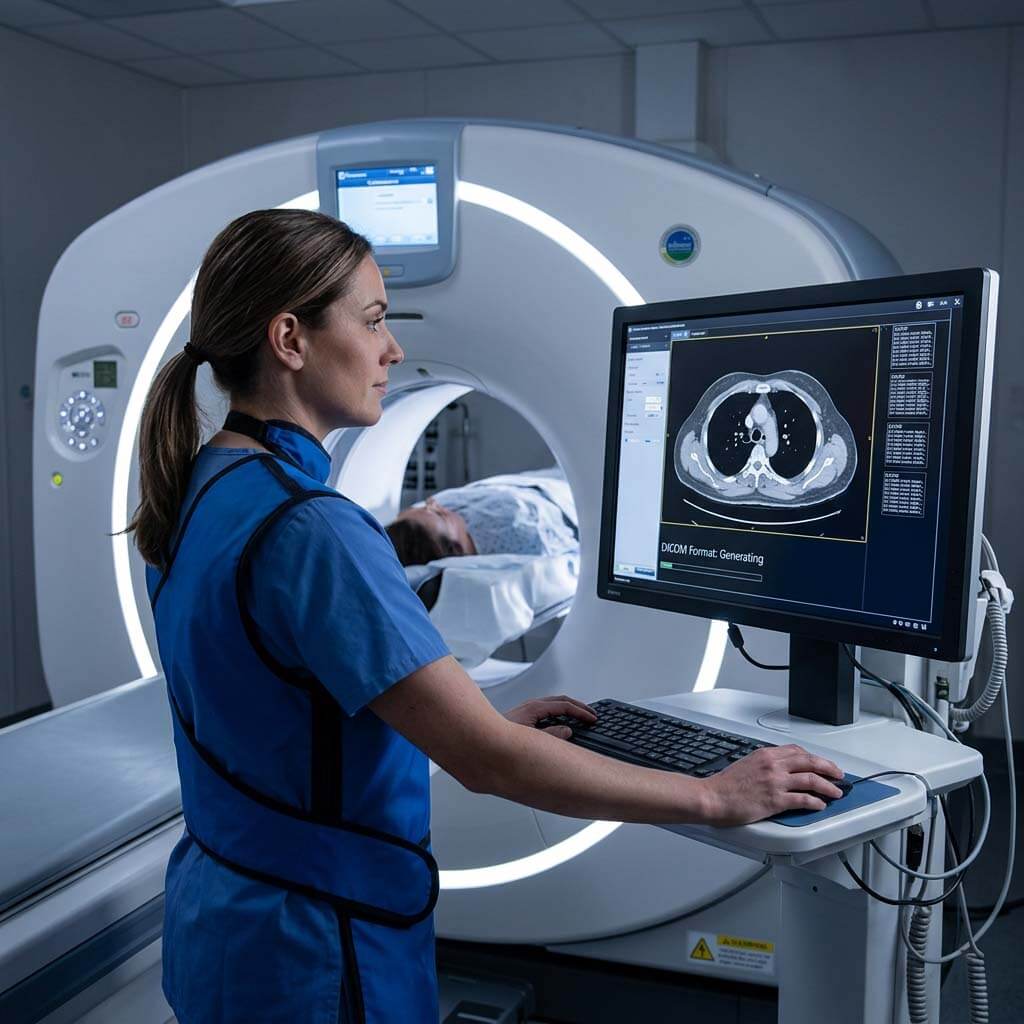
The Shift Toward Intelligent Contrast Management
The field of diagnostic radiology is undergoing a rapid digital transformation. Historically, contrast media injectors were treated as standalone mechanical pumps—tools tasked simply with delivering a fixed volume of contrast fluid at a preset speed.
Today, radiology is shifting toward personalized medicine, automated data connectivity, and patient-centric safety. Modern CT, MRI, and Cath Lab environments require power injectors to act as intelligent diagnostic nodes that communicate directly with scanners, analyze patient renal metrics, automatically document injection parameters, and minimize chemical contrast exposure.
This article explores the future of contrast delivery technology, detailing how Artificial Intelligence (AI), connected health architecture, and eco-friendly design are reshaping clinical workflows—and how UMY Medical Equipment Co Ltd is driving these innovations forward.
1. AI-Driven Dosing & Personalized Injection Protocols
In traditional injection protocols, a standardized contrast volume (e.g., $100 \text{ mL}$) is often administered regardless of individual patient physiological differences. This static approach can lead to over-dosing in smaller patients or sub-optimal diagnostic enhancement in patients with higher body mass index (BMI) or elevated cardiac output.
                    AI PERSONALIZED DOSING ENGINE
+----------------------------------------------------------------------------------+
| INPUT DATA          -->  AI ALGORITHM COMPUTATION  -->  OPTIMIZED INJECTION      |
| - Patient Weight/BMI     - Vascular Volume Est.         - Customized Iodine Vol  |
| - eGFR / Renal Function  - Flow Velocity Calculation    - Tailored Flow Rate     |
| - Cardiac Output Scan    - Bolus Arrival Prediction     - Saline Ratio Adjustment|
+----------------------------------------------------------------------------------+
Key AI Dosing Innovations
-
Weight and BMI-Based Dosing Algorithms: AI algorithms automatically calculate the exact iodine delivery rate needed to achieve target Hounsfield Unit (HU) attenuation in blood vessels, preventing excessive contrast load.
-
Renal Function Guardrails (eGFR Integration): By syncing with hospital laboratory databases, smart injectors read the patient’s latest eGFR (estimated Glomerular Filtration Rate) level. If renal function is compromised, the injector automatically caps contrast dosage and alerts the clinician.
-
Dynamic Bolus Tracking Synchronization: AI algorithms process low-dose monitor scans in real time, adjusting injection speeds dynamically as the contrast bolus enters the aorta or pulmonary arteries.
Clinical Benefit: Personalized contrast dosing reduces the incidence of Contrast-Induced Acute Kidney Injury (CI-AKI) and Contrast-Induced Nephropathy (CIN), protecting vulnerable renal patients while delivering pristine diagnostic scans.

2. Connected Care: PACS/RIS, DICOM & HL7 Bidirectional Integration
Manual documentation of contrast volume, brand name, batch numbers, and injection pressures in patient charts is prone to human error and consumes valuable technologist time. Next-generation contrast delivery systems feature bidirectional integration with hospital enterprise networks.
                     CONNECTED RADIOLOGY ECOSYSTEM
+---------------------------------------------------------------------------------+
| RADIOLOGY INFORMATION SYSTEM (RIS)  <--->  SMART CONTRAST INJECTOR              |
| - Imports Patient Protocol Specs           - Executes Precision Injection       |
|                                            - Monitors Real-Time Pressure        |
|                                                                                 |
| PICTURE ARCHIVING SYSTEM (PACS)     <---  AUTOMATED DICOM / HL7 DATA EXPORT     |
| - Stores Injection Data with Images        - Volume, Peak PSI, Flow Rate Logs   |
+---------------------------------------------------------------------------------+
The Integrated Workflow Advantage
-
Automated Patient Pre-Fetch: When a technologist selects a patient on the injector touchscreen, the console pulls physiological data and scan protocols directly from the Radiology Information System (RIS) via HL7 interfaces.
-
DICOM Structured Reporting (SR): Following the scan, the injector generates an automated DICOM Structured Report containing:
-
Total contrast volume injected
-
Total saline flush volume
-
Peak injection pressure
-
Actual flow rate curve
-
Contrast lot/batch number and expiration date
-
-
Seamless PACS & EHR Archiving: This report is attached directly to the patient’s diagnostic image series in PACS and archived in their Electronic Health Record (EHR) for regulatory compliance and audit tracking.
3. Dose Reduction & Contrast Media Optimization Strategies
Minimizing contrast dosage is a primary objective for radiology departments worldwide, driven both by clinical safety guidelines (such as ACR contrast recommendations) and healthcare cost containment goals.
                     CONTRAST DOSE REDUCTION MODEL
+---------------------------------------------------------------------------------+
| TRADITIONAL SINGLE-HEAD INJECTOR  --> [ 100 mL Contrast ] [ No Saline Chase ]   |
| NEXT-GEN DUAL-HEAD SMART SYSTEM  --> [ 60 mL Contrast  ] [ 40 mL Saline Chase]  |
|                                       (30-40% Reduction in Contrast Volume!)    |
+---------------------------------------------------------------------------------+
Core Technologies Driving Dose Reduction
-
High-Concentration Iodine + High-Speed Saline Chase: Using high-concentration iodinated contrast agents combined with dual-head saline flushing maintains peak blood vessel brightness while reducing overall iodine volume by 20% to 40%.
-
Sub-Milliliter Metering Precision: Next-generation servo drives allow precise micro-dosing adjustments for pediatric imaging, cardiac perfusion scans, and low-dose CTA protocols.
-
Low-kVp CT Protocol Optimization: Modern CT scanners running at low peak kilovoltage increase iodine attenuation, allowing smart contrast injectors to administer significantly smaller contrast volumes without losing image sharpness.
4. Sustainability & Eco-Friendly Design in Medical Devices
As healthcare systems work to lower their environmental footprint, medical device manufacturers are redesigning equipment and disposables to minimize plastic waste and chemical environmental contamination.
                   SUSTAINABLE RADIOLOGY INITIATIVES
                                   |
     +-----------------------------+-----------------------------+
     |                             |                             |
     v                             v                             v
[ Reduced Plastic Waste ]   [ Multi-Dose Syringeless ]   [ Recyclable PET Polymers ]
- Thinner high-tensile walls - Lower disposable weight   - 100% recyclable components
- Minimal packaging footprint- Reduced fluid wastage     - Eco-friendly production
Green Medical Device Trends in Contrast Injection:
-
Syringeless & Multi-Dose Systems: Transitioning toward multi-dose fluid delivery systems reduces single-use plastic waste by up to 50% per scan shift.
-
Recyclable High-Tensile Polymers: Replacing non-recyclable plastics with 100% recyclable medical-grade PET (polyethylene terephthalate) materials in high-pressure syringe barrels.
-
Energy-Efficient Standby Modes: Smart injector consoles incorporate automated sleep modes and eco-friendly heating collars that reduce power consumption during off-peak clinic hours.
5. Traditional Power Injectors vs. Next-Gen Smart Injectors
The structural differences between legacy contrast injectors and modern AI-connected systems highlight the ongoing evolution in radiology technology:
| Feature / Capability | Legacy Power Injector | Next-Gen Smart Injector (UMY Medical) |
| Dosing Protocol | Fixed volume manual entry | AI-driven personalized dosing (Weight, BMI, eGFR) |
| Data Logging | Manual paper entry / basic log | Automated DICOM / HL7 data export to PACS & EHR |
| Scanner Connectivity | Basic relay cable start/stop | Bidirectional real-time protocol sync |
| Air Detection | Single optical / basic sensor | Dual-frequency ultrasonic air detection |
| Consumable Waste | High single-use plastic waste | Eco-friendly recyclable PET / optimized tubing |
| Pressure Management | Fixed max pressure cutoff | Real-time dynamic pressure curve optimization |
| Maintenance Tracking | Manual biomedical logs | Cloud-based predictive self-diagnostics |
6. UMY Medical Equipment Co Ltd: Engineering Next-Gen Diagnostic Solutions
As a pioneer in high-pressure contrast media delivery technology, UMY Medical Equipment Co Ltd is actively driving the future of smart, safe, and connected radiology systems.
                    UMY MEDICAL NEXT-GEN ROADMAP
                                  |
     +----------------------------+----------------------------+
     |                            |                            |
     v                            v                            v
[ AI Smart Consoles ]     [ Universal PACS Sync ]     [ Sustainable Disposables ]
- Auto eGFR dose capping  - DICOM/HL7 native export   - Recyclable PET plastics
- Real-Time PSI curves    - Cross-brand scanner sync  - Low-waste fluid sets
UMY Medical’s Technology Roadmap:
-
AI-Assisted Injector Operating System: UMY Medical’s development team is integrating intelligent dosing assistants into touchscreen consoles, allowing technicians to enter patient weight and eGFR to automatically generate safe, optimized injection protocols.
-
Universal Scanner & PACS Connectivity: UMY injectors feature open-architecture DICOM and HL7 communication modules, ensuring instant compatibility with GE, Siemens, Philips, Canon, Neusoft, and United Imaging scan suites alongside global PACS platforms.
-
Eco-Conscious Manufacturing: UMY Medical is committed to environmental sustainability, utilizing $100\%$ recyclable medical-grade polymers, optimized sterile packaging, and energy-efficient motor systems across all product lines.
-
Accessible Factory-Direct Innovation: By manufacturing in state-of-the-art ISO 13485 facilities and supplying directly to global markets, UMY Medical ensures next-generation smart injection technology remains affordable for both metropolitan hospitals and expanding tier-2 medical centers.
Frequently Asked Questions (FAQ)
Q1: How does AI personalized dosing improve patient safety during CT scans?
AI personalized dosing calculates contrast volume based on individual body mass, blood volume, and renal function (eGFR). This prevents over-dosing, lowers the chemical burden on the kidneys, reduces Contrast-Induced Nephropathy (CIN) risks, and maintains clear diagnostic image contrast.
Q2: What is DICOM Structured Reporting for contrast media injectors?
DICOM Structured Reporting (SR) is a standardized digital format that allows contrast injectors to automatically send injection records—including contrast volume, flow rate, injection duration, peak pressure, and batch numbers—directly into PACS and EHR databases without manual typing.
Q3: Can UMY Medical contrast injectors connect to older CT or MRI scanners?
Yes. UMY Medical contrast injectors feature universal relay interfaces and open DICOM/HL7 software protocols, making them fully compatible with both older diagnostic imaging systems and modern digital scanner suites.
Q4: How does dual-head saline chase technology reduce contrast agent costs?
A dual-head contrast injector uses saline solution to push the contrast agent remaining in extension tubing completely into the patient’s vascular system. This “saline bolus chase” tightens the contrast column and eliminates fluid waste, reducing contrast media consumption by up to 20% – 40% per scan.
Q5: How can healthcare distributors partner with UMY Medical Equipment Co Ltd for next-gen products?
Medical device distributors and hospital supply directors can contact UMY Medical Equipment Co Ltd directly to explore OEM/ODM opportunities, request technical product datasheets, and secure factory-direct wholesale pricing for next-generation contrast delivery systems.
Conclusion: Complete 5-Part Blog Series Overview
This article completes our 5-Part Ultimate Guide to Contrast Media Injectors. Across this comprehensive series, we have covered every critical dimension of contrast delivery systems for hospital procurement, biomedical engineering, and clinical management:
-
Post 1: The Ultimate Contrast Media Injector Buyer’s Guide for Hospital Procurement – Procurement strategies, single vs. dual-head systems, and core specifications.
-
Post 2: CT vs. MRI vs. Angiography Contrast Injectors: Technical Specs & Applications – Modality comparison, PSI pressure limits, flow rates, and fluid dynamics.
-
Post 3: Contrast Media Injector Safety Protocols, Preventative Maintenance & Troubleshooting – Extravasation prevention, air embolism protection, and biomedical maintenance routines.
-
Post 4: Total Cost of Ownership (TCO) & OEM Sourcing Guide for Contrast Injectors – Lifetime financial modeling, proprietary vs. compatible consumables, and OEM factory-direct sourcing.
-
Post 5: Next-Gen Contrast Injection Technology: AI, Automated Protocols & Future Trends – AI personalized dosing, PACS/DICOM integration, dose reduction, and green radiology solutions.
By partnering with UMY Medical Equipment Co Ltd, healthcare institutions gain access to cutting-edge diagnostic injection hardware, ISO/CE-certified disposable supplies, and substantial factory-direct savings.
Contact UMY Medical Equipment Co Ltd today to elevate your diagnostic imaging capabilities.