The Critical Role of Equipment Safety in Diagnostic Radiology
In modern CT, MRI, and Cath Lab procedures, contrast media injectors operate under high mechanical loads and rapid injection pressures. While power injection allows precise dynamic contrast enhancement, it also carries clinical risks—primarily contrast media extravasation (subcutaneous tissue infiltration) and venous air embolism.
Furthermore, because contrast agents are sticky, salt-based solutions, fluid leaks can seep into injector heads, hardening on optical sensors and circuit boards to cause mechanical jams or electrical faults.
This comprehensive technical guide outlines clinical safety protocols, preventative maintenance (PM) checklists, troubleshooting steps, and consumable handling practices to keep imaging departments running safely and efficiently.
1. Preventing Clinical Complications: Extravasation & Air Embolism
Clinical safety protocols and machine safety features must work in unison to protect patients during high-pressure power injections.
                    DUAL-PROTECTION SAFETY ARCHITECTURE
+---------------------------------------------------------------------------------+
|   CLINICAL SAFETY PROTOCOLS            HARDWARE SAFETY MECHANISMS               |
|   - Antecubital IV site selection      - Ultrasonic Air Detection Sensors       |
|   - Pre-warm contrast to 37°C          - Real-Time Pressure Limit Auto-Cutoff   |
|   - Saline test flush validation       - Automatic Motor Overload Protection    |
+---------------------------------------------------------------------------------+
A. Contrast Media Extravasation Prevention
Extravasation occurs when contrast media leaks out of the target vein into surrounding soft tissues. High injection pressures and viscous contrast agents increase this risk.
-
Pre-Warming Contrast to 37°C: Warming high-viscosity iodinated contrast media reduces its viscosity by approximately 50%. Lower viscosity significantly reduces injection pressure, decreasing vessel wall stress.
-
Catheter Gauge Matching: Use larger flexible plastic angiocatheters for flow rates of $3.0 mL/s or higher. Avoid fragile, hand/foot injection sites or metal butterfly needles.
-
Saline Test Flush Protocol: Perform a pre-injection saline test flush (either manually or via a dual-head injector’s pre-test protocol) to verify catheter patency and vein resistance prior to contrast delivery.
-
ACR Guidelines for Extravasation Management: If extravasation occurs, immediately stop the injection, aspirate residual contrast through the existing catheter, remove the catheter, elevate the affected extremity above heart level, and apply cold compresses to manage localized swelling.
B. Venous Air Embolism Prevention
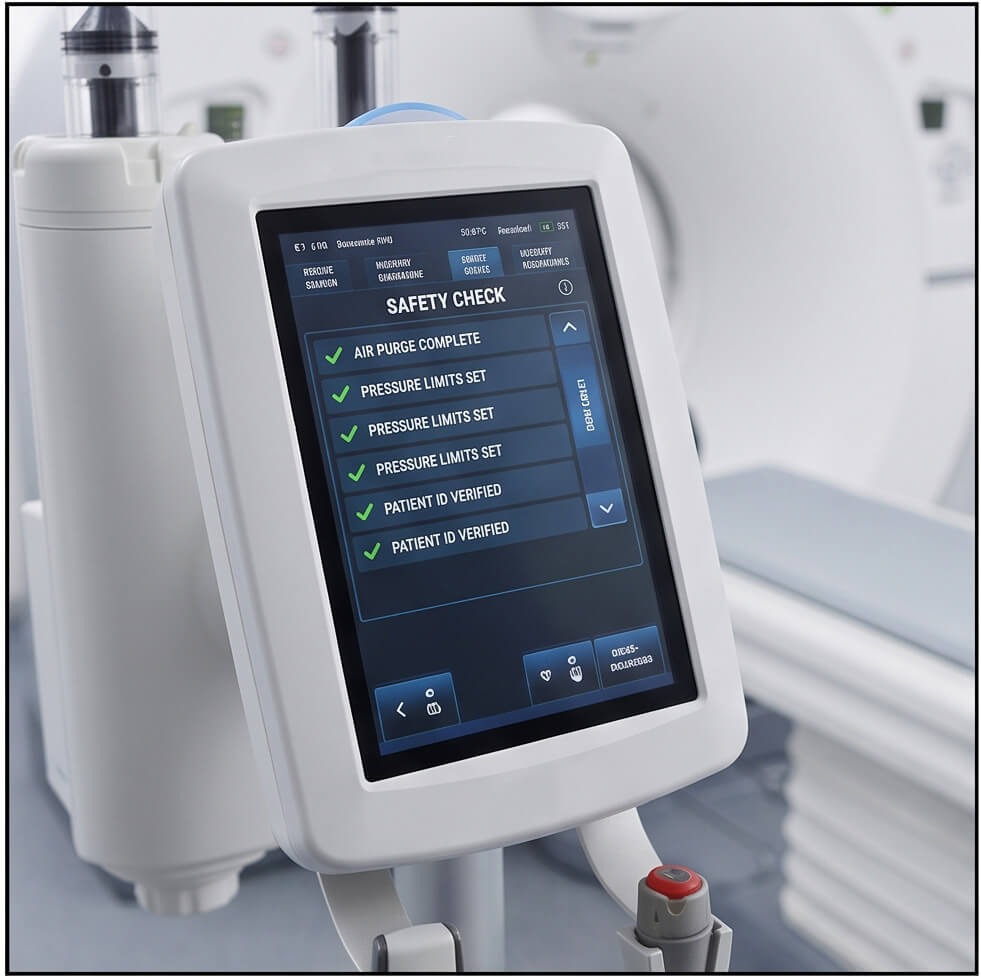
Injecting air into a patient’s venous system can lead to pulmonary embolism or cardiac complications. Power injectors employ both manual workflow checks and automated sensor arrays to prevent air delivery:
                  AIR EMBOLISM PREVENTION WORKFLOW
+----------------------------------------------------------------+
| Step 1: Vertical Syringe Loading (Piston pointing UP)          |
| Step 2: Auto-Fill & Manual Tap to Purge Air Bubbles            |
| Step 3: Upright Auto-Purge Protocol via Injector Head          |
| Step 4: Downward Head Inversion (Piston pointing DOWN)         |
| Step 5: Dual Ultrasonic Sensor Active Air Verification         |
+----------------------------------------------------------------+
-
Inverted Head Injection Design: Always fill and purge syringes with the injector head facing upward so air rises to the tip. Rotate the injector head downward before starting the injection protocol so any residual micro-bubbles remain trapped at the rear piston base.
-
Ultrasonic Air Sensor Arrays: High-performance injectors utilize dual-frequency ultrasonic air sensors clamped around the outlet tubing to detect air bubbles down to 25 mu L, triggering an instant motor lock if air is detected.
2. Preventative Maintenance (PM) Checklist for Biomedical Engineers
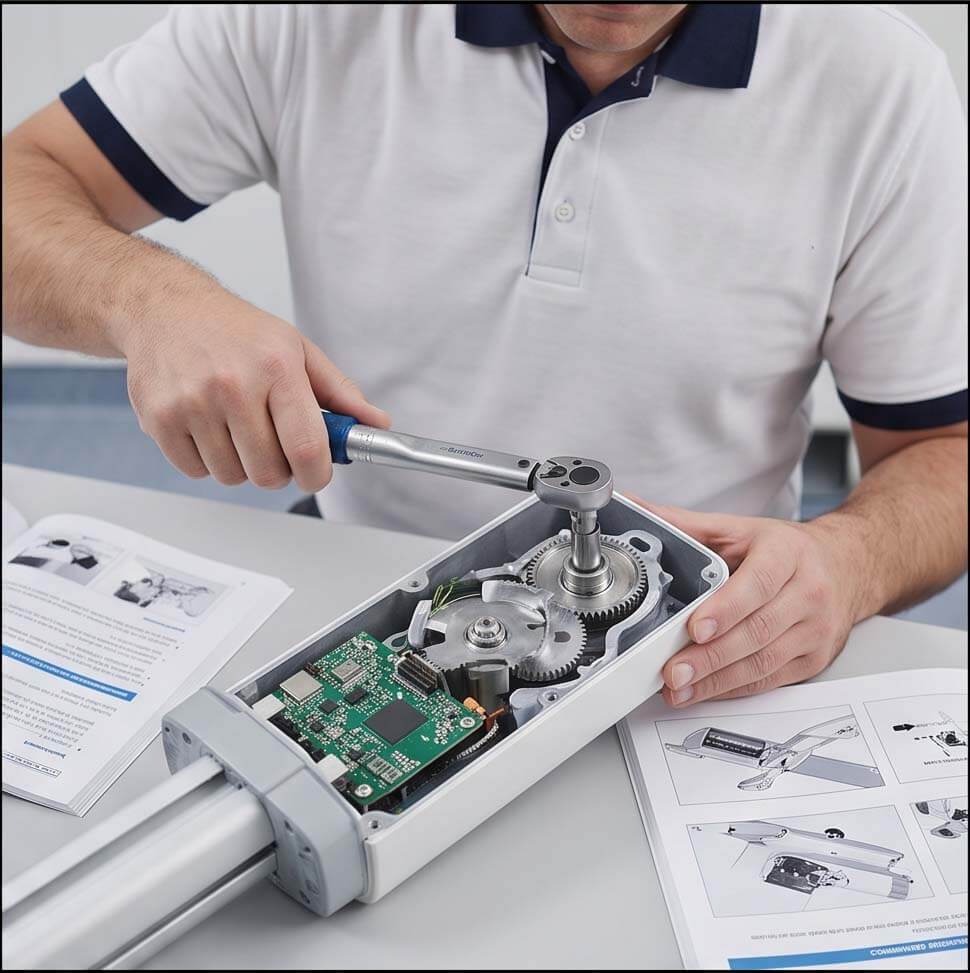
Unplanned equipment downtime stalls scanning schedules and leads to costly emergency service calls. Biomedical engineering departments should perform preventative maintenance annually (or semi-annually in facilities scanning >30 patients per day).
                     ANNUAL PM INSPECTION ROUTINE
                                  |
     +----------------------------+----------------------------+
     |                            |                            |
     v                            v                            v
[ Electrical Safety ]     [ Mechanical & Drive ]     [ Optical & Sensors ]
- Ground resistance       - Piston leadscrew lubric. - Clean optical sensors
- Leakage current test    - Motor torque validation  - Pressure transducer calib.
Biomedical Preventative Maintenance Checklist
| Maintenance Category | Inspection Task | Frequency | Target Standard / Pass Criteria |
| Optical & Sensors | Clean syringe optical sensors & position encoders | Monthly / PM | Remove contrast crusting with alcohol pads; verify sensor status |
| Mechanical System | Inspect & lubricate piston drive leadscrew | Semi-Annual | Smooth piston movement without grinding noise or vibration |
| Pressure Systems | Pressure transducer & auto-stop calibration | Annual | Pressure reading accuracy within pm 5 of gauge standard |
| Safety Alarms | Ultrasonic air sensor trip test | Semi-Annual | Instant stop when air bubble passes sensor |
| Electrical Safety | Ground continuity & chassis leakage testing | Annual | Meets IEC 60601-1 medical electrical safety limits |
| Heating Collar | Syringe heater temperature check | Monthly | Maintained stable temperature at 37°C |
| Cables & Housing | Inspect hand switches, foot pedals & main cable | Monthly | No cable fraying, loose connectors, or cracked casing |
3. Troubleshooting Common Contrast Injector Errors
When an error code or operational alarm appears during a clinical shift, quick diagnostic routines prevent scan cancellations.
                        TROUBLESHOOTING FLOWCHART
+---------------------------------------------------------------------------------+
| ISSUE: High Pressure Alarm Triggered During Injection                           |
|                                                                                 |
| 1. Check Patient Line  --> Is IV catheter kinked or pressed against vessel wall?|
| 2. Check Catheter Size --> Is gauge too small for flow rate? (e.g. 24G at 5mL/s)|
| 3. Check Viscosity     --> Was contrast pre-warmed to 37°C?                     |
| 4. Check Syringe Lock  --> Is syringe barrel properly seated in receptor bay?   |
+---------------------------------------------------------------------------------+
Common Faults & Solutions
1. High Pressure Alarm / Motor Stall
-
Possible Causes: Kinked extension line, undersized IV catheter, cold/viscous contrast media, or blood clot at catheter tip.
-
Action Steps: Pause procedure. Check patient tubing for kinks or position shifts. Verify that contrast heater is active. Lower injection flow rate if patient vascular access is limited.
2. Syringe Sensor Error / Syringe Not Recognized
-
Possible Causes: Contrast media spilled onto optical sensors, crystallizing into a cloudy film. Damaged or non-standard syringe keying tabs.
-
Action Steps: Power down injector. Wipe optical sensor windows with a damp lint-free cloth or isopropyl alcohol pad to remove contrast crusting. Inspect syringe tabs for deformation.
3. Air Sensor False Alarms
-
Possible Causes: Dirty sensor housing, micro-bubbles clinging to inner tubing walls, or improperly fitted extension tubing.
-
Action Steps: Clean sensor slot. Flick tubing gently to dislodge micro-bubbles during priming. Ensure line is snugly seated against ultrasonic transmitter face.
4. Motor Drive Noise / Unstable Flow Rates
-
Possible Causes: Dried contrast media dripping onto internal drive screws or worn servo gear assemblies.
-
Action Steps: Request biomedical technician inspection to clean and lubricate internal drive assemblies. Replace worn mechanical components before motor drive failure occurs.
4. Disposable Syringe & Tubing Management Protocols
Maintaining aseptic techniques and using high-quality disposable supplies is vital to preventing cross-contamination and avoiding fluid leaks.
                   DISPOSABLE CONSUMABLE SYSTEM
+----------------------------------------------------------------+
| High-Pressure Syringe (PET) --> Dual-Cap Luer Connections      |
| Single-Use / Multi-Patient Tubing --> Dual One-Way Check Valve |
| Patient Extension Line with Pressure-Activated Safety Valve    |
+----------------------------------------------------------------+
Best Practices for Disposable Syringes & Tubing
-
Single-Use vs. Multi-Patient Syringes: Always follow local regulatory directives and manufacturer labeling regarding syringe re-use. Standard high-pressure disposable syringes are single-patient items.
-
Dual Check-Valve Tubing: Use patient connection tubing equipped with dual internal check valves (one-way valves) to prevent backflow of blood or patient fluids into the main syringe barrel.
-
Pressure Rating Compliance: Ensure disposable tubing sets are rated to withstand maximum system pressure.
-
Preventing Dripping & Crusting: When dismounting syringes, cover tips immediately with protective caps to prevent contrast from dripping down the front panel into optical sensor slots.
5. UMY Medical Safety Engineering & Global Support
UMY Medical Equipment Co Ltd integrates safety engineering into every contrast injector model, minimizing human error and protecting sensitive internal electronics.
                  UMY MEDICAL SAFETY ARCHITECTURE
                                 |
     +---------------------------+---------------------------+
     |                           |                           |
     v                           v                           v
[ Real-Time PSI Monitor ]  [ Auto-Purge & Air Lock ]  [ Sealed Optical Sensors ]
- Graphic pressure curve    - Dual ultrasonic detection  - Contrast-proof housing
- Instant auto-stop cutoff  - Auto-retract motor drive   - Easy-clean surface
Key Safety Innovations in UMY Contrast Injectors:
-
Real-Time Pressure Curve Graphing: High-resolution touchscreen consoles display live pressure curves during injections, enabling technicians to spot vascular resistance changes before pressure limit alarms sound.
-
Dual-Layer Ultrasonic Air Sensor: Built-in dual ultrasonic sensors continuously scan outgoing fluid streams, halting injection within milliseconds if air is detected.
-
Sealed, Contrast-Resistant Injector Heads: Sensor housings and piston faces feature IP-rated fluid seal gaskets to prevent spilled contrast from leaking onto internal circuit boards and optical switches.
-
Automated Self-Diagnostics: On power-up, UMY injectors run automated self-checks verifying motor encoder accuracy, sensor response, RAM stability, and heating element calibration.
-
Comprehensive Spare Parts & Support: UMY Medical maintains a global supply of original replacement parts (optical sensors, motor assemblies, control boards, and pressure jackets) alongside remote engineering support to ensure operational uptime.
Frequently Asked Questions (FAQ)
Q1: What is the most effective way to prevent contrast extravasation during high-flow CT injections?
Pre-warming iodinated contrast to 37°C reduces fluid viscosity by nearly 50%, lowering required injection pressure. Combined with selecting large antecubital veins, and performing a pre-injection saline test flush, extravasation rates can be significantly reduced.
Q2: How often should the optical sensors on a contrast injector head be cleaned?
Optical sensors should be inspected daily and cleaned monthly—or immediately whenever contrast media spills onto the head. Wipe sensor slots using alcohol pads or a damp swab with warm water to clear dried contrast crusting.
Q3: What causes hardened contrast crusting, and why is it dangerous to the injector?
Contrast media contains high concentrations of dissolved iodine salts. When spilled liquid contrast evaporates, it leaves behind abrasive, hardened salt crystals. These crystals can scratch optical sensors, jam piston lead screws, and corrode internal circuit boards if fluid penetrates the housing.
Q4: Does UMY Medical provide spare parts and preventative maintenance guides for hospital biomedical teams?
Yes. UMY Medical Equipment Co Ltd provides complete service manuals, circuit diagrams, preventative maintenance checklists, and original OEM replacement parts to certified biomedical engineering departments and authorized service partners.