Executive Overview: Strategic Procurement of Bone Densitometry Equipment
Acquiring a bone densitometer involves evaluating upfront capital outlay alongside ongoing operational expenditures. Hospital purchasing boards, outpatient imaging centers, and medical device distributors must choose between brand-new OEM central systems, certified refurbished units, or compact peripheral devices.
A thorough procurement strategy evaluates initial equipment costs, spatial site modifications, software licensing models, and long-term service agreements to ensure maximum return on investment (ROI).
+-----------------------------------------------------------------------------------+
|                     BONE DENSITOMETER PROCUREMENT PIPELINE                         |
+-----------------------------------------------------------------------------------+
|  1. Clinical Scope         | Patient volume, central DXA vs peripheral needs     |
|  2. Vendor Sourcing        | Direct OEM, authorized distributor, refurbished   |
|  3. Financial Modeling     | Purchase price, site prep, warranty, & TCO        |
|  4. Supplier Compliance    | ISO 13485, CE/FDA clearance, spare parts guarantee|
+-----------------------------------------------------------------------------------+
1. Average Pricing Benchmarks Across Equipment Categories
Capital expenditure for bone densitometers depends heavily on beam geometry, scan speed, software features, and brand reputation.
Central / Full-Body DXA Systems
-
Entry-Level Pencil-Beam Systems: $20,000 – $40,000. Ideal for lower-volume practices focusing on routine lumbar spine and hip scans.
-
Mid-Tier Fan-Beam Systems: $45,000 – $80,000. Features rapid acquisition times, high-definition imaging, and standard body composition packages.
-
Premium High-Definition Fan-Beam Systems: $85,000 – $150,000+. Includes advanced software (Trabecular Bone Score, Vertebral Fracture Assessment, Visceral Adipose Tissue analysis, and pediatric modules).
Peripheral Bone Densitometers & Ultrasound Units
-
Peripheral DXA (pDXA): $12,000 – $25,000. Desktop or mobile units targeting forearm or calcaneus scanning.
-
Quantitative Ultrasound (QUS) Scanners: $4,000 – $15,000. Radiation-free heel scanners ideal for rapid screening programs.
2. Equipment Sourcing Strategy: Factory-New vs. Certified Refurbished
Evaluating equipment sourcing tiers helps clinical buyers optimize capital deployment across main hospitals and secondary clinics.
                      EQUIPMENT SOURCING COMPARISON
                                    |
       +----------------------------+----------------------------+
       |                                                         |
Factory-New OEM Systems                      Certified Refurbished Systems
- Full manufacturer warranty (12–36 mos)     - 30% to 50% discount off list price
- Latest software, TBS & PACS compatibility  - Factory-tested tube & detector array
- Highest capital requirement                - Shorter warranty terms (90 days–1 yr)
Factory-New OEM Systems
-
Benefits: Access to the latest imaging software, full manufacturer warranty, long-term technical support, and maximum system lifespan (8 to 12 years).
-
Drawbacks: High initial capital investment and standard corporate equipment depreciation.
-
Best Suited For: Tertiary care hospitals, academic research institutions, and high-volume diagnostic centers.
Certified Refurbished Systems
-
Benefits: Costs 30% to 50% less than equivalent new models, allowing faster capital payback.
-
Drawbacks: Potential software limits, shorter warranty coverage, and earlier end-of-life component obsolescence.
-
Best Suited For: Private practices starting new bone health programs or facilities adding secondary diagnostic capacity.
3. Calculating Total Cost of Ownership (TCO)
Evaluating a purchase solely on initial sticker price overlooks hidden operational costs. A comprehensive TCO model accounts for every stage of the asset lifecycle.
+-----------------------------------------------------------------------------------+
|                        5-YEAR COST DISTRIBUTION EXAMPLE (DXA)                     |
+-----------------------------------------------------------------------------------+
| System Purchase Price (65%)           | $60,000                                   |
| Service & Maintenance Contracts (18%)  | $16,000 ($4,000 / year post-warranty)    |
| Site Prep, Lead Shielding & Delivery (9%)| $8,000                                 |
| Software Licensing & DICOM PACS (8%)   | $7,000                                   |
+-----------------------------------------------------------------------------------+
-
Site Preparation & Shielding: Room modification costs, electrical grounding, and local radiation safety officer (RSO) inspections.
-
Software Licensing & DICOM Upgrades: Ensure software modules like TBS (Trabecular Bone Score), FRAX, and full-body composition are permanent licenses rather than recurring software subscriptions.
-
Post-Warranty Service Agreements: Service contracts typically cost 8% to 12% of the original equipment purchase price per year.
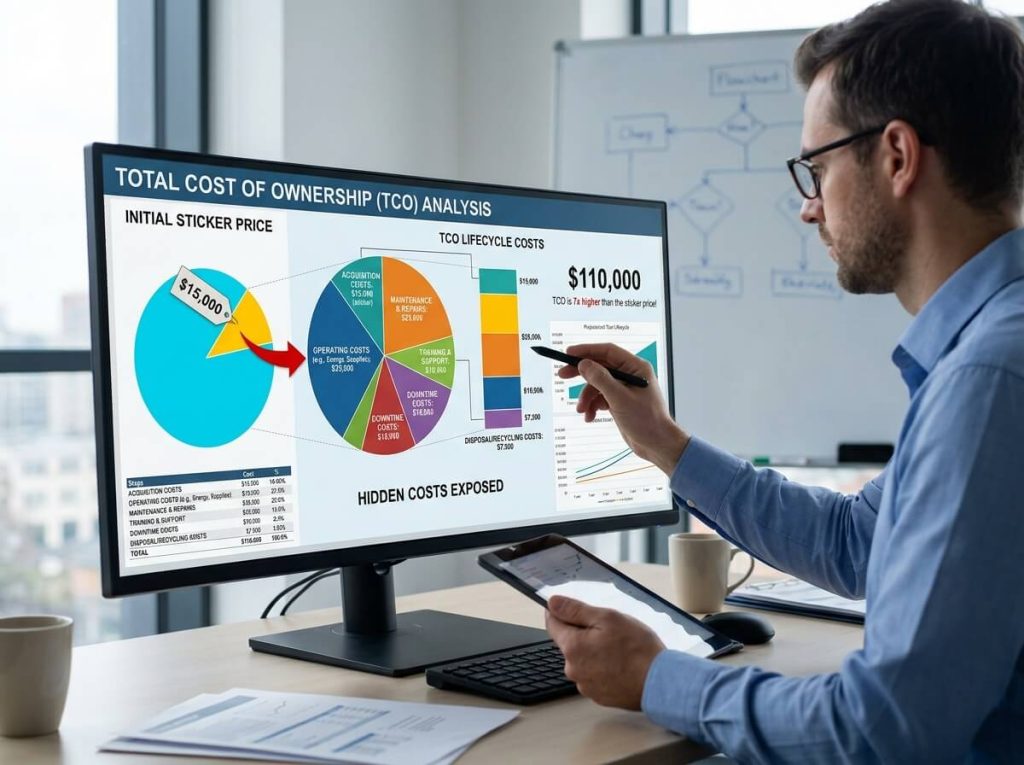
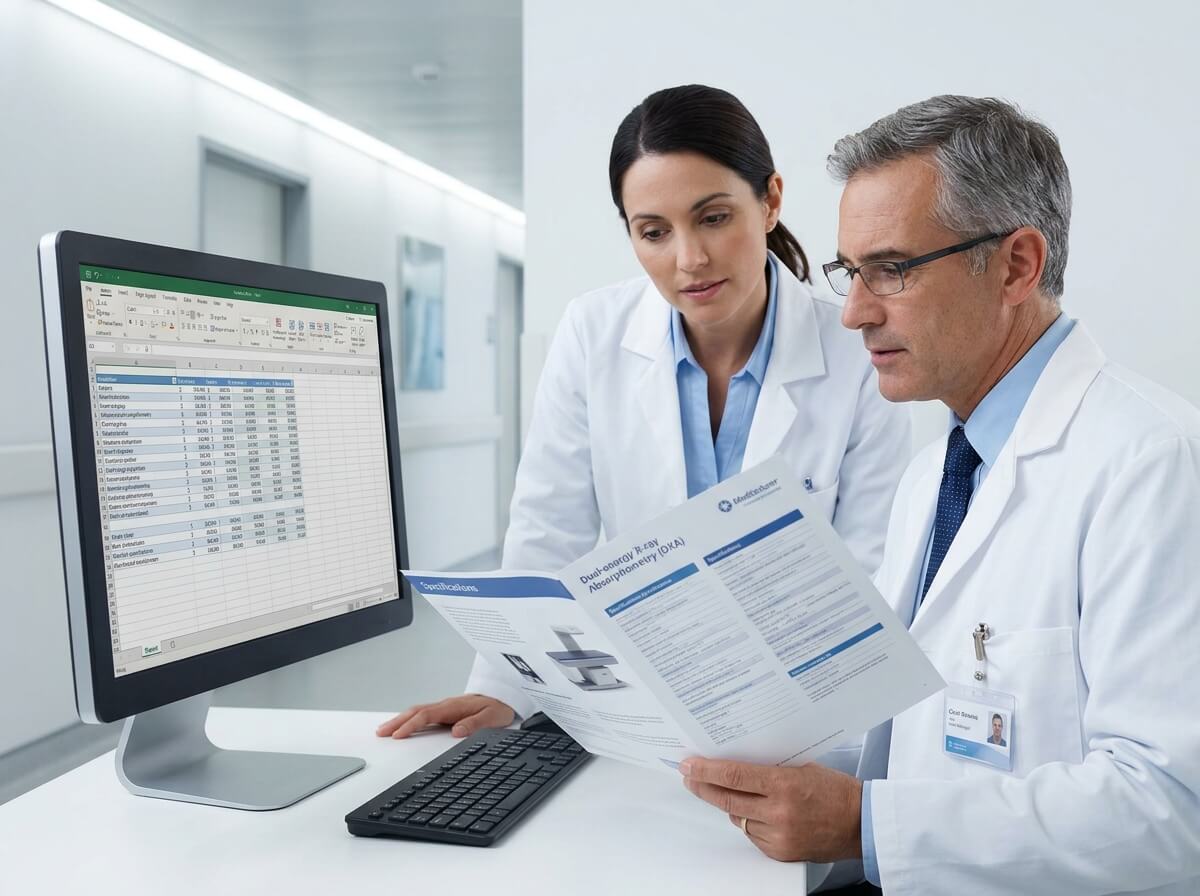
Executive pointing to a TCO analysis dashboard detailing acquisition, maintenance, and operating costs for radiology equipment.
4. B2B Vendor Vetting & Supplier Evaluation Matrix
When importing bone densitometers or negotiating with OEM distributors, use this criteria matrix to evaluate supplier reliability:
-
Regulatory Clearances: Require official documentation confirming ISO 13485 manufacturing compliance, CE marking under European MDR, and FDA 510(k) approval where applicable.
-
Guaranteed Spare Parts Lifecycle: Secure a written guarantee that replacement X-ray tubes, high-voltage generators, and detector boards will be stocked for at least 7 to 10 years.
-
Installation & Calibration Support: Ensure the contract explicitly includes on-site assembly, daily spine phantom calibration setup, and radiation output safety sign-offs.
-
Export Packaging Standards: For international freight, verify that the unit is shipped in shock-monitored, moisture-sealed, export-certified wooden crates to prevent optical misalignments during transit.
5. Bone Densitometer Procurement Matrix
| Device Category | Average Price Range (New) | Refurbished Savings Potential | Key Software Add-Ons | Recommended Warranty |
| Pencil-Beam DXA | $20,000 – $40,000 | 35% – 45% | Basic DICOM, FRAX, Spine/Hip | 12 to 24 Months |
| Fan-Beam DXA | $45,000 – $80,000 | 30% – 50% | TBS, VFA, Body Composition | 24 to 36 Months |
| High-Definition DXA | $85,000 – $150,000+ | 25% – 40% | Advanced Hip, VAT, Pediatric | 24 to 36 Months |
| Peripheral DXA (pDXA) | $12,000 – $25,000 | 30% – 40% | Forearm/Heel reporting, EMR link | 12 to 24 Months |
| Ultrasound (QUS) | $4,000 – $15,000 | 20% – 35% | Quick screen software, STI export | 12 to 24 Months |
6. Frequently Asked Questions (FAQ)
Q1: What is the typical return on investment (ROI) timeline for a central fan-beam DXA scanner?
Assuming a moderate daily volume of 5 to 8 scans at average insurance or private-pay reimbursement rates, most outpatient diagnostic centers recoup their total capital investment within 10 to 16 months.
Q2: Should a medical practice purchase Trabecular Bone Score (TBS) software with its initial DXA order?
Yes. Purchasing TBS software during the initial system procurement is generally cheaper than adding it as a post-installation retrofit. TBS allows clinicians to charge for advanced bone quality assessments, increasing per-scan revenue.
Q3: Are refurbished bone densitometers safe and accurate?
Yes, provided they are certified by an ISO 13485 compliant refurbisher. Certified units undergo complete X-ray tube calibration, detector array testing, and mandatory daily spine phantom verification to ensure diagnostic accuracy matches factory standards.